

The Real Reason Customs Declarations
Still Take Hours
The Real Reason Customs Declarations Still Take Hours: Outdated Processes
- John Hall
- Customs Specialist at iCustoms.ai
Your shipment is ready, and the necessary paperwork has been filed, but the customs clearance process is taking a long time. Why?
Inspections and regulations aren’t the only things that slow you down. Most of the time, the true culprit is something much simpler: outdated manual procedures that are unable to keep up with modern trade.
These delays cost businesses more than just time; they can risk compliance, damage customer trust, and disrupt supply chains.
This blog post describes how the customs declaration process is being slowed down by outdated procedures and how to expedite it.
The real culprit behind slow customs declaration
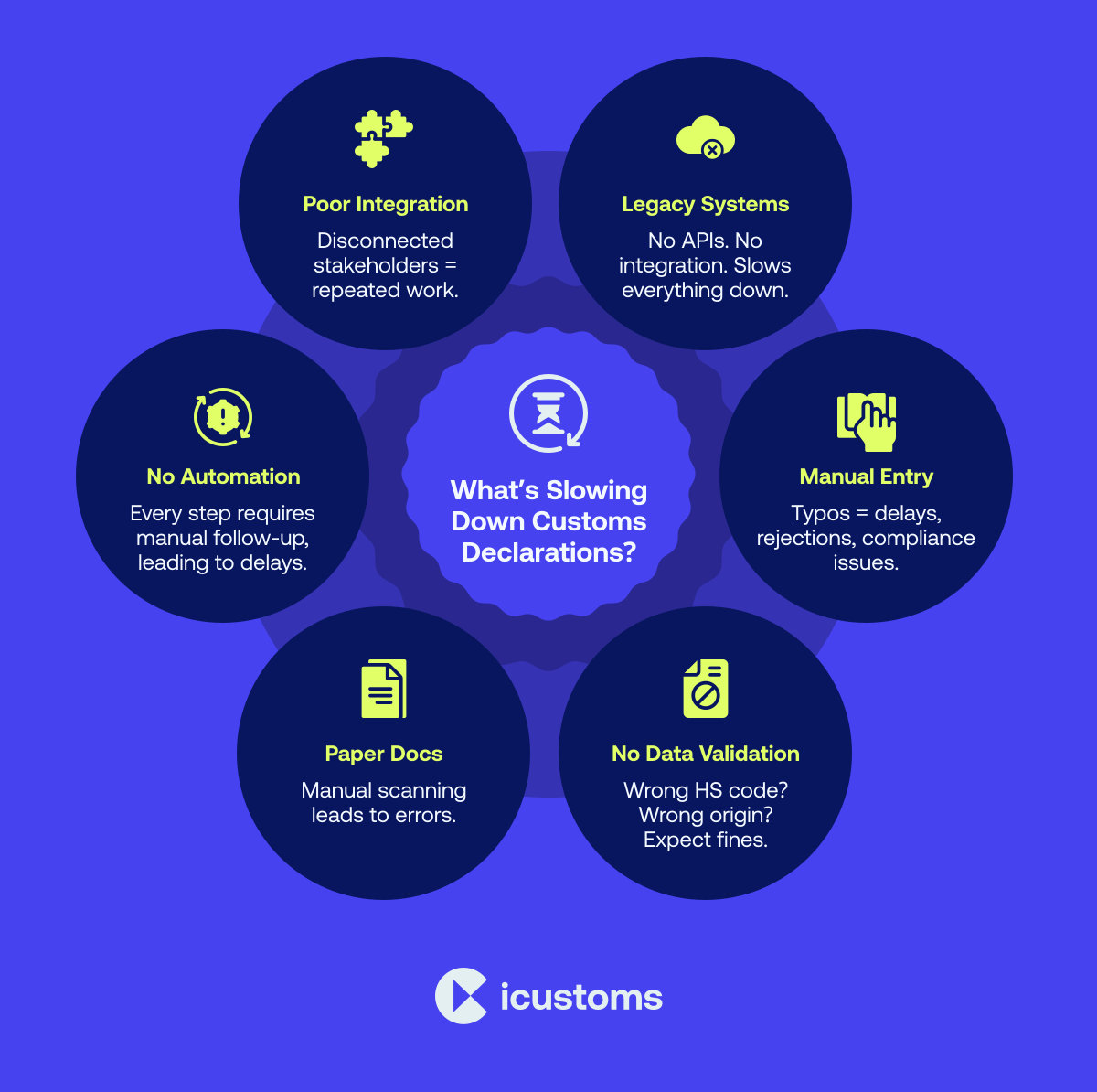
Aside from rules and regulations, there are many other reasons for slow customs declarations, including:
Legacy IT systems undermine trade efficiency
Most customs clearance systems were built before the days of cloud infrastructure and API connectivity. Even while some countries are moving towards more contemporary customs systems, many organisations and government agencies continue to rely on:
- Manually entered data
- Isolated systems with no integration
- Non-standardised formats for supporting documents
This results in:
- Double data-entry errors
- Time-consuming validations
- Incompatibility with Single Trade Windows
These inefficiencies raise the risk of regulatory violations in trade compliance, particularly when mistakes are overlooked.
Error-prone manual data entry
Most declarations still go through laborious interfaces or Excel templates where product descriptions, HS codes, and quantities are retyped.
This leads to:
- Mistyped HS codes
- Incorrect EORI number or VAT
- Non-compliant document formats
A single misspelling could cause your entire clearance to be reset and flag your shipment for manual review.
Insufficient or no data validation
Data integrity is essential to compliance. Regretfully, customs paperwork is frequently assembled from many departments (procurement, logistics, and sales), which results in:
- Inconsistent values between the declaration and the invoice
- Inaccurate country of origin
- Misclassified products
- Incomplete license numbers or certifications
These are not merely operational problems; they are also violations of the law that may lead to:
- Fines or shipment seizure
- Audits and penalties
- Suspension of preferential trade benefits
Outdated systems lack integrated decision engines and real-time validation procedures to identify risks before submission.
Manual declarations hamper trade simplification
In many areas, manual declaration procedures continue to be the norm, despite international initiatives like the Trade Facilitation Agreement (TFA).
This stops businesses from having access to:
- Simplified customs procedures (SCP)
- Transit simplifications under NCTS
Without digitalised, standardised, and auditable declaration processes, businesses are stuck in a reactive compliance mindset, constantly battling fires instead of strategically managing trade risks.
Paper-based documentation still exists
A lot of traders continue to use paper packing lists, certificates, and invoices despite digital transformation. Scanned PDFs do not solve the problem because they are not machine-readable, requiring manual data entry.
It leads to these consequences:
- Delayed data processing
- Paper document loss or damage
- Manual handling and storage of documents
Digitised, structured data formats are not only faster to process; they are also required for AI-powered validation and customs pre-clearance.
Lack of workflow automation leads to bottlenecks
Customs declarations are rarely completed in a single step. Most need many levels of cross-checks, supporting documentation, and approvals.
In the absence of automation, these procedures are carried out through countless email exchanges, phone conversations, or document transfers.
This results in:
- Deadlines missed while awaiting internal approvals
- Lack of visibility on document status
- A higher likelihood of misunderstandings
A centralised digital workflow system can track progress, assign tasks to the appropriate individuals automatically, and identify delays before they result in shipping holds.
Poor systems integration between stakeholders
Importers, exporters, goods forwarders, customs brokers, and border agencies are all involved in the customs clearance process. If their systems are not integrated, information does not flow smoothly.
Instead, we get:
- Manual reconciliation of values across platforms
- File format conversions that introduce errors
- Delays due to duplicated efforts
Integrated platforms with secure APIs enable all stakeholders to access the same real-time data, reducing duplication and speeding up clearance.
What can be done: Real solutions
Here are the possible solutions businesses can adopt:
Implement intelligent document processing (IDP)
Digitising documents is just the beginning. Intelligent Document Processing uses OCR, machine learning, and NLP to extract structured data from unstructured sources like invoices, certificates, and packing lists.
Benefits:
- Converts scanned PDFs into machine-readable formats
- Reduces manual data entry errors
- Speeds up pre-clearance preparation
With IDP, traders no longer have to rely on back-and-forth communication between departments to gather data manually.
Move to cloud-based customs platforms
Cloud-based customs declaration systems provide scalability, secure access, and real-time updates; features legacy systems simply can’t match.
Why it matters:
- Enables multi-user collaboration across locations
- Updates automatically with the latest regulatory changes
- Reduces IT overhead and infrastructure costs
Such platforms are often API-ready, making them much easier to integrate into your existing tech stack.
Automate workflows and internal approvals
Instead of routing documents manually, set up automated workflows that assign tasks, trigger validations, and alert stakeholders when action is needed.
This results in:
- Fewer missed deadlines
- Greater transparency on declaration status
- Faster turnaround on compliance checks
Automation also builds audit trails, which are essential for regulatory compliance and internal quality control.
Integrate systems using APIs and middleware
Customs brokers, logistics partners, and regulatory bodies all need to work off the same data. Integrating your ERP, warehouse, and customs software using APIs ensures seamless data flow.
Integration enables:
- Real-time updates between systems
- Automatic syncing of shipment and product information
- Elimination of redundant data entry
This not only speeds up processing but also boosts confidence that the data is accurate across the board.
Use AI-powered validation and decision engines
AI is a practical tool for flagging risks before a declaration is submitted. Advanced customs platforms can:
- Auto-suggest HS codes based on product descriptions
- Validate values against past shipments or templates
- Highlight missing or inconsistent data in real-time
This leads to fewer rejections and manual interventions at the border.
Wrapping up
Customs delays are often the result of outdated manual procedures rather than regulations. Legacy systems, paper documents, and disconnected workflows slow down operations and increase compliance risks.
Businesses need to use contemporary tools like cloud platforms, workflow automation, intelligent document processing, and API integration to address this. These solutions help you remain competitive, compliant, and prepared for the future of trade by streamlining declarations, lowering errors, and expediting clearance.
Frequently Asked Questions
Why do customs declarations still take hours to process?
Customs declarations are often delayed by manual data entry, disconnected systems, paper-based documentation, and outdated legacy processes that slow down data validation and submission.
How do manual customs processes increase compliance risks?
Manual processes can lead to incorrect HS codes, inaccurate EORI or VAT information, missing documentation, and data inconsistencies that may result in customs delays, audits, penalties, or shipment holds.
What role does Intelligent Document Processing (IDP) play in customs declarations?
IDP automatically extracts and structures data from invoices, packing lists, and trade documents, reducing manual data entry, improving accuracy, and accelerating customs clearance workflows.
How can cloud-based customs platforms improve declaration efficiency?
Cloud-based customs platforms enable real-time collaboration, automatic regulatory updates, secure access, and system integration, helping businesses process declarations faster and more accurately.
How does iCustoms help reduce customs declaration delays?
iCustoms combines Intelligent Document Processing, workflow automation, API integrations, and AI-powered validation tools to streamline customs declarations, reduce errors, and improve compliance performance.
You may also like:
Simplify Customs with our Powerful Customs Management Software

Automate declarations, track shipments, & ensure compliance.
About iCustoms
iCustoms is an all-in-one solution helping businesses automate customs processes more efficiently. With AI-powered and machine-learning capabilities, iCustoms is designed to streamline your all customs procedures in a few minutes, cut additional costs and save time.
Simplify Customs with our Powerful Customs Management Software
Automate declarations, track shipments, & ensure compliance.