
VAT on Imports in Ireland: How It Works, What You Pay & How to Calculate It
- John Hall
- Customs Specialist at iCustoms.ai
Here’s how VAT on imports Ireland works, in plain terms: it isn’t a separate, unpredictable charge, it’s a calculation with a fixed formula, applied at a fixed rate, that every importer can work out in advance. Where it catches businesses out isn’t the calculation itself, it’s not knowing the formula includes duty, not knowing which rate applies, or not realising Postponed VAT Accounting exists and could keep the cash in their account instead of tied up at the border.
This guide covers exactly how VAT on imports Ireland works: what you actually pay, the formula behind it, who’s responsible for paying it, when you can defer it, and a couple of specific situations, claiming it back and importing a car from the UK, that come up often enough to deserve their own answers.
How Is the VAT Liability on Imported Goods Calculated?
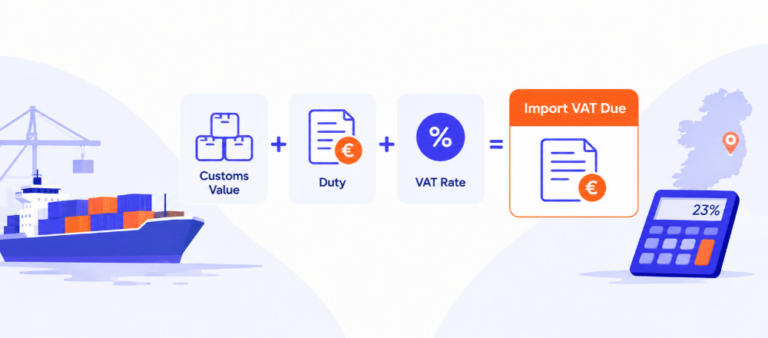
Import VAT is calculated on the customs value of the goods plus any duty payable, not on the goods value alone. That’s the detail that catches out businesses used to calculating VAT domestically: duty gets added first, and VAT is then calculated on that combined figure. The formula is:
(Customs Value + Duty) × VAT Rate = Import VAT Due
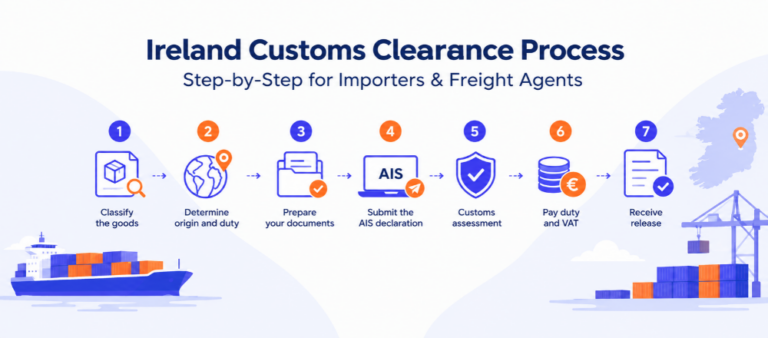
Customs value is generally the price paid for the goods plus transport and insurance costs to the point of entry. Duty is calculated separately, based on the commodity code and origin, and gets added to that customs value before the VAT rate is applied. Get the classification or origin wrong upstream, and the VAT figure downstream is wrong too, which is why the earlier steps in a declaration matter as much as the VAT calculation itself.
A Worked Example
Say a shipment has a customs value of €10,000 and attracts €500 in duty. The VAT calculation runs against the combined figure, not the customs value alone: €10,000 plus €500 duty gives a VAT base of €10,500, and at the standard 23% rate, that’s €2,415 in import VAT due. Change any one input, a different duty rate from a different origin, a different VAT rate for a different goods category, and the final figure moves accordingly, but the formula itself never changes. Running this calculation by hand for every shipment is exactly the kind of repetitive, error-prone task that automated declaration software exists to remove.
Import VAT Ireland vs Customs Duty: What’s the Difference?
It’s worth being clear on the distinction, since the two get calculated together but aren’t the same charge. Customs duty is a tariff based on the commodity code and origin of the goods, and it exists specifically to protect or regulate trade in particular goods categories; some goods attract no duty at all, depending on classification and origin. Import VAT Ireland applies far more broadly, at the standard or an applicable reduced rate, to most goods entering the country regardless of duty status, and it’s calculated on top of whatever duty applies rather than as an alternative to it. A shipment can owe VAT with zero duty attached, but it’s unusual for a shipment to owe duty without any VAT also applying. Our import duty Ireland guide covers duty-rate lookup specifically; this article treats duty only as the input that feeds into the VAT formula above.
What VAT Rate Applies to Imports?
Ireland’s standard VAT rate is 23%, and this is the rate that applies to most goods entering the country from outside the EU. Reduced rates of 13.5%, 9%, and 4.8% apply to specific categories of goods, so the applicable rate depends on what’s actually being imported, not a single blanket figure. Confirming the correct rate for your specific goods category before calculating is worth doing early, since it feeds directly into the formula above.
Who’s Responsible for Paying It: The Importer of Record
The importer of record is the party legally responsible for the import declaration, including the accuracy of the customs value, the classification, and the resulting VAT and duty liability. This is usually the business bringing the goods into Ireland, but where a freight forwarder or clearing agent files under indirect representation, that agent can share liability alongside the importer. Knowing who holds importer-of-record responsibility on a given shipment matters beyond the paperwork: it determines who’s on the hook if a VAT or duty calculation later turns out to be wrong.
Can I Claim VAT Back on Imported Goods?
If your business is a VAT registered business, generally yes: import VAT is recoverable as input VAT on your VAT return, in the same way VAT on domestic purchases is, provided the imported goods are used for a taxable business activity. This is where being VAT registered actually matters for cash flow, since an unregistered business or a private individual importing goods for personal use typically cannot reclaim import VAT at all. If your business is VAT registered and imports regularly, this is also where Postponed VAT Accounting, covered next, becomes especially relevant, since it changes when that reclaim happens rather than whether it happens.
Postponed VAT Accounting (PVA): Pay It on Your Return, Not at the Border
Postponed Accounting for import VAT is the single biggest cash-flow lever available to Irish importers, and it’s been available since Brexit changed the trading relationship with Great Britain. Instead of paying import VAT at the point of entry and reclaiming it later, an eligible, authorised importer declares and reclaims the same VAT on the same VAT return, with no cash outlay at the border at all.
A few things about PVA are worth being precise on:
- It has to be elected at the time of the original declaration. PVA cannot be added retroactively once a declaration has already been released, so this is a decision made upfront, not a fix applied afterward.
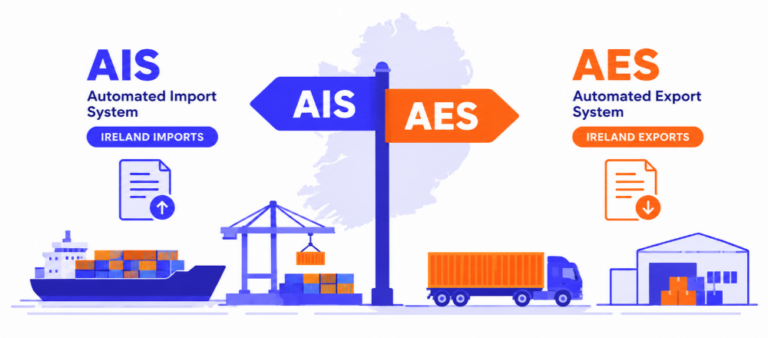
- It’s declared through a specific code on the AIS declaration, currently 1A05 in the Documents Produced field. This is a detail that’s changing under the AIS V2 upgrade, where the code is being replaced with FR7 in a different declaration field, so if you’re reading this after that transition, confirm which version applies to your filing.
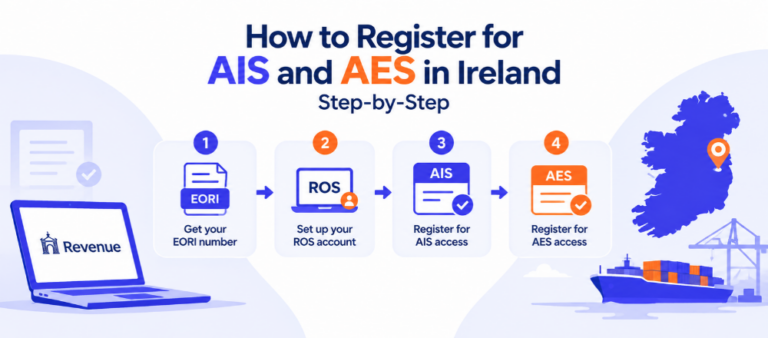
- It requires authorisation. Not every importer can use PVA automatically; the business needs to hold the relevant postponed VAT authorisation, tied to their EORI and VAT registration.
For a VAT registered business filing regularly, the practical effect of PVA is straightforward: instead of cash leaving the business at the border and sitting there until the next VAT return reclaims it, the same VAT is declared and reclaimed in one step, with nothing actually changing hands.
VAT on Imported Cars from the UK
Importing a car from the UK into Ireland follows the same underlying import VAT rules as any other goods: VAT is calculated on the customs value plus duty, at the standard rate, using the same formula covered above. Where car imports differ is that Ireland also charges Vehicle Registration Tax (VRT), a separate tax applied specifically to registering a vehicle in the country, on top of any import VAT and duty due. VRT is administered separately from AIS and the import VAT rules covered in this guide, so if you’re importing a car from the UK to Ireland, budget for VRT as an additional, distinct cost, not a variation of the import VAT calculation itself, and check current VRT rates directly with Revenue rather than assuming they follow the same formula as VAT.
Common Import VAT Mistakes
A handful of errors account for most of the avoidable VAT problems importers run into:
- Calculating VAT on the goods value alone. Forgetting to add duty before applying the VAT rate produces a figure that’s wrong every time duty applies, not just occasionally.
- Assuming Postponed VAT Accounting applies automatically. PVA has to be actively elected and requires a valid authorisation; it isn’t the default treatment for every importer.
- Trying to add PVA after the declaration is released. As covered above, this election has to be made at the time of the original declaration, not after the fact.
- Assuming a private import qualifies for VAT reclaim. Reclaim through input VAT is a business mechanism tied to VAT registration and taxable business use, not something available to personal imports.
- Confusing VRT with import VAT on a vehicle import. They’re separate charges administered separately; paying one doesn’t cover the other.
How iAIS Handles VAT Automatically
Manually, this means calculating customs value, adding duty, applying the correct VAT rate for the specific goods category, and correctly populating the right declaration field depending on whether PVA applies, all without a mistake that could delay release or misstate a VAT liability. iCustoms’ iAIS platform runs this calculation automatically on every declaration: duty and VAT are calculated on the correct basis, the appropriate postponed VAT code is applied where authorisation exists, and the result is validated before submission rather than checked after the fact.
Frequently Asked Questions
How is the VAT liability on imported goods calculated?
Import VAT is calculated as (Customs Value + Duty) × VAT Rate. Duty is added to the customs value first, and the applicable VAT rate is then applied to that combined figure, not to the goods value alone.
Can I claim VAT back on imported goods?
If you’re a VAT registered business using the imported goods for a taxable business activity, generally yes, as input VAT on your VAT return. Private individuals and unregistered businesses typically cannot reclaim import VAT.
What is Postponed VAT Accounting?
It’s a mechanism that lets an eligible, authorised importer declare and reclaim import VAT on the same VAT return instead of paying it at the point of entry, removing the cash-flow hit of paying VAT at the border and waiting to reclaim it.
Do I need to pay VAT on a car imported from the UK?
Yes, the same import VAT rules apply to vehicles as to other goods, calculated on customs value plus duty. Ireland also charges Vehicle Registration Tax separately when the vehicle is registered, which is distinct from import VAT.
Who is responsible if the VAT calculation on a declaration is wrong?
The importer of record carries primary responsibility, though a freight forwarder or clearing agent filing under indirect representation can share that liability depending on the representation basis used.
Is import VAT the same rate as domestic VAT?
It uses the same rate structure, Ireland’s standard 23% rate or the applicable reduced rate depending on the goods category, but the calculation basis is different since duty is added before the rate is applied.
You may also like:
Still Calculating Import VAT by Hand?

iAIS calculates duty and VAT automatically on every declaration.
Subscribe to our Newsletter
About iCustoms
iCustoms is an all-in-one solution helping businesses automate customs processes more efficiently. With AI-powered and machine-learning capabilities, iCustoms is designed to streamline your all customs procedures in a few minutes, cut additional costs and save time.
Get Postponed VAT Right, Every Time
iAIS applies the correct postponed VAT code and checks your authorisation status.