
HMRC Bonded Warehouse Audits & Inspections: What Gets Checked
- John Hall
- Customs Specialist at iCustoms.ai
An HMRC bonded warehouse audit checks three things: that your physical stock matches your records, that your documentation supports every movement in and out, and that your premises and systems are secure. Most failures are record failures rather than fraud.
The uncomfortable part is that HMRC is not only auditing your stock. It is auditing the system you keep the stock in. Customs warehousing guidance is explicit that software which has not been approved by HMRC cannot be used, and that the responsibility and accuracy of that system lies with the warehousekeeper. This guide covers what gets checked, where audits actually fail, what your records and systems have to be capable of, and a five-step routine for staying ready.
How often are bonded warehouses audited?
There is no published audit cycle, and anyone promising one is guessing. What HMRC does state is that it visits authorised warehousekeepers and approved premises to carry out checks, and that it regularly reviews the compliance of existing authorised warehousekeepers and registered businesses. Frequency in practice tracks risk: the duty at stake, your compliance history, the goods you hold, and how much confidence your last visit generated.
Three things are certain regardless of frequency. You must co-operate with HMRC as supervisors of your authorisation. You must allow access to the premises, your records and the goods at any reasonable time. And you must be able to facilitate updating your stock records at an officer’s request, so that the officer can see the current stock under the procedure.
That last obligation is easy to skim and hard to meet. It means an HMRC compliance visit can require your stock position to be brought current on the spot, in front of the officer. A system that is reconciled weekly cannot do that.
Your supervising office is named in your authorisation letter, and it is also the right first contact for questions about whether your systems meet the requirements. If you are still at the application stage, our customs warehouse authorisation guide covers what HMRC assesses before approval.
The three areas HMRC checks
Every bonded warehouse compliance audit works through the same three areas. A customs warehouse inspection and an excise warehouse HMRC visit differ in the paperwork examined, not in the shape of the check, and a site holding both approvals should expect both in one visit.
- Inventory control. Matching physical stock against your records. Expect a physical stock count on selected lines rather than a wall-to-wall count, chosen by the officer rather than by you, and weighted towards high duty value. The warehouse physical record check is the moment your stock account either holds up or does not.
- Documentation verification. Tracing individual consignments through the paperwork: import declarations, bills of lading, entry documents, duty suspension records, licences and proof of origin where they apply. The officer is testing whether the documentation can be related back to specific goods, not whether a file of documents exists somewhere.
- Security and access. Warehouse security controls, including the perimeter, the clearly marked customs area, entry and exit points, CCTV and its retention period, visitor logs, and who has authority to move stock. Physical security is part of the approval, so it is part of the audit.
Warehouse customs regulation compliance is judged across all three together. Perfect paperwork with an unsecured perimeter is still a finding, and a secure site with a stock account that will not reconcile is a worse one.
Your duty management system is part of what HMRC approves
This is the part most warehouse operators discover late, and it is the single most consequential thing on this page.
HMRC’s guidance on duty management and closing stock balance systems is where this sits, and it repays reading in full. A warehouse duty management system is a software package supporting your commercial stock records, containing modules for declaration procedures and stock accounting. HMRC is direct about its status: in most cases the duty management system forms part of the customs warehouse stock account, because the data in it is critical to maintaining an audit trail and is usually the point of reference to the customs declaration of entry and discharge.
The line that changes the buying decision HMRC customs warehousing guidance states plainly: “Software that has not been approved by HMRC cannot be used.” A duty management system that cannot meet the stated requirements will not be approved for customs warehousing purposes. This is not a recommendation to use good software. It is a condition on which system you are permitted to operate, and the responsibility and accuracy of that system lies with the warehousekeeper, not the supplier. |
Three baseline obligations sit behind that.
- Real time. The standard requirement is that customs warehouse stock records must always show the current stock of goods under the procedure.
- Update deadline. Where a duty management system is used in support of a commercial system, stock records must be updated as soon as information becomes available and no later than before midnight of the following warehouse operation day.
- Retention. Records must be kept for a minimum of four years after the goods have been discharged from the procedure.
Warehouse duty management system approval requirements go further. To be authorised, the system must:
- allow a full audit of the warehousing arrangements, including physical examinations when required, and allow documentation for goods released to free circulation to be checked
- together with your commercial stock records, contain all the information necessary for the operation, validation and integrity of the warehousing arrangements
- identify goods carrying a tariff preference, quota or licensing restriction, and make sure the appropriate certificate or licence is available before those goods are removed to free circulation
- meet the update deadline above
A closing stock balance system is a particular type of duty management system used to control customs warehouse stock and enable Simplified Customs Declaration Process declarations, usually interfaced with commercial records. Where one is used, consignment details, quantities and removal dates go into the commercial records before removal, with the duty management system updated afterwards. Critically, the commercial records and the duty management system are then regarded as one system, and together they constitute the customs warehouse stock account for both Entry in Declarant’s Records authorisation and stock records purposes.
Additional conditions apply to approving a closing stock balance system. There must be an audit trail from the commercial system through to the duty management system update. You must have arrangements ensuring duty-suspended stock has its documentation, such as licences or proof of origin, available before it is picked or removed to free circulation. Where common storage is approved, the system has to identify equivalent products correctly, for example by matching the same eight-digit commodity code, commercial quality and technical characteristics. And one requirement catches people out entirely: before authorisation the system must be tested to confirm it can handle the proposed volume of goods, and the warehousekeeper should provide evidence that testing took place.
Two further points worth knowing. It is not permitted to time your updates to coincide with Simplified Customs Declaration Process notifications, because that is not adequate for customs warehouse purposes. And if a duty management system is operated by a third party, you must always have access to its records, preferably view-only access or daily reporting of receipts, deliveries, adjustments and balances. Outsourcing the system does not outsource the responsibility.
HMRC also tests the interfaces and reconciliations between your inventory system and the Simplified Customs Declaration Process messaging as part of its assurance activity. If you take on new contracts for goods different from those your authorisation covers, they need to be covered by the authorised inventory system too.
Warehouse inventory records: what the stock account must contain
For excise goods, the stock account has a defined minimum content. It must show a commercial description of the product, the quantity received in litres or in litres of alcohol for spirits, the alcoholic strength, the quantity received in cases, casks or polydrums, a unique identifying reference number, the date received, and the owner of the goods.
Three obligations attach to that.
- Ownership. Stock records must accurately record any change of ownership, and full details of owners storing goods in your warehouse must be available to HMRC.
- Location. Goods must be kept in clearly identified locations so they can be readily traced to the stock account, and the stock account must be noted whenever goods move to a new location within the warehouse.
- Stocktaking. Accuracy must be checked through an inventory-checking system agreed with HMRC, plus complete stocktaking at reasonable intervals. Stock must be taken monthly for bulk goods in vats or storage tanks, and annually for all other excise goods.
Read the owner requirement carefully if you hold stock for clients. Ownership can change while goods sit motionless in the same bay, and the record has to follow the change rather than the pallet.
Stock reconciliation, physical counts and cycle counting
Stock reconciliation is where audits are won or lost, and the annual stocktake is the weakest possible way to do it.
The problem with a single annual count is timing. If a discrepancy arose in March and you find it in December, you have nine months of movements to work through to explain it, and the supporting evidence may no longer exist. HMRC will ask what happened. Not being able to say is itself the finding.
Cycle counting solves this. Rather than one wall-to-wall count, you count a subset continuously: daily or weekly passes over high duty value lines, rotating through the rest on a schedule. Discrepancies surface within days, while the movement history is fresh and the people involved still remember. The regulatory minimum for excise goods stays as it is, monthly for bulk and annually for the rest, but cycle counting sits on top of it as an operational control rather than replacing it.
Traceability is the other half. Every item needs an unbroken trail from arrival through storage to final release or re-export, and that trail has to survive being asked about years later. Bonded warehouse monthly reports are the natural rhythm for this: a monthly reconciliation that ties opening stock, receipts, removals and closing stock together, with variances explained rather than absorbed.
For excise premises that monthly cycle is formalised. Bonded warehouse W1 reconciliation is the process of proving that your stock account agrees with the W1 excise warehouse return you submit, per category, before you submit it. A return that balances is a control. A return that is made to balance is a finding. The filing mechanics themselves are covered in our excise warehouse authorisation guide.
Bonded warehouse stock movement types
An auditor does not just check that a movement happened. They check that it was recorded as the right kind of movement, because the type determines the duty treatment and the documentation required. Recording an export as a duty paid removal, or a transfer as a release to free circulation, creates a duty error even where the physical goods went exactly where they should.
The bonded warehouse stock movements type categories you need to distinguish are:
- Receipt into the warehouse, whether from import, from another warehouse, or from production.
- Removal to home use on payment of duty, meaning release into the UK market with duty and any import VAT becoming payable.
- Removal to free circulation, the customs-side equivalent, where customs duty and import VAT fall due.
- Onward movement under duty suspension to another approved warehouse or approved person, where the suspension continues and nothing becomes payable.
- Transfer between sites, which may be within the same authorisation or between different authorisation holders. The declaration obligation differs between the two.
- Export or re-export, where UK duty is never paid. Worth distinguishing destination, because Northern Ireland and EU movements carry different rules from Great Britain and international ones.
- Northern Ireland movements specifically, because duty-suspended movements to EU member states are only possible on XI-prefixed identifiers.
- Miscellaneous removals: ships, aircraft and train stores, duty free stores, supplies to diplomats, entitled international organisations and visiting forces, and other duty-free purposes.
- Movement to another customs procedure, which discharges customs warehousing without duty becoming due.
Each type needs its own evidence. An export needs proof the goods left. A duty-suspended dispatch needs a movement guarantee and an electronic record. A removal to home use needs the duty accounted for. If your records carry movements as a single undifferentiated list with a free-text note, an auditor cannot test any of it and neither can you.
Common bonded warehouse audit failure points
These are the recurring findings, what HMRC is actually worried about in each case, and the control that prevents them.
| Failure point | What concerns HMRC | The control |
|---|---|---|
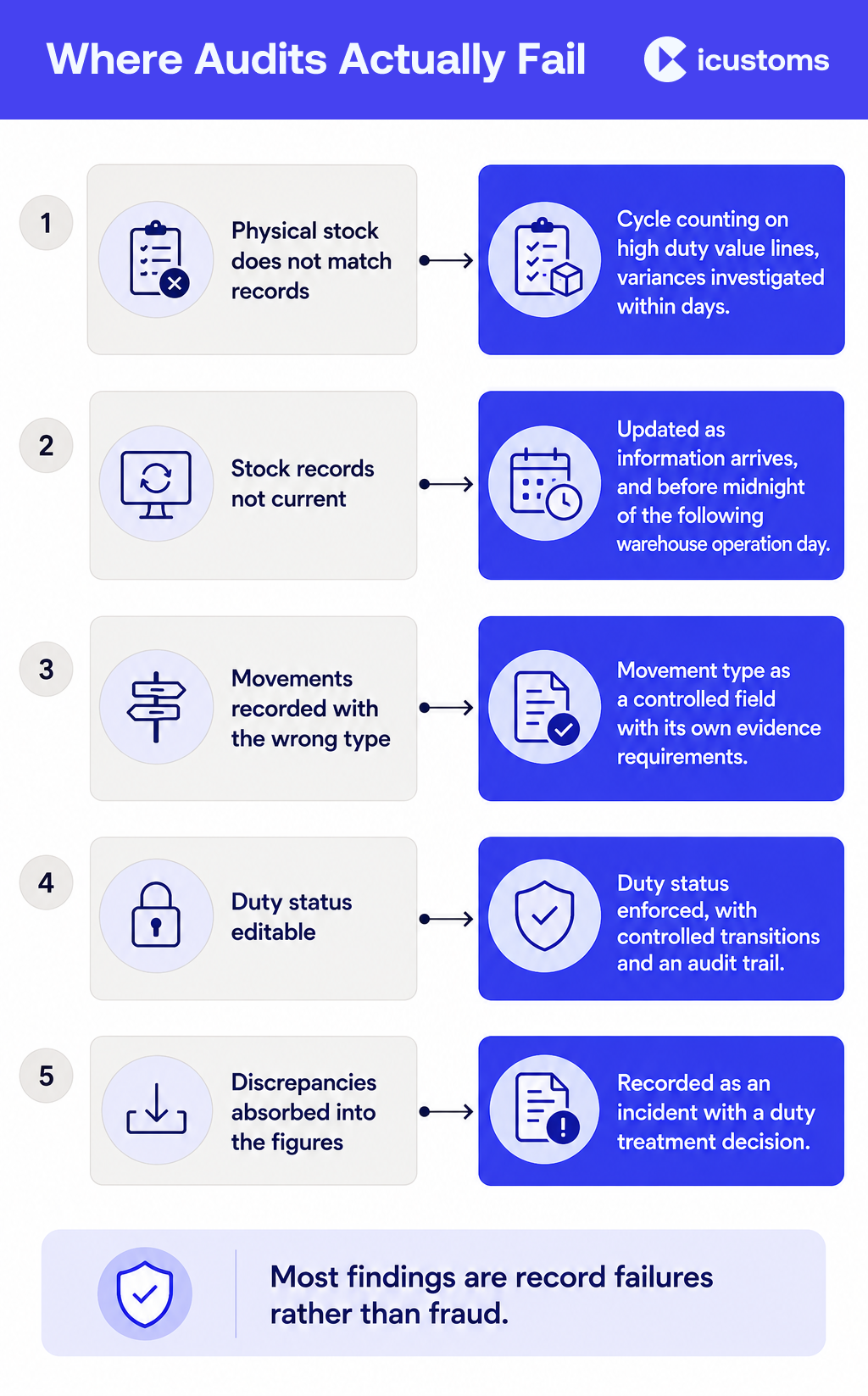
| Physical stock does not match records | Duty-suspended goods may have entered the market untaxed. | Cycle counting on high duty value lines, with variances investigated within days. |
| Stock records not current | The officer cannot see the real position on request, as required. | Records updated as information arrives, and before midnight of the following warehouse operation day. |
| Movements recorded with the wrong type | Wrong duty treatment applied, even where goods went to the right place. | Movement type as a controlled field with its own evidence requirements, not free text. |
| Documentation cannot be related to specific goods | Release to free circulation may have happened without a required licence or preference evidence. | Documents attached to the consignment record, checked before pick or removal. |
| Licences or proof of origin missing at removal | Restricted or preferential goods released without entitlement. | System flags restricted lines and blocks removal until evidence is present. |
| Duty status editable or ambiguous | Duty-paid stock reverting to duty-suspended without payment. | Duty status as an enforced attribute with controlled transitions and an audit trail. |
| Owner details incomplete | HMRC cannot establish who is liable for the duty. | Owner recorded per consignment, with ownership changes captured. |
| Discrepancies absorbed rather than reported | Concealment of losses on which duty is due. | A formal incident record with a duty treatment decision on each one. |
| Undischarged duty-suspended movements | Goods dispatched with no evidence they arrived. | Open movements visible continuously, not discovered at period end. |
| System never volume tested | The system may fail under real throughput. | Documented evidence of volume testing, retained. |
Table: common bonded warehouse audit failure points, HMRC’s concern in each case, and the control that prevents it.
What happens if stock discrepancies are found
A discrepancy is not automatically a penalty, and the difference usually comes down to whether you found it and reported it, or HMRC found it and you had not.
Where goods cannot be accounted for, the starting assumption is that duty-suspended goods have been released without duty being paid, and the duty becomes due. Where a loss is genuine and evidenced, relief may be available. That is the whole reason bonded warehouse incidents reporting matters as a discipline: a breakage, spoilage or shortage that is recorded at the time, with a cause and supporting evidence, is a manageable event with a duty treatment decision attached. The same loss discovered later with no record is a shortage, and shortages attract duty.
So a discrepancy write-off is not a bookkeeping adjustment you make quietly. It is a decision with a duty consequence that has to be documented, evidenced and, where required, notified. Adjusting a stock figure to make a reconciliation balance is the single most damaging thing an operator can do, because it converts an explainable loss into an apparent concealment.
Beyond duty, exposure includes financial penalties, claims against any guarantee you have provided, and in serious or persistent cases the withdrawal of your authorisation and approval. That last one is existential rather than expensive, and it is why persistent record failures matter more than any single discrepancy.
Audit-ready in five steps
A practical routine, in the order that makes each step easier than the last.
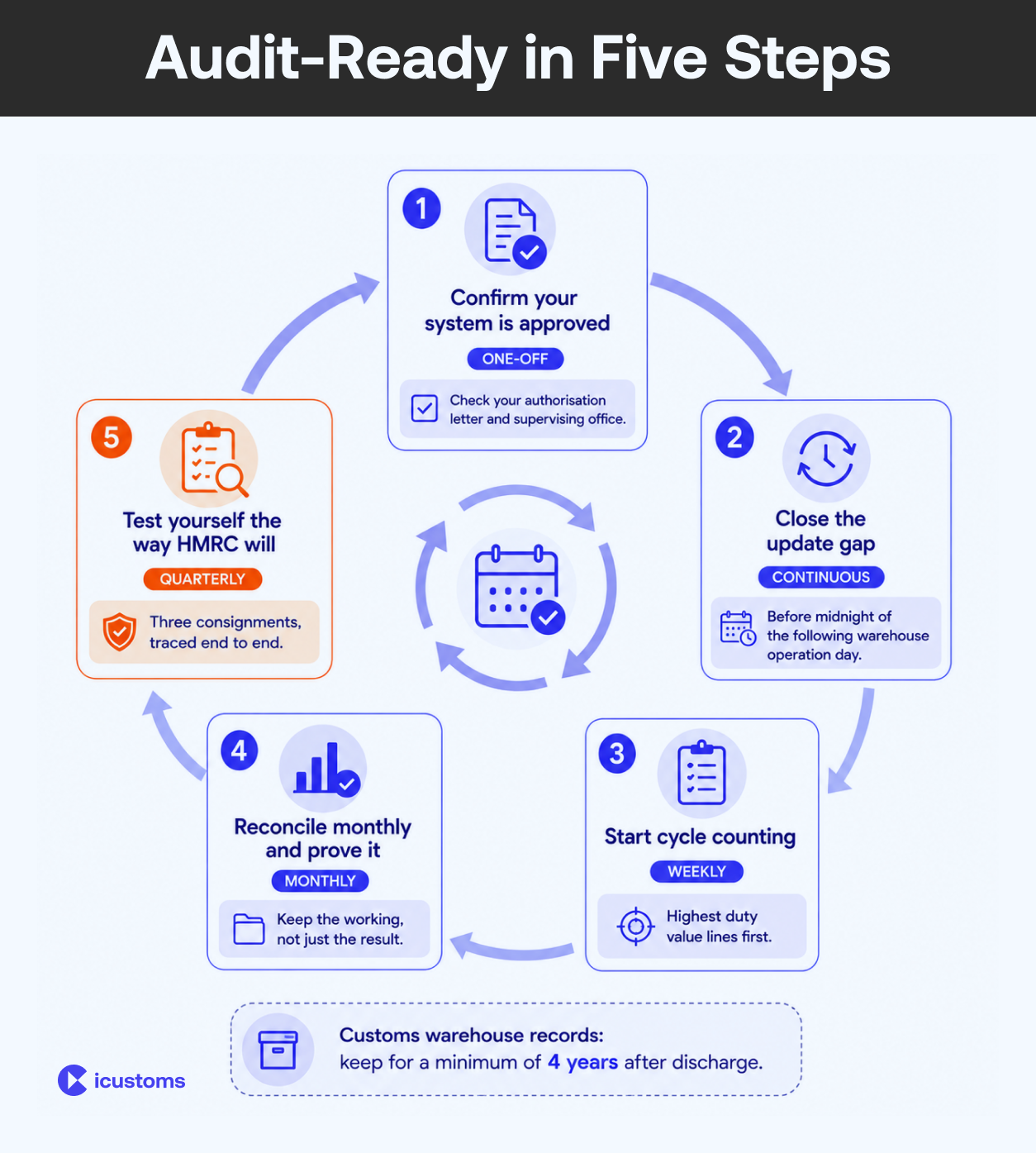
Step 1. Confirm your system is approved and can be updated on demand. Check your authorisation letter and your supervising office. Establish that your duty management system meets the stated requirements, that you hold evidence of volume testing, and that you can bring the stock position current in front of an officer.
Step 2. Close the update gap. Get every receipt, removal and adjustment into the record as information arrives, and never later than before midnight of the following warehouse operation day. Most reconciliation problems are timing problems first.
Step 3. Start cycle counting. Weekly passes over your highest duty value lines, rotating through everything else on a documented schedule. Investigate variances within days, and record what you found rather than just correcting the number.
Step 4. Reconcile monthly and prove it. Tie opening stock, receipts, removals and closing stock together every month, per category, and keep the working. For excise premises this is also what makes the W1 defensible rather than merely submitted.
Step 5. Test yourself the way HMRC will. Pick three consignments at random, one received, one released to home use and one exported. Trace each end to end: entry documentation, movement type, evidence, duty treatment, current location or proof of departure. If any of the three takes more than a few minutes, that is your finding, and you have found it before HMRC did.
Step 5 is the one to run quarterly. It is the closest thing to a real customs warehouse inspection checklist you can apply to yourself, and it surfaces problems in the specific form an officer will meet them.
Audit-ready against audit-risk
The gap between a warehouse that passes comfortably and one that does not is rarely effort. It is usually whether the records can answer a question in the form it gets asked.
| Area | Audit-ready | At audit risk |
|---|---|---|
| Stock position | Current, and can be brought up to date in front of an officer. | Reconciled periodically, accurate as at some past date. |
| Movement types | Distinct types with their own evidence requirements. | One list with free-text notes. |
| Documents | Attached to the consignment they relate to. | Filed separately by date or supplier. |
| Duty status | An enforced attribute with controlled transitions. | A column that can be edited. |
| Discrepancies | Recorded as incidents with a duty treatment decision. | Corrected in the figures. |
| History | Retrievable years later, with who changed what and when. | Rebuilt from memory and email. |
Table: audit-ready records against audit-risk records, across the six things an officer tests.
The cost comparison between the two, in time and in risk, is covered in our guide to customs warehouse software against manual Excel records.
Keeping the trail without keeping it by hand
Read the requirements back and they describe a system rather than a habit. Stock current in real time. Updates before midnight of the following operational day. Movement types distinguished with their own evidence. Documents attached to consignments. Duty status enforced rather than editable. Owners recorded and ownership changes captured. Four years of retrievable history. Volume tested and approved.
That is the specification iWarehouse is built against. It keeps the bonded stock position and movement history together rather than in two systems that have to agree, holds duty status against stock, attaches supporting documents to the consignment they belong to, records losses and incidents with their duty treatment, and reconciles the period so the figures you report are the figures your records support. Every action lands in a trail you can retrieve later, which is what lets you keep an always-audit-ready trail with iWarehouse rather than assembling one when a visit is booked.
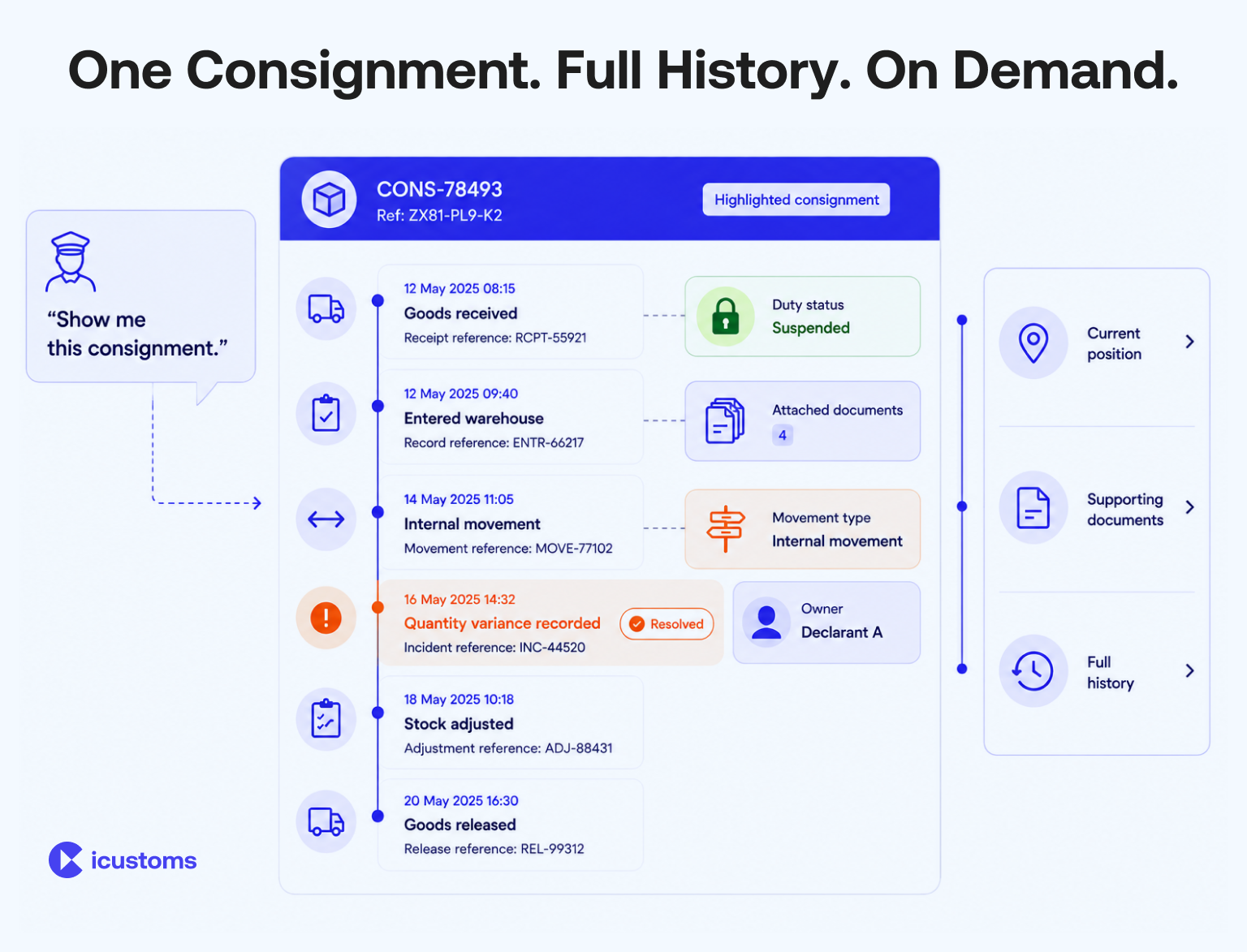
Bonded warehouse software for stock audit purposes has one job above all others: answering an officer’s question about a specific consignment, quickly, with evidence. If you are earlier in the process, start with what a bonded warehouse is or see how iWarehouse handles both customs and excise stock on the iWarehouse bonded warehouse software page.
Frequently Asked Questions
What does HMRC check in a bonded warehouse audit?
Three areas. Inventory control, matching physical stock against your records through a physical stock count on selected lines. Documentation verification, tracing consignments through import declarations, entry documents, duty suspension records, licences and proof of origin. And security and access, covering the perimeter, the marked customs area, CCTV and its retention, and visitor logs.
How often are bonded warehouses audited?
There is no published cycle. HMRC visits authorised warehousekeepers and approved premises to carry out checks and regularly reviews the compliance of existing authorised businesses. Frequency tracks risk: duty at stake, compliance history, goods held, and the outcome of previous visits.
What happens if stock discrepancies are found?
Where goods cannot be accounted for, the duty generally becomes due. Genuine, evidenced losses may qualify for relief, which is why recording incidents at the time with a cause and evidence matters. Exposure can also include financial penalties, claims against your guarantee, and in serious or persistent cases withdrawal of your authorisation and approval.
What records must a warehousekeeper keep?
For excise goods, a stock account showing commercial description, quantity in litres or litres of alcohol for spirits, strength, quantity in cases, casks or polydrums, a unique reference number, date received and the owner of the goods. Ownership changes must be recorded and owner details available to HMRC. Goods must sit in clearly identified locations traceable to the account. Customs warehouse records must be kept for a minimum of four years after discharge.
Does HMRC have to approve my warehouse software?
For customs warehousing, yes. HMRC guidance states that software which has not been approved cannot be used, and a duty management system that does not meet the requirements will not be approved. The system must permit a full audit, identify goods with preference, quota or licensing restrictions, and be updated no later than before midnight of the following warehouse operation day. Responsibility for its accuracy sits with the warehousekeeper, not the supplier.
You may also like:
Struggling to Extract, Catagorise & Validate Your Documents?

Capture & Upload Data in Seconds with AI & Machine Learning
Subscribe to our Newsletter
About iCustoms
iCustoms is an all-in-one solution helping businesses automate customs processes more efficiently. With AI-powered and machine-learning capabilities, iCustoms is designed to streamline your all customs procedures in a few minutes, cut additional costs and save time.
Struggling to Extract, Catagorise & Validate Your Documents?
Capture & Upload Data in Seconds with AI & Machine Learning