
Managing Multi-Client Bonded Warehouses: A Guide for 3PLs
- John Hall
- Customs Specialist at iCustoms.ai
Multi-client bonded warehouse management means operating one HMRC-approved customs warehouse on behalf of several depositor clients at once. It combines shared storage infrastructure with strict inventory isolation, and it requires duty liability to be tracked separately for every client.
For a 3PL or freight forwarder this is a commercial opportunity and an operational trap in the same package. Bonded storage is a service you can sell at a margin general warehousing cannot reach. It also makes you accountable to HMRC for stock you do not own, belonging to clients whose duty exposure you have to keep separate and provable. This guide covers how that works, who is liable when it goes wrong, and the system distinction most 3PLs discover too late.
What multi-client bonded warehouse management involves
A public customs warehouse for multiple clients is the model that makes this possible. A public authorisation permits you to store goods belonging to other businesses, known as depositors. A private authorisation covers only your own stock, where the authorisation holder and the depositor are the same person.
One point removes a lot of confusion early. Your clients do not need their own HMRC authorisation to deposit goods with you. Only the warehousekeeper is authorised. A depositor does not even have to own the goods, but must be established in the UK, must submit the import declaration or arrange for an agent to do so, and takes on the liability if duty and import VAT become due.
So the division of roles in third party logistics and warehouse operations under bond is unusual: you hold the approval and the accountability for the records, your client holds the duty liability, and neither of you can see the whole position without a shared, reliable record. That asymmetry drives everything else on this page.
If you have not yet chosen between the two authorisation models, the application detail and the evidence HMRC expects sit in our customs warehouse authorisation guide, and the underlying concept is covered in what a bonded warehouse is.
Public against private, from an operational angle
The authorisation difference is well documented. The operational difference is not, and it is what actually determines whether multi-client bonded storage is viable for your business.
| Area | Public: multi-client | Private: single-client |
|---|---|---|
| Whose goods | Multiple depositors, none of whom you own the stock for. | Your own stock only. |
| Records burden | Every position must be attributable to a named owner, and ownership can change while goods sit still. | One owner, so attribution is trivial. |
| Who carries the duty | Each depositor, separately, on their own releases. | You. |
| Who answers to HMRC | You, for all of it, including stock you do not own. | You, for your own stock. |
| Extra evidence at application | Customer letters of intent showing annual VAT and duty suspension figures. | None of that required. |
| Billing | Per client, per activity, and it has to reconcile to the stock record. | Internal cost allocation at most. |
| Commercial model | Bonded storage sold as a service, at a margin. | Cost centre offset by deferred duty. |
| Failure mode | One client’s bad data becomes your compliance finding. | Contained within your own operation. |
Table: public (multi-client) against private (single-client) bonded warehouse operation, compared on operational responsibilities rather than authorisation.
The final row is the one worth sitting with. In a private warehouse a record error is your problem. In a multi-client warehouse, a client who gives you an incorrect commodity code or an incomplete declaration creates a finding against your authorisation, not theirs.
Who is liable if stock records are wrong?
This is the question 3PLs ask first and the one most content avoids, so here it is plainly.
As warehousekeeper you are responsible for the security and control of the goods, for keeping the stock records and accounting for shortages, for co-operating with HMRC as supervisors of your authorisation, and for allowing HMRC access to the premises, your records and the goods at any reasonable time. That responsibility does not shrink because the goods belong to someone else.
Your depositor carries the duty liability on release. But if stock cannot be accounted for, the assumption is that duty-suspended goods have entered the market untaxed, and the duty becomes due. Recovering it from a client contractually is a separate matter from your position with HMRC, and it is a much weaker one if your records are the thing in doubt.
Two practical consequences. First, your client onboarding needs to establish data quality obligations in writing, because you are absorbing the consequence of their declaration errors. Second, your records need to show whose goods were whose at every point in time, not just now. HMRC requires that full details of owners storing goods in your warehouse are available, and that your stock records accurately record any change of ownership. Ownership can transfer while a pallet never moves.
What HMRC checks when it visits, and where multi-client operations typically fail, is covered in our guide to HMRC bonded warehouse audits.
The line that changes the buying decision HMRC customs warehousing guidance states plainly: “Software that has not been approved by HMRC cannot be used.” A duty management system that cannot meet the stated requirements will not be approved for customs warehousing purposes. This is not a recommendation to use good software. It is a condition on which system you are permitted to operate, and the responsibility and accuracy of that system lies with the warehousekeeper, not the supplier. |
Bonded warehouse segregation of stock
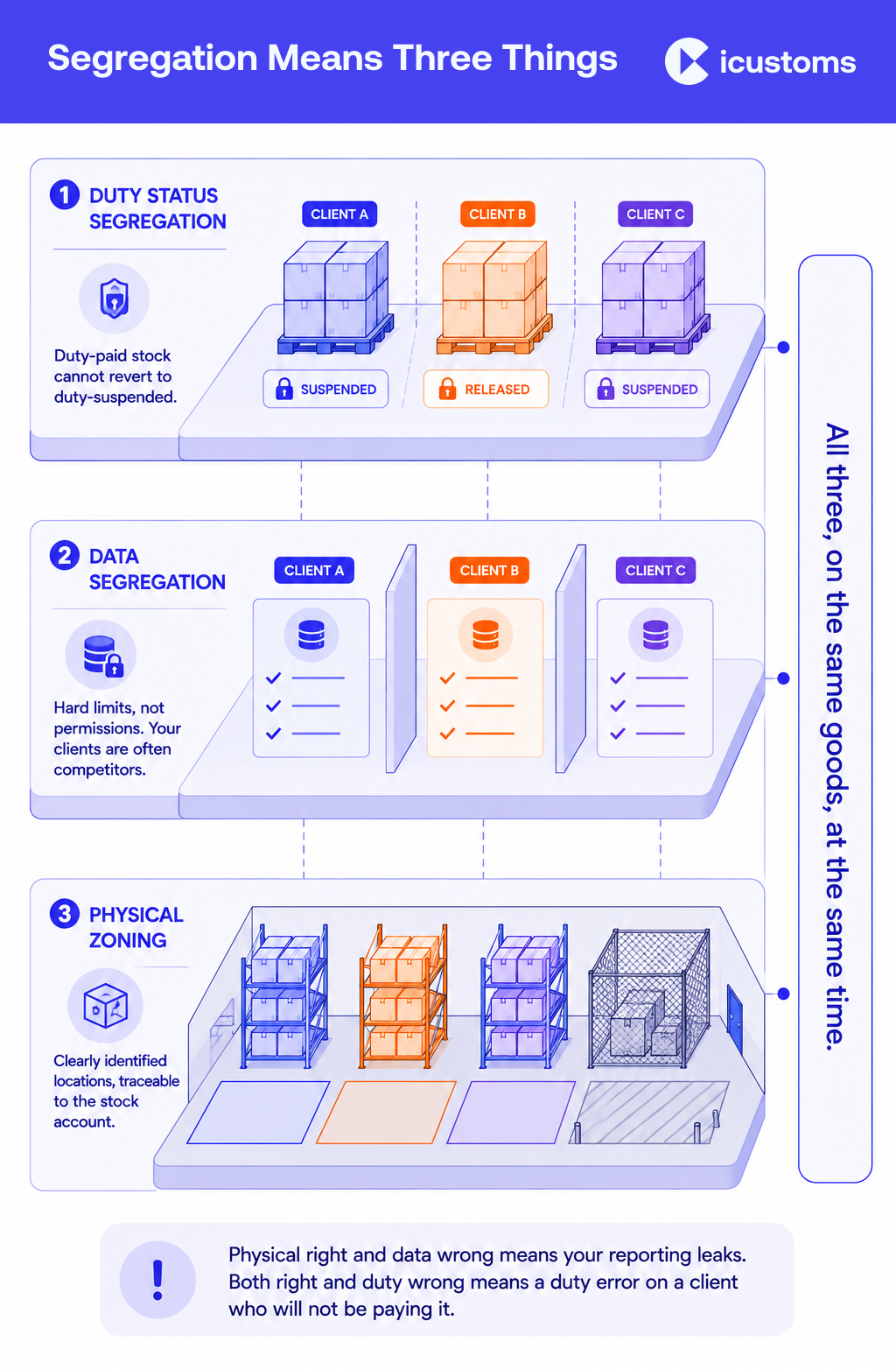
Segregation in a bonded context means three separate things, and most operations get one or two of them right.
Data segregation. Each client’s stock, movement history, documents and audit trail must stay separate, with no possibility of one client’s data appearing in another’s reporting. A genuine multi-tenant system maintains that as a hard architectural limit rather than as a permissions setting bolted on afterwards, and it matters commercially as well as legally: your clients are often competitors.
Physical zoning. Allocating specific rack bays, caged areas or floor-marked zones to distinct clients so a picker cannot take the wrong client’s stock. HMRC separately requires that goods are kept in clearly identified locations traceable to the stock account, and that the account is noted whenever goods move to a new location inside the warehouse. Physical zoning and record accuracy are the same requirement viewed from two ends.
Duty status segregation. The one general warehousing has no concept of. Every position needs its duty status held against it, per client, tracked until formal release or re-export. Where you hold duty-suspended and duty-paid goods on the same site, that is co-storage and it needs HMRC permission, with a system that can identify the location and duty status of all goods at all times and that prevents duty-paid stock reverting to duty-suspended without payment.
Get physical zoning right and data segregation wrong, and your reporting leaks. Get both right and duty status wrong, and you have a duty error on a client who will not be paying it.
A 3PL warehouse management system is not a duty management system
This is the most expensive misunderstanding in the sector, and HMRC itself makes the distinction explicit.
When you apply to operate a customs warehouse, HMRC asks for inventory records with screenshots of your Warehouse Management System or your Duty Management System, and says to include both if you use both. Two systems, named separately, in the same requirement. The reason is that they do genuinely different jobs.
| Area | A 3PL warehouse management system | A duty management system |
|---|---|---|
| Tracks | Locations, bins, picks, waves, labour, despatch. | Duty status, procedure, declarations, the stock account. |
| Question it answers | Where is it and who picks it? | What is owed on it, to whom, and when? |
| Client view | Inventory and order status. | Duty exposure and released position. |
| Regulatory status | A commercial system. | Forms part of the customs warehouse stock account. |
| Approval | Your choice of vendor. | Software not approved by HMRC cannot be used for customs warehousing. |
Table: what a 3PL warehouse management system does against what a duty management system must do.
So the answer to what is 3PL warehouse management system in a bonded context is: necessary, and not sufficient. A best-in-class 3PL warehouse management system handles receiving, putaway, picking, packing and despatch superbly, and knows nothing about duty suspension. That is not a defect. It is a different product category.
Which is why the question to ask when comparing 3PL solutions and 3PL warehouse solutions is not whether a platform is good, but which of the two layers it is. Cloud-based warehouse software for 3PL operations, 3PL warehouse shipping software, ecommerce 3PL software and 3PL ecommerce warehouse software all cluster in the first layer. They handle fulfilment. 3PL customs warehouse software is the second layer, and it is a much narrower market. Where both are used, HMRC regards your commercial records and the duty management system as one system that together constitutes the stock account.
If you are evaluating the duty layer specifically, our bonded warehouse software buyer’s guide sets out the criteria that matter, including the ones that only apply to multi-client operations. Searching for the best 3PL warehouse software or the best 3PL warehouse management software will mostly return the fulfilment layer, so search deliberately for the other one.

Per-client billing and duty visibility
Two client-facing outputs decide whether multi-client bonded storage is profitable or merely busy.
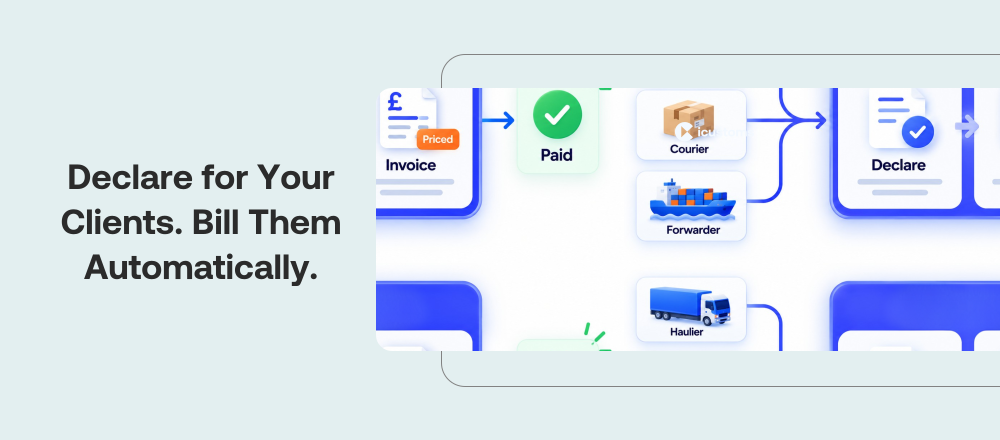
Billing has to be transactional rather than flat. Storage by pallet or case per period, handling in and out, and value-added activities priced separately, with rates varying by client and often by contract term. That is standard 3PL practice. What bonded storage adds is that your billing has to reconcile to the same movement record your compliance reporting comes from. If your billing system and your stock account disagree about how many pallets moved, one of them is wrong and you do not know which.
Duty visibility is the differentiator you can actually charge for. Clients storing goods under bond want to know their suspended duty exposure, what has been released, and what is still in bond, without asking you to compile it. A 3PL warehouse inventory solution that can show a client their own duty position, and only their own, turns a compliance obligation into a retention feature. Very few operators can do it, which is precisely why it is worth doing.
This is also the point at which bonded warehouse software for bookkeepers stops being a niche phrase and becomes a real requirement. Someone has to reconcile the duty position, the billing and the stock account monthly, and that person is usually in finance rather than operations.
Shared infrastructure without shared risk
The economics of multi-client operation come from sharing. Warehouse shared storage infrastructure means one building, one racking investment, one team and one set of equipment spread across many accounts, with labour and equipment redistributed dynamically as workload shifts between clients through the week.
That is the upside, and in 3PL warehousing generally it is well understood. Under bond it comes with a constraint worth planning around: shared resources must not become shared records. Your team, your forklifts and your dock doors can flex across accounts freely. Your stock account, your duty positions and your client reporting cannot.
The practical test is whether adding a client is a configuration change or a project. If onboarding a new depositor means a new spreadsheet, a new folder structure and a new manual reconciliation, your operation scales linearly with headcount and multi-client bonded storage will stop being profitable at exactly the point it starts being significant.

Documents: the multi-client bottleneck
One client sends commercial invoices as PDFs. Another sends spreadsheets. A third sends scanned paperwork from their supplier. All of it has to become accurate declaration and stock data, and under bond the documentation has to be relatable to specific goods rather than filed by date.
This is where multi-client operations quietly lose their margin. The compliance work per consignment is broadly fixed, so a 3PL handling twenty clients does twenty times the document handling of a single-client operation, on the same goods volume. Adding headcount is the obvious answer and the one that eliminates the margin bonded storage was supposed to create.
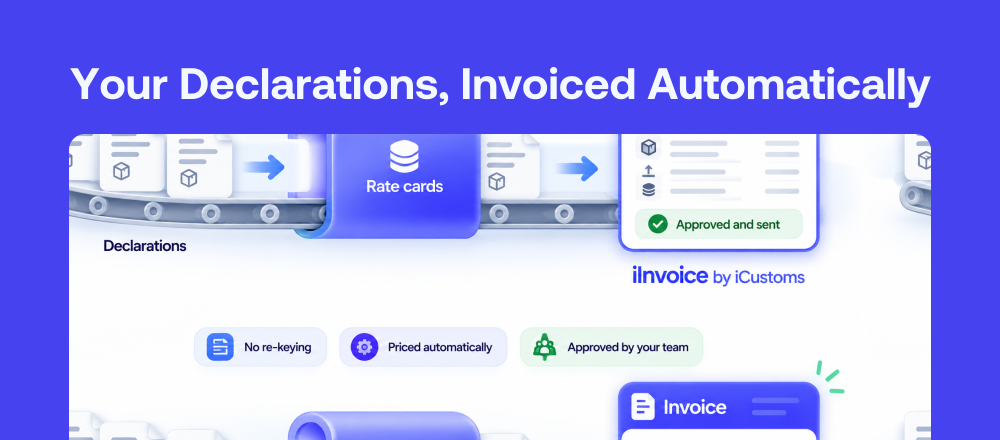
It is also where AI-based document processing earns its place rather than being a talking point. iCustoms uses intelligent document processing with OCR to extract, validate and structure data from trade documents, whatever format each client sends, so the data entering your stock account and your declarations comes from the source paperwork rather than from re-keying. For a multi-client bonded operation, that is the difference between compliance overhead scaling with client count and staying roughly flat.
Running it from one place
Pull the requirements together and multi-client bonded storage needs a system that holds, per client and per consignment, the duty status, the owner and any change of ownership, the movement history with documents attached, and a period reconciliation that both your compliance reporting and your invoicing can be built from. Plus the ability to add a client without adding a process.
iWarehouse is built for bonded storage operations rather than adapted from general warehousing. It keeps the bonded stock position and movement history together, holds duty status against stock so suspended and released positions stay distinct, attaches supporting documents to the consignment they belong to, and reconciles the period so the numbers you report and the numbers you bill come from the same record. You can run multi-client bonded storage from one dashboard with iWarehouse, across both the customs and excise sides of the same site.
It sits alongside your fulfilment system rather than replacing it, which is the arrangement HMRC anticipates when it asks for both.
Frequently Asked Questions
Can one warehouse store goods for multiple different importers?
Yes, under a public customs warehouse authorisation, which permits you to store goods belonging to other businesses. A private authorisation covers only your own stock. Your depositor clients do not need their own HMRC authorisation, but each must be established in the UK and must submit the import declaration or arrange for an agent to do so.
How do 3PLs keep bonded stock segregated by client?
Three ways at once. Data segregation, so no client's stock, history or reporting can appear in another's. Physical zoning, using allocated bays, caged areas or floor markings, with goods in clearly identified locations traceable to the stock account. And duty status segregation, tracking each client's suspended liability separately until release or re-export.
Who is liable if stock records are wrong in a shared bonded warehouse?
You are, as warehousekeeper. You are responsible for the security and control of the goods, for keeping stock records and accounting for shortages, and for HMRC access. Your depositor carries the duty liability on release, but where stock cannot be accounted for the duty becomes due, and recovering it from a client contractually is separate from your position with HMRC.
Is a 3PL warehouse management system enough for bonded storage?
No. HMRC's own application requirements ask for screenshots of your Warehouse Management System or your Duty Management System, and to include both if you use both. A fulfilment system tracks locations, picks and despatch. A duty management system tracks duty status, procedure and the stock account, and forms part of that account. Software not approved by HMRC cannot be used for customs warehousing.
How does per-client billing work in a bonded warehouse?
Transactionally: storage by pallet or case per period, handling in and out, and value-added services priced separately, with rates varying by client. The bonded-specific requirement is that billing reconciles to the same movement record your compliance reporting comes from, so the two cannot disagree about what moved.
You may also like:
Struggling to Extract, Catagorise & Validate Your Documents?

Capture & Upload Data in Seconds with AI & Machine Learning
Subscribe to our Newsletter
About iCustoms
iCustoms is an all-in-one solution helping businesses automate customs processes more efficiently. With AI-powered and machine-learning capabilities, iCustoms is designed to streamline your all customs procedures in a few minutes, cut additional costs and save time.
Struggling to Extract, Catagorise & Validate Your Documents?
Capture & Upload Data in Seconds with AI & Machine Learning