
Excise Warehouse Authorisation UK: ATWD, Returns & APPA Explained
- John Hall
- Customs Specialist at iCustoms.ai
Excise warehouse authorisation is HMRC approval to hold excise goods in duty suspension. Two things are approved: you as an authorised excise warehousekeeper, and your premises as an excise warehouse. HMRC asks you to apply at least 45 working days before you want the authorisation to begin.
Getting approved is the first half of the job. The second half is the reporting cycle that starts the day the certificate arrives: ATWD registration, a monthly W1 return for every set of premises, removal warrants for every consignment that leaves, and a stock account that has to reconcile every time. This guide covers both halves, and answers the question that has caused the most confusion since the alcohol duty reforms: whether an APPA removes the need for an excise warehouse at all.
What excise warehouse authorisation covers
Excise warehouse authorisation UK businesses apply for differs from the customs equivalent in one structural way: the excise regime approves two things separately. You need authorisation as an excise warehousekeeper, and you need your premises approved as an excise warehouse. Notice 196 puts it bluntly: do not assume HMRC will automatically authorise you. If you are unsure which regime applies to your goods, our customs warehouse vs excise warehouse comparison sets the two side by side.
HMRC considers three types of premises approval: general storage and distribution warehouses, trade facility warehouses, and motor and heating fuels warehouses. Alcohol, tobacco and vaping product applications, including general storage and distribution and trade facility approvals, go through a single online form. Motor and heating fuels applications are still paper: form EX61 for the warehousekeeper, EX70 for the premises, EX71 for vessels, plant and equipment, plus EXCISE 102 if the business is a partnership.
On timing, HMRC aims to process premises applications within 45 working days of receipt and asks you to apply at least 45 working days before you want to trade. That is a firmer published figure than the customs guidance gives, but it assumes a complete application and a successful pre-approval visit.
The APPA question: does an APPA replace an excise warehouse?
This is the single most misread point in UK excise warehousing, and getting it wrong in either direction is expensive. The precise answer is narrow.
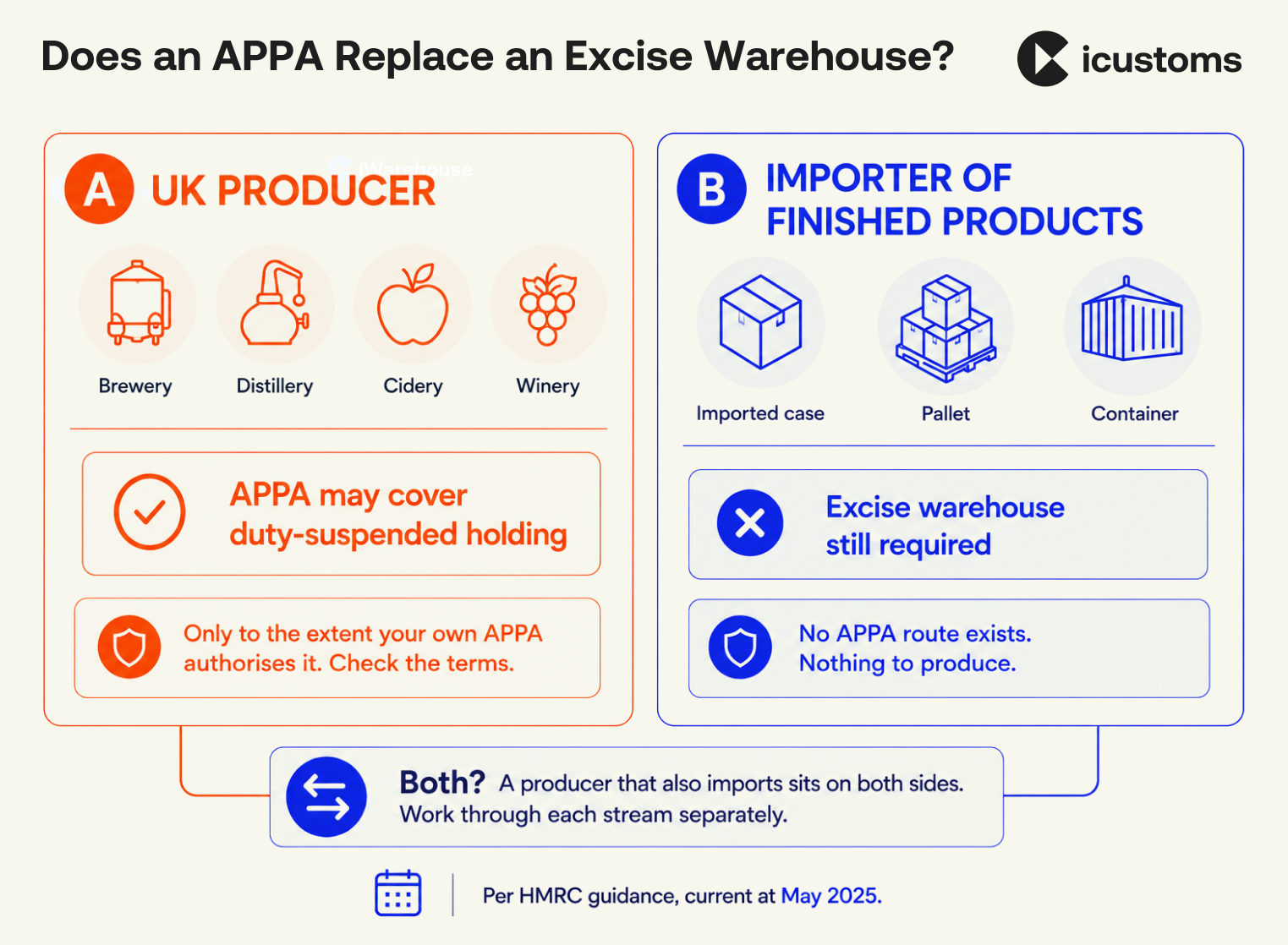
An alcoholic products producer approval can carry authorisation to receive, store and dispatch alcoholic products in duty suspension. HMRC guidance is explicit that this applies if you are an alcoholic products producer and hold the appropriate authorisation under your APPA. That is a genuine simplification, and for a brewery or distillery holding its own output it can remove the need for a separate excise warehouse approval.
What it does not do is change anything for importers. An APPA is a producer approval. If you buy in finished alcoholic products and store them, you are not producing anything, so there is no APPA route available to you and excise warehousing remains the mechanism for holding that stock in duty suspension. The reform did not touch this.
| UK Producer | Importer of Finished Products | |
|---|---|---|
| Who this is | Breweries, distilleries, cider makers, and winemakers producing alcoholic products in the UK. | Wine, spirits, and beer importers buying finished goods for resale. |
| APPA available? | Yes, as the producer approval for making alcoholic products. | No. There is nothing to produce, so no APPA route exists. |
| Excise warehouse still needed? | Not necessarily. Duty-suspended holding may be covered by the appropriate authorisation under the APPA. | Yes. Excise warehousing remains the route to holding the stock in duty suspension. |
| Practical read | Check what your APPA actually authorises before assuming it covers storage and dispatch. | Plan for excise warehouse authorisation. The APPA changes nothing here. |
Two cautions. First, “producer” and “importer” are not mutually exclusive: a distillery that also imports finished spirits for its own brand portfolio sits on both sides of this table and needs to work through each stream separately. Second, an APPA authorises what it says it authorises. Read the terms rather than assuming scope. For the vertical detail on how each business type handles Alcohol Duty in practice, see our guide to alcohol duty warehousing for producers and importers.
Fit and proper: what HMRC actually assesses
Notice 196 sets a single headline test. HMRC must be satisfied that the business is a genuine enterprise which is commercially viable, with a genuine need for approval, and that all persons with an important role or interest in it are law abiding, responsible, and do not pose any significant threat in terms of potential revenue non-compliance or fraud.
That test is applied not just to the legal entity but to all partners, directors and other key persons, meaning anyone who can be seen as one of the business’s guiding minds. In practice HMRC looks for evidence that:
- there is no history of significant revenue non-compliance or fraud in any regime, including civil penalties, previously revoked or refused approvals, confiscation orders or disqualified directors
- there are no connections to other known non-compliant or fraudulent businesses
- there are no relevant unspent criminal convictions among key persons
- the application is accurate and complete, with no attempt to deceive
- there have been no persistent or negligent record-keeping failures
- the business has not previously traded unapproved
- commercial viability is evidenced, with a genuine plan to trade legitimately from the proposed approval date
- there are no outstanding unmanaged debts or history of poor payment to HMRC
- satisfactory due diligence procedures cover prospective customers and suppliers
The systems requirement most applicants underestimate Alongside the conduct tests, Notice 196 requires warehousekeepers to have an accounting system that satisfies HMRC’s requirements, and adequate IT infrastructure in place sufficient to support the business and HMRC systems such as EMCS. This is not a soft expectation. Your duty management system, stock records and EMCS connection are part of what HMRC is approving, and a pre-approval visit can and does probe suppliers, customers, business plans, accounting systems, premises and financial viability. Spreadsheets are a difficult answer to give at that visit. |
Premises approval, economic need and the guarantee position
Two changes have made premises approval more accessible than older guidance suggests, and both are commonly missed.
On throughput, Notice 196 states that from 1 June 2022 you no longer need to meet minimum throughput levels if you can show a real economic need to store goods at your premises. Instead HMRC wants expected volumes including the potential excise duty liability of stock likely to be held at any time, and evidence of customers lined up should the application succeed. Where other approved premises are nearby, you must also justify further capacity in that location.
On security, from 1 January 2021 HMRC no longer routinely requires a premises guarantee, although it may still require one where there is a risk to the revenue. Where required, it is banded against the potential duty on your average month-end stock: nil below a £100,000 potential liability, with a stated minimum of £250,000 for new general storage and distribution warehouses. Security can halve after two consecutive years without a claim or significant irregularity, and fall away entirely after four. Levels must be reviewed at least every six months and the review recorded.
Motor and heating fuels warehouses are the exception: they are normally required to provide a minimum of one million litres of bulk storage capacity.
ATWD registration and EMCS enrolment: getting set up to file
Approval does not make you able to file. Two separate digital enrolments do that, and both take time you should build into your go-live plan.
ATWD registration. The Alcohol and Tobacco Warehousing Declarations service is how you submit W1 returns and removal warrants electronically. You register and enrol for it through HMRC online services. There are two electronic routes: the online service itself, or the XML direct submission service, which sends data straight from your own system to HMRC without re-keying. The XML route does not give HMRC access to your system.
EMCS enrolment. Separately, you must register for HMRC online services and enrol for EMCS, and you must do this even if you use a commercial software package or in-house built excise warehouse software to record consignments. You enrol using your System for the Exchange of Excise Data (SEED) Excise ID, entering the authorised person’s ID rather than the premises ID. Warehousekeepers use an ID beginning GBWK for a Great Britain registered business or XIWK for a Northern Ireland registered business. Notice 196 indicates EMCS registration can take up to seven days to process, and the activation code you are then sent is valid for 28 days. Miss that window and you enrol again.
This page covers enrolment only. For how a movement actually runs once you are enrolled, including electronic administrative documents, ARCs and reports of receipt, see our guide to how EMCS works.
The W1 excise warehouse return, and the warrants that go with it
The W1 is the backbone of excise warehouse reporting. All excise warehousekeepers must submit one, normally monthly, for each set of premises they operate. Returns must be received within 14 days of the end of each return period.
There are exceptions. Certain trade facility warehouses sit outside the requirement, and currently export shop operators, aircraft store floor operators and motor and heating fuels warehouses do not submit a W1, except fuels warehouses holding ethanol. Non-standard periods must be agreed with HMRC’s National Warrant Processing Unit before 1 March for the following financial year and cannot exceed five weeks.
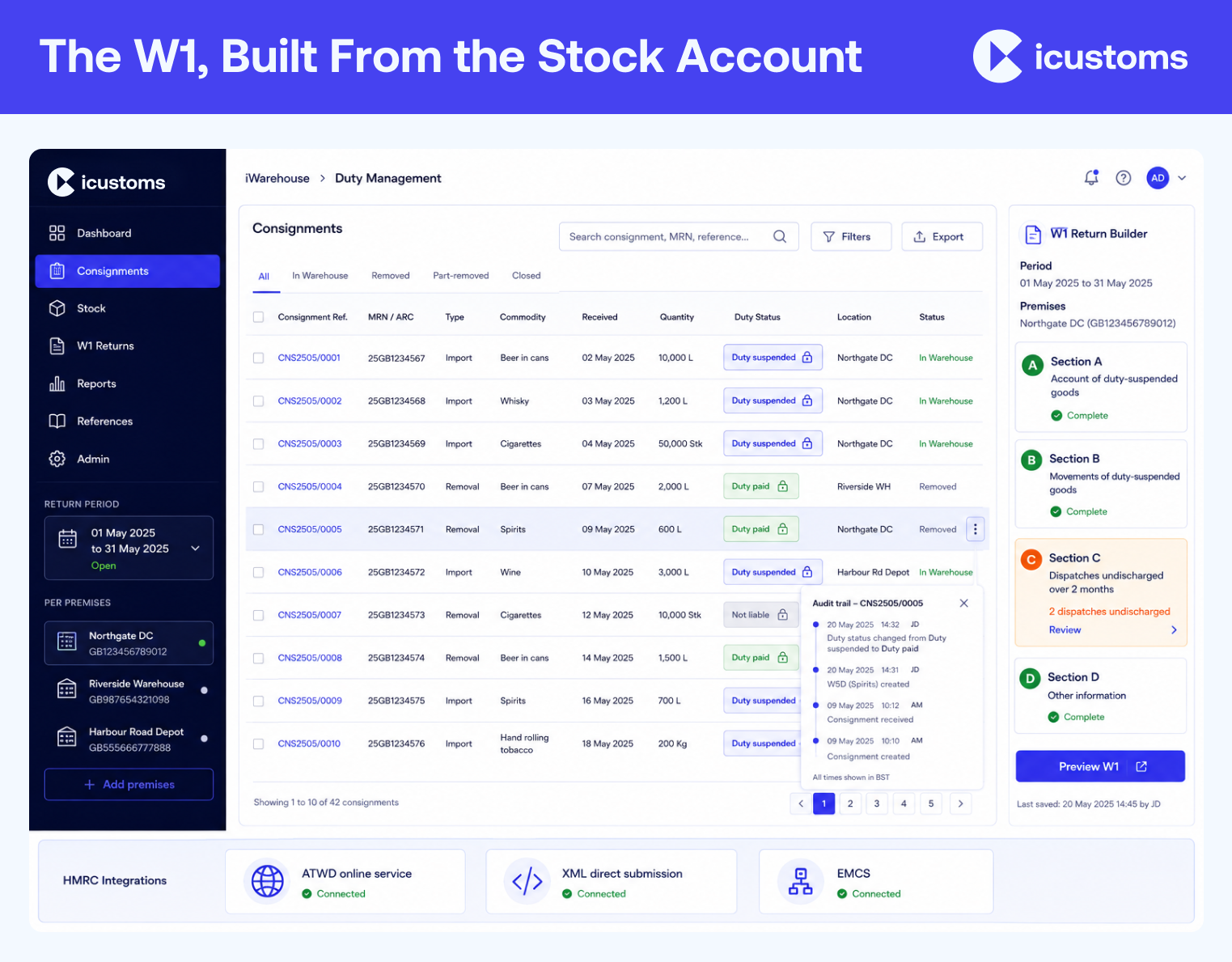
The return has four sections, and section C is where most reconciliation pain lives:
- Section A: the warehousekeeper’s declaration that the information is true and complete, signed by a proprietor, partner, director, company secretary or authorised representative.
- Section B: the stock return, showing alcoholic and tobacco product stock movements and stock on hand at period end.
- Section C: information on electronic administrative documents and duty-suspended dispatches under simplified arrangements, including every duty-suspended dispatch not discharged after two months, and any reports or certificates of receipt or export showing shortages.
- Section D: changes to the details of owners storing goods in the warehouse.
Late filing may attract a financial penalty, and Notice 196 is direct about the escalation: persistent failure to submit returns could result in withdrawal of your authorisation and approval. Paper W1 returns remain permitted until HMRC announces otherwise, but the electronic routes carry validation, automatic closing-stock calculation and an on-screen acknowledgement, which is why most warehousekeepers move to them.
Alongside the return sit the warrants used when goods actually leave.
| Form | Purpose | When it is Used | Who Files |
|---|---|---|---|
| W1 | Excise warehouse return: stock, movements, undischarged dispatches, owner changes. | Normally monthly, within 14 days of the period end, for each set of premises. | Excise warehousekeeper |
| W5 | Payment warrant for removal of alcohol goods on immediate payment of duty. | At removal, where duty is paid by cash or equivalent. | Person removing the goods |
| W5D | Deferment warrant for removal of alcohol goods under duty deferment. | At removal, where duty is deferred. | Person removing the goods |
| W6 | Payment warrant for removal of tobacco goods on immediate payment of duty. | At removal, where duty is paid by cash or equivalent. | Person removing the goods |
| W6D | Deferment warrant for removal of tobacco goods under duty deferment. | At removal, where duty is deferred. | Person removing the goods |
Two adjacent points. For mineral oils, immediate payment uses form W50 and deferment uses HO10. And separately from the warrant cycle, owners paid or expecting to be paid in cash above £9,000 for duty-suspended alcoholic products must complete form W7, which has to be submitted before the goods leave the dispatching warehouse.

Duty deferment and the Excise Payment Security System
Excise duty deferment is only available if HMRC has authorised you to defer. Where approved, duty deferment normally requires a guarantee covering your total monthly liabilities. The Excise Payment Security System is the route by which you may be able to defer excise duty payments without that guarantee, which materially changes the working capital position for a high-volume warehouse.
Deferment is the mechanism that turns duty from a per-shipment cash event into a monthly one, and it is worth modelling properly before you assume the benefit. Our guide to how duty deferral improves cash flow works through what that changes.
Co-storage: the systems condition people miss
If you want to hold different classes of excise goods on one approved site, duty-suspended alongside UK duty-paid and goods not liable to any duty, that is co-storage and it is permitted under conditions. It is not automatic. You must write to HMRC and ask for your excise warehouse approval to be varied.
The conditions are systems conditions. Your accounting system has to identify and record the location and duty status of all the excise goods at all times, run the accounting routines for every class of goods, and show clearly when duty becomes due. Notice 196 adds one absolute requirement: your system must make sure duty-paid goods cannot revert to duty-suspended status, and that duty-suspended goods cannot be shown as duty-paid without prior payment of duty.
Read that as a software specification rather than a policy. Duty status has to be an enforced attribute on every stock line with controlled transitions and an audit trail, not a column somebody edits. Most spreadsheet-based stock accounts cannot demonstrate that control, which is a common reason a co-storage variation stalls.
How to apply for excise warehouse authorisation: step by step
Step 1. Confirm you need it. If you are a UK producer, check what your APPA already authorises. If you are an importer of finished products, you need this authorisation.
Step 2. Decide the premises type. General storage and distribution, trade facility, or motor and heating fuels. This determines your application route and your evidence.
Step 3. Build the economic need case. Expected volumes, the potential duty liability of stock likely to be held, and evidence of customers lined up. Justify further capacity if approved premises are nearby.
Step 4. Prepare the premises evidence. Three copies of plans showing the proposed approved area, your premises health and safety risk assessment or an executive summary of it, and any business plan HMRC requests.
Step 5. Get your systems ready. An accounting system that meets HMRC requirements and IT infrastructure adequate to support EMCS. This is assessed, so have it working before the visit rather than promised.
Step 6. Apply, at least 45 working days ahead. Online for alcohol, tobacco and vaping products, including general storage and distribution and trade facility approvals. Paper EX61, EX70, EX71 and EXCISE 102 for motor and heating fuels.
Step 7. Pass the pre-approval visit. Every applicant gets one. HMRC checks the premises are physically secure and suitable, revenue risks are appropriately managed, and its officers can work safely.
Step 8. Enrol for ATWD and EMCS. Do this as soon as the certificate is issued. Remember the 28-day activation window.
If you are refused, or an approval is withdrawn, you have 30 days from the date of the decision letter to request a review or appeal to the tribunal. HMRC aims to complete a review within 45 days.
Automating the monthly excise cycle
Look at what the regime asks for and a pattern appears. A stock account accurate at all times. Duty status enforced per line with controlled transitions and a complete audit trail. Every duty-suspended dispatch tracked until discharge, and any still open after two months reported on the W1. A return filed within 14 days of period end for each set of premises, every month, with the warrants for every removal reconciled to it. And an IT estate HMRC considers adequate to support its own systems.
That is a duty management system specification, and it is precisely what iWarehouse is built to run. It creates declarations automatically on arrival, holds duty status against every consignment, tracks movements without manual monitoring, and reconciles removals so you can automate your monthly excise returns with iWarehouse instead of rebuilding the stock position by hand each period. Because the same platform covers the customs side, a site holding both approvals does not become two systems that have to agree.
If you are evaluating options rather than ready to see ours, our bonded warehouse software buyer’s guide sets out the criteria to compare against, including EMCS and ATWD integration.
Two things to take away The APPA does not remove the excise warehouse requirement for importers of finished alcoholic products, and it only removes it for producers to the extent their own approval says so. And the W1 deadline is 14 days after period end, every month, for every set of premises, with persistent failure putting the authorisation itself at risk. Book a demo of iWarehouse to see the monthly cycle run automatically, or download the excise filing calendar to map your own deadlines first. |
Frequently Asked Questions
Do I still need an excise warehouse if I have an APPA?
Possibly not, if you are a UK producer. An alcoholic products producer approval can carry authorisation to receive, store and dispatch alcoholic products in duty suspension where you hold the appropriate authorisation under it. Check what your own APPA actually authorises rather than assuming it covers storage and dispatch.
Does APPA apply to importers as well as producers?
No. An APPA is a producer approval. If you import finished alcoholic products rather than producing them, there is no APPA route open to you and excise warehouse authorisation remains the way to hold that stock in duty suspension. This did not change with the alcohol duty reforms.
What is a W1 return?
The W1 is the excise warehouse return. It reports stock movements and closing stock, information on electronic administrative documents including any duty-suspended dispatch not discharged after two months, and changes to the owners storing goods with you. It has four sections, A to D.
How often do I file ATWD returns?
The W1 is normally monthly, for each set of premises you operate, and must reach HMRC within 14 days of the end of each return period. Non-standard periods can be agreed with HMRC in advance but cannot exceed five weeks.
What happens if I file a W1 return late?
Late submission may result in a financial penalty. HMRC is explicit that persistent failure to submit returns could lead to withdrawal of your authorisation and approval, so repeated lateness is an existential risk to the business rather than an administrative cost.
How long does excise warehouse authorisation take?
HMRC asks you to apply at least 45 working days before you want the authorisation to begin, and aims to process premises applications within 45 working days of receipt. Every applicant receives a pre-approval visit, so build in time for that and for any information HMRC requests.
You may also like:
Struggling to Extract, Catagorise & Validate Your Documents?

Capture & Upload Data in Seconds with AI & Machine Learning
Subscribe to our Newsletter
About iCustoms
iCustoms is an all-in-one solution helping businesses automate customs processes more efficiently. With AI-powered and machine-learning capabilities, iCustoms is designed to streamline your all customs procedures in a few minutes, cut additional costs and save time.
Struggling to Extract, Catagorise & Validate Your Documents?
Capture & Upload Data in Seconds with AI & Machine Learning