

ENS vs EXS: What's the Difference Between Entry and Exit Summary Declarations?
- John Hall
- Customs Specialist at iCustoms.ai
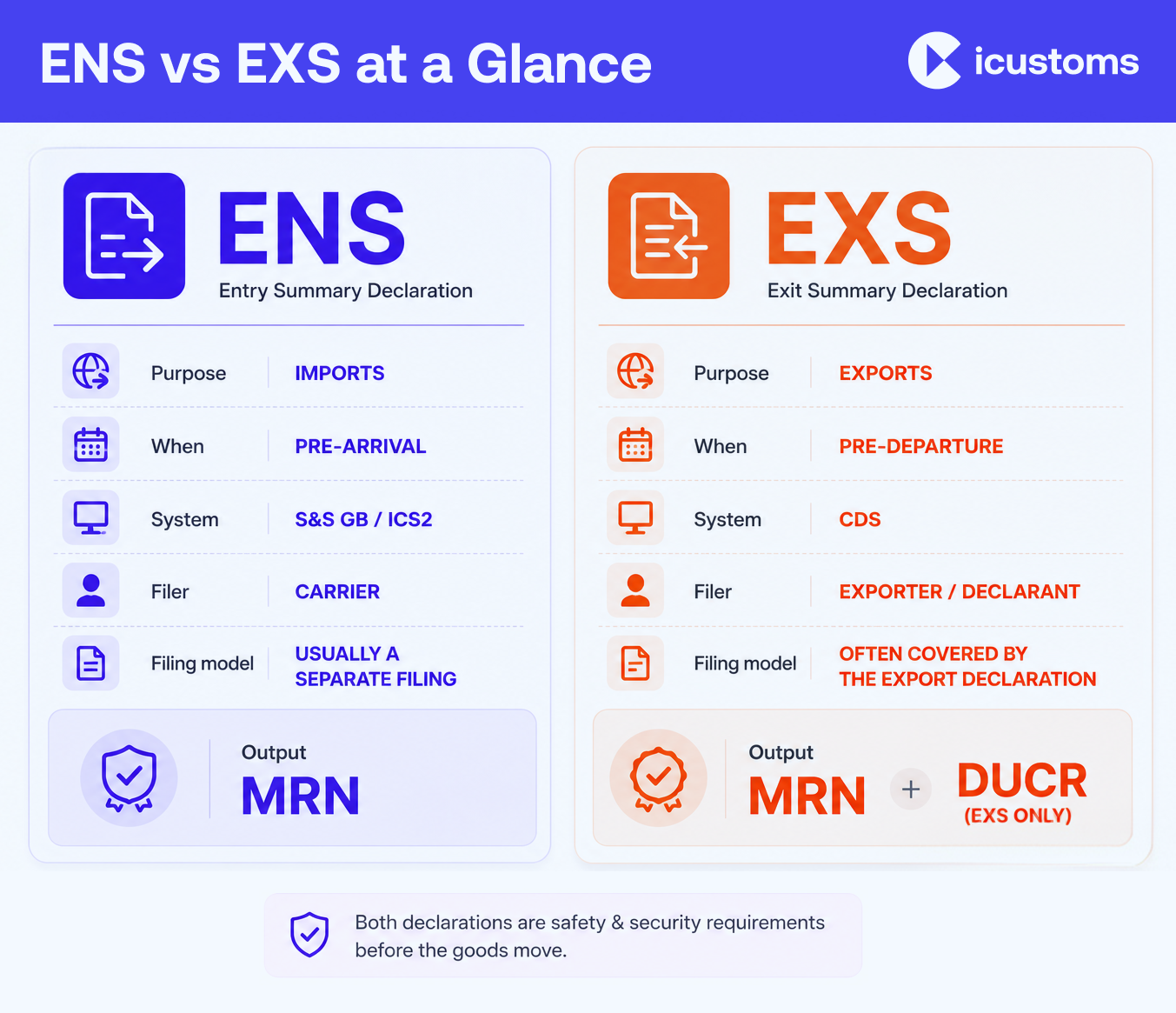
ENS and EXS are both safety and security declarations, but they point in opposite directions. An ENS (Entry Summary Declaration) covers goods entering a customs territory. An EXS (Exit Summary Declaration) covers goods leaving it. Same purpose, letting customs screen a shipment for risk before it moves, but one is for imports and the other for exports.
The practical twist is that you almost always file a separate ENS for imports, while an EXS is usually absorbed into your export declaration and only needed as a standalone document in a few specific cases. This guide explains the difference and when each applies. For the import side in full, see our S&S GB ENS pillar guide.
ENS vs EXS: the core difference
Think of them as the two ends of a border crossing. When goods arrive, customs want advance data to decide whether to let them in: that is the ENS. When goods leave, customs want advance data on what is going out: that is the EXS. Both are pre-movement, both are about security rather than duty, and both produce a Movement Reference Number when accepted. The direction of travel is what sets them apart, and it changes which system you use and who files.
ENS vs EXS at a glance
| Aspect | ENS (Entry Summary Declaration) | EXS (Exit Summary Declaration) |
|---|---|---|
| Direction | Goods entering a customs territory (imports) | Goods leaving a customs territory (exports) |
| Purpose | Pre-arrival safety and security declaration | Pre-departure safety and security declaration |
| UK system | S&S GB (and ICS2 for Northern Ireland and the EU) | Customs Declaration Service (CDS) |
| Usually separate? | Yes, filed separately for imports | Often covered by the export declaration |
| Who files | The carrier (or an authorised agent acting on the carrier’s behalf) | The exporter or declarant (or an authorised agent) |
| Output | Movement Reference Number (MRN) | Movement Reference Number (MRN) and a DUCR (Declaration Unique Consignment Reference) |
What is an ENS?
An ENS is the pre-arrival safety and security declaration for goods coming into a territory. For imports into Great Britain it is filed through S&S GB; for the EU and Northern Ireland it goes through ICS2. The carrier is legally responsible, and it must be lodged before the goods arrive, to a deadline that depends on the transport mode. For the full explanation, see our complete ENS guide.
What is an EXS?
An EXS is the pre-departure safety and security declaration for goods leaving a territory. In the UK, it is submitted through the Customs Declaration Service (CDS), the same system used for export declarations. Once accepted, it returns a Movement Reference Number and a Declaration Unique Consignment Reference (DUCR), and it must be presented to the customs office of export and cleared before the goods can leave.
Safety and security requirements have applied to all movements out of Great Britain since the start of 2021, so the exit side is not optional. What varies is whether you need a standalone EXS or whether your export declaration already covers it.
When do you need an EXS (and when you don't)?
The key rule: if you make a full customs export declaration, you do not need a separate EXS. The export declaration can carry the safety and security data, which HMRC calls a combined export declaration. A standalone EXS is only required when a movement needs safety and security data but does not require a full export declaration.
In practice, a standalone EXS is needed in a small set of cases, including:
- an empty pallet, container or vehicle moved under a transport contract, including empty reusable packaging such as stillages or roll-cages
- goods moved under transit where there is no full export declaration
Some movements are exempt altogether, such as goods covered by an existing waiver, and goods going to Northern Ireland follow separate arrangements. HMRC’s exit summary declaration guidance sets out the current detail, and it is the authoritative source to check against for your specific movement.

Do you ever need both an ENS and an EXS?
Not usually for the same movement, because a single shipment is either arriving or leaving. Where both come into play is across a round trip or a supply chain. A lorry importing goods into Great Britain needs an ENS on the way in; when it later takes a load out, that export leg needs its safety and security covered, through an export declaration or, where relevant, a standalone EXS.
So a business that both imports and exports will handle both declarations routinely, just on different legs. The mistake to avoid is assuming an ENS on the inbound leg covers you for the outbound one. It does not.
Who files, and through which system
This is where the two diverge most for day-to-day operations:
- ENS: the carrier is legally responsible, filing through S&S GB (or ICS2). A freight forwarder or agent often files on their behalf.
- EXS: the exporter or declarant files through CDS, again often via a customs agent. It sits with the export process rather than the arrival process.
Because the ENS runs through S&S GB and the EXS through CDS, they are separate filings in separate systems, even though the underlying idea is the same.
Timing
Both are pre-movement declarations with mode-based deadlines. An ENS must be lodged before arrival, and for deep-sea containers before loading. An EXS must be lodged before the goods leave, with its own pre-departure time limits and a long-versus-short distinction for rail. The safe approach for either is to file early and work to the carrier’s cut-off. Our ENS deadlines by transport mode guide covers the import timings in full.
Common misunderstandings about ENS and EXS
- “EXS and export declaration are the same thing.” They are not. The export declaration handles customs and export control; the EXS is the safety and security layer. The export declaration can carry the EXS data, but they are distinct requirements.
- “My ENS covers the return export leg.” It does not. An ENS is import-only. The outbound leg needs its own safety and security cover.
- “EXS goes through S&S GB like the ENS.” No. In the UK, the EXS is filed through the Customs Declaration Service, while the ENS goes through S&S GB or ICS2.
- “Empty trailers never need anything.” On the export side, an empty pallet, container or vehicle moved under a transport contract can actually trigger a standalone EXS, the opposite of the import-side conduct exemption.
How iCustoms handles both directions
Whether goods are coming in or going out, the safety and security step is a data and deadline problem. iCustoms files S&S GB and ICS2 ENS declarations for imports and handles CDS export declarations for the outbound side, from the same shipping documents, so both directions are covered without re-keying.
Frequently Asked Questions
What is the difference between ENS and EXS?
An ENS (Entry Summary Declaration) is the safety and security declaration for goods entering a territory; an EXS (Exit Summary Declaration) is for goods leaving it. Same purpose, opposite directions. In the UK, ENS goes through S&S GB and EXS through the Customs Declaration Service.
Do I need an EXS if I've made an export declaration?
No. A full customs export declaration can carry the safety and security data as a combined export declaration, so you do not need a separate EXS. A standalone EXS is only required when a movement needs safety and security data but not a full export declaration.
Is an EXS the same as an export declaration?
No. An export declaration handles customs and export control; an EXS handles safety and security. The export declaration can include the EXS data, but the EXS itself is the safety and security element.
When is a standalone EXS required?
In limited cases, such as an empty pallet, container or vehicle moved under a transport contract, or goods moved under transit with no full export declaration.
Do I need both an ENS and an EXS?
Not for the same shipment, since goods are either arriving or leaving. A business that imports and exports will file an ENS on inbound legs and cover safety and security on outbound legs through an export declaration or a standalone EXS.
Is an EXS submitted through S&S GB?
No. In the UK, a standalone EXS is submitted through the Customs Declaration Service (CDS), the same system as export declarations. S&S GB is the import system used for the ENS.
You may also like:
Struggling to Extract, Catagorise & Validate Your Documents?

Capture & Upload Data in Seconds with AI & Machine Learning
Subscribe to our Newsletter
About iCustoms
iCustoms is an all-in-one solution helping businesses automate customs processes more efficiently. With AI-powered and machine-learning capabilities, iCustoms is designed to streamline your all customs procedures in a few minutes, cut additional costs and save time.
Struggling to Extract, Catagorise & Validate Your Documents?
Capture & Upload Data in Seconds with AI & Machine Learning