

ENS for Sea Freight & Maritime: Complete Guide for Shipping Lines & Agents
- John Hall
- Customs Specialist at iCustoms.ai
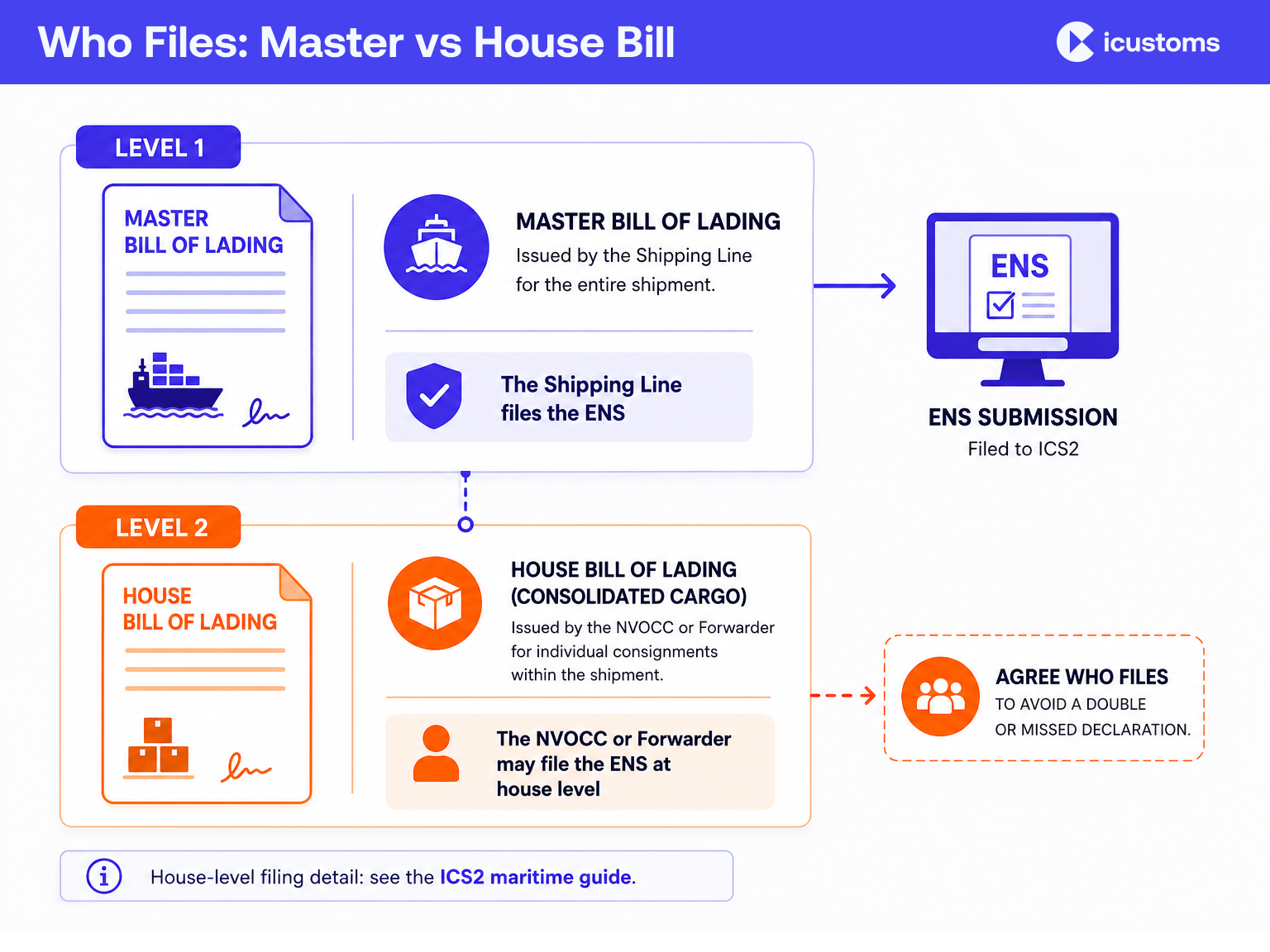
For sea freight into Great Britain, the shipping line that issued the bill of lading is responsible for the S&S GB Entry Summary Declaration.
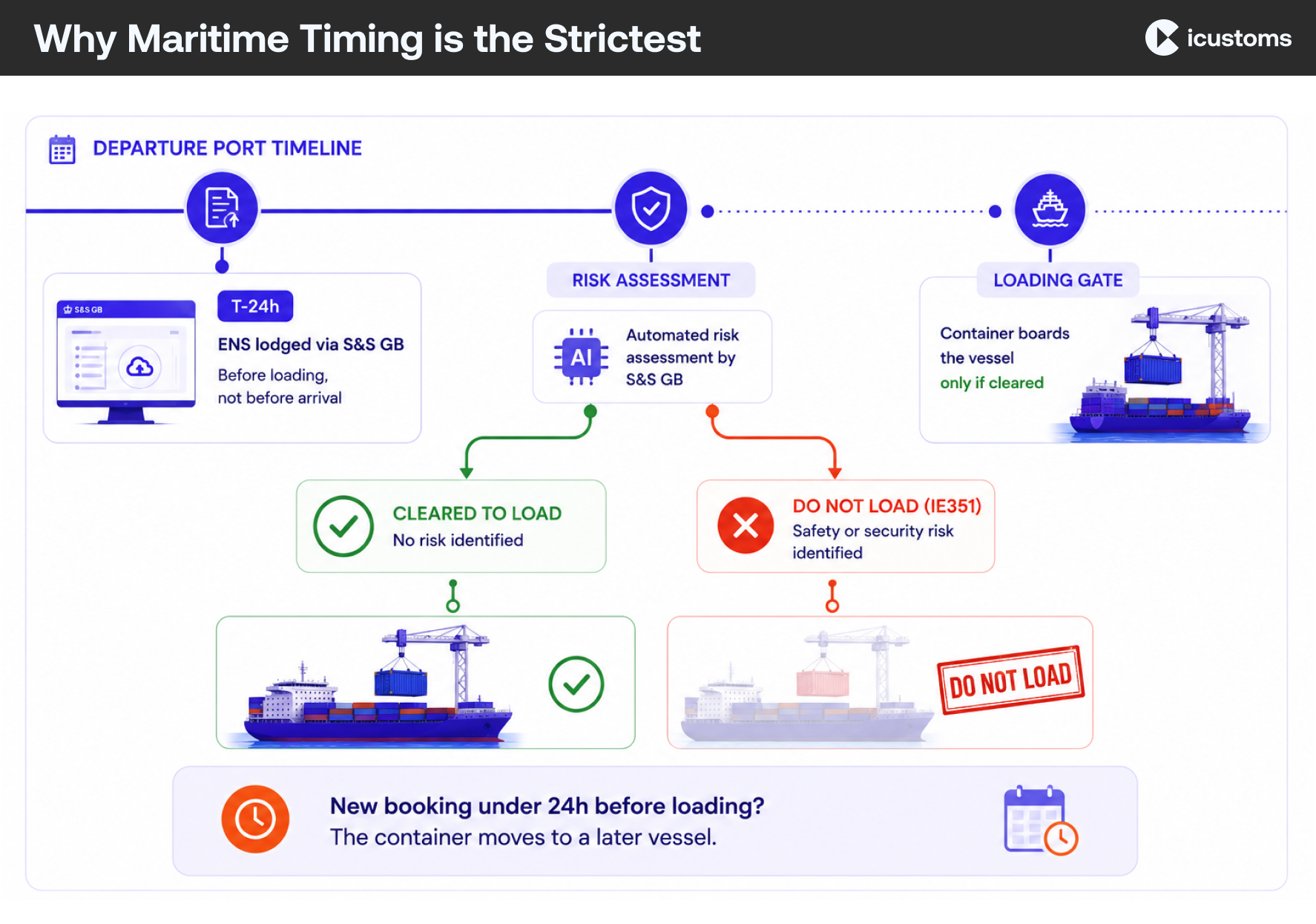
Maritime has the strictest timing of any mode: for deep-sea containerised cargo the ENS must be lodged 24 hours before loading at the port of departure, not before arrival.
This is the maritime view of ENS for shipping lines and agents. For the full cluster, start with our S&S GB ENS pillar guide.
Who files the ENS for sea freight?
The carrier is the shipping company that contracted and issued the bill of lading, and the legal duty to lodge the ENS sits with them. On consolidated cargo carried under house bills of lading, the NVOCC or forwarder may file at house level, and the arrangement should be agreed in advance so a shipment is not filed twice or missed. Our ICS2 maritime house-level filing guide covers house-level filing in detail.
Maritime ENS deadlines
| Maritime Service | ENS Deadline (Minimum) |
|---|---|
| Deep-sea containerised cargo | At least 24 hours before loading at the port of departure |
| Bulk or break-bulk cargo | At least 4 hours before arrival |
| Short sea journeys | At least 2 hours before arrival |
Deep-sea containerised is measured against loading, not arrival, which makes it the earliest deadline in the whole regime. For a new booking made less than 24 hours before loading, the carrier must move the cargo to a later vessel. The full mode table is in our ENS deadlines by transport mode guide.
The "do not load" message: why maritime timing is strict
The 24-hour-before-loading rule exists so customs can screen a container before it is put on the vessel. For deep-sea containerised shipments, the system can issue a “do not load” message, an IE351 advanced intervention, to whoever submitted the declaration. Border Force then tells you what to do with the affected container, identified by its container and transport document numbers. No other mode has a pre-loading stop like this, which is why accurate, early filing matters most at sea.
Short sea vs deep sea
Short sea journeys use the 2-hour-before-arrival rule and cover routes from the English Channel and the Atlantic coast of Europe up to Algeciras, plus Norway, Ireland, the Faroe Islands, Iceland, and Baltic and North Sea ports. Deep-sea containerised traffic from further afield follows the 24-hour-before-loading rule. Knowing which category a route falls into decides your deadline.
S&S GB vs ICS2 for maritime
Goods entering Great Britain are declared through S&S GB. Goods entering the EU use ICS2, which applies the same maritime time limits but has its own house-level filing rules for consignments under house bills of lading. A carrier serving both markets needs to meet both sets of obligations.
After you file: the MRN and risk assessment
Once the declaration passes validation, S&S GB issues a Movement Reference Number as proof it was accepted, and the consignment is risk assessed. For deep-sea containers, that assessment can result in a do-not-load instruction, so treat the MRN as a checkpoint, not a formality. You can amend a declaration until the goods arrive if details such as the vessel or arrival change, but the original must still have been lodged on time. The ENS is separate from the customs entry used for duty and VAT, so filing it does not clear the goods for import.
How iENS helps shipping lines and agents
At maritime volumes, the ENS is a data and deadline problem. iENS from iCustoms reads the shipping documents, validates the data, and files through S&S GB or ICS2 well before the loading cut-off, returning the MRN and flagging any intervention early. See how it works on the iENS Entry Summary Declaration page.
Frequently Asked Questions
What is the ENS deadline for sea freight?
For deep-sea containerised cargo, at least 24 hours before loading at the port of departure. Bulk or break bulk cargo is 4 hours before arrival, and short sea journeys are 2 hours before arrival.
Who files the ENS for maritime shipments?
The shipping line that issued the bill of lading. On house bill consignments, the NVOCC or forwarder may file at house level by prior arrangement.
What is a "do not load" message?
An IE351 advanced intervention that customs can issue for deep-sea containerised cargo, instructing that a container should not be loaded onto the vessel until Border Force advises otherwise.
Does short sea shipping use the 24-hour rule?
No. Short sea journeys use the 2-hour-before-arrival rule for both containerised and non-containerised cargo. The 24-hour-before-loading rule applies to deep-sea containerised traffic.
Do I need GVMS as well as an ENS?
Usually yes for road. You create a Goods Movement Reference in GVMS to cross. Adding the ENS MRN to the GMR is optional for Great Britain and required for Northern Ireland.
You may also like:
Struggling to Extract, Catagorise & Validate Your Documents?

Capture & Upload Data in Seconds with AI & Machine Learning
Subscribe to our Newsletter
About iCustoms
iCustoms is an all-in-one solution helping businesses automate customs processes more efficiently. With AI-powered and machine-learning capabilities, iCustoms is designed to streamline your all customs procedures in a few minutes, cut additional costs and save time.
Struggling to Extract, Catagorise & Validate Your Documents?
Capture & Upload Data in Seconds with AI & Machine Learning