

TSS EIDR Explained: How Entry in Declarant's Records Works
- John Hall
- Customs Specialist at iCustoms.ai
EIDR, Entry in Declarant’s Records, is one of two ways to make the initial declaration under the Simplified Customs Declaration Process through TSS: instead of submitting anything at the border, you record the movement in your own commercial records at the time it happens, then file a supplementary declaration afterwards. TSS can create and submit the EIDR on your behalf, but you stay responsible for making sure what it contains is correct.
This guide covers what EIDR is, who can use it, how a movement runs from record to supplementary declaration, and two distinctions worth getting straight: EIDR against the TSS Simplified Procedure, and EIDR against UKIMS-EIDR.
What EIDR is, in practice
EIDR lets a trader make the initial declaration in their own books rather than lodging anything with customs upfront. It is restricted to standard, non-controlled goods: current TSS guidance is explicit that EIDR cannot be used for controlled goods, which need a full or simplified declaration instead.
TSS can create the EIDR entry for you, using its own built-in Simplified Customs Declaration Process authorisation, or you can bring your own and add it to your TSS Company Profile. Either way, the responsibility for accuracy sits with you: TSS’s own guidance says plainly that you are responsible for making sure the information in the simplified declaration or EIDR is correct, even where TSS submitted it on your behalf.
EIDR at a glance
| Question / Answer | |
|---|---|
| What it is | A record made in your own commercial records at the time of movement, standing in for an upfront declaration |
| Who can use it | Traders moving standard, non-controlled goods, using TSS’s built-in authorisation or their own |
| What you still owe | A supplementary declaration, due by the 10th calendar day of the month after the movement |
| What it does not cover | Controlled goods, which need a full or simplified declaration instead of EIDR |
| Where it sits | One of two initial declaration formats under the Simplified Customs Declaration Process; the other is a simplified frontier declaration |
| Who is responsible for accuracy | The trader, even when TSS creates and submits the entry |
EIDR vs the TSS Simplified Procedure: not the same route
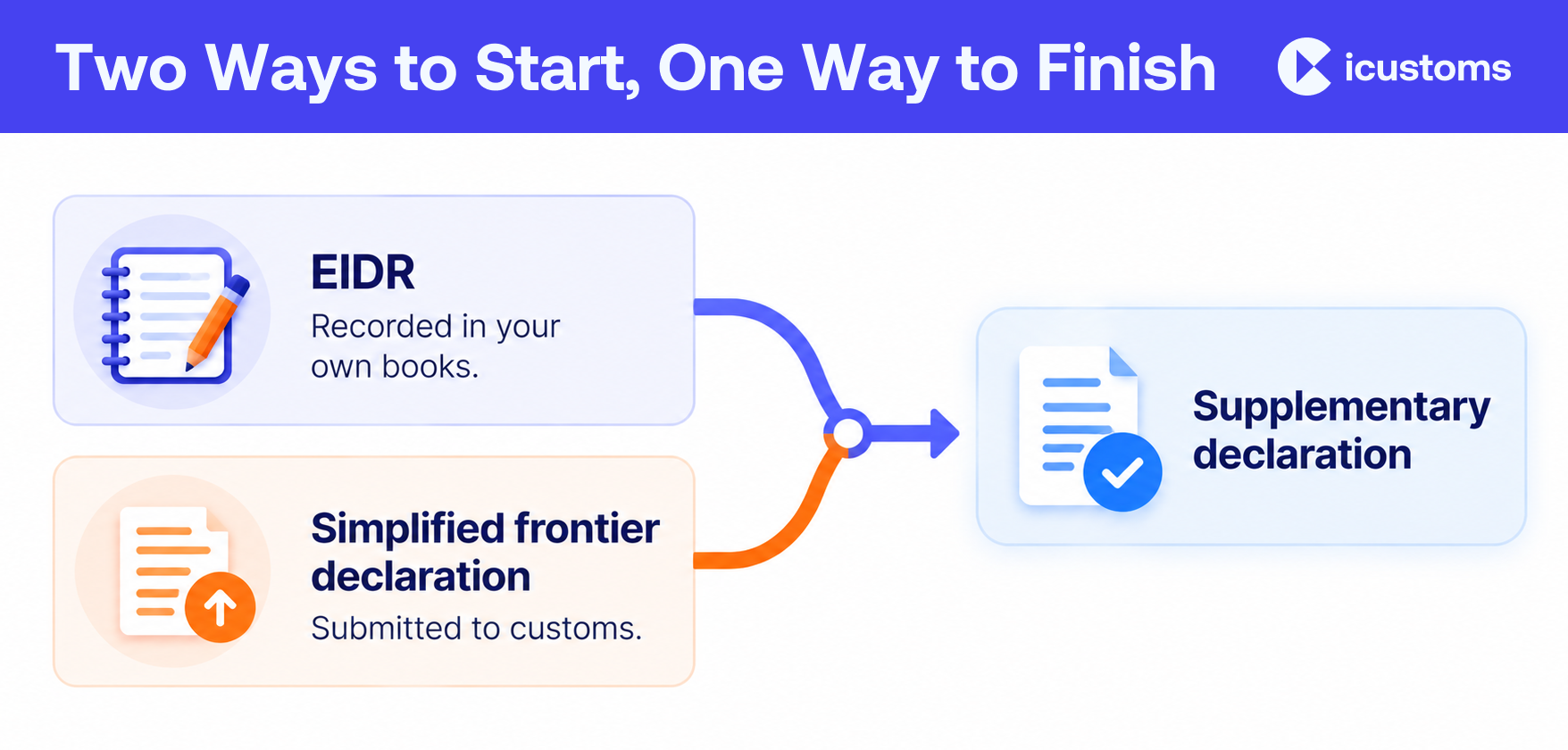
The TSS Simplified Procedure, covered in full in our guide to TSS declaration types, pairs a simplified frontier declaration with a supplementary declaration. It is one of two ways to make the initial declaration under the Simplified Customs Declaration Process; EIDR is the other. Both routes end the same way, with a supplementary declaration carrying the full data set. The difference is entirely in the first step: submit a simplified frontier declaration to customs, or keep the record yourself in EIDR and submit nothing upfront. For the simplified frontier declaration walkthrough itself, see TSS declarations explained; this guide stays with the EIDR route.
EIDR vs UKIMS-EIDR: same acronym, different authorisation
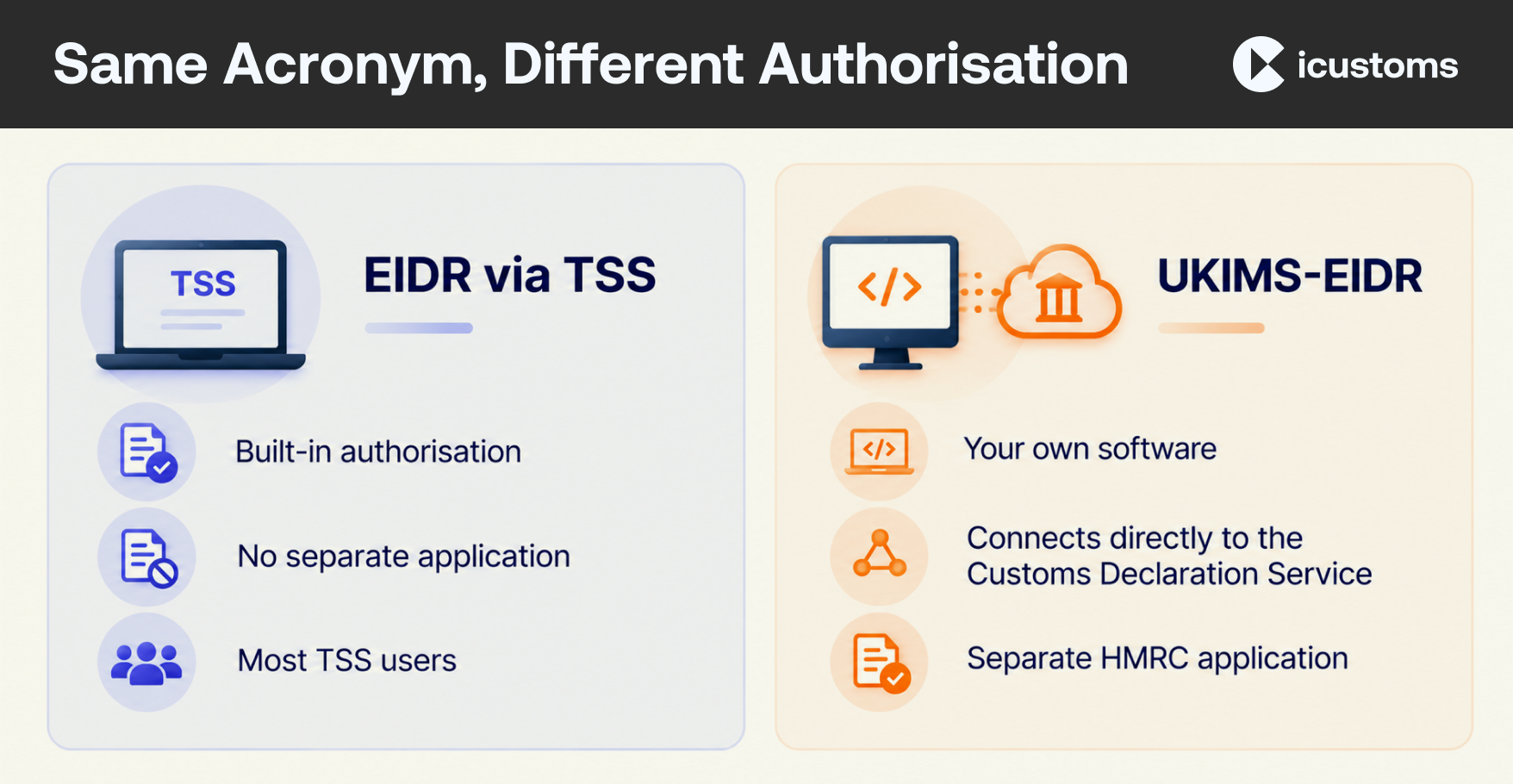
UKIMS-EIDR is a separate, standalone HMRC authorisation, not the same thing as the EIDR TSS provides by default. It lets a trader’s own systems talk directly to the Customs Declaration Service to record Internal Market movements, without going through TSS at all. Applying for it means holding current UKIMS authorisation first, being established in Northern Ireland with an XI EORI number, naming a compliance contact, and having software HMRC can test for compatibility with the Customs Declaration Service.
The detail that matters for most TSS users: current guidance says explicitly that you do not need to apply for UKIMS-EIDR if you use the Trader Support Service. TSS’s own EIDR provision already covers eligible Internal Market movements, so UKIMS-EIDR is aimed at businesses handling declarations through their own software instead. If you use TSS, the route in this guide is almost certainly the one that applies to you.
Who can use EIDR, and what you need
- Goods must be standard, non-controlled goods. Controlled goods are excluded outright.
- You need an EORI number and an authorisation: TSS’s own built-in Simplified Customs Declaration Process authorisation covers most users, or you can add your own.
- You need the ability to keep accurate commercial records, because that record is the declaration until the supplementary declaration is filed.
Bringing your own authorisation instead of using TSS’s means meeting HMRC’s standard Simplified Customs Declaration Process eligibility: UK establishment, documented procedures and controls, an EORI number, and security for customs duty through a deferment account. Most TSS users never deal with this directly, since TSS’s own authorisation stands in.
How an EIDR movement works, step by step
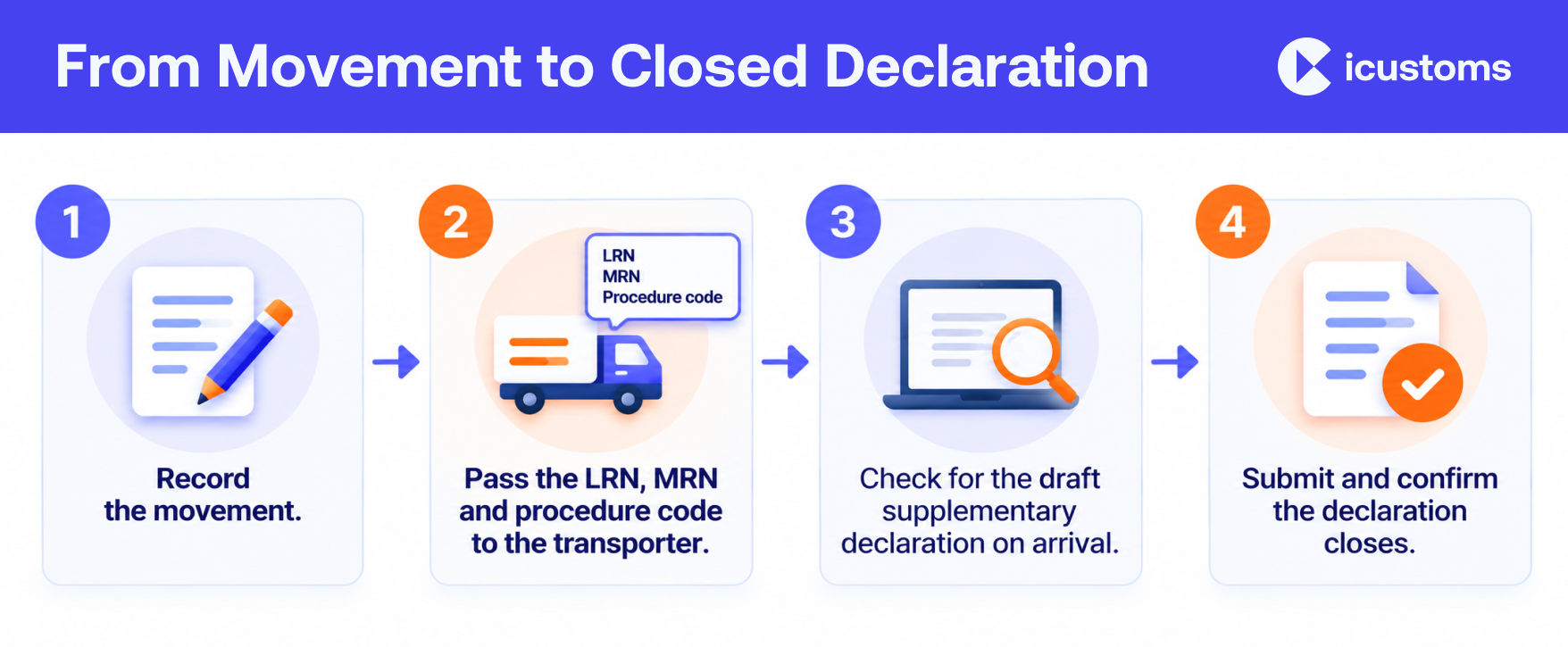
- Record the movement in your own records at the time it happens, and submit the EIDR through TSS before or at the point of movement.
- Give the transporter the Local Reference Number, the Movement Reference Number and the procedure code, so they can confirm Notification of Presentation when creating a goods movement reference on GVMS.
- When the goods arrive in Northern Ireland, check your account for a draft supplementary declaration.
- Gather the supplementary declaration details: parties, goods and transport information, drawn from commercial invoices, packing lists and transport documents. Some fields are pre-filled by TSS from your EIDR.
- Submit the supplementary declaration by the 10th calendar day of the month after the movement. Goods moved on 5 March, for example, need their supplementary declaration by 10 April.
- Check the declaration closes. If it shows Trader Input Required or Amendment Required, correct the errors and resubmit; if it shows Pending Payment, pay any duty due before it can close.
TSS handles the routine parts of steps two and four where you have asked it to, but the checks in steps three and six are yours to make.
Who does what: trader, transporter, intermediary
| Action | Trader | Transporter | Intermediary |
|---|---|---|---|
| Provide the LRN, MRN and procedure code to the transporter | Yes | No | Yes, when acting for the trader |
| Check for a draft supplementary declaration on arrival | Yes | No | Yes, when acting for the trader |
| Gather the supplementary declaration details | Yes | Yes | Yes, when acting for the trader |
| Check the declaration closes and pay any duty due | Yes | No | Yes, when acting for the trader |
EIDR and the entry summary declaration
Moving goods to Northern Ireland also needs an entry summary declaration for safety and security, covered in depth in our guide to TSS and entry summary declarations. You can complete your EIDR alongside it, as part of the same consignment. If you created the EIDR yourself, give the haulier or intermediary handling the entry summary declaration the Local Reference Number TSS generated when you saved the form.
Common misconceptions
EIDR removes the need for a supplementary declaration. It does not. EIDR defers the paperwork, and a supplementary declaration is still due by the 10th calendar day of the following month.
EIDR and UKIMS-EIDR are the same thing. They are not. EIDR is what TSS provides by default for eligible standard goods. UKIMS-EIDR is a separate HMRC authorisation for businesses connecting their own software directly to the Customs Declaration Service, and TSS users typically do not need to apply for it.
EIDR works for any goods. It does not. Controlled goods are excluded outright and need a full or simplified declaration.
Because TSS can create the EIDR, TSS carries the responsibility for it. It does not. The trader is responsible for the record’s accuracy even when TSS submits it on their behalf.
Frequently Asked Questions
What is EIDR?
Entry in Declarant's Records. It lets a trader record a movement in their own commercial records at the time it happens, rather than submitting a declaration to customs upfront, with a supplementary declaration following afterwards.
What does EIDR stand for?
Entry in Declarant's Records.
Do I use a simplified declaration procedure or an EIDR?
For standard, non-controlled goods, EIDR is usually the lighter option, since nothing is submitted to customs upfront. A simplified frontier declaration is the other route, submitted before or at the point of movement. Both end with a supplementary declaration.
What is the difference between EIDR and SDP?
SDP, the Simplified Declarations Procedure, is the umbrella authorisation. EIDR and the simplified frontier declaration are the two ways to make the initial declaration under it.
Is EIDR the same as the TSS Simplified Procedure?
No. The TSS Simplified Procedure refers to the simplified frontier declaration paired with a supplementary declaration. EIDR is the alternative: a record kept in your own systems rather than a submission to customs.
What is UKIMS-EIDR and how is it different from EIDR?
UKIMS-EIDR is a separate HMRC authorisation that lets a trader's own software connect directly to the Customs Declaration Service to record Internal Market movements, without using TSS. If you use TSS, its own built-in EIDR authorisation already covers eligible movements, and current guidance says you do not need to apply for UKIMS-EIDR separately.
Does the EU require EIDR for EU imports?
No. EIDR is part of the UK's Simplified Customs Declaration Process, used through TSS for Great Britain to Northern Ireland movements. Importing into the EU itself follows the EU's own rules under the Union Customs Code, a separate regime that TSS does not handle.
Can I use EIDR for controlled goods?
No. Controlled goods are excluded outright and need a full or simplified declaration, not an EIDR.
What happens if I miss the supplementary declaration deadline?
The declaration remains outstanding past the 10th calendar day deadline, which is a compliance issue in its own right. Submit as soon as you can, and fix whatever caused the delay.
You may also like:
Chasing EIDR Supplementary Deadlines?

iCustoms tracks every EIDR movement’s 10th-day deadline automatically, across every client.
Subscribe to our Newsletter
About iCustoms
iCustoms is an all-in-one solution helping businesses automate customs processes more efficiently. With AI-powered and machine-learning capabilities, iCustoms is designed to streamline your all customs procedures in a few minutes, cut additional costs and save time.
See EIDR and Supplementary Declarations Linked Automatically
Turn trade documents into structured declaration data with intelligent automation.