
TRACES Classic vs TRACES NT: What Changed and Why It Matters
- John Hall
- Customs Specialist at iCustoms.ai
EU TRACES NT is the current version of the Trade Control and Expert System, launched in 2017 and the only version in operation since the Commission decommissioned TRACES Classic in 2022. If you certify animals, plants, food or feed for the EU market today, TRACES NT is where it happens.
Yet plenty of guidance, supplier instructions and internal SOPs still reference the old system. Therefore, this guide sets out exactly what changed between the two platforms, why the European Commission replaced Classic, and what the shift means in practice for importers, customs brokers and freight forwarders.
What is EU TRACES NT?
TRACES NT (New Technology) is the European Commission’s online platform for sanitary and phytosanitary certification, managed by DG SANTE. Under the Official Controls Regulation (EU) 2017/625, it forms a core component of IMSOC, the Information Management System for Official Controls, alongside iRASFF, ADIS and EUROPHYT.
Today, more than 113,000 users across 90+ countries work in TRACES NT, and the platform handled over 5.4 million official documents in 2024. Access is free of charge and requires only an EU Login account, as our TRACES registration guide explains step by step.
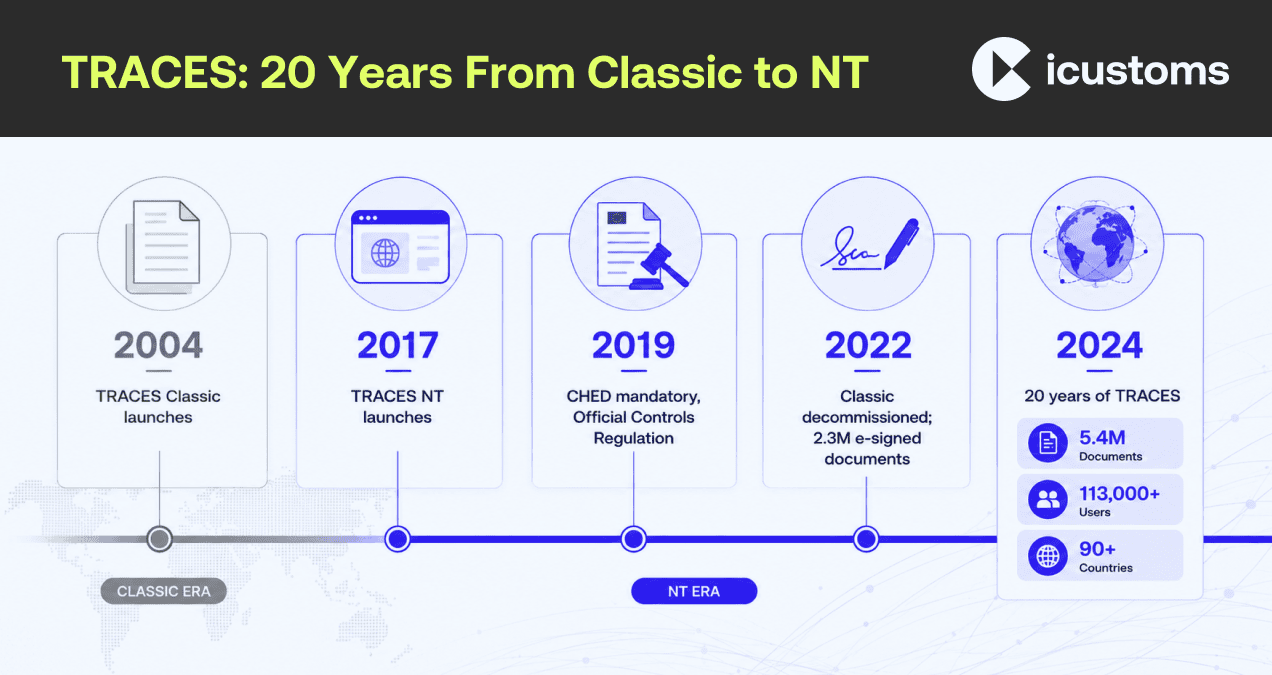
From TRACES Classic to TRACES NT: the timeline
The system’s history explains its design. After the 1997 classical swine fever outbreak exposed how slowly paper certificates moved, the Commission merged its ANIMO and SHIFT systems into a single platform, named Traces under Decision 2003/623/EC.
| Year | Milestone |
|---|---|
| 2004 | TRACES Classic launches to manage intra-EU animal movements and imports from non-EU countries. |
| 2006 | The IMPORT module extends electronic certification and controls for consignments arriving from non-EU countries. |
| 2013 | The platform expands to support plant health controls, and QlikView analytics are introduced for reporting and monitoring. |
| 2017 | TRACES NT launches with a modern interface, improved workflows, and broader regulatory coverage. |
| 2019 | The Official Controls Regulation expands the system’s scope, and the Common Health Entry Document (CHED) becomes mandatory from 14 December. |
| 2022 | TRACES Classic is officially decommissioned, all operations transition to TRACES NT, and more than 2.3 million documents are electronically signed during the year. |
| 2024 | TRACES marks its 20th anniversary, and Qlik Sense replaces QlikView as the platform’s analytics solution. |
Why was TRACES Classic replaced?
Three pressures made replacement inevitable. First, the technology dated from the early 2000s and could not support modern demands such as electronic signatures and system-to-system exchange. Second, the 2019 Official Controls Regulation widened official controls to every category of goods at border control posts, far beyond Classic’s veterinary origins. Third, the Commission’s paperless-trade agenda needed a platform built for fully digital certification rather than printed forms with digital copies.
EU TRACES NT vs TRACES Classic: what actually changed
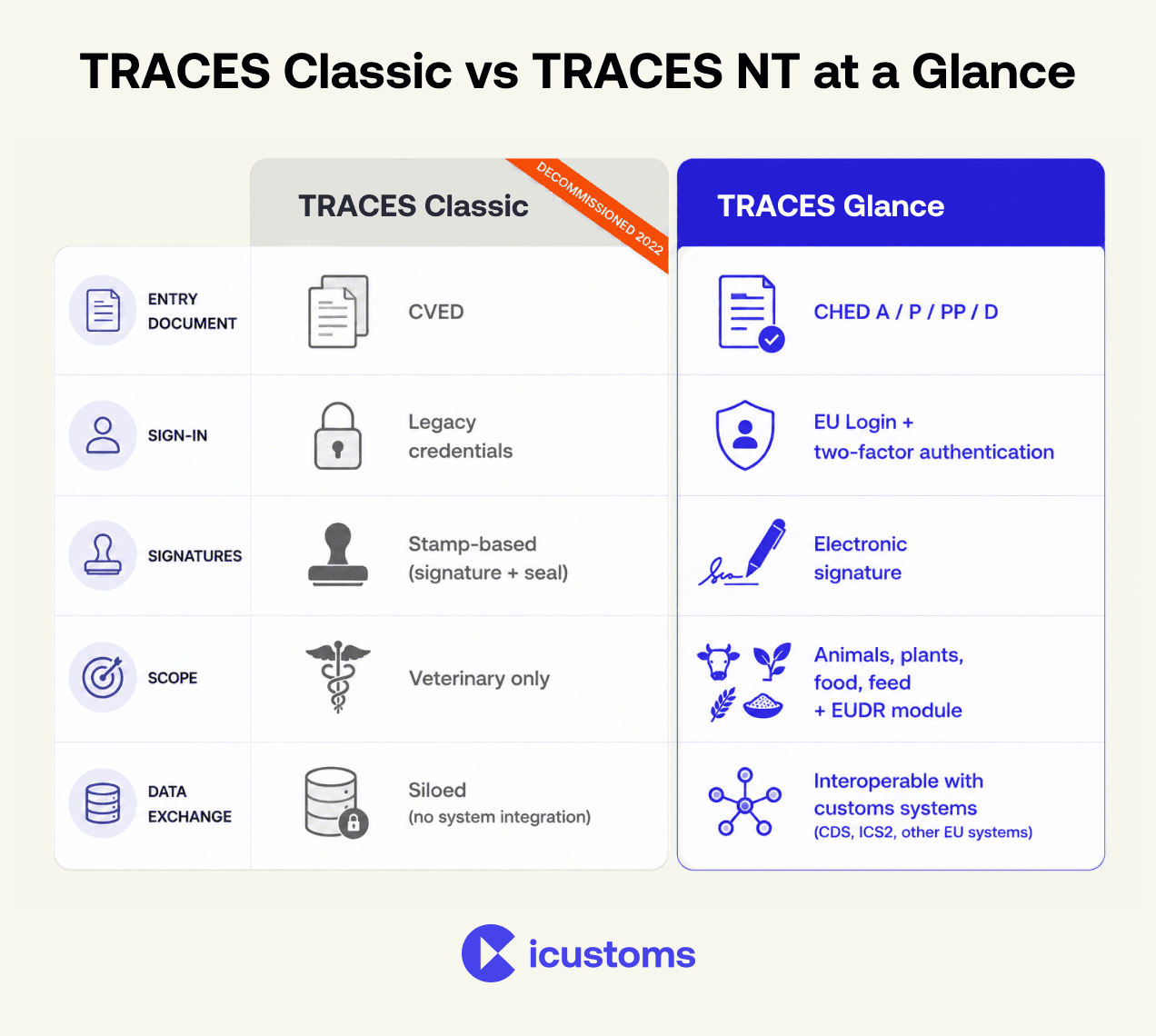
| Aspect | TRACES Classic (2004–2022) | TRACES NT (2017–Today) |
|---|---|---|
| Entry Document | CVED (Common Veterinary Entry Document). | CHED available in four types: CHED-A, CHED-P, CHED-PP, and CHED-D. |
| Sign-in | System-specific user credentials. | EU Login with two-factor authentication (2FA). |
| Scope | Primarily focused on veterinary movements and controls. | Supports animals, animal products, plants, food and feed, plus additional modules such as PHYTO and EUDR. |
| Signatures | Printed, signed, and stamped paper documents. | Free electronic signatures with legal recognition across the EU. |
| Interface | Early-2000s form-based interface. | Modern browser-based interface available in all official EU languages. |
| Data Exchange | Limited integration with external systems. | Interoperable with customs IT systems, iRASFF, and other EU digital platforms. |
| Analytics | QlikView analytics (introduced in 2013). | Qlik Sense dashboards with flexible filtering and trade data analysis. |
The changes that matter day to day
- CVED became CHED: if a supplier document still says CVED, it predates 2019 and needs updating
- Electronic certification: e-signed certificates replace wet-ink paper, cutting courier time out of clearance
- A cloning tool: certificates transform into entry documents without re-typing the same consignment data
- Real-time visibility: every party sees border decisions as they are recorded, creating a shared audit trail
What the change means for traders
For importers, brokers and forwarders, TRACES NT genuinely reduced friction: certificates move at connection speed, decisions are visible without phone calls, and one platform covers products that once needed separate processes. Consequently, clearance is faster wherever the data is right.
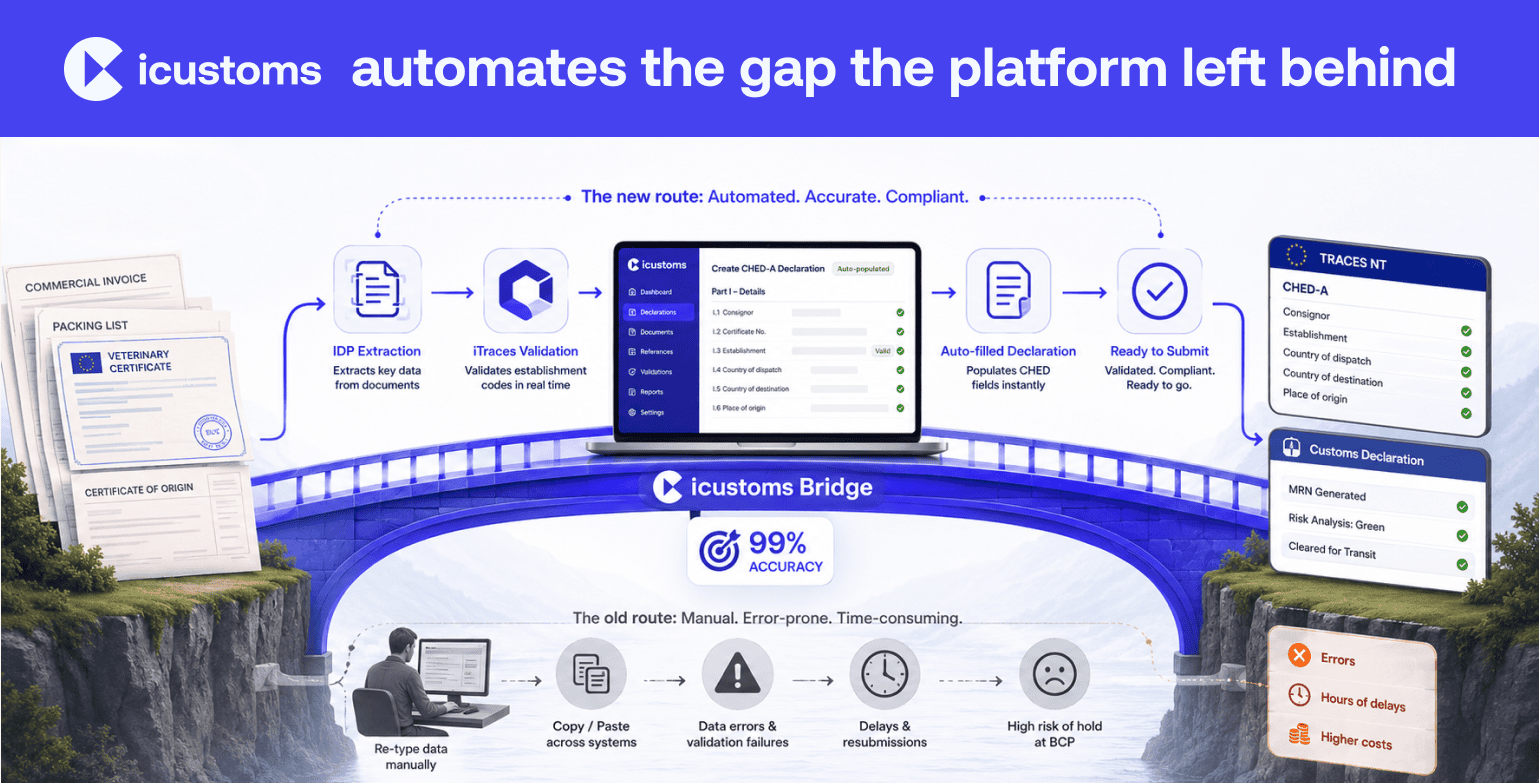
However, the platform did not remove manual work; it relocated it. Someone still types consignment details, certificate numbers and establishment codes into CHEDs, and someone still checks that codes match the official lists. TRACES NT digitised certification; it never promised to digitise your data entry. That remaining gap is where most border holds are born, and where automation earns its keep.
Still Re-Keying Data into TRACES NT?
iCustoms extracts document data, validates establishment codes and files declarations automatically around TRACES.
Why choose iCustoms alongside EU TRACES NT
Think of iCustoms as the automation layer around the EU’s systems. Intelligent Document Processing extracts and validates trade document data with 99% accuracy, so CHED and declaration fields stop depending on tired eyes and copy-paste. iTraces checks every establishment code against the official TRACES EU database in bulk, catching delistings before booking. And iCustoms files customs declarations across the UK, Ireland and 22 EU nations, keeping TRACES references and customs data consistent end to end.
The result mirrors the Commission’s own modernisation logic: less paper, fewer manual touches, full audit trails. iCustoms customers cut manual effort by 80% and manage exceptions instead of emergencies.
The future: digital trade beyond TRACES NT
The direction of travel is unmistakable. TRACES NT now hosts the EUDR TRACES workflow, ICS2 reshapes safety filings, and paperless certification keeps expanding. Each new system multiplies the data flows between your documents and your declarations, which is precisely why logistics leaders such as Kerry Logistics, Ziegler and Woodside Logistics Group run their operations on the iCustoms AI platform, with iClassification and API integration connecting the pieces. Digital customs infrastructure is no longer optional; the only choice is whether you build the habits now or after the next held consignment.
Ready for What Comes After TRACES Classic?
Book a demo and see how iCustoms automates the data work that TRACES NT still leaves on your desk.
Frequently Asked Questions
What is TRACES NT?
TRACES NT (New Technology) is the European Commission's current platform for sanitary and phytosanitary certification of animals, plants, food and feed. Launched in 2017, it operates under the Official Controls Regulation (EU) 2017/625 as part of IMSOC.
What happened to TRACES Classic?
The Commission decommissioned TRACES Classic in 2022 and moved all operations to TRACES NT. The original 2004 platform no longer exists, so any process still referencing it needs updating.
When was TRACES NT introduced?
TRACES NT launched in 2017 and ran alongside Classic during a phased migration. From 2022 it became the only platform, and that year users signed over 2.3 million documents electronically.
What is the difference between CVED and CHED?
The CVED was TRACES Classic's veterinary entry document. TRACES NT replaced it with the Common Health Entry Document (CHED) in four types: CHED-A for live animals, CHED-P for animal products, CHED-PP for plants and CHED-D for non-animal food and feed.
Is TRACES NT mandatory?
Yes, for regulated goods. Since 14 December 2019, CHEDs for animals and goods entering the EU must be issued through TRACES NT under the Official Controls Regulation.
Can customs software integrate with TRACES NT workflows?
Yes. Although TRACES NT is the official certification platform, software such as iCustoms automates the surrounding work: extracting document data, validating establishment codes with iTraces, and filing customs declarations, so the data entering TRACES is right the first time.
You may also like:
Struggling to Extract, Catagorise & Validate Your Documents?

Capture & Upload Data in Seconds with AI & Machine Learning
Subscribe to our Newsletter
About iCustoms
iCustoms is an all-in-one solution helping businesses automate customs processes more efficiently. With AI-powered and machine-learning capabilities, iCustoms is designed to streamline your all customs procedures in a few minutes, cut additional costs and save time.
Struggling to Extract, Catagorise & Validate Your Documents?
Capture & Upload Data in Seconds with AI & Machine Learning