
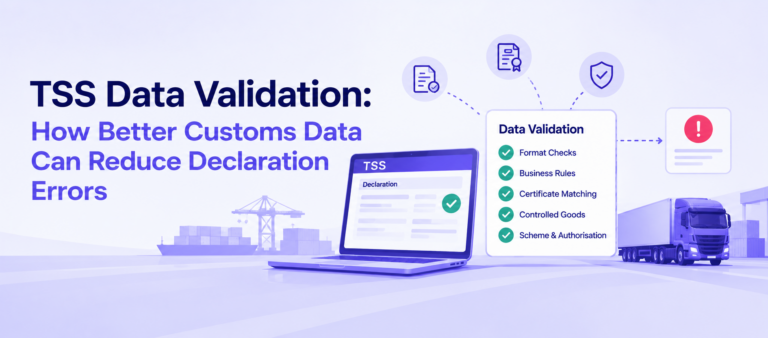
TSS for B2B Parcels: What Businesses Need to Know About Northern Ireland Movements
- John Hall
- Customs Specialist at iCustoms.ai
A parcel sent from one business to another business in Northern Ireland is a B2B parcel movement, and since 1 May 2025 it has followed its own arrangements under the Windsor Framework, separate from freight and separate from parcels sent to private consumers. Whether it needs a full customs declaration, or can move without one, comes down to a single question: does UKIMS authorisation cover it.
This guide covers what counts as a B2B parcel movement, the checklist for getting a sending business ready, which goods qualify under UKIMS, how to get an EORI number, and the options for getting the parcel actually declared.
What counts as a B2B parcel movement
Parcel movements from Great Britain to Northern Ireland fall into three categories, and each follows different rules. A parcel from a business to a private individual for personal use needs no customs declaration at all, though some of these movements still need an entry summary declaration for safety and security. Correspondence, such as letters and printed matter, sits outside the rules entirely. A parcel between two businesses, or between two private individuals, follows a different set of arrangements again; this article covers the business-to-business case.
The distinction matters because the answer to almost every other question, whether a declaration is needed, whether UKIMS helps, what your carrier needs from you, depends on getting this classification right first.
B2B parcels at a glance
| Question | Answer |
|---|---|
| What is it | A parcel sent by one business to another business in Northern Ireland, not to a private consumer |
| What decides if a full declaration is needed | Whether the sending or receiving business holds UKIMS authorisation and the goods qualify as not at risk |
| Who can hold UKIMS | Either the sending business or the receiving business; only one side needs to |
| Where it is declared | Through TSS, a parcel carrier’s own service, or a customs intermediary |
| Does it need an entry summary declaration | Sometimes; check the parcel-specific guidance rather than applying your freight rule |
| What happens without UKIMS | Full customs processes apply, as they would for freight, and EU-rate duty may be due |
The UKIMS route: moving parcels without a full declaration
Some goods qualify as not at risk without any authorisation at all, purely on the duty rate involved. Goods already in free circulation in Great Britain qualify if the applicable EU duty rate on them is zero. Goods entering from outside the EU or UK qualify if the UK duty rate is at least as high as the EU rate, or does not fall more than three percentage points short of it.
Where the gap is wider than that, or the EU rate is not zero, the duty-rate test does not clear the goods on its own. That is where UKIMS becomes relevant, not before.
The UKIMS route: not at risk despite the duty rate
Either the sending business or the receiving business can hold UKIMS authorisation; the movement only needs one of them to. Once one side holds it, eligible parcels can move without a full international customs declaration and without duty, provided the goods are not at risk of moving on to the EU and are for sale to, or final use by, end consumers in the UK. Eligibility for UKIMS itself, and how to apply, is covered in full in UKIMS and TSS; the at-risk test behind it is covered in TSS and Customs Duty.
Whichever side holds the authorisation is responsible for keeping evidence, for five years, that the goods stayed within the UK. A written agreement with the other business confirming UK-only destination is one accepted form of that evidence.
What happens if the parcel doesn't move under UKIMS
Where neither business holds UKIMS, or the goods don’t meet its conditions, the parcel follows the same full customs processes as a freight movement, and duty may be due at the applicable EU rate. Waiver schemes, reliefs and repayment of duty already paid can still apply in some circumstances, on the same basis they would for any other at-risk movement.
The B2B parcel checklist for sending businesses
Getting ready to send B2B parcels comes down to a short sequence of decisions and admin, most of which only needs doing once.
- Work out whether each parcel is going to a business or a private consumer in Northern Ireland. This is the step most businesses get wrong first, because the rules genuinely differ.
- Agree with the receiving business which side’s UKIMS authorisation the movement will use; you only need one side to hold it.
- If your business will hold the authorisation, check you meet the eligibility conditions and apply for UKIMS.
- Confirm the goods are not at risk of moving on to the EU and are for sale to, or final use by, UK end consumers.
- Get the right EORI number: an XI number if your business is established or has a fixed place of business in Northern Ireland, otherwise a GB number.
- Decide how the parcel will be declared: through TSS, your carrier’s own service, or a customs intermediary.
- Tell your parcel carrier or express operator which movements are B2B and which are consumer parcels; the two are handled differently and carriers need to know which is which.
- Give your carrier the UKIMS authorisation number and the associated EORI number so they can complete the movement.
- Keep the evidence your UKIMS declaration relies on, in case HMRC asks for it later.
Choosing how to declare: TSS, your carrier, or an agent
Sending businesses have three practical options for getting a B2B parcel declared, and they aren’t mutually exclusive across a business’s different carriers or lanes.
- Sign up for TSS. It’s free to use, and if you already move freight from Great Britain to Northern Ireland, the same account handles parcels.
- Use your courier or express operator’s own service. Some parcel carriers complete the declaration for you as part of door-to-door delivery, so you may not need to touch TSS directly, though you’ll still need to give them what they ask for.
- Hire a customs intermediary or agent, or use a training provider to bring the work in-house. GOV.UK maintains a register of customs agents and express operators if you’d rather not handle declarations yourself.
Businesses that already declare through UKIMS-EIDR, using their own software rather than TSS, can apply the same UKIMS conditions to parcel movements; TSS EIDR Explained covers how that route differs from TSS.
How TSS fits into a B2B parcel movement
Once a parcel movement is declared through TSS, it follows the same declaration types available to any other movement: Internal Market Movement Information for goods that qualify under UKIMS, covered in TSS and IMMI, or a full declaration where they don’t. Goods still need to be categorised as Standard, Category 1 or Category 2 the same way they would for freight; TSS Declarations Explained covers that categorisation in full, and it isn’t repeated here.
TSS collects what a parcel movement needs and routes it to the correct process; it doesn’t decide UKIMS eligibility or the at-risk status of the goods on your behalf. That judgement, and the evidence behind it, stays with whichever business holds the authorisation.
How TSS fits into the decision
TSS does not make the at-risk decision for you. It is where the decision gets declared, using the Additional Information code covered in UKIMS and TSS, and where the supporting Trader Goods Profile and IMMI or declaration data come together. The judgement itself, and the evidence behind it, remains the trader’s responsibility.
TSS is free to use directly. Some businesses choose to hire a customs intermediary or agent to handle the declaration and the at-risk assessment on their behalf instead, particularly where volumes are high or the goods categories are mixed. That is a business choice about who does the work, not a different set of rules: whoever submits the declaration is applying the same duty-rate, UKIMS and processing conditions set out above.
Common Misapprehension
All parcels to Northern Ireland need a customs declaration. They don’t. Parcels to private consumers for personal use generally need none at all; it’s the B2B and private-to-private categories that carry their own rules.
Both businesses need to hold UKIMS. They don’t. Only one side of the movement, sender or receiver, needs the authorisation for the parcel to benefit from the simplified process.
Using a courier means you don’t need to think about customs. Not necessarily. Some carriers complete declarations as part of their service, but you still need to tell them whether a movement is B2B, get the right EORI number, and supply your UKIMS details.
B2B parcels are treated like consumer parcels. They aren’t. Business-to-business movements that don’t move under UKIMS follow the same full customs processes as freight, including potential EU-rate duty.
Frequently Asked Questions
What is a B2B parcel movement to Northern Ireland?
A parcel sent from one business to another business in Northern Ireland, as distinct from a parcel to a private consumer or between private individuals, each of which follows different rules.
What's the checklist for getting ready to move B2B parcels?
Classify each parcel correctly, agree who holds UKIMS, apply for it if that's your business, confirm the goods are not at risk, get the right EORI number, decide how you'll declare, and give your carrier your UKIMS and EORI details.
Which goods are eligible for UKIMS when sent as B2B parcels?
Goods that are not at risk of moving on to the EU and are for sale to, or final use by, end consumers located in the UK, moved by a business that holds, or whose counterparty holds, UKIMS authorisation.
What steps does a sending business need to take?
Work through the checklist above once, then repeat the classification and evidence steps for each new movement; the EORI number and UKIMS authorisation, once obtained, cover future parcels.
What do I need to check before I move goods?
Whether the movement needs a declaration at all, and whether an entry summary declaration is required before the goods arrive; only some parcel movements need one, so check the parcel-specific guidance rather than your freight rule.
Do I have to use TSS for B2B parcels?
No. You can use TSS, rely on your carrier's own declaration service, or hire a customs intermediary or agent. TSS is free and is the most straightforward option if you already use it for freight.
Can my courier or express operator deal with customs for me?
Often, yes. Some parcel carriers complete declarations as part of their service, though you still need to classify the movement correctly and supply your UKIMS and EORI details.
Do I need an EORI number to send B2B parcels?
Yes. Use an XI EORI number if your business is established or has a fixed place of business in Northern Ireland, otherwise a GB EORI number.
What happens if my parcel doesn't move under UKIMS?
It follows the same full customs processes as a freight movement, and EU-rate duty may be due, though waivers, reliefs or repayment can still apply in some circumstances.
How does iCustoms help with TSS B2B parcel movements?
iCustoms checks UKIMS eligibility and the not-at-risk conditions against your goods data, flags what your carrier will need, and keeps the EORI and evidence records together with the declaration, rather than across separate spreadsheets and emails.
You may also like:
Sending B2B Parcels to Northern Ireland?

iCustoms checks UKIMS eligibility and the paperwork your carrier needs, before you ship.
Subscribe to our Newsletter
About iCustoms
iCustoms is an all-in-one solution helping businesses automate customs processes more efficiently. With AI-powered and machine-learning capabilities, iCustoms is designed to streamline your all customs procedures in a few minutes, cut additional costs and save time.
Turn the B2B Parcel Checklist Into One Step
iCustoms handles the UKIMS check, the EORI details and the declaration together.