

EUDR TRACES Compliance: A Guide for UK-EU Traders and Hauliers
- John Hall
- Customs Specialist at iCustoms.ai
EUDR TRACES compliance means proving, through the EU’s digital systems, that the commodities you place on the EU market are deforestation-free under Regulation (EU) 2023/1115. For UK-EU traders, the countdown is real: after two delays, the EU Deforestation Regulation applies to large and medium operators from 30 December 2026, and the due diligence evidence flows through an EU information system connected to the TRACES environment.
Confusingly, TRACES also runs a completely separate workflow for establishment codes and health certificates. Many traders mix the two up, and that confusion causes real compliance mistakes. Therefore, this guide covers both what EUDR requires and how it differs from the classic TRACES checks you may already perform.
What is the EUDR?
The EU Deforestation Regulation, formally Regulation (EU) 2023/1115 on deforestation-free products, was adopted in 2023 and repeals the EU Timber Regulation (EUTR). Its objective is blunt: products consumed in the EU should not contribute to deforestation or forest degradation anywhere in the world. In addition, the EU expects the rules to cut carbon emissions linked to these commodities by at least 32 million tonnes per year.
Under the EUDR law, any operator or trader who places the covered commodities on the EU market, or exports them from it, must prove the products do not originate from recently deforested land. Crucially for UK businesses, that includes non-EU exporters selling into the EU.
Which commodities are in scope?
| Commodity | Derived Products (Examples) |
|---|---|
| Cattle | Beef, leather, hides, and other cattle-derived products. |
| Wood | Timber, furniture, paper, charcoal, plywood, and wood-based products. |
| Cocoa | Chocolate, cocoa butter, cocoa powder, and confectionery products. |
| Soy | Soybean meal, tofu, soy flour, soy protein, and animal feed ingredients. |
| Palm Oil | Food products, cosmetics, soaps, detergents, biodiesel, and oleochemicals. |
| Coffee | Roasted coffee, ground coffee, instant coffee, and coffee extracts. |
| Rubber | Tyres, gloves, seals, hoses, and other natural rubber products. |
Scope is defined by HS code in Annex I of the Regulation. Consequently, correct product classification is the very first EUDR compliance step: if you misclassify a product, you may miss an obligation entirely or carry compliance costs you do not owe.
EUDR deadlines after the delays
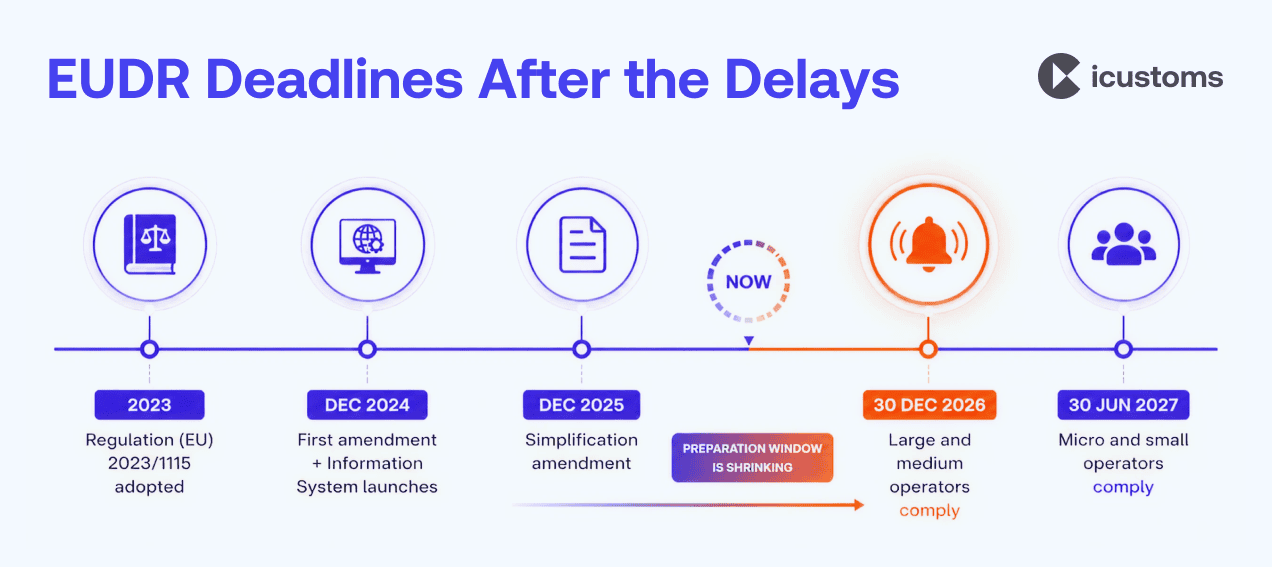
The EUDR delay has been one of the most searched compliance topics of the past two years. Following amendments in December 2024 and December 2025, which also introduced simplification measures to reduce administrative burden, the entry into application now stands as follows.
| Business Size | EUDR Applies From |
|---|---|
| Large and medium operators | 30 December 2026 |
| Micro and small operators | 30 June 2027 |
| Micro and small operators already covered by the EUTR | 30 December 2026 |
In practice, that leaves large and medium traders under six months from now. Supply chain data collection, especially geolocation of production plots, takes far longer than most businesses expect, so the preparation window is effectively already open.
How EUDR compliance runs through the EU's systems
EUDR evidence is digital from end to end. The Commission launched the EUDR Information System on 4 December 2024, with registration open since November 2024, and it operates within the same EU ecosystem as TRACES NT. This is where due diligence statements are filed and where their reference numbers are issued.
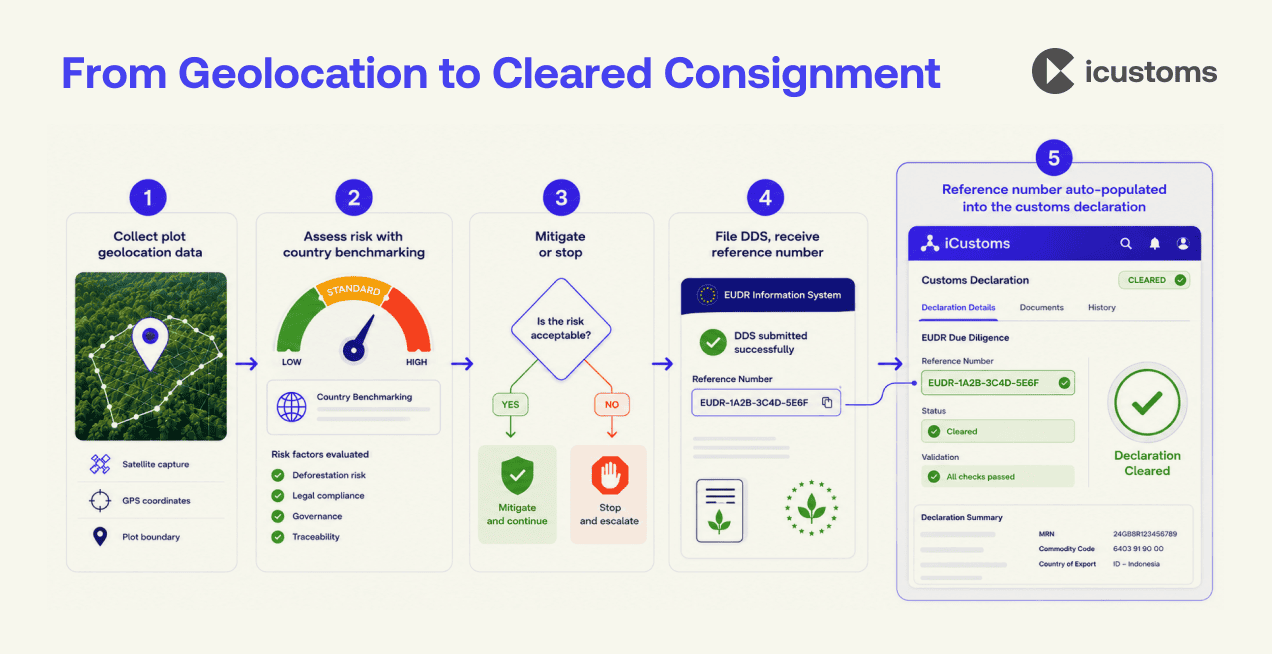
The due diligence statement (DDS), step by step
- Step 1: Collect supply chain data, including the geolocation coordinates of every plot of land where the commodity was produced.
- Step 2: Assess deforestation risk using the country benchmarking classification and supplier evidence.
- Step 3: Mitigate any risk that is not negligible, or do not place the product on the market.
- Step 4: Submit the DDS in the EUDR Information System and receive a DDS reference number.
- Step 5: Quote that reference number in the customs declaration, because customs authorities check it at import and export.
Step 5 is where EUDR meets your customs workflow. A missing or mismatched DDS reference on the declaration stops the consignment just as surely as a missing health certificate does. For hauliers, that means goods held at the border through no fault of the driver, so forwarding and haulage teams need visibility of DDS status before wheels move.
EUDR TRACES vs classic TRACES: two different jobs
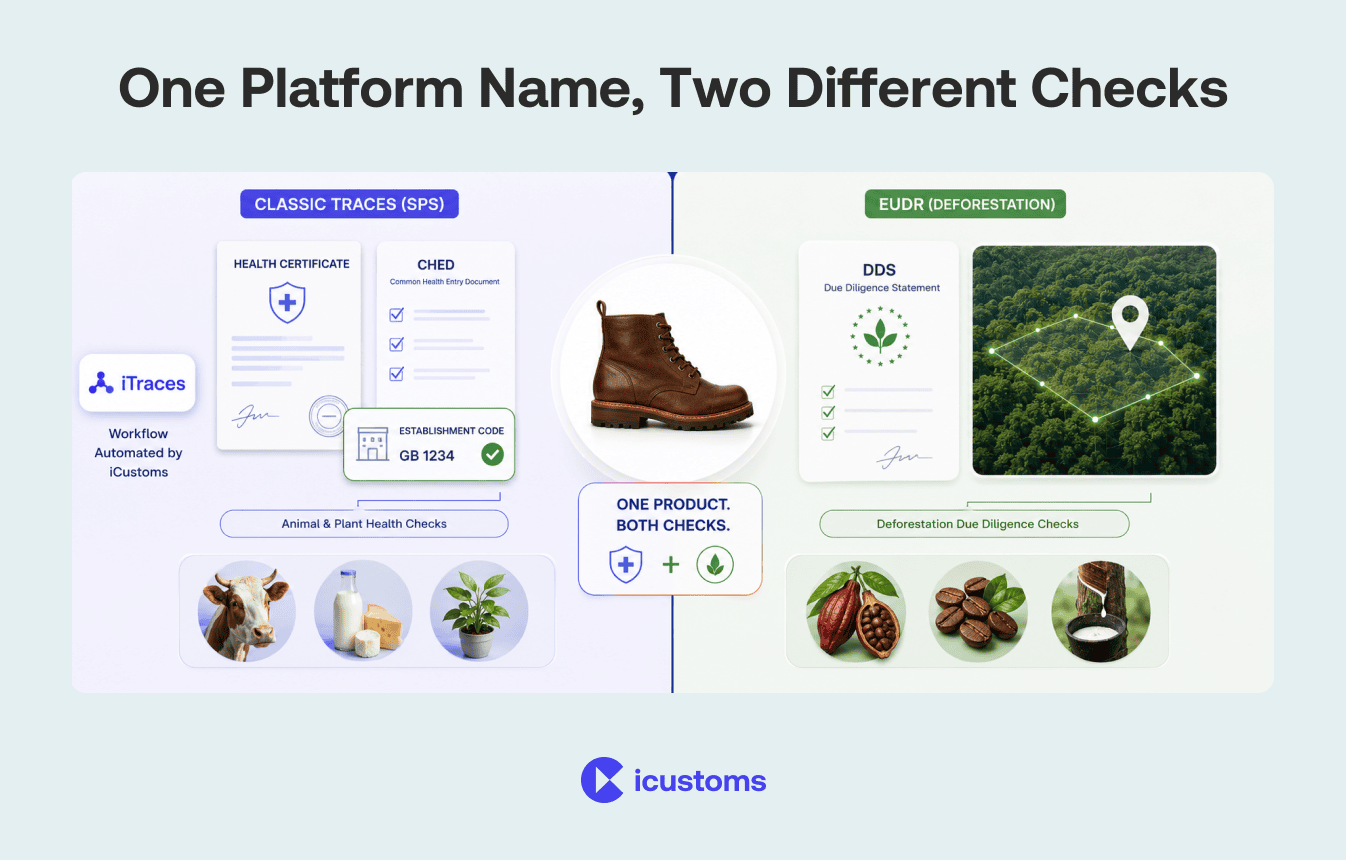
Here is the distinction that trips up so many traders. TRACES has certified animal, plant and food movements for two decades. The EUDR workflow is new, sits alongside it, and does something entirely different. Treating them as one system leads to wrong assumptions about what has been checked.
| Aspect | Classic TRACES (SPS) | EUDR Workflow |
|---|---|---|
| Purpose | Health and safety certification for animals, plants, food, and feed entering or moving within the EU. | Demonstrates that regulated commodities are deforestation-free before being placed on or exported from the EU market. |
| Key Document | Health certificates and the Common Health Entry Document (CHED). | Due Diligence Statement (DDS). |
| Key Data | Establishment approval codes, health certificates, and SPS documentation. | Geolocation coordinates of production plots and supporting due diligence information. |
| Legal Basis | Regulation (EU) 2017/625. | Regulation (EU) 2023/1115. |
| Applies To | Animal-origin products, plants, food, and feed subject to sanitary and phytosanitary (SPS) controls. | Cattle, wood, cocoa, soy, palm oil, coffee, rubber, and products derived from these commodities. |
One consignment can need both. For example, leather (a cattle derivative) may require establishment code checks under the SPS rules and a DDS under the EUDR. In other words, passing one check says nothing about the other.
Country benchmarking and the EUDR risk list
An Implementing Regulation classifies producer countries as low, standard or high risk for deforestation. The classification matters commercially: sourcing from low-risk countries allows simplified due diligence, whilst high-risk sourcing attracts enhanced scrutiny and a higher share of official checks. Consequently, the EUDR risk list now belongs in sourcing decisions, not just compliance reviews.
What UK-EU traders and hauliers should do now
- Map your scope: check your product HS codes against Annex I; classification decides everything downstream
- Chase geolocation data early: suppliers rarely hold plot coordinates in a usable format on the first request
- Assign responsibility: agree with your EU customers who files the DDS, because both operators and traders carry obligations
- Connect DDS to declarations: build the reference number into your customs data flow before the deadline, not after the first held lorry
- Brief your hauliers: drivers and transport planners need to know a missing DDS reference stops the load
Still Managing EU Compliance Data Manually?
Automate declarations, document data and product classification with iCustoms before the EUDR deadlines land.
Where iCustoms fits in your EUDR readiness
iCustoms does not file your DDS; that duty stays with your business in the EUDR Information System. What iCustoms does is remove the manual work around it, which is where most EUDR errors will actually happen.
- Classification first: iClassification confirms HS codes across 32+ countries with AI, so you know precisely which products fall under Annex I
- Declarations with the DDS reference: iCustoms files customs declarations across the UK, Ireland and 22 EU nations, keeping reference data consistent between systems
- Document data without re-keying: Intelligent Document Processing extracts and verifies trade document data with 99% accuracy, so reference numbers do not get mistyped between PDF and declaration
And if your goods are animal-origin, iTraces covers the other TRACES workflow, validating establishment codes in bulk against the official EU database so the SPS side never holds you up either.
One platform as EU rules multiply
EUDR follows CBAM, ICS2 and the post-Brexit declaration regimes; each new rule adds another data flow between your documents and your declarations. iCustoms puts those flows on one AI platform, which is why logistics leaders such as Kerry Logistics, Ziegler and Woodside Logistics Group run their customs operations on it. As deadlines approach, the businesses that automate early will absorb EUDR with the least disruption.
EUDR Deadlines Are Under Six Months Away
Book a demo and see how iCustoms keeps your declarations, documents and classifications EUDR-ready.
Frequently Asked Questions
What is the EUDR in simple terms?
The EU Deforestation Regulation (Regulation (EU) 2023/1115) requires businesses placing cattle, wood, cocoa, soy, palm oil, coffee or rubber products on the EU market to prove the goods do not come from recently deforested land. Proof takes the form of a due diligence statement filed in the EU's Information System.
When does the EUDR apply?
After the December 2024 and December 2025 amendments, large and medium operators must comply from 30 December 2026. Micro and small operators follow from 30 June 2027, unless they were already covered by the EU Timber Regulation, in which case 30 December 2026 applies.
What is a due diligence statement (DDS)?
It is the digital declaration confirming you have collected geolocation data, assessed deforestation risk and found it negligible. The Information System issues a DDS reference number, which customs authorities check against your customs declaration.
Is EUDR the same as TRACES establishment codes?
No. Establishment codes prove a facility is approved for animal-origin products under EU health rules; the DDS proves commodities are deforestation-free. They are separate workflows, and one consignment can require both. iTraces from iCustoms automates the establishment code side.
What is EUDR country benchmarking?
The Commission classifies producer countries as low, standard or high deforestation risk. Low-risk sourcing qualifies for simplified due diligence, whilst high-risk sourcing faces enhanced checks, which makes the risk list a sourcing decision as much as a compliance one.
How should traders prepare for EUDR TRACES compliance?
Start with classification to confirm scope, gather supplier geolocation data early, and connect DDS reference numbers to your customs declarations. Automating that data flow with a platform such as iCustoms removes the re-keying errors that cause most border holds.
You may also like:
Struggling to Extract, Catagorise & Validate Your Documents?

Capture & Upload Data in Seconds with AI & Machine Learning
Subscribe to our Newsletter
About iCustoms
iCustoms is an all-in-one solution helping businesses automate customs processes more efficiently. With AI-powered and machine-learning capabilities, iCustoms is designed to streamline your all customs procedures in a few minutes, cut additional costs and save time.
Struggling to Extract, Catagorise & Validate Your Documents?
Capture & Upload Data in Seconds with AI & Machine Learning