
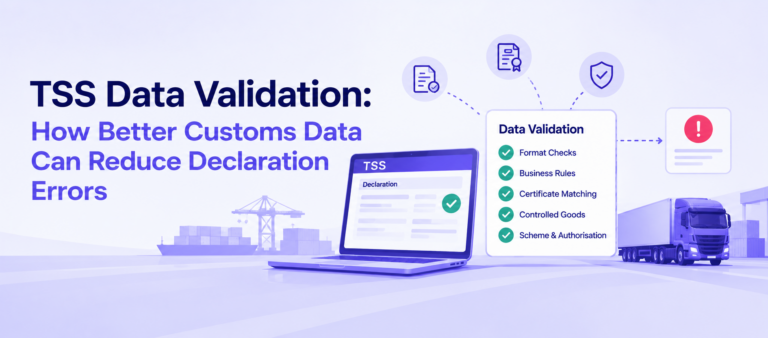
TSS and Customs Duty: How to Determine Whether Goods Are 'At Risk' or 'Not at Risk'
- John Hall
- Customs Specialist at iCustoms.ai
Goods moved from Great Britain to Northern Ireland are either ‘at risk’ of moving on into the EU, in which case the applicable EU rate of duty is charged, or ‘not at risk’, in which case no duty is due, or UK duty applies instead, depending on where the goods started. Which one applies is decided by a duty-rate test, or by holding UK Internal Market Scheme (UKIMS) authorisation, and it is not a status a business can simply assert.
This guide covers how the at-risk decision is actually made, what changes it for goods that are processed, when goods cannot be declared not at risk however UKIMS is held, what duty follows each outcome, and what evidence HMRC expects you to keep.
What 'at risk' and 'not at risk' actually mean
Goods are at risk if they may subsequently move on from Northern Ireland into the EU. At-risk goods are charged the applicable EU rate of duty, which in many cases is higher than the UK rate.
Goods are not at risk when they meet one of two tests: a duty-rate test that applies regardless of authorisation, or the conditions of the UK Internal Market Scheme. Depending on where the goods started, not-at-risk treatment means no duty at all, or UK duty rather than the EU rate.
At risk vs not at risk, at a glance
| Question | Answer |
|---|---|
| What decides it | A duty-rate test, or UKIMS authorisation and its conditions |
| At risk means | Charged the applicable EU rate of duty |
| Not at risk means | No duty (goods in free circulation from GB), or UK duty (goods from elsewhere) |
| Can you self-assert it | No; it rests on the test or authorisation, plus evidence you can produce if asked |
| Where it is declared | Through TSS, using the Additional Information code covered in UKIMS and TSS |
| How long to keep evidence | Five years, and accessible in the UK |
The duty-rate test: not at risk without needing UKIMS
Some goods qualify as not at risk without any authorisation at all, purely on the duty rate involved. Goods already in free circulation in Great Britain qualify if the applicable EU duty rate on them is zero. Goods entering from outside the EU or UK qualify if the UK duty rate is at least as high as the EU rate, or does not fall more than three percentage points short of it.
Where the gap is wider than that, or the EU rate is not zero, the duty-rate test does not clear the goods on its own. That is where UKIMS becomes relevant, not before.
The UKIMS route: not at risk despite the duty rate
Businesses holding UKIMS authorisation can declare eligible goods not at risk even where the duty-rate test alone would not clear them, provided the goods are for sale to, or final use by, end consumers in the UK, the importer holds the authorisation, and the goods are not subject to EU trade remedies such as anti-dumping duty. Eligibility for UKIMS itself, and how to apply for it, is covered in full in UKIMS and TSS; this article covers only what holding it unlocks for the at-risk decision.
Holding UKIMS is not, on its own, enough for every movement. Two further sets of conditions can still block a not-at-risk declaration: processing, and EU trade remedies.
Extra conditions for goods that are processed
Goods that will be processed in Northern Ireland before sale or use need to meet at least one further condition to qualify as not at risk, on top of everything above.
- The business’s annual turnover is under £2 million, or
- The goods are sheepmeat, poultry or beef imported under UK tariff rate quotas, or
- The processing is for an approved purpose: food for sale to UK end consumers, permanent construction, healthcare or care provision, non-profit activity without resale, or animal feed for final use in Northern Ireland.
Processed goods that meet none of these fall back to being treated as at risk, whatever the duty-rate test or UKIMS authorisation would otherwise suggest.
When goods cannot be declared not at risk
Three situations override everything else and keep goods at risk.
- The goods are processed and meet none of the additional conditions above.
- The goods enter from outside the EU or UK and the EU duty rate exceeds the UK rate by more than three percentage points.
- The goods are subject to EU trade remedies, such as anti-dumping or countervailing duty.
None of these can be worked around by holding UKIMS. They are hard stops, not conditions UKIMS authorisation offsets.
What happens next: duty and evidence
At-risk goods are charged the applicable EU rate of duty at the point of movement, through the declaration TSS submits. Not-at-risk goods either attract no duty, where they were already in free circulation in Great Britain, or UK duty, where they entered from outside the EU or UK; either way, the EU rate does not apply.
A not-at-risk declaration is not evidence in itself. HMRC expects supporting documentation kept for five years and accessible in the UK: commercial receipts and invoices, VAT invoices, commercial contracts, and, where relevant, customer declarations confirming Northern Ireland end use. Where goods are later found not to have met the conditions claimed, the business is liable for the EU-rate duty that should have been charged.
Other ways duty is reduced or avoided
The at-risk decision is not the only route to paying less duty, though it is the one most GB to NI movements rely on. Goods that meet UK rules of origin can claim preference under the UK-EU Trade and Cooperation Agreement instead. Previously exported goods returning to the UK can qualify for Returned Goods Relief. A Duty Reimbursement Scheme exists to claim back duty already paid where a movement later turns out to qualify for a lower rate. Customs special procedures, such as inward processing or customs warehousing, can suspend duty during storage or processing rather than avoiding it outright. Each of these is a distinct scheme with its own conditions, not an extension of the at-risk test covered here.
How TSS fits into the decision
TSS does not make the at-risk decision for you. It is where the decision gets declared, using the Additional Information code covered in UKIMS and TSS, and where the supporting Trader Goods Profile and IMMI or declaration data come together. The judgement itself, and the evidence behind it, remains the trader’s responsibility.
TSS is free to use directly. Some businesses choose to hire a customs intermediary or agent to handle the declaration and the at-risk assessment on their behalf instead, particularly where volumes are high or the goods categories are mixed. That is a business choice about who does the work, not a different set of rules: whoever submits the declaration is applying the same duty-rate, UKIMS and processing conditions set out above.
Common misconceptions
Not at risk is a status you can just declare. It is not. It rests on the duty-rate test or UKIMS authorisation and its conditions, backed by evidence you can produce if HMRC asks.
Holding UKIMS guarantees not-at-risk treatment. It does not. Processing conditions and EU trade remedies can still keep goods at risk even with UKIMS authorisation in place.
Not at risk always means no duty. It does not. Goods from outside the EU or UK that qualify as not at risk are charged UK duty, not zero duty; only GB-origin free-circulation goods pay nothing.
TSS decides whether goods are at risk. It does not. TSS is where the decision is declared and submitted; the assessment and the supporting evidence are the trader’s responsibility.
Frequently Asked Questions
What does at risk mean for NI goods?
It means the goods may move on from Northern Ireland into the EU, so they are charged the applicable EU rate of duty.
What does not at risk mean for NI goods?
It means the goods meet a duty-rate test or UKIMS authorisation and its conditions, so no duty is due, or UK duty applies instead of the EU rate, depending on where the goods started.
When can I declare goods not at risk?
When the applicable EU duty rate is zero on GB-origin goods in free circulation, when UK duty is at least as high as the EU rate (or within three percentage points) on goods from elsewhere, or when you hold UKIMS authorisation and the goods meet its conditions, including any processing requirements.
When can I not declare goods not at risk?
When the goods are processed and meet none of the additional conditions, when the EU duty rate exceeds the UK rate by more than three percentage points on non-GB-origin goods, or when the goods are subject to EU trade remedies.
What duty applies to at-risk goods?
The applicable EU rate of duty.
What duty applies to not-at-risk goods?
No duty, if the goods were already in free circulation in Great Britain, or UK duty, if they entered from outside the EU or UK.
Do I need UKIMS to declare goods not at risk?
Not always. The duty-rate test can clear goods without any authorisation. UKIMS becomes relevant when the duty-rate test alone would not clear them.
What extra conditions apply to processed goods?
At least one of: annual turnover under £2 million, the goods being sheepmeat, poultry or beef under UK tariff rate quotas, or the processing being for an approved purpose such as food for UK consumers, construction, healthcare, non-profit activity or animal feed.
What evidence do I need to keep?
Commercial receipts and invoices, VAT invoices, commercial contracts, and customer declarations confirming Northern Ireland end use, retained for five years and accessible in the UK.
Can TSS make the at-risk decision for me?
No. TSS is where the decision is declared, not where it is made. The assessment and its evidence remain the trader's responsibility, whether submitted directly or through an intermediary.
You may also like:
Guessing Goods at Risk Status by Hand?

iCustoms flags the at-risk decision and the evidence it needs, before you submit.
Subscribe to our Newsletter
About iCustoms
iCustoms is an all-in-one solution helping businesses automate customs processes more efficiently. With AI-powered and machine-learning capabilities, iCustoms is designed to streamline your all customs procedures in a few minutes, cut additional costs and save time.
See the At-Risk Test Run Automatically
Turn duty-rate checks and UKIMS conditions into a single automated decision.