
Which Products Need an Approved EU Establishment? HS Chapters 2-5, 15 and 16
- John Hall
- Customs Specialist at iCustoms.ai
If your goods contain material of animal origin, you almost certainly need an approved establishment for EU export. The rule spans HS chapters 2 to 5, 15 and 16: meat, fish, dairy, eggs, honey, animal fats and prepared foods, plus animal by-products such as gelatine and pet food ingredients. Every facility that produces, processes or stores these goods must appear on the EU’s official lists before the consignment can clear a border control post.
This guide maps the product categories chapter by chapter, covers the composite-product grey area that surprises most importers, and shows how to confirm both your classification and your supplier’s approval before you ship.
What is an approved EU establishment?
An approved establishment is a facility that a national competent authority has authorised to handle food of animal origin (Regulation (EC) 853/2004) or animal by-products (Regulation (EU) 1069/2009) destined for the EU market. Each facility receives an establishment approval number, published on the TRACES NT establishment lists by country and activity. Our guide to the TRACES establishment code covers the number itself in detail; this article focuses on which products trigger the requirement.
Which products need an approved establishment for EU export?
The table below maps the main HS chapters to the approval requirement. Treat it as a first filter, then confirm the specific commodity code, because chapter-level rules always carry exceptions.
| HS Chapter | Covers | Examples | Approval Needed? |
|---|---|---|---|
| 2 | Meat and edible meat offal | Beef, pork, poultry, and game meat | Yes, always |
| 3 | Fish and aquatic products | Fresh fish, crustaceans, and molluscs | Yes, always |
| 4 | Dairy produce, eggs, and natural honey | Milk, cheese, butter, eggs, and natural honey | Yes, always |
| 5 | Products of animal origin, not elsewhere specified or included (NESOI) | Hides, bristles, bones, and other animal by-products (ABPs) | Yes, where covered by animal by-product (ABP) rules |
| 15 | Animal fats and oils | Tallow, lard, fish oils, and similar products | Yes, for products of animal origin |
| 16 | Prepared meat, fish, and other aquatic food products | Sausages, canned tuna, pâtés, and prepared meals containing meat or fish | Yes, always |
Composite products: the grey area
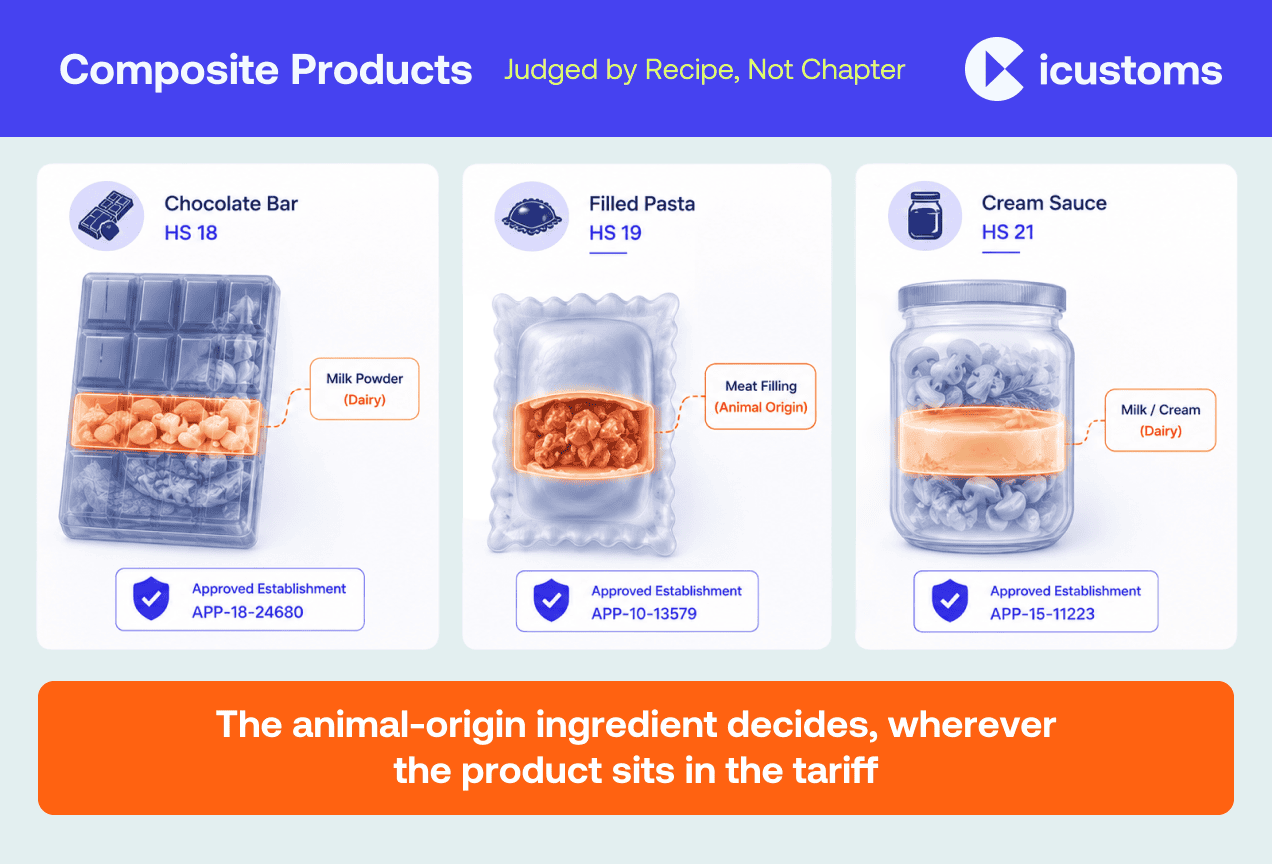
Composite products combine processed animal-origin ingredients with plant-based ones: chocolate with dairy, filled pasta, sauces with cream. Many sit outside chapters 2-16 entirely, for example chocolate in chapter 18, yet still carry establishment requirements for their animal-origin components. Consequently, you cannot judge by chapter alone; the recipe and the specific commodity code decide.
Animal by-products (ABP)
Products not intended for human consumption follow Regulation (EU) 1069/2009 instead: pet food ingredients, gelatine and collagen for technical uses, rendered fats, hides and processed proteins. These need establishments approved specifically for ABP activities, which is a separate listing from food approval. A supplier approved for edible meat is not automatically approved for pet food material.
Why the HS code decides everything
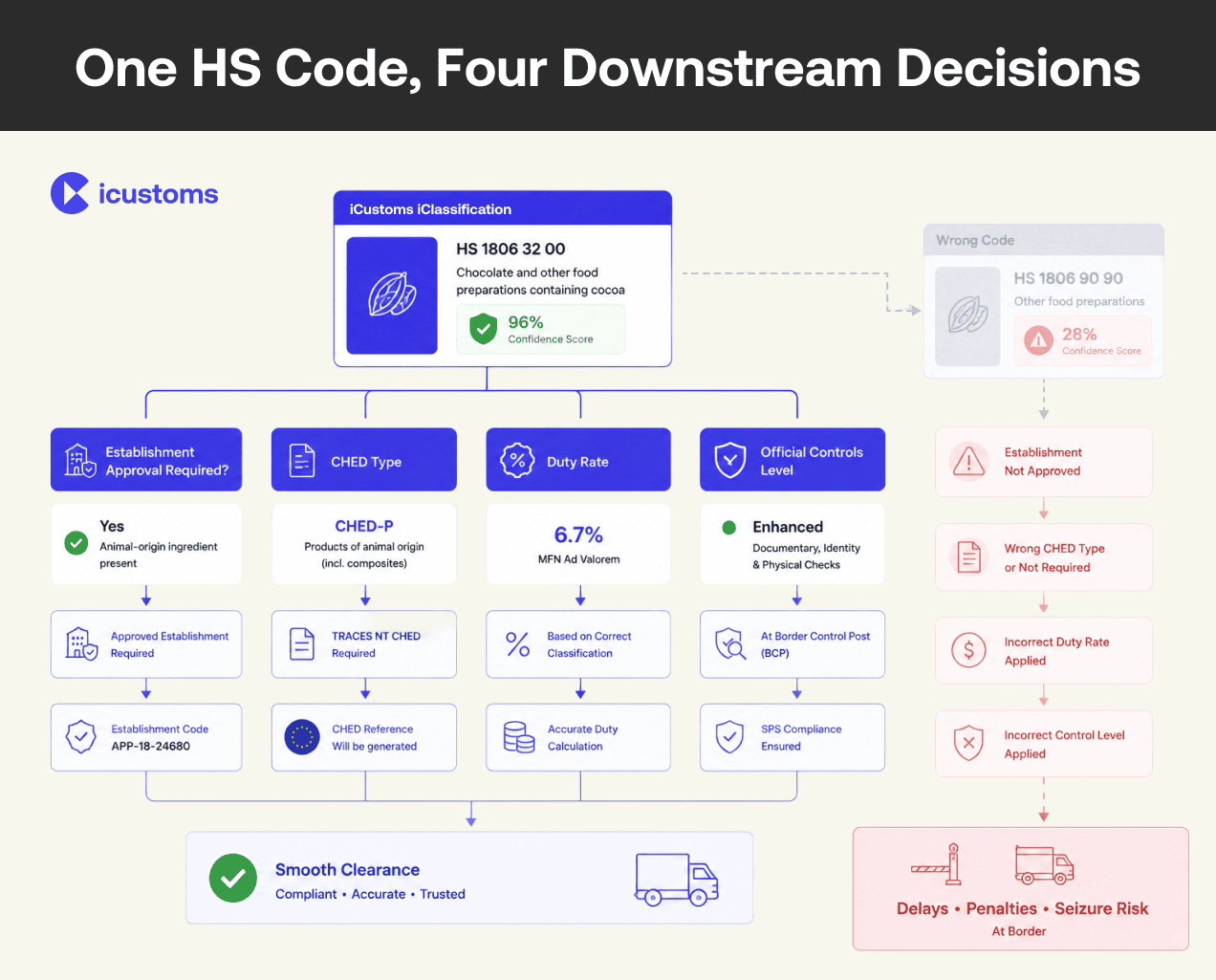
Classification sits upstream of every other compliance decision. The commodity code determines whether an establishment approval applies, which CHED type the consignment needs, what duty rate you pay, and which official controls it faces at the border control post under Regulation (EU) 2017/625.
Declare the wrong HS code and the errors cascade. A composite product misclassified as purely plant-based skips the establishment check it legally needs, and the border finds out before you do. In the other direction, over-cautious classification buys compliance costs you never owed. Neither mistake is rare: tariff classification across the Combined Nomenclature is genuinely hard, and manual lookups against thousands of codes invite it.
Still Classifying Products Manually? iClassification finds accurate HS codes with AI across 32+ countries, so the right rules apply from the start. |
How to check your product and supplier comply
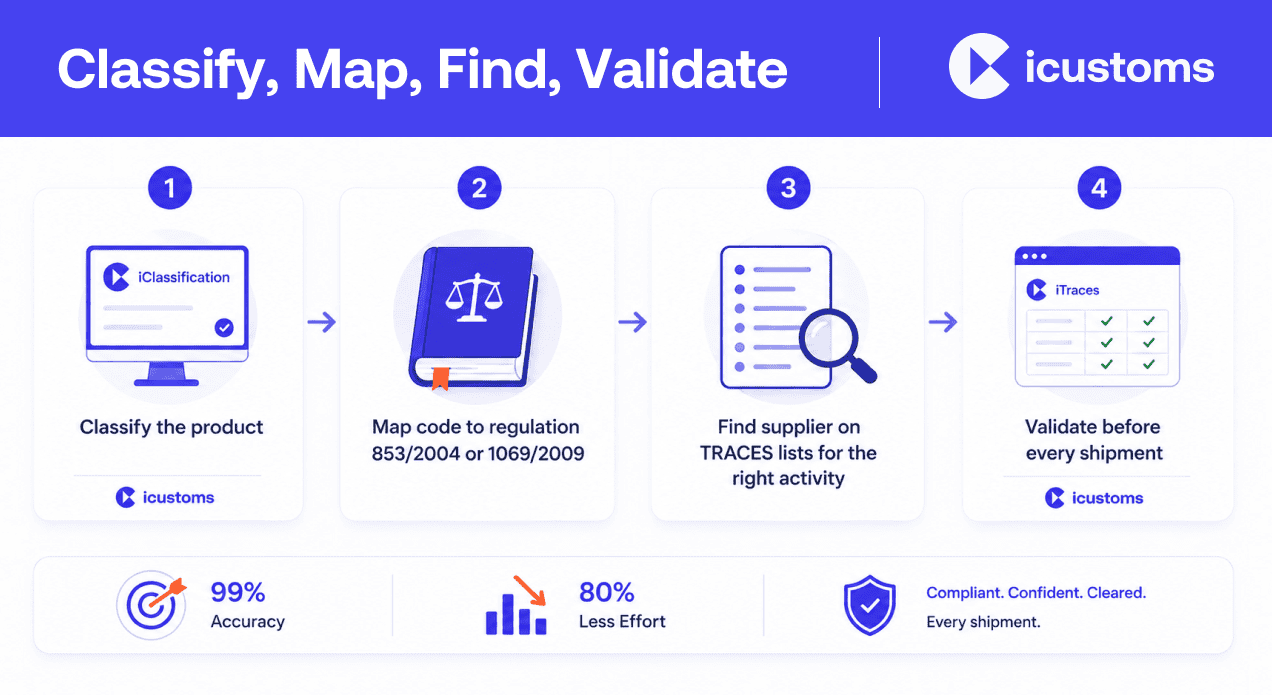
- Step 1: Classify the product properly. Confirm the commodity code first, including composite recipes; everything downstream depends on it.
- Step 2: Map the code to the requirement. Check whether the code falls under Regulation (EC) 853/2004 (food) or (EU) 1069/2009 (ABP).
- Step 3: Find the supplier on the TRACES lists. Verify the establishment appears for the exporting country and, crucially, for the right activity.
- Step 4: Validate before every shipment. Approvals change without notice, so re-check codes at booking, not once a year.
Steps 3 and 4 collapse from hours to seconds with automation, especially across a full catalogue of products and suppliers.
Why choose iCustoms for classification and approval checks
This topic is where two iCustoms tools meet. iClassification handles step 1: AI product classification across 32+ countries, with confidence scoring and an audit trail, so composite products land on the right commodity code instead of a guess. iTraces handles steps 3 and 4: bulk validation of every establishment code against the official TRACES EU database, with 99% accuracy and automatic flags for delisted or mismatched approvals.
Together they close the loop that manual processes leave open: the right code, checked against the right list, before every shipment. iCustoms customers cut manual compliance effort by 80% and stop discovering approval gaps at the border.
One platform from classification to clearance
Classification and establishment checks feed the same consignment as your documents and declarations, so iCustoms connects all of it: Intelligent Document Processing for document data, iTraces for codes, iClassification for tariffs, and customs filing across the UK, Ireland and 22 EU nations. Logistics leaders such as Kerry Logistics, Ziegler and Woodside Logistics Group run their compliance this way, with one AI platform instead of five spreadsheets.
Right Code, Right List, Every Shipment Book a demo and watch iCustoms classify your products and validate your suppliers in one workflow. |
Frequently Asked Questions
Which products require an approved EU establishment?
Products of animal origin across HS chapters 2-5, 15 and 16: meat, fish, dairy, eggs, honey, animal fats and prepared meat or fish. Composite products with animal-origin ingredients and animal by-products such as gelatine and pet food materials also qualify under their own rules.
Do dairy products require an establishment code?
Yes. Milk, cheese, butter and other chapter 4 dairy produce must come from establishments approved under Regulation (EC) 853/2004 and listed on the TRACES NT establishment lists for dairy activity.
What is an establishment approval number?
It is the unique number a national competent authority assigns to a facility approved to handle animal-origin products for the EU market. Officials verify it during the documentary check at the border control post.
How do I know if my HS code requires an approved establishment?
Classify the product accurately first, then check whether the code falls under the food hygiene or animal by-product regulations. AI classification tools such as iClassification from iCustoms settle the code, which settles the requirement.
What happens if the wrong HS code is declared?
The errors cascade: wrong CHED type, missed establishment checks, wrong duty. Misclassified consignments risk holds, penalties and back-payments, so classification accuracy is the cheapest insurance in the chain.
How do I verify a supplier's establishment approval?
Search the TRACES NT establishment lists for the exporting country and the exact activity, then re-validate before every shipment because approvals change without notice. iTraces from iCustoms automates this in bulk with 99% accuracy.
You may also like:
Struggling to Extract, Catagorise & Validate Your Documents?

Capture & Upload Data in Seconds with AI & Machine Learning
Subscribe to our Newsletter
About iCustoms
iCustoms is an all-in-one solution helping businesses automate customs processes more efficiently. With AI-powered and machine-learning capabilities, iCustoms is designed to streamline your all customs procedures in a few minutes, cut additional costs and save time.
Struggling to Extract, Catagorise & Validate Your Documents?
Capture & Upload Data in Seconds with AI & Machine Learning