IDP Software Integration: API, ERP & Workflow Automation Explained
- John Hall
- Customs Specialist at iCustoms.ai
Customs declaration preparation is a multi system, multi document, multi party process that most logistics operators and freight forwarders still manage through manual data entry. Commercial invoices arrive by email from suppliers. Packing lists are uploaded to shared drives. Bills of lading come from carriers in inconsistent formats. Each document contains data that must reach a customs declaration system, but no automated pipeline connects them.
AI-driven IDP workflow solves this by acting as an integration layer rather than a standalone extraction tool. IDP software integration connects document ingestion, AI data extraction, validation, and workflow routing to ERP systems, customs APIs, CDS submission workflows, and trade compliance infrastructure in a single, orchestrated pipeline.
Quick definition: IDP integration in customs is the automated pipeline that extracts structured trade data from incoming documents, validates it against customs rules and ERP master data, and routes it directly into declaration workflows, API submission engines, and compliance audit systems, without manual rekeying at any stage.
This guide explains the full integration architecture for customs teams evaluating IDP platforms: how document ingestion works, how AI extraction connects to CDS and TSS APIs, how ERP synchronisation eliminates duplicate data entry, and how workflow automation handles exception processing, rejection management, and audit trail generation.
What Is Intelligent Document Processing (IDP) in Customs?
Optical character recognition converts document images to text. Intelligent Document Processing also known as IDP goes further: An IDP software understands the context of that text, identifies what each data field represents, and maps it to the correct position in a customs declaration schema. The difference matters for customs operations where an invoice line item description must be interpreted to produce an HS code rather than simply copied.
Beyond OCR: IDP Software for Trade Document Intelligence
Standard OCR outputs raw text without understanding the structure or semantics of trade documents. IDP software applies trained AI models to identify specific data entities in commercial invoices, packing lists, bills of lading, certificates of origin, supplier declarations, and customs supporting documents. The system distinguishes between a declared value and a unit price, between a country of origin and a country of dispatch, and between an invoice reference and an EORI number, mapping each to the correct field in the customs data schema without human instruction on a per document basis.
IDP Software for Structured Customs Data Generation
The output of IDP in a customs context is not unstructured text. IDP software works for structured, field mapped customs data: consignor and consignee details, goods item descriptions, commodity code candidates, declared values, package counts, weights, Incoterms, country of origin, and transport references. This structured output is the input that customs declaration APIs require. IDP generates it automatically from documents that previously required manual transcription.
Why Customs Teams Need IDP Software Integration
Customs declaration workflows depend on data that exists in multiple disconnected systems: supplier documents, carrier notifications, ERP purchase orders, freight management platforms, and the customs declaration system itself. The gap between where that data lives and where it needs to be is filled today by manual data entry, a process that creates delays, errors, and compliance risk at every handover point.
The Data Silo and Manual Rekeying Problem
When a commercial invoice arrives from a supplier, an operator must read the declared value, goods description, package count, and party details, then manually enter each field into the CDS submission interface. The same operator must then open the packing list, cross reference the quantities and weights, and check for inconsistencies before filing. Each manual step carries error risk. Each system transition creates a data silo that requires reconciliation rather than automated flow.
IDP Software Removes Supplier Format Inconsistency at Scale
A freight forwarder managing 50 active importers receives commercial invoices in 50 different layouts, with varying column structures, terminology, currency formats, and description styles. No two suppliers produce identical invoice templates. Manual processing must adapt to each format individually. IDP software integration handles format variation through AI models that understand document structure contextually rather than relying on fixed templates, enabling consistent extraction regardless of supplier layout.
ERP Fragmentation and Declaration Errors
ERP systems contain the master data that customs declarations require: supplier EORI numbers, commodity codes from previous classifications, standard packaging units, and approved Incoterms per trade lane. When declaration preparation runs outside the ERP, this master data is not available to the person completing the declaration. The result is missing fields, incorrect commodity codes, and declarations that are rejected by CDS validation, requiring rework that delays customs clearance and increases operational cost.
Too many customs documents and system handovers?
Streamline workflows with AI powered IDP software integration.
Watch a Demo
How IDP Software Integration Works in Customs Workflows
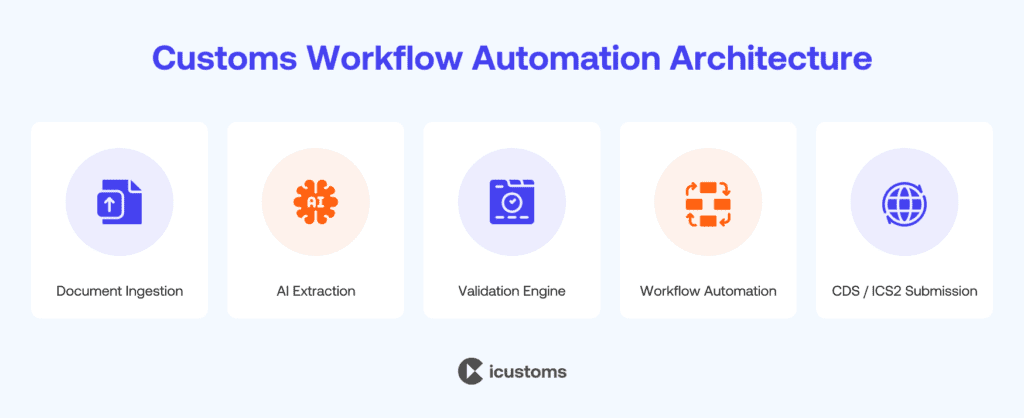
A complete IDP software integration for customs operations covers five layers: document ingestion, AI extraction and classification, validation and compliance checking, workflow automation and exception handling, and customs submission automation. Each layer of IDP software connects to the next without manual intervention.
Document Ingestion Layer
Documents enter the IDP pipeline through multiple channels simultaneously. Email ingestion monitors designated mailboxes and automatically routes attachments to the processing queue by document type. API uploads allow ERP systems, freight management platforms, and trading partner portals to push documents programmatically. EDI integration accepts structured electronic trade documents in standard formats alongside unstructured PDFs and scanned images. The ingestion layer normalises all incoming formats into a unified processing queue without manual sorting, ensuring no document is delayed by format incompatibility.
AI Extraction and Classification by IDP Software
Once ingested, each document is classified by type and processed through the relevant extraction model. For commercial invoices, the extraction identifies goods item descriptions, unit prices, declared values, currency, quantity, weight, country of origin, Incoterms, and all party data including consignor and consignee names, addresses, and EORI numbers.
For transport documents, the extraction captures HAWB and MAWB references, carrier identity, routing, and cargo descriptions. For certificates of origin, origin declarations and exporter certification details are extracted and linked to the corresponding goods items in the consignment. Each extracted field is assigned a confidence score that determines whether it proceeds automatically or is flagged for review.
IDP Software for DATA Validation and Compliance Layer
Extracted data enters the validation layer where multiple checks run in parallel. CDS validation rules are applied to confirm that mandatory declaration fields are present and correctly formatted. Commodity code candidates from the AI classification are checked against the UK Trade Tariff and flagged if they do not match the goods description at the required digit level.
VAT treatment is verified based on the import procedure code. Cross document validation compares values between the commercial invoice and packing list to identify quantity, weight, and value mismatches before any data proceeds to the declaration stage. Confidence scoring from the extraction layer determines which fields proceed automatically and which are routed to the exception queue for human review.
Workflow Automation and Exception Handling via IDP Software
Validated data enters the workflow automation layer, which manages routing, approval chains, and exception processing. High confidence declarations with no validation failures follow a straight through processing route to customs submission without human intervention. Declarations with low confidence fields or validation warnings are routed to the appropriate reviewer with the specific issue flagged and the source document referenced.
Rejection responses from CDS are caught by the exception handler, which logs the rejection reason, routes the declaration back to the operator with the specific data field identified, and triggers the correction and resubmission workflow. Every routing decision, approval action, and exception resolution is recorded in the audit trail.
IDP Software Integration for Customs Submission Automation
The final layer handles the actual customs filing. For import movements, the Entry Summary Declaration is submitted to ICS2 or HMRC ENS systems via the certified API connection. Simplified Frontier Declarations are generated and submitted to CDS for eligible consignments, with the Supplementary Declaration lifecycle managed through to final acceptance.
For transit movements, GMR workflows connect NCTS transit MRNs to the GVMS Goods Movement Reference before the vehicle reaches the border. IMMI data is prepared and submitted where applicable. All submissions return Movement Reference Numbers that are stored against the consignment record for tracking and audit purposes.
Too many manual checks across customs documents?
Streamline validation and exception handling with IDP software integration.
IDP Software API Integration for Customs Declaration Automation
API driven customs integration replaces the manual portal submission model with a programmatic data exchange that enables real time declaration processing, automated status tracking, and structured rejection handling. Understanding the API architecture is essential for customs teams evaluating IDP integration for CDS, TSS, or ICS2 submission workflows.
REST API Architecture for Customs Filing
The TSS API Functional Guide defines a REST API architecture for customs declaration workflows that covers declaration header management, goods item APIs, consignment processing, and ENS submission. IDP integration connects to this architecture by generating the structured JSON or XML payload required by each endpoint from the data extracted from trade documents.
The declaration header is populated from invoice and party data. Goods item records are generated from line item extraction, with one goods item API call per commercial invoice line. The consignment workflow manages the relationship between transport documents and declaration records, ensuring that each goods item is linked to the correct master or house bill of lading reference.
CDS API Interoperability and Rejection Handling
CDS validation applies a series of rules to incoming declarations before acceptance. Common rejection causes include missing mandatory fields, invalid commodity codes, EORI format errors, and value inconsistencies. IDP integration with CDS handles rejection responses through a structured exception workflow: the rejection message is parsed, the specific error code is matched to the corresponding declaration field, the operator is notified with the exact correction required, and the corrected declaration is resubmitted programmatically through the same API connection.
API testing environments allow declaration workflows to be validated against live CDS validation rules before production submission, reducing the frequency of rejection in live operations.
ERP Integration with Intelligent Document Processing
ERP systems hold the master data that customs declarations depend on: supplier records with EORI numbers, approved commodity codes from previous classifications, standard packaging configurations, and trade lane specific Incoterms. IDP integration with ERP systems makes this master data available to the declaration workflow automatically, without requiring operators to retrieve and manually apply it during declaration preparation.
IDP Software: SAP and Oracle Integration for Customs Data Mapping
SAP and Oracle ERP systems contain purchase order data that maps directly to customs declaration requirements. When an IDP platform integrates with SAP via API or direct data connection, incoming commercial invoice data can be matched against the corresponding purchase order record, enriching the extracted data with approved commodity codes, supplier EORI numbers, and standard packaging units that the ERP holds as master data. Discrepancies between the invoice and the purchase order are flagged automatically before the declaration is prepared, preventing customs rejections caused by value mismatches that would otherwise only be identified after CDS submission.
Microsoft Dynamics, NetSuite, and Sage Connectivity in Trade Operations
For mid market operators using Microsoft Dynamics, NetSuite, or Sage, IDP integration typically operates via API or CSV synchronisation rather than direct database connection. Extracted invoice data is matched against supplier master records in the ERP to validate consignor EORI numbers and enrich goods descriptions with standardised commodity code references. Customs declaration data is written back to the ERP after submission, creating a complete consignment record that connects procurement, logistics, and customs compliance in a single operational system.
IDP Software for Workflow Automation for Customs Operations
Workflow automation in customs operations is the orchestration layer that manages the routing, status tracking, approval chain, and exception handling for declarations from document receipt through to CDS acceptance. Without workflow automation, customs teams manage these steps manually, creating bottlenecks, missed deadlines, and compliance gaps.
Straight Through Processing and Approval Chains
Straight through processing is the target state for high confidence consignments: the document is ingested, data is extracted and validated, the declaration is generated and submitted, and the MRN is returned without any human action at any stage.
For consignments that do not meet the confidence threshold for straight through processing, the workflow engine routes the declaration to the appropriate customs compliance team member with the specific issue identified and the source document referenced.
Approval chains for high value or sensitive consignments can require sign off from a compliance manager before API submission, with all approval actions recorded in the audit trail.
Status Tracking, SLA Management, and Audit Readiness
Every declaration in the workflow is assigned a status that is updated in real time as it progresses through ingestion, extraction, validation, approval, and submission. Status notifications are sent to relevant stakeholders at configurable trigger points, enabling operations teams to monitor declaration progress without manually querying the customs system.
SLA thresholds for each declaration stage generate alerts when processing time exceeds the target, enabling intervention before a filing deadline is missed. The complete workflow history for every consignment, including every extraction result, validation outcome, routing decision, and submission response, is stored in a structured audit trail that satisfies HMRC record keeping requirements without additional manual documentation.
IDP Software vs Traditional OCR in Customs Compliance Operations
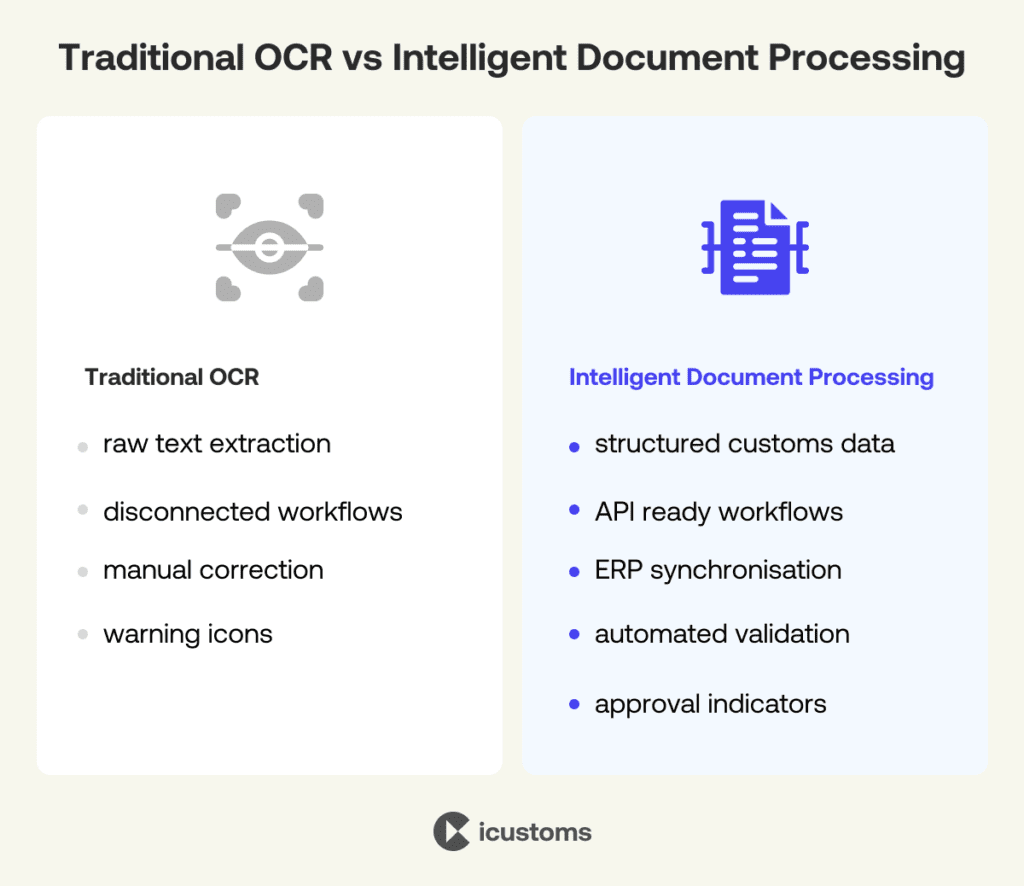
The distinction between OCR and IDP software is not a question of technology generation. It is a question of what the system does with the text it reads. For customs declaration workflows, the difference determines whether the output is a raw text dump that an operator must still interpret, or structured, validated, workflow ready declaration data.
IDP Software vs OCR: What customs teams actually get from each approach
| Capability | Traditional OCR | Intelligent Document Processing (IDP Software) |
| Output type | Raw text from document image | Structured, field mapped customs data ready for declaration APIs |
| Document understanding | Character recognition only | Contextual field identification, distinguishes declared value from unit price, EORI from invoice reference |
| Variable document handling | Template dependent, breaks on new layouts | AI model adapts to format variation without reconfiguration for each supplier template |
| Customs logic validation | None, raw text only | CDS rules, commodity code checks, and cross document consistency validation applied automatically |
| ERP connectivity | Manual data transfer required | Direct API or data connector synchronisation with SAP, Oracle, Dynamics, NetSuite, and Sage |
| Confidence scoring | Not available | Field level confidence scoring determines automated processing or exception routing |
| Continuous learning | Static, accuracy does not improve | AI model improves accuracy using operator verified corrections from real customs documents |
| Workflow integration | Requires separate workflow tools | Integrated exception handling, approval routing, and audit trail generation |
| Customs submission | No direct submission capability | Direct API submission to CDS, ICS2 ENS, NCTS, and TSS API endpoints |
Still relying on OCR that stops at text extraction?
Upgrade to IDP software built for customs workflow automation.
Benefits of IDP Software Integration for Customs Teams
The operational impact of IDP software integration on customs workflows is measurable across six dimensions that customs managers and operations leaders can quantify against current state performance.
- Faster declaration processing: from multi hour manual preparation to sub five minute automated generation for standard consignments with complete documentation
- Reduced manual work: data entry eliminated from the declaration preparation workflow, freeing customs operators for exception resolution and compliance management
- Improved data accuracy: AI extraction with field level confidence scoring and cross document validation reduces CDS rejection rates caused by data entry errors
- Fewer CDS rejections: pre submission validation catches commodity code errors, mandatory field gaps, and value mismatches before the declaration reaches HMRC
- Lower operational cost: processing cost per declaration decreases as automation absorbs volume growth without proportional headcount increase
- Higher straight through processing rates: consignments with complete, consistent documentation are processed and submitted without human intervention, improving throughput during peak periods
How iCustoms Automates Customs Document Processing
iCustoms is an AI driven customs infrastructure platform that integrates Intelligent Document Processing with ERP connectivity, customs API submission, workflow orchestration, and trade compliance validation in a single, ISO certified platform. It is designed for customs operations that need production ready integration, not a proof of concept.
- AI classification and extraction: incoming documents are classified by type and processed through customs specific extraction models trained on real trade document data, including commercial invoices, packing lists, air waybills, bills of lading, certificates of origin, and supplier declarations
- ERP and API integration: iCustoms connects to SAP, Oracle, Microsoft Dynamics, NetSuite, and Sage via API and data connectors, enriching extracted data with ERP master data and writing declaration outcomes back to the ERP
- CDS integration and ICS2 readiness: direct API connection to HMRC CDS for import and export declarations, with ICS2 ENS submission via certified AS4 access point covering air, maritime, and road freight
- TSS API and customs declaration workflows: ENS, SFD, Supplementary Declaration, IMMI, and GMR workflows are managed through the API orchestration layer, with CDS rejection handling and resubmission automation built in
- Audit trails and compliance reporting: every processing decision, extraction result, validation outcome, and submission response is logged with a timestamp and operator attribution, satisfying HMRC audit requirements
- ISO 27001 and ISO 9001 certified: data security and quality management certifications provide the governance assurance required by enterprise procurement teams
- EU customs filing support: iCustoms supports EU customs filing requirements alongside UK CDS, covering ICS2 Release 3 for road and rail and maritime freight forwarder obligations
The Future of AI Driven Customs Workflow Automation
The trajectory of customs automation is toward fully autonomous declaration workflows where AI systems prepare, validate, and submit declarations without human action except for defined exception scenarios. The regulatory and technological conditions for this trajectory are already in place.
AI Assisted Declarations and Predictive Compliance
AI assisted declaration preparation is already operational for standard consignment types. The next development is predictive compliance: using historical declaration data and commodity risk profiles to identify consignments that are statistically likely to be queried or examined by customs authorities before submission. This enables customs teams to resolve compliance issues proactively rather than responding to HMRC queries after clearance has been initiated.
EU Customs Data Hub and ICS2 Evolution
The European Union Customs Reform, centred on the EU Customs Data Hub, is moving toward a single data environment where all EU customs data is managed centrally across member states. ICS2 Release 3, now fully operational for road and rail freight, is the first phase of this consolidation. Platforms that already operate ICS2 compliant ENS workflows with certified AS4 connectivity are positioned to integrate directly with the EU Customs Data Hub architecture as it evolves, without requiring separate system changes for each new regulatory requirement.
Cross Border Automation and Real Time Orchestration
Cross border customs automation increasingly depends on real time data exchange between traders, carriers, customs authorities, and port community systems. GVMS for UK RoRo movements, Destin8 for port community system integration, and ICS2 for EU advance cargo information all require pre arrival data that is available only if document processing happens before the goods depart. IDP integration that operates on received documents as they arrive, rather than waiting for manual processing, is the technical foundation for meeting pre departure filing deadlines consistently across all transport modes.
Conclusion
The customs declaration process is not a single system challenge. It is an integration challenge: connecting supplier documents, ERP master data, customs APIs, compliance validation, and workflow orchestration into a pipeline that operates at the speed and accuracy that modern cross border trade requires. IDP integration is the layer that makes this pipeline work without manual rekeying at every stage.
Customs teams operating in an environment of increasing regulatory complexity, from ICS2 Release 3 to HMRC CDS enforcement to the emerging EU Customs Data Hub, need infrastructure that can adapt to new API requirements and compliance obligations without requiring full system replacement. The platforms that will serve customs operations through the next decade are those built on open API architecture, certified connections to live customs systems, and AI models that improve accuracy continuously on real operational data.
iCustoms provides this infrastructure today: AI driven document processing connected to ERP systems, customs APIs, CDS and ICS2 submission workflows, structured audit trails, and continuous learning, all within an ISO 27001 and ISO 9001 certified platform built specifically for customs and trade compliance operations.

Ready to eliminate manual customs bottlenecks and compliance delays?
Automate extraction, validation, ERP integration, and customs filing with intelligent IDP software integration.
You may also like:
Struggling to Extract, Catagorise & Validate Your Documents?

Capture & Upload Data in Seconds with AI & Machine Learning
Subscribe to our Newsletter
About iCustoms
iCustoms is an all-in-one solution helping businesses automate customs processes more efficiently. With AI-powered and machine-learning capabilities, iCustoms is designed to streamline your all customs procedures in a few minutes, cut additional costs and save time.
Struggling to Extract, Catagorise & Validate Your Documents?
Capture & Upload Data in Seconds with AI & Machine Learning