
Why Was My Shipment Held at EU Border Control? Establishment Code Errors Explained
- John Hall
- Customs Specialist at iCustoms.ai
A shipment held at EU border control almost always comes down to paperwork, and establishment code errors sit near the top of the list. Officials at the border control post (BCP) check every regulated consignment against the Common Health Entry Document (CHED) and the official TRACES records. If a code is invalid, delisted or missing, the goods stop, whatever the driver or the schedule says.
This guide explains how the EU BCP process works, the most common EU customs hold reasons, and what to do while your consignment sits in limbo. More importantly, it shows how to stop the next hold before the goods ever leave the warehouse.
What happens at an EU border control post?
Under the Official Controls Regulation (EU) 2017/625, consignments of animals, animal products, plants and certain foods must enter the EU through a designated border control post. There, officials carry out veterinary and phytosanitary border checks before the goods can clear customs.
The three checks every consignment faces
- Documentary check: officials verify the CHED, health certificates and the establishment codes on them against the TRACES records. Every consignment gets this check.
- Identity check: seals, labels and container details are matched to the paperwork.
- Physical check: a proportion of consignments undergo inspection and lab sampling, with frequency depending on product risk and the trader’s compliance history.
Documentary failures cause the majority of holds. That is worth pausing on: the checks that stop most shipments involve no laboratory and no inspection bay, just data that does not match.

Top reasons a shipment is held at EU border control
| Hold Reason | Typical Cause | Who Can Fix It |
|---|---|---|
| Establishment code not listed on TRACES | The supplier has been delisted, suspended, or approved for a different activity than the one declared. | Supplier and the relevant competent authority. |
| Invalid or incorrect establishment code | Typographical errors or outdated establishment codes reused from previous shipments. | Importer or customs agent. |
| CHED errors or late submission | Incorrect CHED type selected, missing mandatory information, or submission after the consignment arrived. | Importer or customs agent at the Border Control Post (BCP). |
| Certificate mismatch | Information on the health certificate does not match the CHED or commercial invoice. | Exporting authority and customs agent. |
| Seal or identity failure | The seal number or shipment identity differs from the details recorded on the health certificate. | Carrier and exporter. |
| Physical check findings | Issues such as temperature breaches, labelling defects, or adverse sampling and laboratory test results. | Exporter or producer. |
Notice a pattern: four of the six reasons are pure data problems. Consequently, they are also the four you can eliminate entirely with better validation before departure.

Establishment code errors: the silent shipment-stopper
Code not listed on TRACES
Approval is specific: a facility is listed by country and by activity on the EU approved establishment list. Your supplier may hold valid approval for meat products yet ship you a dairy line, and the code fails. Worse, authorities can suspend or delist a facility mid-contract after an audit or an outbreak, and no one tells the importer. The code that cleared in May stops the June load.
Invalid or incorrect establishment code
Simpler, and just as costly: a digit mistyped into the certificate, an old code copied from last year’s order sheet, or a merged spreadsheet cell that swapped two suppliers’ numbers. Officials at the BCP do not judge intent; they match characters against the TRACES NT establishment search. Anything that does not match, stops.
CHED refusal reasons explained
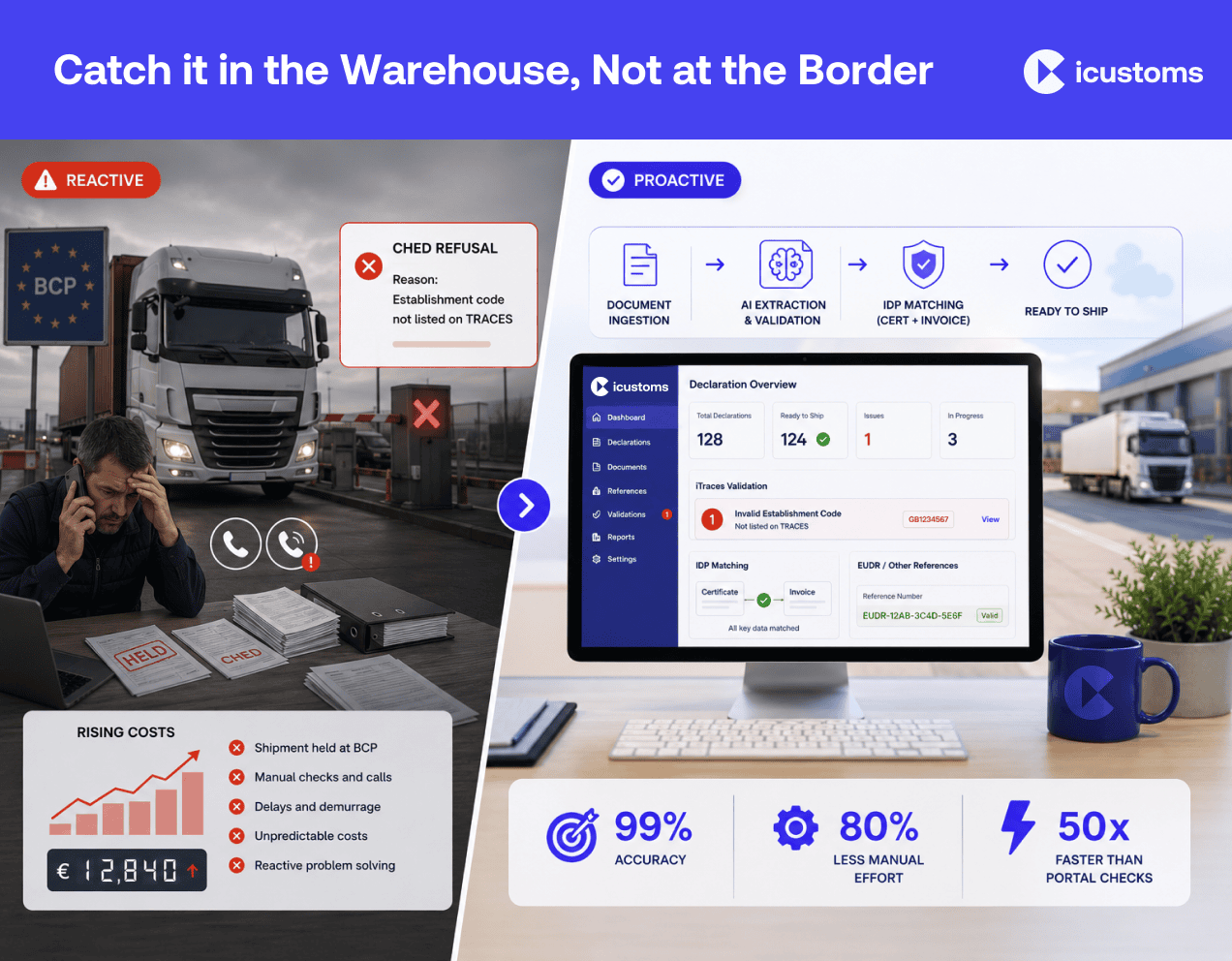
The Common Health Entry Document is the consignment’s entry ticket, submitted through TRACES NT before arrival. When officials refuse a CHED, the decision falls into one of three buckets, mirroring the three checks.
- Documentary refusal: missing or inconsistent certificates, invalid establishment codes, wrong CHED type for the product.
- Identity refusal: goods, seals or quantities that do not match the declared details.
- Physical refusal: failed inspection or sampling results.
A refusal is not a delay; it is a decision. The consignment must then be re-exported, destroyed or, in limited cases, transformed under official supervision. In addition, the refusal is recorded in TRACES and visible to authorities across the EU, which can raise your inspection frequency on future consignments. We unpack the CHED workflow fully in our dedicated guide.
What to do when your shipment is held
- Step 1: Contact the BCP or your customs agent immediately and get the precise hold reason in writing.
- Step 2: If it is an establishment code issue, check the supplier’s current listing yourself on the EU lists, for the exact activity.
- Step 3: For certificate errors, contact the exporting country’s competent authority; only they can amend or replace official certificates.
- Step 4: Track the costs (demurrage, storage, temperature risk) and keep your customer informed with realistic timelines.
- Step 5: Afterwards, run a root-cause review. A hold is expensive tuition; make sure the lesson sticks.
Whilst some holds resolve in hours, certificate replacements routinely take days. For perishables, that difference is the margin on the load.
Still Discovering Code Errors at the Border?
iTraces validates every establishment code before your goods ship, so holds become someone else’s story.
How to prevent border holds before goods ship
Every documentary hold is preventable, because the data existed before departure; it just was not checked. Three habits close the gap.
- Validate establishment codes before every shipment: automated bulk validation catches delistings and typos in seconds.
- Verify document data against source: certificate, invoice and CHED details must match character for character; automated customs document validation removes the re-keying that breaks them.
- Submit CHEDs early and correctly: pre-arrival submission gives time to fix issues while the goods are still moving.
Why choose iCustoms to keep shipments moving
iCustoms AI attacks exactly the failures listed above. iTraces checks every establishment code against the official TRACES EU database, in bulk, with 99% accuracy, and flags delisted or mistyped codes before booking. Meanwhile, Intelligent Document Processing extracts and validates trade document data so certificates, invoices and declarations tell the same story. The result: teams cut manual checking effort by 80% and stop paying for border holds they could have prevented.
For customs agents and food importers, the compliance dashboard shows every product, supplier and code status in one view, with an audit trail behind each check. When a customer asks why their goods are safe with you, iCustoms gives you the evidence, not just the assurance.
From held shipments to handled exceptions
Border holds are rarely one bad document; they are a workflow problem. iCustoms puts the whole flow on one AI platform: document data, establishment codes, HS classification and customs declarations across the UK, Ireland and 22 EU nations. Logistics leaders such as Kerry Logistics, Ziegler and Woodside Logistics Group already work this way, and their teams manage exceptions instead of emergencies.
Make Your Last Border Hold Your Last
Book a demo and see how iCustoms validates codes, documents and declarations before wheels move.
Frequently Asked Questions
Why was my shipment held at EU border control?
Most holds are documentary: an establishment code not listed on TRACES, an invalid establishment code, CHED errors or certificate mismatches. Officials at the border control post check paperwork against TRACES records, and any mismatch stops the consignment.
How long can a border control post hold a consignment?
Simple documentary queries can clear in hours, but certificate replacements involve the exporting country's competent authority and routinely take days. Perishable goods therefore carry the highest financial risk during a hold.
What is a CHED and why do they get refused?
The Common Health Entry Document is the entry declaration for regulated consignments, submitted via TRACES NT. Refusals fall into documentary, identity and physical categories; documentary failures, including invalid establishment codes, are the most common.
What happens if the establishment code is not listed on TRACES?
The consignment cannot clear the border control post. It will be held and, if the listing cannot be resolved, refused, meaning re-export or destruction. Checking listings before shipment is the only reliable protection.
Can I fix an invalid establishment code at the border?
Sometimes, if it is a clerical error and the correct code is valid, your agent can arrange corrected documents. However, if the facility genuinely lacks approval for that activity, no paperwork fix exists; the goods must come from an approved establishment.
How do I prevent shipments being held at EU border control?
Validate establishment codes in bulk before every shipment, verify document data automatically rather than re-keying it, and submit CHEDs early. Tools such as iTraces and Intelligent Document Processing from iCustoms automate all three with 99% accuracy.
You may also like:
Struggling to Extract, Catagorise & Validate Your Documents?

Capture & Upload Data in Seconds with AI & Machine Learning
Subscribe to our Newsletter
About iCustoms
iCustoms is an all-in-one solution helping businesses automate customs processes more efficiently. With AI-powered and machine-learning capabilities, iCustoms is designed to streamline your all customs procedures in a few minutes, cut additional costs and save time.
Struggling to Extract, Catagorise & Validate Your Documents?
Capture & Upload Data in Seconds with AI & Machine Learning