
What Freight Forwarders Need to Know About ICS2
-
 Freya Jane
- Director of Customer's Success
The original compliance deadline for ICS2 Release 3—covering road and rail movements—officially closed on September 1, 2025. However, several EU Member States have granted a national derogation (temporary extension), pushing the absolute final enforcement date to December 31, 2025, for shipments entering via those countries
For freight forwarders, this grace period is not a buffer to relax — it’s the final window to act.
Unlike carriers, your responsibility under the ICS2 Multiple Filing Model is non-transferable. You must provide accurate, complete, and timely house-level data, regardless of whether your carrier has already transitioned.
This extension should be treated as what it truly is: the last opportunity to refine your data processes, strengthen partner coordination, and secure ICS2 compliance before enforcement becomes universal. So, let’s start
What is the Import Control System (ICS2)?
The Import Control System (ICS2) is the European Union’s safety and security system designed to ensure the security of goods entering the EU market.
Want to learn more about ICS2? Click here!
Early, accurate data submission is now mandatory, including HS codes, EORI numbers, and full cargo details.
Here’s a closer look at its operation and significance:
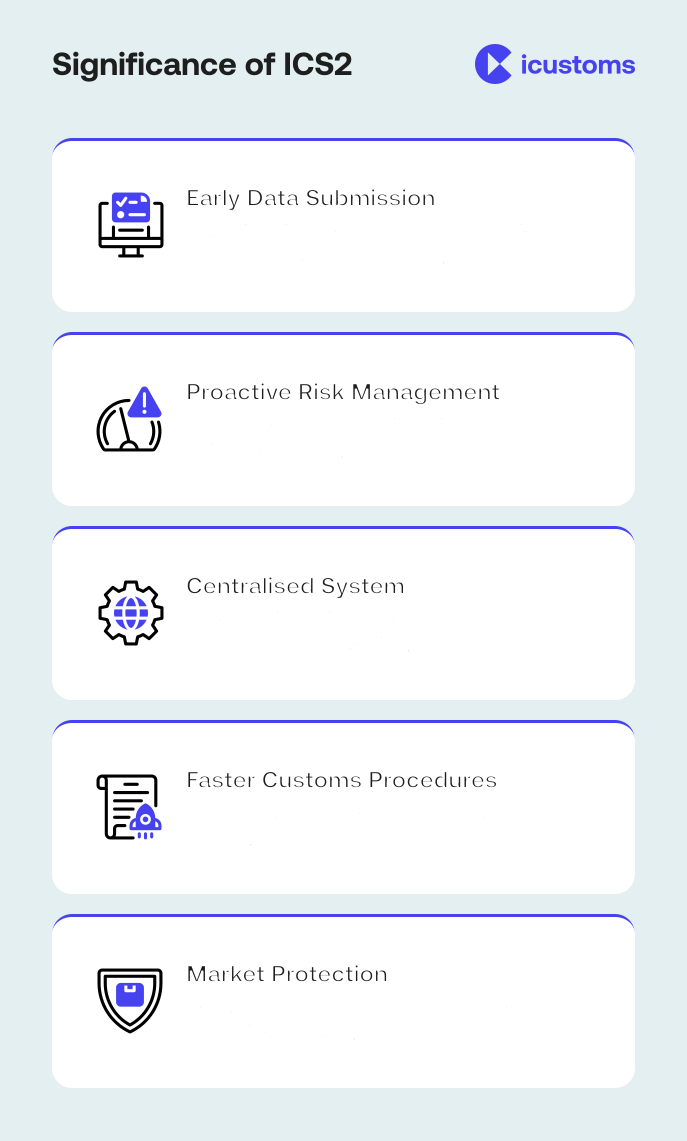
Early data submission
Carriers and freight forwarders must submit detailed shipment information, including cargo descriptions, HS codes, and EORI numbers, to ICS2 before goods are loaded. Customs officials can evaluate hazards early thanks to this pre-arrival data, guaranteeing safer and more transparent trade processes.
Proactive risk management
By checking the provided data, customs officers can detect potentially high-risk shipments and take preventative action. This saves you from non-compliance and lessens the possibility that illicit or hazardous products will reach the EU.
Centralised and unified system
ICS2 replaces fragmented procedures with a standardised framework, centralising risk management and data exchange among all EU member states. This promotes smooth collaboration between national customs administrations and guarantees uniform enforcement of laws.
Streamlined customs procedures
The system uses advanced IT tools to speed up important processes like information sharing, risk assessments, and customs clearance. For companies, this translates into fewer delays, quicker approvals, and less administrative work.
Enhanced protection of single market
ICS2 enhances transparency in international trade operations by supporting legal trade, thereby strengthening the EU’s single market protection against external risks. Before entering the union, it ensures that goods from third nations adhere to strict safety and compliance rules.
Why December 31st Matters to Freight Forwarders
While the current derogation applies only to select EU Member States, December 31, 2025, marks the last operational buffer for freight forwarders using those entry points.
From January 1, 2026, ICS2 becomes fully mandatory across the EU — leaving no room for delay, exceptions, or manual workarounds.
| Entry Point Status | Status until Dec 31, 2025 | Action Required from Jan 1, 2026 |
|---|---|---|
| No Derogation (e.g., Germany, Netherlands, Czechia) | ICS2 has been mandatory since Sept 1, 2025. | Full ICS2 compliance is required. |
| Derogation Granted (e.g., France, Spain, Italy, Ireland, Greece, Hungary, Finland, Lithuania, Northern Ireland) | Operators may continue using the legacy ICS1 system. | ICS2 compliance becomes 100% mandatory. |
The Forwarder's Core Responsibility: House-Level Filing
ICS2 mandates the Multiple Filing Model (MFM) for consolidated cargo, which places the primary data burden on the forwarder.
- The Carrier’s Role (Master-Level): The road or rail operator files the M-ENS, covering the vehicle/train and basic contract details.
- Your Role (House-Level): As the party holding the detailed contract (House Bill/Consignment Note), you must file the H-ENS. This is the data that customs uses for its critical pre-arrival risk analysis.
| Key Data You Must Submit (H-ENS) | Consequences of Failure |
|---|---|
| 6-Digit HS Code (mandatory for every product) | Rejected filing or immediate Request for Information (RFI) |
| EU Consignee’s EORI (if established in the EU) | Increased risk scoring and potential physical inspection |
| Detailed, Specific Goods Description | “Do Not Load” (DNL) or a complete refusal of entry |
Urgent Insight: The carrier’s extension to December 31st does NOT absolve you of your responsibility. You must ensure your H-ENS is filed within the correct timeline for the mode of transport; otherwise, the carrier’s master declaration will be rendered non-compliant.
ICS2 deadlines won’t wait—are you ready?
See how iCustoms automates compliance and protects your cargo from delays.
The Risk: What Happens on January 1, 2026?
The consequences of non-compliance will be immediate and severe once all temporary filing arrangements expire.
- Customs Rejections: Filings submitted via the old ICS1 system or missing the mandatory new data elements (like the 6-digit HS code) will be automatically rejected by the ICS2 system.
- Physical Delays and Fines: Non-compliant cargo will be stopped at the border. This leads to costly delays, storage fees, and potential administrative fines levied by national customs authorities.
- Supply Chain Breakdown: As a forwarder, failure to file the H-ENS on time can cause a “Do Not Load” (DNL) instruction to be issued, affecting the carrier and the entire master shipment. This severely damages your relationship with both clients and transport partners.
The rollout of ICS2
Import Control System 2 (ICS2) is being implemented in three phases to guarantee safe and effective trade into the EU. Here’s a brief overview of each phase:
Phase 1: Air Courier & Postal Services (March 2021)
Launched on 15 March 2021, the first phase of ICS2 focused on postal and air courier services. Before cargo is loaded onto an aircraft, shippers have to provide Pre-Loading Advance Cargo Information (PLACI), which includes EORI numbers, HS codes, and goods descriptions.
Customs officials can evaluate risks and authorise shipments prior to departure thanks to this early data. Authorities make a Request for Information (RFI) if more information is required.
Phase 2: Full Air Freight Industry (March 2023)
Phase 2 implemented on 1 March 2023, that covers all air freight, including postal shipments, general cargo, and couriers.
ICS2 Phase 2 Freight Forwarder Requirements
- A comprehensive Entry Summary Declaration (ENS) must be submitted.
- Adhering to rigorous deadlines:
- Short-haul flights: ENS must be sent by departure.
- Long-haul flight: ENS must arrive at customs at least four hours before arrival
Additional steps are registering arrivals, presenting goods, and transferring them to the appropriate customs process.
Moreover, important documents that need to be easily available are the ENS, PLACI, MAWB, and HAWB.
Phase 3: Maritime, Rail, Road & Inland Waterways (June 2024 – September 2025)
ICS2 is extended to other modes of transport in the final phase:
Maritime & inland waterways: Full ENS requirements start on 3 June 2024, with house-level filers complying by 4 December 2024.
- Maritime and inland waterways carriers: Between 3 June 2024 to 4 December 2024
- Maritime and inland waterways house level filers: Between 4 December 2024 to 1 April 2025
- Road and rail carriers: Between 1 April 2025 to 1 September 2025
After 1 September 2025, all operators must file via ICS2; no more ICS1 fallback.
Read more about ICS2 for Road & Rail here!
What freight forwarders must do to comply with the ICS2?
Freight forwarders must follow these practices to ensure compliance with the ICS2 requirements:
Submit required data
For data requirements, freight forwarders must submit the following data to ICS2:
- Entry Summary Declaration (ENS)
- Pre-Loading Advance Cargo Information (PLACI) for air freight
- Detailed information such as the EORI number, HS codes and comprehensive cargo descriptions
Stick to timelines for data submission
Freight forwarders must follow this strict timeline for submitting the ENS for the goods entering the EU:
| Transport Mode | Timing for ENS submission |
| Air Freight |
|
| Sea Freight |
|
| Road Freight (RoRo) |
|
| Rail Freight |
|
| Eurotunnel |
|
Follow the five-stage clearance process

To ensure seamless customs clearance under ICS2, freight forwarders must follow these steps:
1. Prepare the Entry Summary Declaration (ENS)
ENS include all necessary information, including product descriptions, HS codes, and the EORI number. Note that six-digit HS codes are now mandatory.
2. Submit Pre-Loading Advance Cargo Information (PLACI)
Give this information prior to the cargo being loaded on the transport vehicle.
3. Register arrival and present goods
Inform customs officials that the shipment has arrived and, if necessary, bring the items for inspection.
4. Manage intermediate storage
If required, set up temporary storage while you wait for clearance.
5. Transfer Goods to Appropriate Customs Procedures
Ensure goods are moved to the correct customs procedure based on their classification and intended use.
How iCustoms Supports Freight Forwarders Under ICS2 (deadline)
ICS2 requires complete, accurate, and timely data at every stage of clearance. iCustoms helps freight forwarders stay compliant with automated ENS and PLACI filing, real-time data validation, and fast declaration input.
Powered by Intelligent Document Processing (IDP), it drafts declarations from shipment files, supports bulk uploads, and enables template reuse for recurring shipments.
With iCustoms, managing ELO and ICS2 becomes simple, reliable, and stress-free — giving you full visibility, fewer errors, and faster EU clearance.
For advanced users, iCustoms offers deep API integration, enabling:
- API support for F15 and F50 messages across ocean and road modes
- API-based contact management to easily reuse shipper and consignee data
- API support for ENS amendments (F15 & F50) for quick corrections
Access to the ENS EU Technical Completion Matrix documentation to support seamless client integration
Still learning how ICS2 impacts freight forwarders?
Understand the Multiple Filing Model, deadlines, and data rules with iCustom
Wrapping up
The EU has strictly implemented the Import Control System 2 (ICS2) for all goods to strengthen border security and improve trade efficiency.
Freight forwarders must be fully compliant by 1 September 2025 or risk delayed or rejected shipments.
Simplify ICS2 compliance with iCustoms!
We can help you:
- Automate ENS submissions
- Get HS code suggestions with AI
- Reduce compliance errors
- Save time with smart data capture
The EU has fully implemented the Import Control System 2 (ICS2) to strengthen border security and improve trade efficiency by requiring accurate shipment data before goods enter the Union. For freight forwarders, compliance is mandatory — while some countries granted temporary extensions, the absolute final deadline across the entire EU is December 31, 2025, with full enforcement beginning January 1, 2026.
Failure to comply may result in delayed or rejected shipments and significant operational disruption. iCustoms simplifies this transition with automated ENS and PLACI submissions, AI-powered HS code classification, real-time validation to reduce errors, and smart data capture to accelerate processing. With the right digital tools, freight forwarders can stay compliant, keep cargo flowing smoothly, and confidently adapt to the new ICS2 framework.
Frequently Asked Questions
What is ICS2 and why is it important for freight forwarders?
ICS2 is the EU’s Import Control System 2 that requires pre-arrival safety and security data for goods entering the EU. It enables customs authorities to perform risk assessments before arrival and improves supply chain security.
What is the final ICS2 compliance deadline for freight forwarders?
Although some Member States granted temporary derogations until 31 December 2025, full ICS2 compliance becomes mandatory across the EU from 1 January 2026.
What are freight forwarders required to file under ICS2?
Freight forwarders must submit house-level ENS data, including detailed goods descriptions, 6-digit HS codes, consignee information, and other mandatory shipment details.
What are the consequences of failing to comply with ICS2?
Non-compliance can result in rejected filings, customs delays, Do Not Load instructions, increased inspections, financial penalties, and disruption to customer supply chains.
What are the key ENS submission timelines under ICS2?
ENS deadlines vary by transport mode. Examples include 24 hours before loading for deep-sea container cargo and specific pre-arrival deadlines for road, rail, air, and maritime movements.

Are you ready for the January 1, 2026, ICS2 cut-off?
Automate ENS & PLACI filings with confidence.
You may also like:
Simplify Your ENS Submissions with iCustoms

Automate data entry, reduce errors and ensure compliance
Subscribe to our Newsletter
About iCustoms
iCustoms is an all-in-one solution helping businesses automate customs processes more efficiently. With AI-powered and machine-learning capabilities, iCustoms is designed to streamline your all customs procedures in a few minutes, cut additional costs and save time.
Simplify Your ENS Submissions with iCustoms
Automate data entry, reduce errors and ensure compliance