
EMCS Export Process: How iWarehouse, EMCS and CDS Work Together
- John Hall
- Customs Specialist at iCustoms.ai
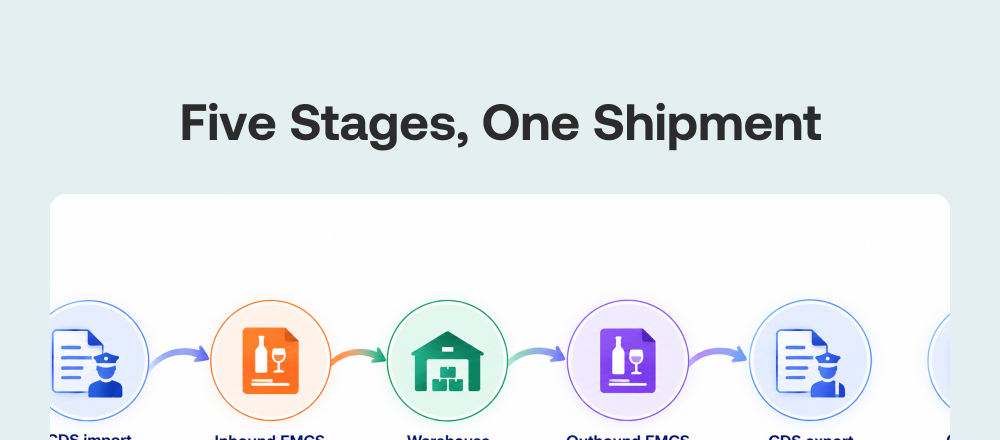
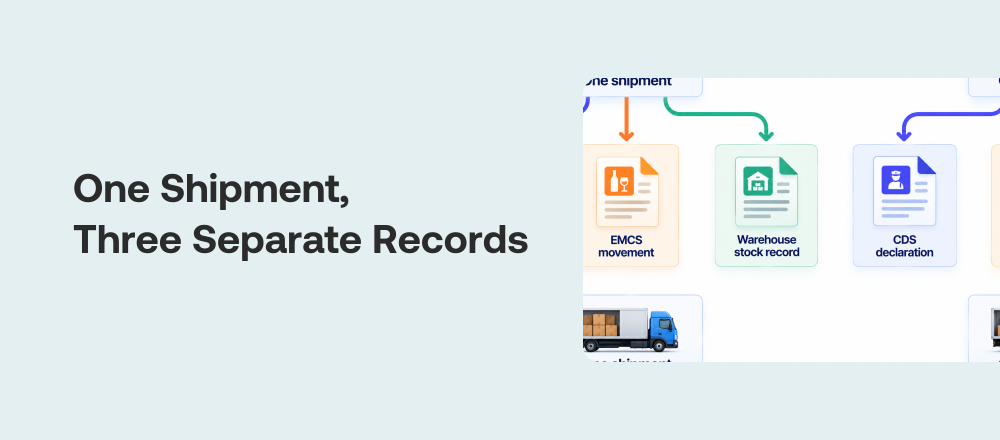
A single export out of a bonded warehouse touches three systems that were not built as one. The warehouse has to show the goods leaving stock. EMCS has to carry them out under duty suspension, from the removal to a movement that formally closes. CDS has to declare the export to customs, referencing the same movement rather than describing it from scratch. None of that is optional, and none of it happens automatically unless something is actually connecting the three.
This guide walks the export process end to end, warehouse removal, outbound e-AD, customs export declaration, and the message that finally closes the movement, so it is clear where each system’s job starts and stops. The warehouse-to-EMCS handoff itself is covered in more depth in our guide to iWarehouse to EMCS; this article picks up from there and carries the journey through to customs and back.
The Four Handoffs, at a Glance
Strip the process down and an export from an excise warehouse is four handoffs, not one declaration. First, the removal is recorded against the warehouse’s own stock, whatever is leaving has to come off the record it arrived under. Second, that removal has to become an outbound eAD on EMCS, opened and guaranteed before dispatch. Third, the eAD’s ARC has to be referenced correctly on the CDS export declaration, so customs and excise are describing the same movement rather than two unrelated ones. Fourth, once the goods have actually departed, a message closes the loop and discharges the eAD. Miss any one of the four and the paperwork stops matching the goods.
Handoffs One and Two: What's Already Covered
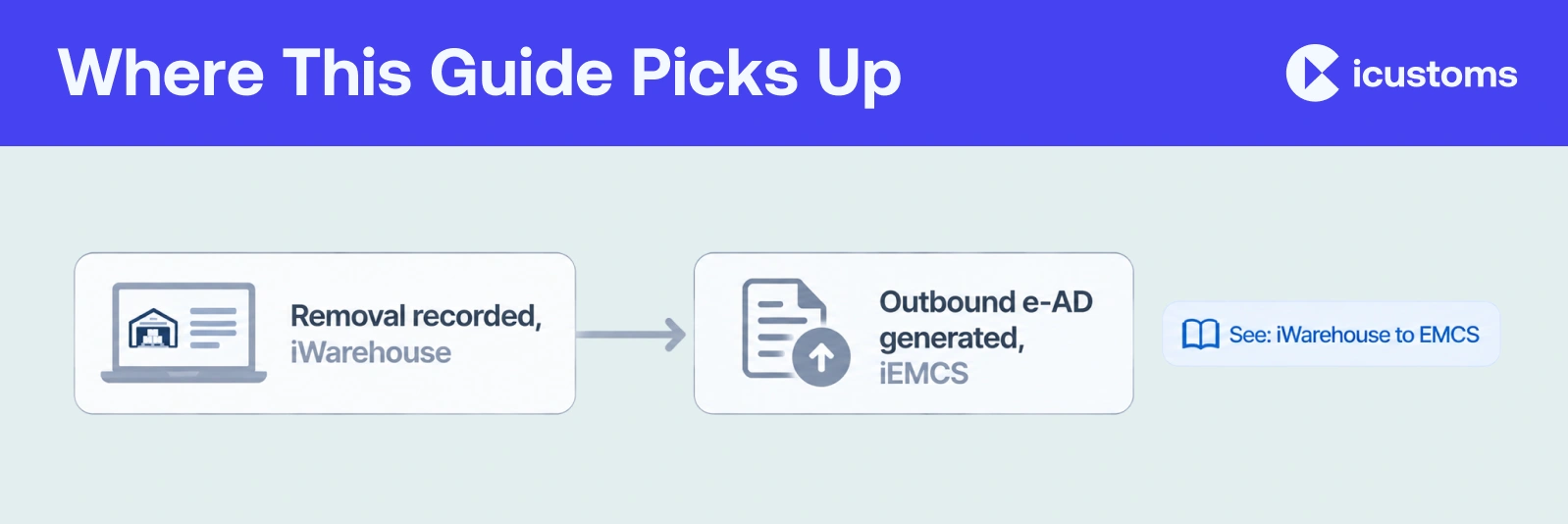
The first two handoffs, recording the removal and generating the outbound eAD, are the subject of our warehouse-to-EMCS guide, and the short version is worth repeating here. A removal for re-export needs a valid movement guarantee in place, a completed eAD on EMCS before dispatch, and the goods accounted for out of the warehouse’s stock record. Where iWarehouse and iEMCS are connected, recording the removal in iWarehouse triggers a pre-populated outbound eAD in iEMCS, carrying the stock’s existing commodity, quantity, lot and duty-suspended detail forward rather than asking someone to retype a shipment that was already fully described on arrival. This article does not repeat that detail; it starts from the point where the eAD exists and has an ARC.
Handoff Three: Putting the ARC on the Customs Declaration
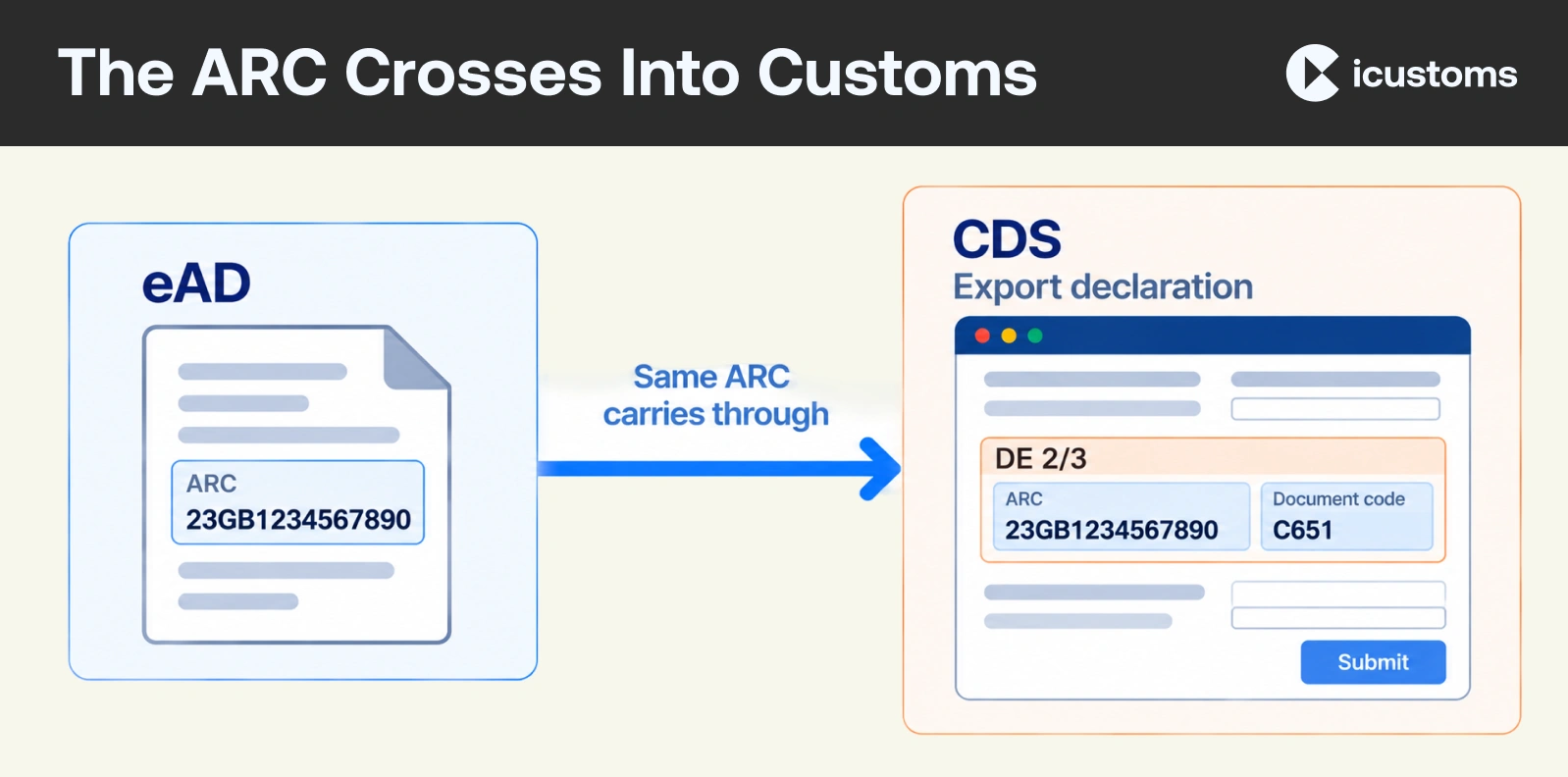
Once the eAD exists, the export still needs a customs declaration on CDS, and the two are not independent of each other. HMRC’s guidance on export procedure codes sets out Requested Procedure 1007 for exports from excise warehouses where duty and VAT have not been paid. That declaration has to carry the ARC from the eAD: the ARC is referenced using document code C651 in data element 2/3, alongside a status code, or C658 where EMCS fallback procedures are in use. A valid financial security is mandatory for the movement, and the goods cannot leave the premises without valid EMCS documentation, an eAD or a fallback document, except under Customs Supervised Export arrangements for direct exports on standard declarations, where the excise guarantee detail goes into data elements 8/2 and 8/3 instead of the ARC field.
There is also a country-specific control worth knowing about before it causes a rejected declaration: exports from Northern Ireland carry a mandatory additional information code, NIEXP, that does not apply to a GB export. Getting the ARC into the right field, with the right document code, is what makes the customs declaration and the excise movement describe the same shipment instead of two separate stories about it.
Handoff Four: How the Movement Actually Closes
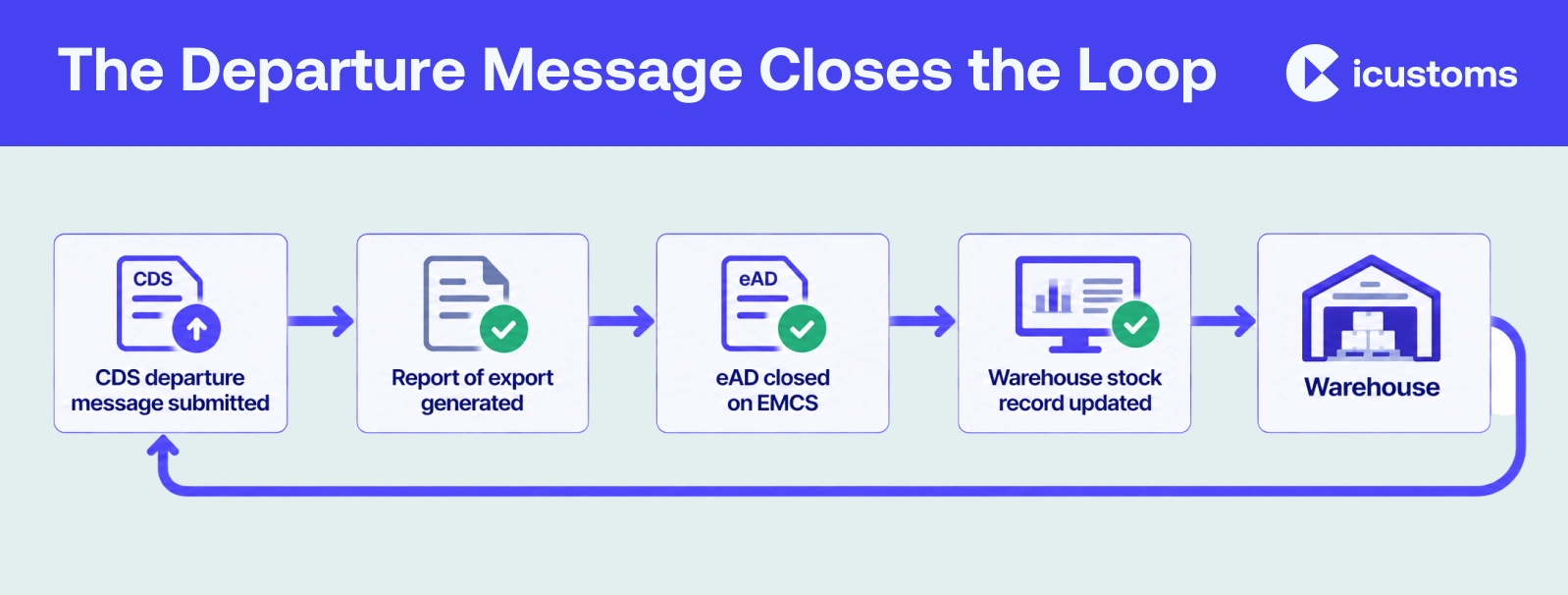
An export does not close the way a transfer to another warehouse does. A transfer is discharged by a report of receipt from the consignee warehousekeeper, submitted within five business days of arrival. An export has no warehousekeeper at the other end to file that report. Instead, once the departure message is submitted on CDS confirming the goods have actually left, a report of export is generated and the eAD is closed on EMCS. The two closing mechanisms exist for different situations and are not interchangeable; an export that never gets its departure message confirmed does not get the report of export that closes it.
For movements between Northern Ireland and the EU specifically, there is a narrower fallback: where the standard report cannot be obtained, HMRC’s assurance guidance allows alternative evidence of export instead, an official letter from the receiving member state’s fiscal authority, signed delivery documentation, or commercial documents that clearly show delivery to the consignee. That evidence is only accepted where every reasonable effort has genuinely been made to get the report first; it is a fallback for a specific NI-to-EU situation, not a general substitute for the departure message and report of export that close most exports.
Closing the eAD Is Not the Same as Proving the Export Happened
This is the part of the process that is easy to treat as a formality once it is done, and HMRC’s own assurance guidance is explicit that it should not be. A report of export and a closed eAD on EMCS confirm that the paperwork went through; they do not by themselves confirm that the goods that left the warehouse are the goods that actually left the country. HMRC’s guidance describes cases where a movement was recorded as exported, the eAD closed, and it later emerged the goods had not left the UK at all. In that situation, the excise duty point still arises and duty becomes payable, even though a report of export was generated and the eAD shows as closed. The practical implication is that the four handoffs above get the paperwork right, but ongoing stock accuracy and assurance readiness matter just as much as getting each message filed on time.
A Short Worked Example
A bonded warehouse is asked to export a pallet of spirits to a buyer outside the EU. The removal is recorded against the existing lot in the warehouse’s stock record, and that removal triggers a pre-populated outbound eAD in iEMCS, carrying the commodity, quantity and duty-suspended detail forward. The freight forwarder files the CDS to EMCS export declaration under procedure 1007, referencing the eAD’s ARC in data element 2/3 with document code C651, and the financial security already recorded against the movement covers it. Once the vehicle has actually left and the departure message is submitted on CDS, HMRC generates the report of export, the eAD closes on EMCS, and the warehouse’s stock record reflects the goods as exported, not just as removed.
Common Misconceptions
Once the CDS export declaration is filed, the excise side is finished. It is not. The ARC still has to be referenced correctly in the right field, and the eAD does not close until the departure message is submitted and a report of export is generated.
A report of export and a report of receipt are the same thing. They are not. A report of receipt is filed by the consignee warehousekeeper on a transfer; a report of export is generated by HMRC once the CDS departure message confirms the goods have left, because an export has no warehousekeeper at the receiving end to file anything.
A closed eAD on EMCS proves the export was compliant. It proves the paperwork was completed, not that the declared goods actually left the country. HMRC’s own assurance guidance treats closure and proof of export as two different things, and the excise duty point can still arise if the goods did not genuinely leave.
Things to Take Away
- An export from an excise warehouse is four handoffs, not one declaration: removal, outbound eAD, ARC on the customs declaration, and a closing message after departure.
- The ARC is what ties the excise movement to the customs export declaration; it has to be referenced correctly, typically with document code C651, or the two records describe unrelated shipments.
- An export closes on a report of export, generated automatically once the CDS departure message is submitted, not on a report of receipt, which only applies to transfers between warehousekeepers.
- Northern Ireland exports carry routing and documentation differences GB exports do not, including a mandatory NIEXP code and a narrower fallback for alternative evidence of export.
- A closed eAD confirms the paperwork went through, not that the export was compliant; HMRC’s own guidance treats those as two separate questions.
Frequently Asked Questions
What is the EMCS export process?
It is the sequence of four handoffs behind a duty-suspended export from a bonded warehouse: recording the removal, generating the outbound eAD, referencing that eAD's ARC on the CDS export declaration, and closing the eAD once a report of export is generated after departure.
How does a warehouse removal turn into a customs export declaration?
The removal generates an outbound eAD with its own ARC. That ARC then has to be entered on the CDS export declaration, typically under document code C651 in data element 2/3, so the customs declaration and the excise movement describe the same shipment.
What actually closes an EMCS movement for an export?
The CDS departure message. Once it is submitted confirming the goods have left, HMRC automatically generates a report of export, which closes the eAD on EMCS. This is different from a report of receipt, which only applies to transfers between warehousekeepers.
Does the process work differently for GB and Northern Ireland?
Yes, in the routing and in one additional control. A GB-registered consignor dispatches goods for direct export, while an NI-registered consignor can route via another EU member state. NI exports also require a mandatory NIEXP additional information code on the customs declaration that GB exports do not.
Does closing the eAD prove the export happened?
No. HMRC's assurance guidance treats a closed eAD and a report of export as evidence that the paperwork was completed, not as proof the goods physically left the country. An excise duty point can still arise if it later emerges the goods did not genuinely leave.
You may also like:

One Export, Three Systems to Keep in Sync?

See how a single warehouse removal can carry through to a closed EMCS movement without three separate re-entries.
Subscribe to our Newsletter
About iCustoms
iCustoms is an all-in-one solution helping businesses automate customs processes more efficiently. With AI-powered and machine-learning capabilities, iCustoms is designed to streamline your all customs procedures in a few minutes, cut additional costs and save time.
Chasing the Same ARC Across Three Different Screens?
iEMCS tracks the ARC, the journey and the movement status in one place, and mirrors that data with CDS and the warehouse.