
S&S GB ENS for Freight Forwarders: The Complete Guide
- John Hall
- Customs Specialist at iCustoms.ai
An S&S GB ENS is the safety and security Entry Summary Declaration you file before goods arrive in Great Britain, so customs can screen the shipment for risk.
Get it filed correctly and your cargo keeps moving. This is the hub guide to ENS for freight forwarders: it gives the short answer to each question and links to the detailed guide for every topic, so you can find what you need fast.
An S&S GB ENS for freight forwarders comes down to three things: knowing which system applies, holding the right data, and hitting the deadline for the transport mode. Treat this page as your starting point and follow the links for the depth you need on each one.
What is an ENS?
An ENS (Entry Summary Declaration) is a pre-arrival safety and security declaration. It gives customs advance information about a shipment so they can screen it for risk before it crosses the border. It is not a duty or VAT declaration; that is handled separately through the Customs Declaration Service (CDS). For the full definition, read our explainer on what an Entry Summary Declaration is.
What is S&S GB?
S&S GB (Safety and Security GB) is the UK service that receives, validates and processes ENS declarations for goods entering Great Britain. File a valid declaration and S&S GB issues a Movement Reference Number (MRN), your proof it was accepted. Three rules always apply: you need a GB EORI number, you must complete S&S GB enrolment to file through software, and S&S GB cannot be used where the office of first entry is a Northern Ireland port. The current rules come from the Border Target Operating Model (BTOM), which introduced a reduced dataset from 31 October 2024. See our guide to S&S GB for freight forwarders.
The EU side: ICS2 ENS
Goods entering the EU need an ENS filed through ICS2 (Import Control System 2), the EU equivalent of S&S GB. Same idea, different authority. A single lane can trigger both in opposite directions, so many forwarders file S&S GB one way and ICS2 the other. If you only handle GB imports, S&S GB is all you need; if you also move goods into the EU, ICS2 applies too. Our ICS2 ENS guide and the S&S GB ENS versus EU ICS2 comparison cover the detail.
Who must file an S&S GB ENS?
The legal duty sits with the carrier, the operator of the active means of transport. In practice the freight forwarder or clearing agent often files on the carrier’s behalf because they hold the shipment data, while the importer may supply it. Whoever files must hold an EORI and be enrolled. Agree who files each lane in advance to avoid duplicate or missing declarations, which matters most on consolidated loads with a house bill of lading where more than one party could file the same movement. More in who is responsible for filing an ENS.
ENS deadlines by transport mode
The ENS must be lodged before goods arrive, and for deep-sea containerised shipping before the container is loaded. As a guide:
- Deep-sea container: 24 hours before loading | Short-sea and bulk: 2 to 4 hours before arrival
- RoRo and rail: Around 2 hours | Road and Channel Tunnel: around 1 hour before arrival
- Air: At take-off (short-haul) or up to 4 hours before arrival (long-haul)
The most useful habit is to work backwards from the deadline, not forwards from the booking. Timings differ between UK S&S GB and EU ICS2, so confirm per route. Full detail sits in our ENS deadlines by transport mode guide.
The ENS dataset: 20 mandatory, 8 conditional, 9 optional fields
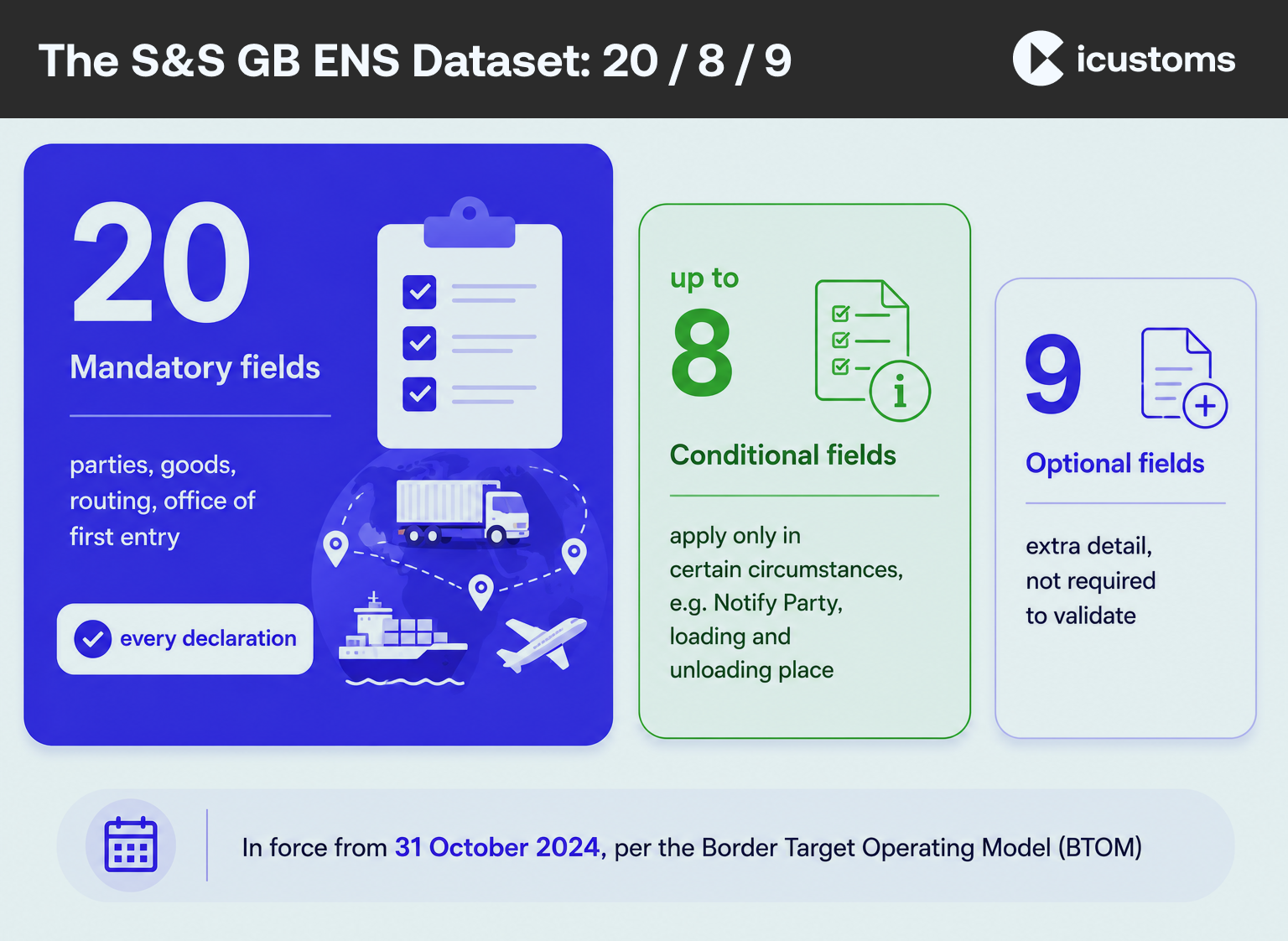
Under the BTOM reduced dataset, an S&S GB ENS uses 20 mandatory fields, up to 8 conditional fields, and 9 optional data fields. The mandatory fields cover the parties, goods and routing; conditional fields apply only in set circumstances, such as certain Notify Party or loading-place details; optional fields add extra detail. Miss a mandatory field and the declaration will not validate. See the full ENS declaration requirements.
How to file an S&S GB ENS
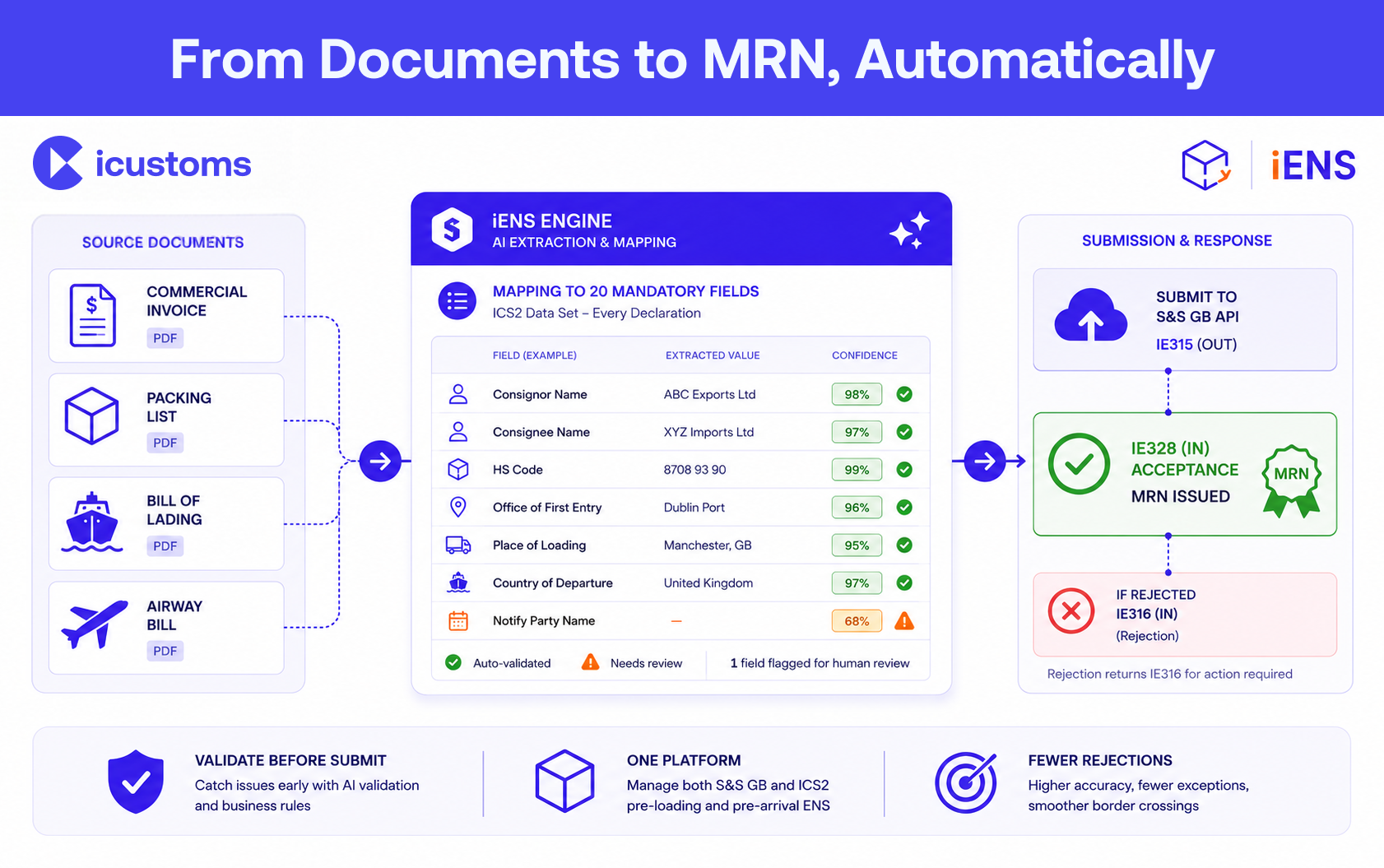
You file through a portal or through software connected to the S&S GB API. A new declaration is sent as an IE315 message; a successful one returns an IE328 acceptance with your MRN, and a failed one an IE316 rejection. Amendments use IE313, and if customs need to act before arrival they send an IE351 intervention notification to acknowledge. Pass the MRN to the carrier, and for UK road movements it links into the Goods Vehicle Movement Service (GVMS). Our step-by-step guide to filing an ENS walks through each stage.
Common errors and penalties
Most rejections come from a missing EORI, a vague goods description, a conditional field handled wrongly, or a late submission. The cost is operational first: goods held, flagged or refused loading, with penalties possible from HMRC or EU customs. Validating the data before it reaches the border, rather than after, prevents almost all of them. Our piece on common filing mistakes and the ENS penalties guide explain what is at stake.
Automating S&S GB ENS filing
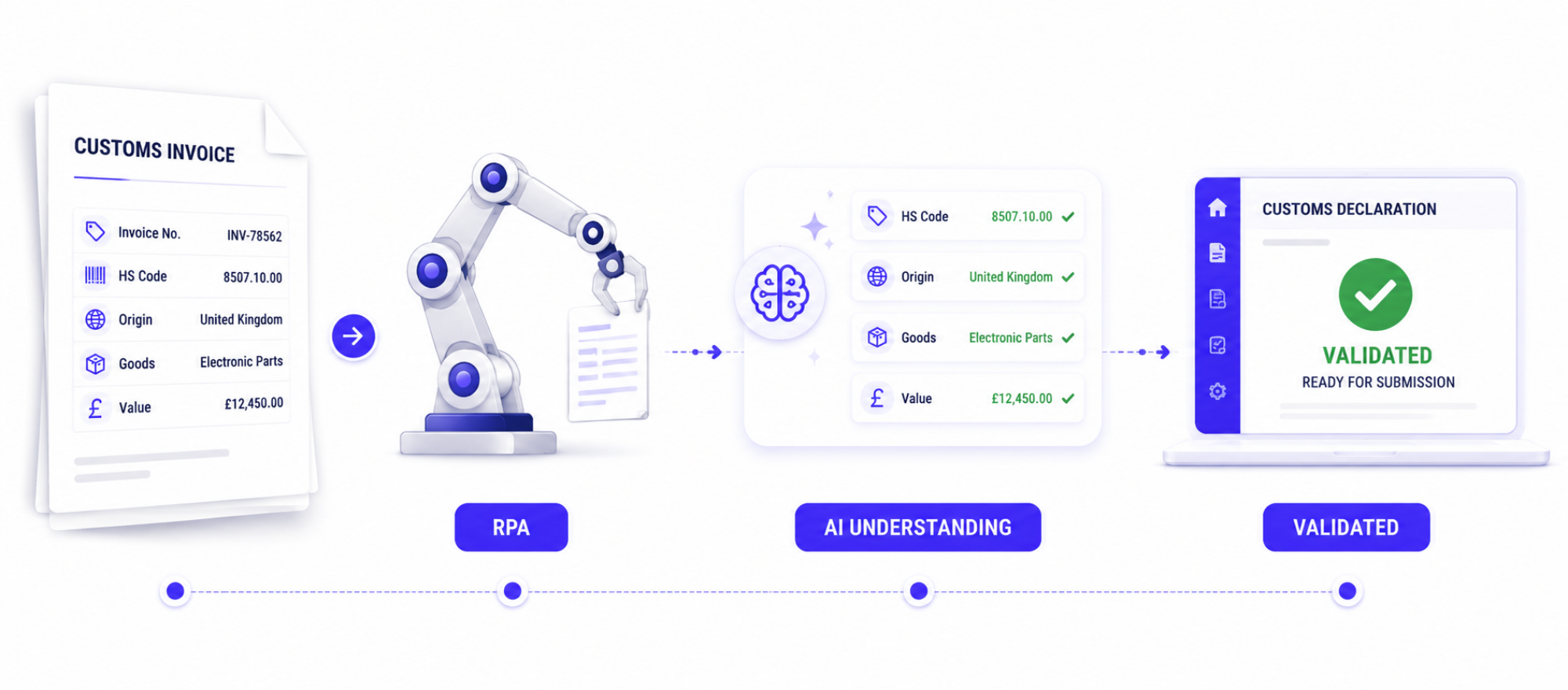
Volume is the real challenge. A busy forwarder files hundreds of declarations across modes and both systems. The data an S&S GB ENS needs already sits in your paperwork: the parties on the commercial invoice, the weights on the packing list, the routing and container numbers on the bill of lading or airway bill. iENS from iCustoms reads those documents, extracts the data, maps it to the mandatory and conditional fields, validates before submission, and files to the S&S GB API to return the MRN.
For a forwarder that means:
- fewer rejections, because data is validated before it is sent
- faster filing, because fields are pre-filled from source documents
- one platform for both UK S&S GB and EU ICS2 declarations
- deadline visibility across every mode, so nothing is lodged late
See how it works on the iENS Entry Summary Declaration page.
Frequently Asked Questions
What is an S&S GB ENS?
An S&S GB ENS is the Entry Summary Declaration submitted through the UK's Safety and Security GB service before goods arrive in Great Britain, so customs can screen the shipment for risk.
Who submits the S&S GB ENS?
The carrier holds the legal duty, but freight forwarders and agents often file on their behalf. Whoever files needs a GB EORI and S&S GB enrolment.
When is an S&S GB ENS required?
Before the goods arrive in Great Britain, and for deep-sea containerised shipping before the container is loaded. The exact deadline depends on the transport mode.
Do I need both S&S GB and ICS2?
You file S&S GB for goods entering Great Britain and ICS2 for goods entering the EU. Traffic in both directions can need both.
Can S&S GB ENS filing be automated?
Yes. Software connected to the S&S GB API can build, validate and submit declarations automatically. iENS extracts the data from your shipping documents and files both S&S GB and ICS2 declarations.
You may also like:
Struggling to Extract, Catagorise & Validate Your Documents?

Capture & Upload Data in Seconds with AI & Machine Learning
Subscribe to our Newsletter
About iCustoms
iCustoms is an all-in-one solution helping businesses automate customs processes more efficiently. With AI-powered and machine-learning capabilities, iCustoms is designed to streamline your all customs procedures in a few minutes, cut additional costs and save time.
Struggling to Extract, Catagorise & Validate Your Documents?
Capture & Upload Data in Seconds with AI & Machine Learning