
ENS for Air Cargo UK & EU: What Airlines and Air Freight Agents Must Know
- John Hall
- Customs Specialist at iCustoms.ai
For air cargo, the airline that issued the air waybill is the carrier responsible for the Entry Summary Declaration.
Air has two things no other mode combines: a very short pre-arrival window tied to take-off, and, for the EU, a separate pre-loading data requirement before the cargo is even put on the aircraft.
This is the air view of ENS for airlines and air freight agents, covering both UK S&S GB and EU ICS2. For the full cluster, start with our S&S GB ENS pillar guide.
Who files the ENS for air cargo?
The carrier is the airline that contracted and issued the air waybill, and the legal duty to lodge the ENS sits with them. Where a freight forwarder consolidates cargo under house air waybills, that forwarder may file at house level. As with any mode, agree who files so a consignment is not declared twice or missed, and remember the airline keeps the legal responsibility even when an agent files. See who is responsible for filing the ENS for the detail.
Air cargo ENS deadlines (UK S&S GB)
| Flight Type | ENS Deadline (Minimum) |
|---|---|
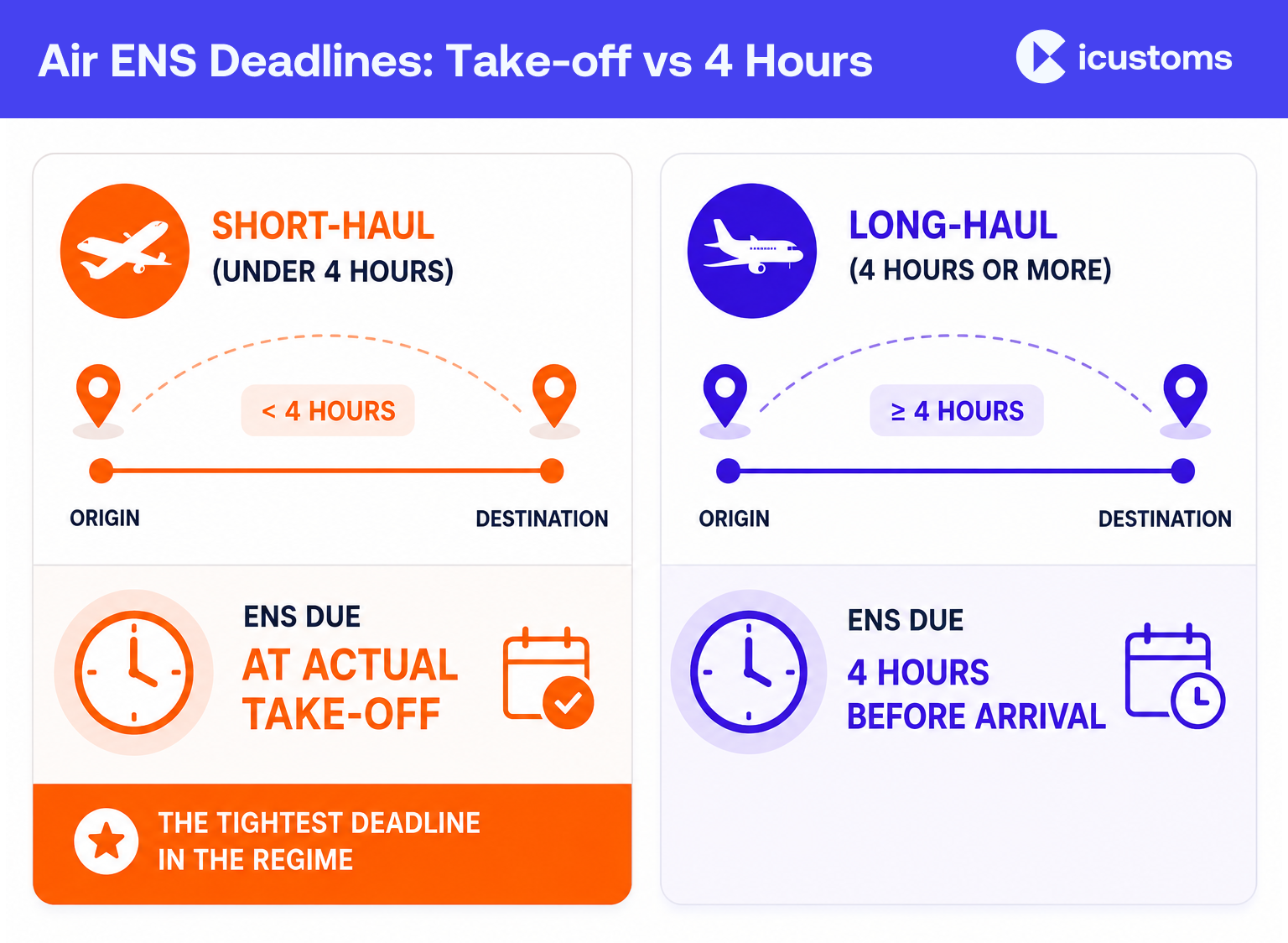
| Short-haul flights (under 4 hours) | At the time of actual take-off |
| Long-haul flights (4 hours or more) | At least 4 hours before arrival |
Short-haul is the tightest deadline in the whole regime: the pre-arrival ENS must be in by the moment the aircraft takes off. The full mode table is in our ENS deadlines by transport mode guide.
The EU difference: ICS2 pre-loading data for air
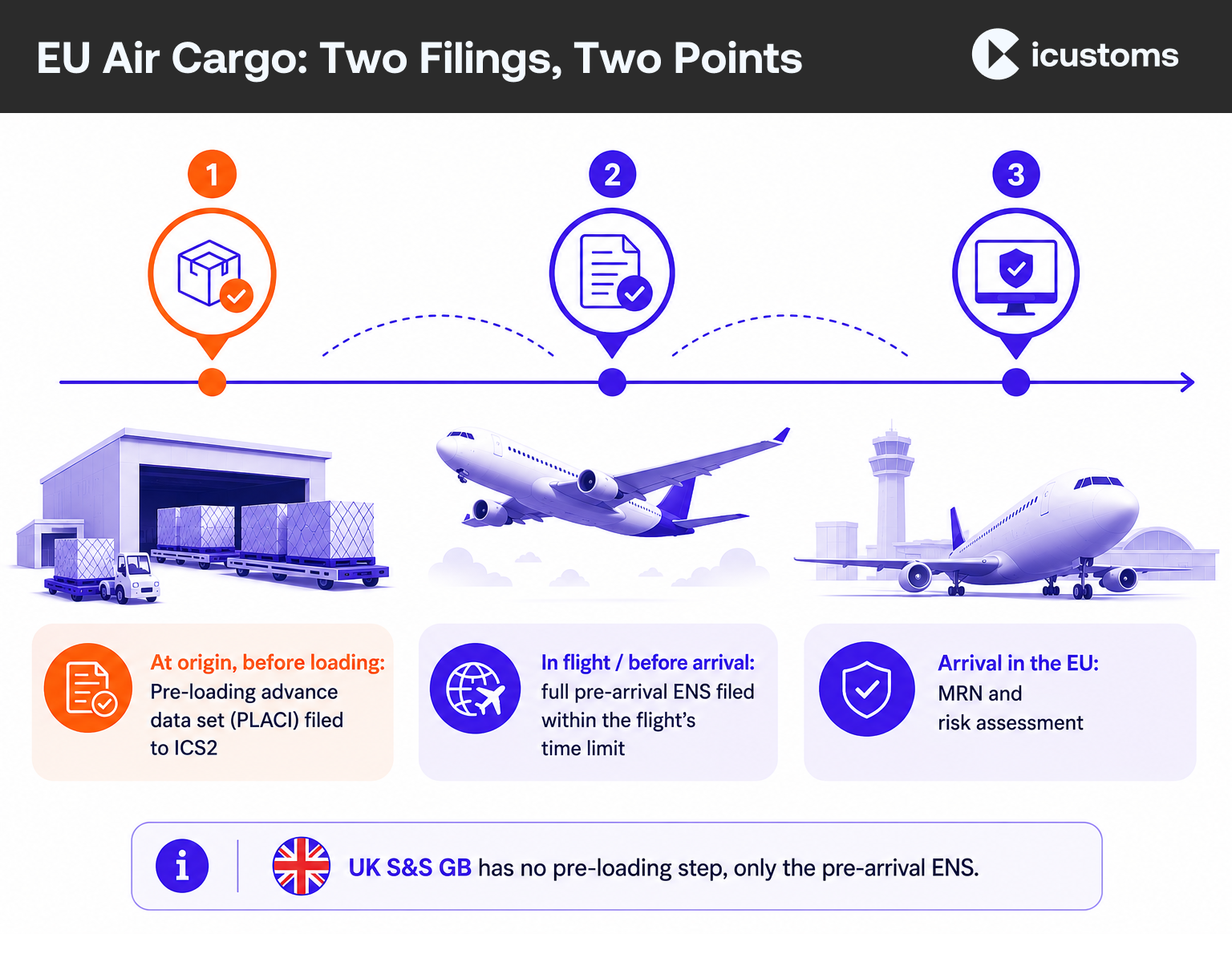
Air is the one mode where the EU asks for data before loading, not just before arrival. Under ICS2, air carriers, freight forwarders, express couriers and postal operators must file a pre-loading advance cargo data set (often called PLACI) before goods are loaded onto an aircraft bound for or through the EU, in addition to the pre-arrival ENS.
The practical effect for airlines and agents is that the clock starts at the origin, before the cargo is accepted onto the aircraft. If you move air freight into the EU, treat pre-loading as a separate, earlier obligation and build it into your acceptance process rather than your arrival process.
Master vs house air waybill filing
On consolidated air freight, the same principle applies as at sea. The airline files against the master air waybill, while a forwarder may file at house level for the individual house air waybills in the consolidation. Getting the master and house filings aligned is what keeps a consolidation from being partly undeclared.
After you file: the MRN
Once the declaration passes validation, S&S GB or ICS2 issues a Movement Reference Number as proof of acceptance, and the cargo is risk assessed. You can amend a declaration until the goods arrive if flight details change, but the original must still have been lodged on time. The ENS is separate from the customs import declaration, so filing it does not clear the goods for duty and VAT.
How iENS helps airlines and agents
Air cargo runs on the tightest timelines in freight, so a slow or error-prone filing step is a real operational risk. iENS from iCustoms reads the air waybill and shipment data, validates it, and files the ENS, and the EU pre-loading data, ahead of the cut-off, returning the MRN and flagging interventions early. See how it works on the iENS Entry Summary Declaration
Frequently Asked Questions
What is the ENS deadline for air cargo?
For short-haul flights under 4 hours, the ENS must be lodged by the time of actual take-off. For long-haul flights of 4 hours or more, it is at least 4 hours before arrival.
Who files the ENS for air freight?
The airline that issued the air waybill. A freight forwarder may file at house level for consolidated cargo, but the airline keeps the legal responsibility.
What is ICS2 pre-loading (PLACI) for air?
For air cargo into or through the EU, ICS2 requires a pre-loading advance data set to be filed before the goods are loaded onto the aircraft, on top of the pre-arrival ENS.
Do I need to file both pre-loading data and an ENS for the EU?
For EU air movements, yes. The pre-loading data set is filed before the cargo is loaded, and the full pre-arrival ENS is filed within the flight's time limit. They are two separate steps at two different points in the journey.
Does air cargo into Great Britain need pre-loading data?
No. The EU pre-loading data set applies to ICS2. For imports into Great Britain through S&S GB, you file the pre-arrival ENS to the short-haul or long-haul deadline.
You may also like:
Struggling to Extract, Catagorise & Validate Your Documents?

Capture & Upload Data in Seconds with AI & Machine Learning
Subscribe to our Newsletter
About iCustoms
iCustoms is an all-in-one solution helping businesses automate customs processes more efficiently. With AI-powered and machine-learning capabilities, iCustoms is designed to streamline your all customs procedures in a few minutes, cut additional costs and save time.
Struggling to Extract, Catagorise & Validate Your Documents?
Capture & Upload Data in Seconds with AI & Machine Learning