

Sustainable Logistics: A Competitive Edge in International Trade
-
 Freya Jane
- Director of Customer's Success
Do you ever worry about the difficulties of trade compliance as an importer or exporter?
Whether or not you believe that there is a crisis caused by climate change, it is undeniable that sustainability has grown in importance for businesses, as customer s prefer to do business with companies that practice environmentally responsible practices.
As per Vantage Market Research, the global logistics market will touch $570.9 billion by 2030 compared to $261.5 billion in 2022.
Therefore, it is imperative that eco-friendly practices be incorporated into all aspects of business, including international trade logistics.
Understanding sustainable logistics
Sustainable logistics, also known as green logistics, refers to the implementation of various environmentally friendly practices to reduce the carbon footprint of logistics operations. It includes optimising route planning, reducing carbon emissions, and promoting eco-friendly transportation of goods.
Significance of sustainable logistics in international trade
Sustainability in logistics benefits the environment and helps companies adhere to legal requirements for international trade.
In the last few decades, our perception of industry has evolved completely due to several research studies demonstrating the negative impact of excessive carbon emissions on the environment. Thus, to minimise this, businesses should adopt green trade practices to cut waste and carbon emissions.
How sustainable logistics is beneficial for global businesses
Sustainable logistics can benefit global businesses in the following ways:
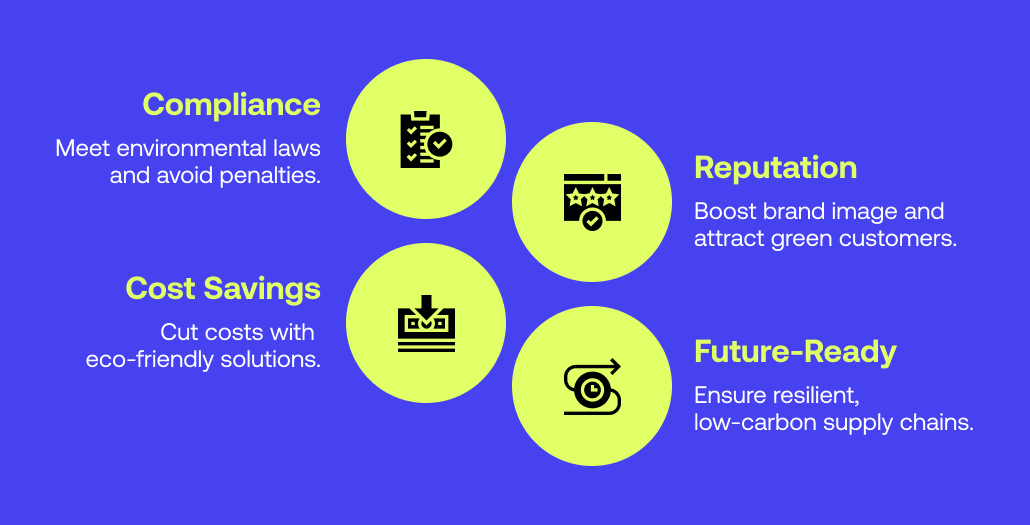
Fulfilling regulatory requirements
International trade organisations such as HMRC are enforcing stricter environmental laws. Companies can use sustainable logistics methods to guarantee adherence to these regulations and prevent penalties, hold-ups, and harm to their brand.
Adhering to green trading schemes or the European Union’s Green Deal can also give companies an advantage in international markets.
Improving brand reputation
Sustainable practices are becoming more and more important to stakeholders and consumers. Green logistics investments show business social responsibility, which improves consumer loyalty and brand image.
Having a solid reputation as a sustainable business helps draw in partners and customers who care about the environment.
Saving costs
In international trade, efficiency is correlated with sustainability. Using paperless solutions to automate customs declaration and using fuel-efficient vehicles can lead to considerable reductions in costs.
Future-proofing operations
The global businesses that employ eco-friendly logistics companies are better equipped to adjust as the world economy shifts to a low-carbon future.
Eco-friendly logistics companies are better equipped to adjust as the world economy shifts to a low-carbon future. By reducing the risks of resource shortage, environmental disruptions, and variable fuel prices, they can make sure that their supply chains are resilient.
How can you attain sustainability in logistics?
Follow these practices to attain sustainability in logistics:
Use advanced technology
Innovative technologies like artificial intelligence and blockchain increase trade visibility and efficiency. Moreover, you can use Internet of Things (IoT) devices to track logistics emissions in real-time, improving sustainability, while trade compliance software streamlines customs procedures.
How iCustoms encourages eco-friendly transportation
With its AI-powered automated solutions, iCustoms is leading the way in promoting sustainable logistics.
iCustoms assists companies in achieving more environmentally friendly and effective logistical operations by incorporating cutting-edge technologies into trade compliance and customs administration procedures.
Here are a few of the main solutions:
Customs Declaration Software (CDS)
iCustoms’ CDS solution automates and simplifies the filing of customs declarations. This results in less paperwork and fewer mistakes, which speeds up clearance processes and uses fewer resources.
CDS helps lessen the negative effects of delays and inefficiency on the environment by streamlining customs operations.
iClassification
The iClassification tool from iCustoms uses AI to correctly identify products based on HS codes. This lowers the possibility of rework or fines and guarantees adherence to trade laws.
By removing unnecessary delays and storage inefficiencies, accurate classification helps to streamline logistics procedures.
Intelligent Document Processing (IDP)
IDP automates the extraction and processing of trade-related documents. By doing away with manual data entry, time and resources are greatly reduced.
IDP facilitates paperless operations by optimising documentation workflows, thereby coordinating logistics procedures with sustainability objectives.
In addition to increasing operational effectiveness, these AI-driven solutions support international initiatives to develop more environmentally friendly supply chains.
Other than AI solutions, you should also consider these measures:
Improving transportation systems: Effective route planning, load optimisation, and customs procedures can help the logistics industry significantly reduce carbon emissions. Customs software solutions can be employed to digitalise these processes.
Switching to green vehicles: Electric vehicles and alternatives like biodiesels are revolutionising logistics businesses. To improve their environmental impact, several businesses are investing in green fleets and expediting customs compliance for these cars.
Using renewable energy: To match infrastructure with sustainable trade goals, warehouses, distribution centres, and customs offices that are powered by renewable energy sources like solar or wind not only cut emissions but also slash energy costs.
Eco-friendly packaging options: To lessen the impact on the environment, switching from single-use plastics to recyclable or biodegradable materials reduces packaging waste and expedites international shipping procedures.
Collaborating with green partners: A continuous dedication to sustainability across the global supply chain is ensured by collaborating with logistics companies, customs brokers, and suppliers who practice environmental responsibility.
Wrapping up
Sustainable logistics is a wise business decision to protect the environment. Businesses that incorporate sustainability into their logistical processes establish themselves as global commerce leaders.
Businesses can help create a greener future by minimising their negative effects on the environment, increasing their efficiency, and coordinating with international sustainability objectives.
Adopting sustainable logistics is about creating a better environment for future generations, not just about being competitive.
Frequently Asked Questions
What is an Entry Summary Declaration and why do many traders delegate it to carriers?
An Entry Summary Declaration (ENS) is a mandatory pre-arrival safety and security filing submitted to customs authorities before goods enter the UK. Many traders historically delegate ENS to their carriers because the process appears complex and the obligation technically rests with the carrier as the active transporter. However, outsourcing removes the trader's visibility and direct control over their own shipment data, submission timelines, and the ability to resolve errors quickly.
What confidentiality risks arise when traders rely on carriers to submit ENS declarations?
When carriers handle ENS submissions, they gain access to commercially sensitive shipment data including supplier identities, freight costs, routing arrangements, and product details. This creates a confidentiality exposure that competitors or market intermediaries could potentially exploit. By self-filing ENS using dedicated automation software, traders restrict access to authorised internal staff only and retain full governance over how sensitive trade intelligence is stored, managed, and processed.
How does in-house ENS submission reduce costs compared to outsourcing to carriers?
Carriers typically charge a per-shipment handling fee for processing ENS submissions on behalf of traders, which accumulates significantly for businesses with regular import volumes. Investing in ENS automation software converts this into a fixed operational cost, eliminating ongoing carrier service fees. The software simultaneously handles multiple declarations and reduces the risk of penalties arising from inaccurate or late submissions, delivering measurable cost savings over time.
How does automated ENS software improve declaration accuracy compared to carrier-managed filing?
Automated ENS software validates each data field in real time against regulatory requirements before submission, catching errors that manual or carrier-managed processes frequently miss. This built-in validation prevents rejection flags from customs authorities and reduces the need for costly amendments. Traders also gain direct editing access, so any changes to shipment details — rerouting, corrections, or late additions — can be applied immediately rather than relayed through a carrier intermediary.
What happens when customs authorities flag an ENS submission with errors, and how does self-filing help?
When customs flag an ENS with missing or inaccurate data, the declaration must be corrected and resubmitted before goods are cleared. If a carrier manages the submission, the trader depends on the carrier to relay and act on the alert, adding delays to an already time-sensitive process. Self-filing with ENS automation software provides instant notifications directly to the trader, enabling same-day corrections without intermediary communication delays.
How does ENS automation software improve operational efficiency for high-volume importers?
High-volume importers processing multiple shipments simultaneously face significant bottlenecks when ENS filings are managed manually or outsourced to carriers. Automation software processes declarations in parallel, ensuring goods are submitted for clearance without delays caused by carrier scheduling or manual data entry queues. Most platforms also integrate with existing supply chain and logistics systems, enabling seamless data flow from order management through to border submission and reducing duplicated data entry.
What criteria should traders use to evaluate ENS automation software for self-filing?
Traders evaluating ENS automation software should prioritise real-time data validation, direct HMRC S&S GB system connectivity, and multi-mode transport support covering road, air, and maritime movements. Integration capability with existing logistics and ERP platforms avoids duplicated data entry. A scalable pricing model accommodating fluctuating shipment volumes, an intuitive interface reducing staff training overhead, and responsive compliance support for regulatory updates are also essential to achieving a sustainable, carrier-independent ENS filing operation.
You may also like:

Tired of compliance issues, delays, and fines? Streamline your operations with iCustoms.

Reduce costs, minimise risks, and improve efficiency
Subscribe to our Newsletter
About iCustoms
iCustoms is an all-in-one solution helping businesses automate customs processes more efficiently. With AI-powered and machine-learning capabilities, iCustoms is designed to streamline your all customs procedures in a few minutes, cut additional costs and save time.
Tired of compliance issues, delays, and fines? Streamline your operations with iCustoms.
Reduce costs, minimise risks, and improve efficiency