
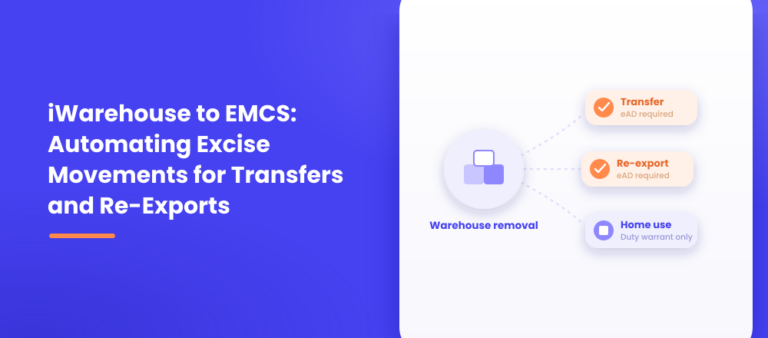
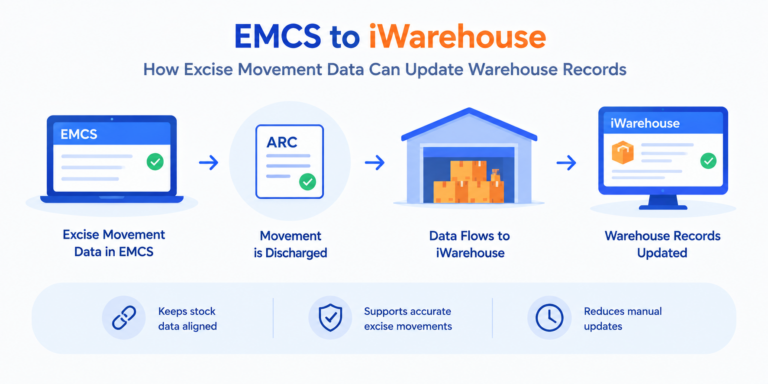
EMCS to iWarehouse: How Excise Movement Data Can Update Warehouse Records
- John Hall
- Customs Specialist at iCustoms.ai
An EMCS movement can be discharged correctly, on time, with no discrepancy, and still leave a warehouse’s own stock system wrong for days. That happens whenever filing the report of receipt in EMCS and updating the warehouse’s own records are two separate actions rather than one, because the second one waits for somebody to notice the first one happened.
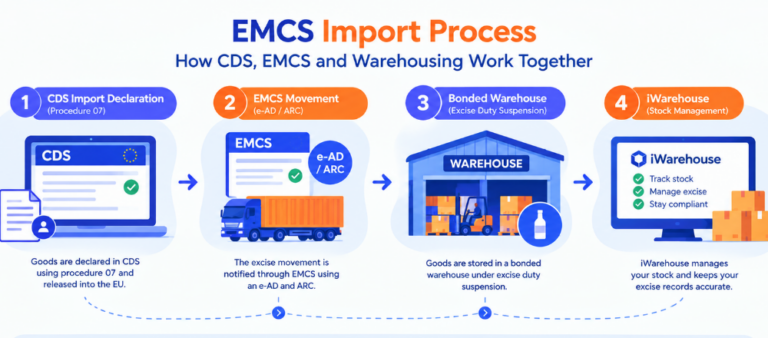
This guide looks specifically at that second handoff: what happens between an EMCS movement being discharged and a warehouse’s own stock record reflecting it. For the full import journey from CDS declaration to warehouse arrival, see our guide to the EMCS import process.
What Actually Happens When an EMCS Movement Arrives
The eAD travels with the goods, and when they arrive the warehousekeeper checks the physical delivery against it, recording any shortage or surplus rather than just confirming a round number. That check becomes a report of receipt, submitted through EMCS within the five business days HMRC allows. Filing it is what discharges the movement and releases the consignor’s movement guarantee. Our EMCS import process guide covers how the movement gets to this point; this article starts from the moment the report of receipt is filed.
From Report of Receipt to Warehouse Stock Record
The report of receipt already contains everything a stock record needs: the ARC the goods arrived under, the quantity actually received against what was dispatched, and any discrepancy. In practice, though, filing it in EMCS and updating the warehouse’s own stock system are still two separate actions in most operations, done in two different places, often by two different people, and often on two different days.
iWarehouse closes that gap. It creates the stock record automatically when goods arrive under an EMCS movement, using the same ARC and report of receipt data rather than asking someone to look the movement up and re-key what already exists elsewhere. Stock is tracked in real time at owner and lot level, which matters as much for a single-client bonded warehouse as it does for one holding stock on behalf of several producers at once.
What Gets Recorded, and Why the Detail Matters
A stock record that only says “goods arrived” is not enough to run a warehouse on. What actually needs to carry across from the movement is the ARC it arrived under, the quantity received against the quantity dispatched, any shortage or surplus flagged at receipt, and the duty status of the stock now sitting on the shelf.
That last point is where mistakes get expensive. Goods that arrive under an EMCS movement are duty-suspended, and they stay that way in the warehouse’s own records until something changes that, a further duty-suspended movement out, or release for consumption with duty paid. iWarehouse maintains that duty-status distinction between suspended and released stock automatically as part of the same record, so a warehouse operator is never relying on memory or a separate spreadsheet to know which pallets can still move under bond and which cannot.
Why This Matters for W1 Returns and Audits
Warehousekeepers still have to account to HMRC periodically for what has moved through the warehouse and what duty is due on it, through the W1 excise warehouse return. A return built from a stock record that was reconciled by hand, sometimes days after the goods actually arrived, carries forward whatever small errors crept in during that gap. A stock record that updates automatically from the EMCS movement itself does not carry that lag, which is what iWarehouse means by W1-ready stock visibility: the return is a reflection of records that were already accurate, not a reconciliation exercise done specially to produce it. The same connected record is what stands behind the platform’s audit trail if HMRC ever asks to see how a specific consignment was accounted for.
A Short Worked Example
A bonded warehouse in Scotland receives a duty-suspended movement of spirits from a distillery a few miles away. The eAD arrives with the tanker, the warehouse team checks the delivery against it and finds one case short of what was dispatched, and the report of receipt is filed in EMCS the same afternoon recording that shortage. Because the warehouse runs iWarehouse, the stock record updates automatically from that same report of receipt: the ARC, the quantity actually received, the shortage, and the duty-suspended status all land in the warehouse’s own system without anyone re-keying them from a printout. When the next W1 return is due, the figures for that delivery are already correct, rather than needing to be reconstructed from a paper receipt note.
Common Misconceptions
Filing the report of receipt in EMCS also updates warehouse stock. It does not, on its own. EMCS and a warehouse’s own stock system are separate unless something connects them.
A discrepancy at receipt is just a note for HMRC. It also has to be reflected in the warehouse’s own duty-suspended stock figure, or later reconciliation and the next W1 return will not match what EMCS shows.
iWarehouse manages the EMCS movement itself. It does not. iEMCS is the product that manages the e-AD and the movement while it is happening. iWarehouse’s job starts once that movement is discharged and turns into a warehouse stock record.
Things to Take Away
- A report of receipt in EMCS and a warehouse stock update are two separate actions unless the systems are connected.
- iWarehouse creates the stock record automatically when goods arrive under an EMCS movement, using the same ARC and report of receipt data.
- The stock record needs to capture quantity received against quantity dispatched, any discrepancy, and duty status, not just that goods arrived.
- Accurate, connected stock records make W1 excise warehouse returns and HMRC audits more straightforward.
- iEMCS manages the movement itself; iWarehouse is what turns a discharged movement into a warehouse stock record.
Frequently Asked Questions
How does EMCS data update warehouse stock records?
Through the report of receipt filed when goods arrive. On its own, EMCS does not update a separate warehouse system; that requires the two to be connected, which is what iWarehouse does automatically.
Does filing a report of receipt automatically update my warehouse system?
Only if that system is connected to EMCS. iWarehouse creates the stock record from the same report of receipt data rather than requiring a second, manual update.
What is the difference between iEMCS and iWarehouse?
iEMCS manages the EMCS movement itself, preparing, validating and tracking the e-AD. iWarehouse manages what happens once that movement is discharged, turning it into an accurate warehouse stock record.
Why does duty status matter for a stock record?
It determines what can legally happen to the stock next. Duty-suspended goods can move again under bond; released goods cannot, because duty has already been accounted for.
Does this affect my W1 return?
Yes. A W1 return is only as accurate as the stock records behind it, and a record that updates automatically from the EMCS movement avoids the lag and small errors that manual reconciliation introduces.
You may also like:

Still Re-Keying EMCS Arrivals Into Your Warehouse System?

iWarehouse creates the stock record automatically the moment an EMCS movement is discharged.
Subscribe to our Newsletter
About iCustoms
iCustoms is an all-in-one solution helping businesses automate customs processes more efficiently. With AI-powered and machine-learning capabilities, iCustoms is designed to streamline your all customs procedures in a few minutes, cut additional costs and save time.
Managing Duty-Suspended and Released Stock in the Same Warehouse?
iWarehouse keeps the duty status distinction clear at owner and lot level, automatically.