ICS2 Release 3 for Road and Rail Hauliers: Requirements, Filing Deadlines, and Compliance Guide (2026)
- Freya Jane
- Director of Customer's Success
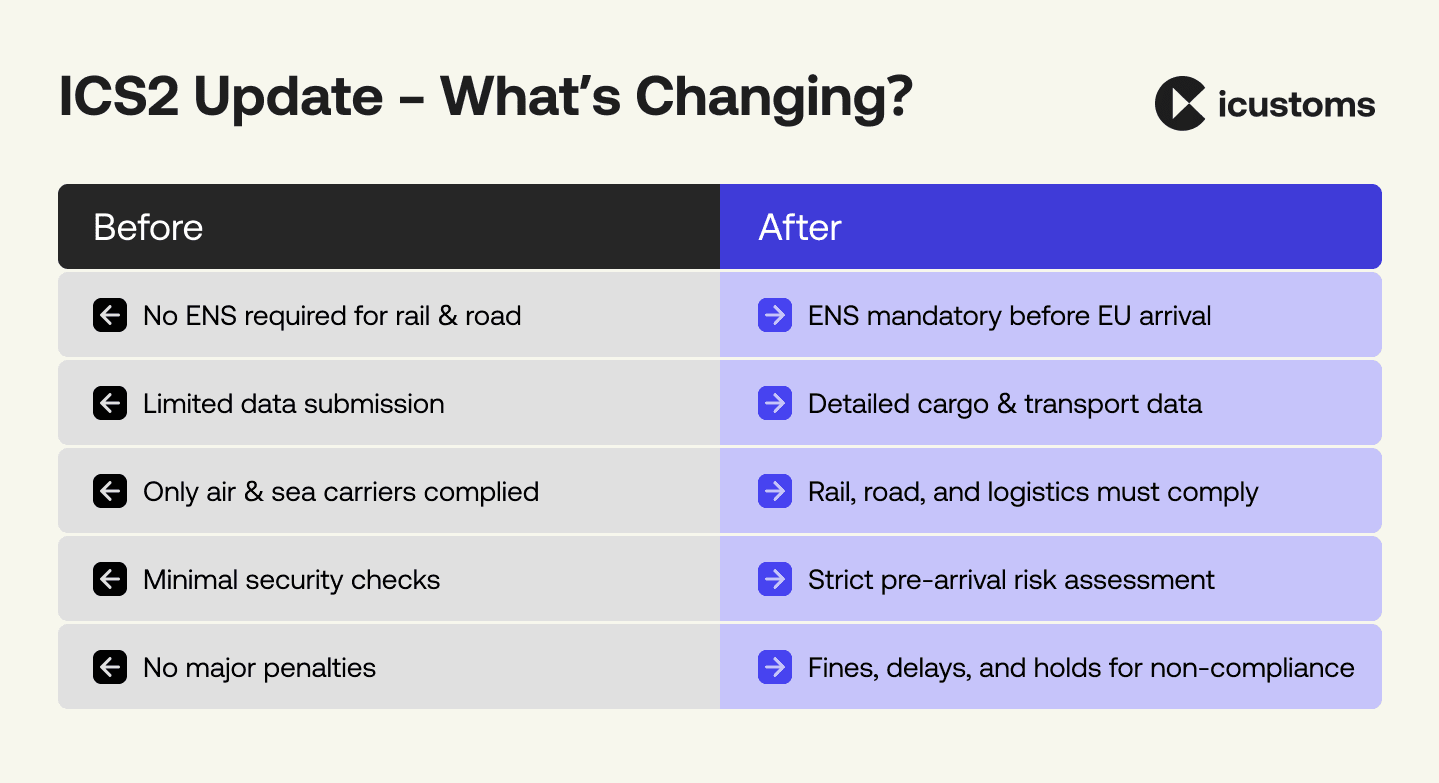
ICS2 Release 3 brought road and rail hauliers fully into the European Union’s advance cargo information system for safety and security. Since 1 April 2025, road hauliers crossing EU borders and rail freight operators carrying goods into or through the EU have been required to submit a complete Entry Summary Declaration (ENS) to the ICS2 system before their goods arrive. Full enforcement across all EU member states came into effect on 1 September 2025.
If you move goods by road or rail into the EU, or if you are a freight forwarder managing road or rail freight movements for clients, ICS2 Release 3 applies to your operation. This guide explains who is responsible, what data must be filed, when it must be submitted, and how automated ICS2 compliance software removes the manual burden of meeting these requirements day to day.
Key Fact: Road freight movements have a 1-hour pre-arrival filing deadline. For cross-Channel traffic entering France via Dover or the Channel Tunnel, this means the ENS must be submitted before the vehicle arrives at the border, in practice, before the driver boards. Late submission at this border results in immediate cargo holds
Want to learn more about ICS2? Click here!
Who is Affected by the ICS2 Release 3 update?
The ICS2 requirements applies to:
| What Changed | Before ICS2 Release 3 (Pre April 2025) | After ICS2 Release 3 (April 2025 Onwards) |
|---|---|---|
| ENS requirement for road freight | No ENS required for road movements from non EU countries into the EU | Full H1 ENS required for all road freight entering EU territory from non EU countries. 1 hour pre arrival deadline. |
| ENS requirement for rail freight | No ENS required for rail movements | Full H1 ENS required for all rail freight entering EU territory. 2 hour pre arrival deadline. |
| Goods description standard | Variable no EU wide advance cargo data requirement for road and rail | Minimum 6 digit HS code required. Vague descriptions such as “general cargo” or “miscellaneous goods” are rejected by ICS2 as stop words. |
| Party data requirements | Not required for road or rail advance filing | EORI numbers for consignor, consignee, and declarant required in every ENS submission. |
| ELO requirement for France | Not applicable for road transit | All road ENS declarations covering France require an ELO Enveloppe Logistique Obligatoire barcode in addition to the ENS submission. |
| RARPC risk responses | No advance risk analysis for road and rail | All ICS2 Release 3 road rail requirements for ENS submissions are subject to automated risk analysis. Risk referrals or “do not load” instructions must be responded to before the vehicle crosses the border. |
| Self conformance testing | Not required | All operators connecting to ICS2 directly must complete self conformance testing before live submission. |
| Transit through the EU | Variable procedures by member state | Goods transiting through the EU by road or rail require ENS filing under ICS2 Release 3, even if the goods are not being cleared for EU free circulation. |
ICS2 Release 3 Road Rail Requirements for Hauliers
ICS2 Release 3 Road rail requirements bounds hauliers to submit the following information for the goods entering the EU from 1 April 2025.
- Consignor and consignee details (names, addresses, EORI numbers)
- Goods description (detailed or commodity code)
- Transport information (mode of transport, journey route, expected arrival time)
- Packaging Details (number and type of packages, total weight)
- The number of packages
What does ICS2 change for Road & Rail hauliers
ICS2 Release 3 Timeline: How Maritime, Road and Rail Were Brought Into Scope
ICS2 was introduced through a phased rollout over four years. Understanding the full timeline (ICS2 Release 3 for maritime, road and rail) is important for compliance teams reviewing whether their current Import Control System 2 implementation covers all the requirements that have now come into force.
| Date | ICS2 Release 3 for Maritime, Road and Rail |
|---|---|
| 15 March 2021 | ICS2 Release 1: Postal and express consignments by air brought into scope (H7 PLACI dataset) |
| 1 March 2023 | ICS2 Release 2: All air freight general cargo brought into scope (H1 full ENS) |
| 3 June 2024 | ICS2 Release 3 Phase 1: Maritime and inland waterways carriers required to submit ENS |
| 4 December 2024 | ICS2 Release 3 Phase 2: Maritime and inland waterways house level filers freight forwarders and consolidators brought into scope |
| 1 April 2025 | ICS2 Release 3 Road and Rail Phase 1: Road and rail carriers required to submit ENS declarations with full H1 dataset. 1 hour pre arrival deadline for road freight. 2 hour pre arrival deadline for rail freight. |
| 1 September 2025 | ICS2 Release 3 Final Phase: Full enforcement across all EU member states and all transport modes. ICS2 now fully operational across EU27, Norway, Switzerland, and Northern Ireland. |
| 31 May 2026 | Latvia derogation expires: Latvia permitted ICS1 or ICS2 combined with NCTS P5 until this date, after which ICS2 is mandatory. |
| June 2026 | Croatia, Poland, Romania, Slovakia: Full ICS2 road and rail framework becomes mandatory for these member states. |
ICS2 ENS Filing Deadlines for Road and Rail Hauliers
The filing deadline is the most operationally critical element of ICS2 compliance for road and rail operators. Unlike maritime freight where the deadline is measured in hours before loading or vessel departure, road freight has a particularly tight 1-hour pre-arrival deadline that creates real operational pressure for cross-border logistics operations.
| Transport Mode | ICS2 ENS Filing Deadline (Maritime, Road and Rail) |
|---|---|
| Road freight | 1 hour before the vehicle arrives at the first point of entry into EU customs territory. For Channel crossings Dover, Eurotunnel, this means the ENS must be submitted before the vehicle boards not before arrival in France. |
| Rail freight | 2 hours before the train arrives at the first EU point of entry. For Channel Tunnel rail freight, the ENS must be submitted at least 2 hours before the train enters EU territory at the Coquelles terminal. |
| Short sea maritime for comparison | 4 hours before the vessel arrives at the EU port. Covers short sea sailings from UK ports to Ireland, the Netherlands, and Belgium. |
| Air freight for comparison | 4 hours before aircraft arrival for general cargo. PLACI must be filed before loading for express and postal items. |
Missing the 1-hour deadline for road freight has immediate consequences. EU customs authorities at the border will hold the vehicle pending risk assessment completion. This hold cannot be resolved by submitting the ENS retrospectively, the deadline must be met before arrival. For hauliers operating tight delivery schedules, even a single missed ENS deadline creates a cascade of delays, driver costs, and client service failures.
Automated ICS2 road transport software eliminates the human error risk around deadline management. iCustoms monitors shipment schedules and triggers ENS submission automatically based on estimated arrival time at the EU border, with alerts if a submission has not been confirmed before the deadline window.
ICS2 Testing, Known Errors, and Stop Words: What Road and Rail Operators Need to Know
ICS2 has a formal testing process and a body of published guidance on common data quality failures. Understanding both is essential for maritime, road and rail operators who are either connecting to ICS2 for the first time or who are experiencing ENS rejections in their current compliance process.
ICS2 Self-Conformance Testing
Before any Economic Operator can submit live ENS declarations to the ICS2 system directly (rather than through a certified ITSP), they must complete a self-conformance test. This test requires the operator to submit a series of test declarations against EU customs test environments and demonstrate that their message formats comply with EUCDM specifications and that their system can correctly handle all ICS2 response messages including ENS acceptance, ENS rejection, RARPC risk responses, and amendment requests.
For most road hauliers and logistics providers, self-conformance testing is handled by their ICS2 compliance software provider. iCustoms has completed the full ICS2 certification process including self-conformance testing as part of its AS4 access point accreditation, which means operators using iCustoms do not need to complete individual testing themselves.
ICS2 Known Error List
The European Commission publishes a Known Error List identifying common technical issues in ICS2 system behaviour that operators should be aware of. The Known Error List is updated regularly as DG TAXUD resolves system issues and releases corrections through the ICS2 release management process. Road and rail operators submitting ENS data should monitor the Known Error List through their software provider or directly via the EU Customs IT portal to stay aware of current system limitations that might affect their filings.
Common operational errors that appear in ENS rejection logs for road freight include: invalid CMR reference formats (the CMR consignment note is the primary road transport document referenced in road ENS filings), EORI numbers that are correctly formatted but not registered in UUM&DS, and goods descriptions that trigger stop-word validation failures.
ICS2 Stop Words: Goods Descriptions That Will Be Rejected
ICS2 maintains a list of “stop words”, generic terms that are insufficient for safety and security risk analysis purposes. When these terms appear as the sole goods description in an ENS submission, the declaration will either be automatically rejected or flagged for risk assessment that will hold the goods at the border.
Road freight operators frequently encounter this issue because cargo manifests and CMR documents often use generic descriptions that are acceptable for transport purposes but fail ICS2 data quality standards. Common ICS2 stop words include: “general cargo,” “miscellaneous goods,” “freight,” “cargo,” “goods,” “various,” “mixed goods,” “package,” and “consolidated shipment.” Any ENS submission using these terms as the primary goods description requires a more specific alternative.
The practical guidance is to use the 6-digit HS code alongside a specific goods description that identifies the nature of the goods. “Electronic components (HS 8534.00)” is a valid description. “General cargo” is not. For road hauliers with diverse cargo in a single vehicle, each distinct goods category must be declared separately with its own HS code and description rather than consolidated under a generic term.
Road hauliers moving consolidated loads: Every distinct goods category on a vehicle must have its own ENS line with a specific 6-digit HS code and description. You cannot consolidate a mixed load under a single generic description. iCustoms automates this line-level data extraction from CMR documents and cargo manifests.
NCTS-P6 and Member State Derogations: What Road Hauliers Need to Know
NCTS-P6 (New Computerised Transit System Phase 6) is relevant for road operators because some EU member states used NCTS-P6 compliance as an alternative pathway during the ICS2 Release 3 transition period. Latvia specifically was permitted to continue using ICS1 combined with NCTS-P5 until 31 May 2026, after which ICS2 becomes mandatory. Croatia, Poland, Romania, and Slovakia have their full ICS2 road and rail framework requirements coming into force in June 2026.
For road hauliers operating routes that transit through Latvia, Poland, Romania, Croatia, or Slovakia, the effective enforcement date of ICS2 may differ from the general September 2025 date. However, the ENS filing obligation applies at the first point of EU entry regardless of the final destination or transit route. A truck entering the EU through Germany (where ICS2 has been fully enforced since September 2025) must file a compliant ENS even if its final destination is Latvia.
iCustoms tracks member state derogation status and ensures that ENS filings are routed correctly for the first EU entry point applicable to each movement, regardless of transit routing through member states with different enforcement timelines.
What will be the consequences of not complying with the requirement?
In case you’re not ready in time, you may encounter the following consequences:
- Goods will be held at the EU customs borders.
- Goods will not be cleared by customs authorities.
- The inadequate declaration will be rejected or subject to amendments, with possible sanctions imposed for non-compliance.


How to be ready for the ICS2 update?
The road and rail hauliers must follow these practices to get ready for the upcoming update:
- Data collection: Companies need to get accurate and comprehensive information from their customers.
- IT System Updates: In order to manage ICS2 data requirements and communication, IT systems must be updated. Investing in dedicated ICS2 road transport software ensures your business can handle ENS submissions accurately and on schedule.
- Operational Process Updates: In order to integrate ICS2 procedures, operational processes need to be modified.
- Training: Staff must receive sufficient training on ICS2 regulations and protocols.
- Self-Conformance Testing: Before connecting to ICS2, businesses must pass a self-conformance test. This test confirms their ability to access and communicate with customs officials.
Attention Road & Rail Businesses: ICS2 Deadline Approaching!
Our software can assist you in handling the complications of data collection and entry, real-time tracking, and automated ENS submissions, guaranteeing that your goods travel across EU borders without any interruption.
Frequently Asked Questions: ICS2 Release 3 for Road and Rail Hauliers
What did ICS2 Release 3 change for road and rail hauliers?
ICS2 Release 3 brought road and rail freight into the EU's advance cargo information system for the first time. From 1 April 2025, road and rail hauliers moving goods into or through the EU are required to submit a complete H1 Entry Summary Declaration (ENS) before their goods arrive at the EU border. Road freight has a 1-hour pre-arrival filing deadline. Rail freight has a 2-hour pre-arrival deadline. The ENS must include a minimum 6-digit HS code, accurate goods description, EORI numbers for all parties, and full routing information. Full enforcement across all EU member states was completed on 1 September 2025.
What are ICS2 stop words and why do they matter for road hauliers?
ICS2 stop words are generic goods description terms that EU customs considers insufficient for safety and security risk analysis. Terms such as "general cargo," "miscellaneous goods," "freight," "various," and "consolidated shipment" are either automatically rejected or flagged for risk review when used as the primary goods description in an ENS. Road hauliers frequently encounter stop-word rejections because CMR transport documents often use generic descriptions. Each distinct goods category on a vehicle must have a specific 6-digit HS code and a description that identifies the nature of the goods.
What is ICS2 self-conformance testing?
ICS2 self-conformance testing is the process by which Economic Operators verify that their IT system can communicate correctly with the EU ICS2 platform before submitting live declarations. The test requires submitting sample declarations against EU customs test environments and confirming that all ICS2 response messages are correctly handled. Operators using a certified IT Service Provider (ITSP) such as iCustoms.ai do not need to complete individual conformance testing — the ITSP has already been certified on their behalf.
Does ICS2 apply to goods transiting through the EU by road?
Yes. ICS2 Release 3 applies to goods transiting through EU customs territory by road or rail, not only goods being cleared for import into the EU. A truck carrying goods from the UK to Turkey via EU member states must file an ICS2 ENS for the EU transit portion of the journey. The filing obligation falls on the carrier or their appointed freight forwarder, and the ENS must be submitted before the vehicle arrives at the first EU entry point.
What is the ICS2 Known Error List?
The ICS2 Known Error List is a document published by the European Commission identifying technical issues in the ICS2 system that may affect how declarations are processed. DG TAXUD updates it regularly as system issues are identified and resolved through the ICS2 release management process. Road and rail operators should monitor the Known Error List through their ICS2 software provider or via the EU Customs IT portal, as known errors can affect ENS submission behaviour and should be taken into account when troubleshooting rejections or unexpected system responses.
How does iCustoms.ai automate ICS2 compliance for road and rail operators?
iCustoms.ai automates ICS2 ENS filing for road and rail operators through direct AS4 access point connectivity to the EU ICS2 system. It extracts data from CMR consignment notes, commercial invoices, and cargo manifests to populate ENS declarations, validates data against ICS2 H1 requirements before submission, checks goods descriptions against the ICS2 stop words list, and submits declarations with automated ELO generation for France-bound road movements. RARPC risk responses from EU customs are monitored automatically with immediate alerts to operators. For road movements, iCustoms.ai tracks shipment schedules and triggers ENS submission to ensure the 1-hour deadline is met before the vehicle reaches the EU border.

Get in touch with us right now to find out more about how iCustoms can streamline your ENS procedure!
You may also like:
Simplify Customs with our Powerful Customs Management Software

Automate declarations, track shipments, & ensure compliance.
About iCustoms
iCustoms is an all-in-one solution helping businesses automate customs processes more efficiently. With AI-powered and machine-learning capabilities, iCustoms is designed to streamline your all customs procedures in a few minutes, cut additional costs and save time.
Simplify Customs with our Powerful Customs Management Software
Automate declarations, track shipments, & ensure compliance.