
How AI Is Redefining Customs Brokerage in the Digital Age: A Guide to AI Customs Automation Software for UK Brokers
- Freya Jane
- Director of Customer's Success
Are you still traditionally processing customs papers? You’re not alone, but things are changing fast.
Customs brokers have had to manually enter data, filter through complicated laws, and double-check every detail for years in order to prevent expensive mistakes.
It is tedious, slow, and prone to errors.
AI is now taking over the labour-intensive tasks. Smart systems are improving the speed, ease, and accuracy of customs procedures by extracting data from invoices and verifying compliance in real time.
This guide covers the full landscape of AI customs brokerage automation for UK brokers: from AI-powered document processing and HS code classification to automated CDS filing, duty calculation, and IOSS compliance. For each capability, we explain which iCustoms product delivers it and what the practical outcome is for your brokerage operation.
Book a free iCustoms demo. See AI customs automation on your own brokerage workflow in 20 minutes.
The Evolution of Customs Brokers: From Manual Paperwork to AI-Powered Automation
Traditionally, customs brokers have spent an enormous amount of time navigating dense regulatory documents, manually entering shipment data, and double-checking declarations for compliance. These repetitive and error-prone tasks have long served as the foundation of customs processing, but they present numerous challenges.
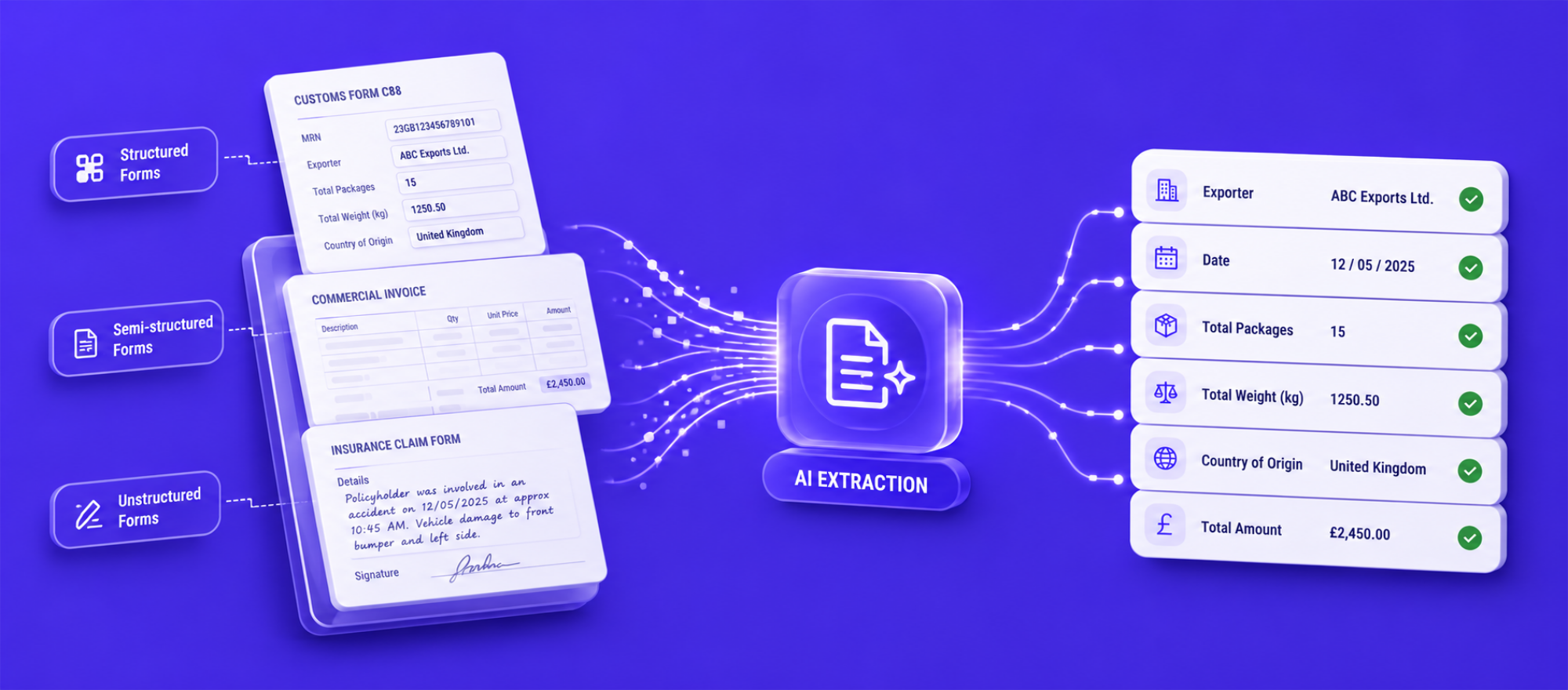
Now, AI is automating much of this groundwork. Advanced data entry systems powered by machine learning and large language models can extract, classify, and validate trade documentation in a fraction of the time it takes a human.
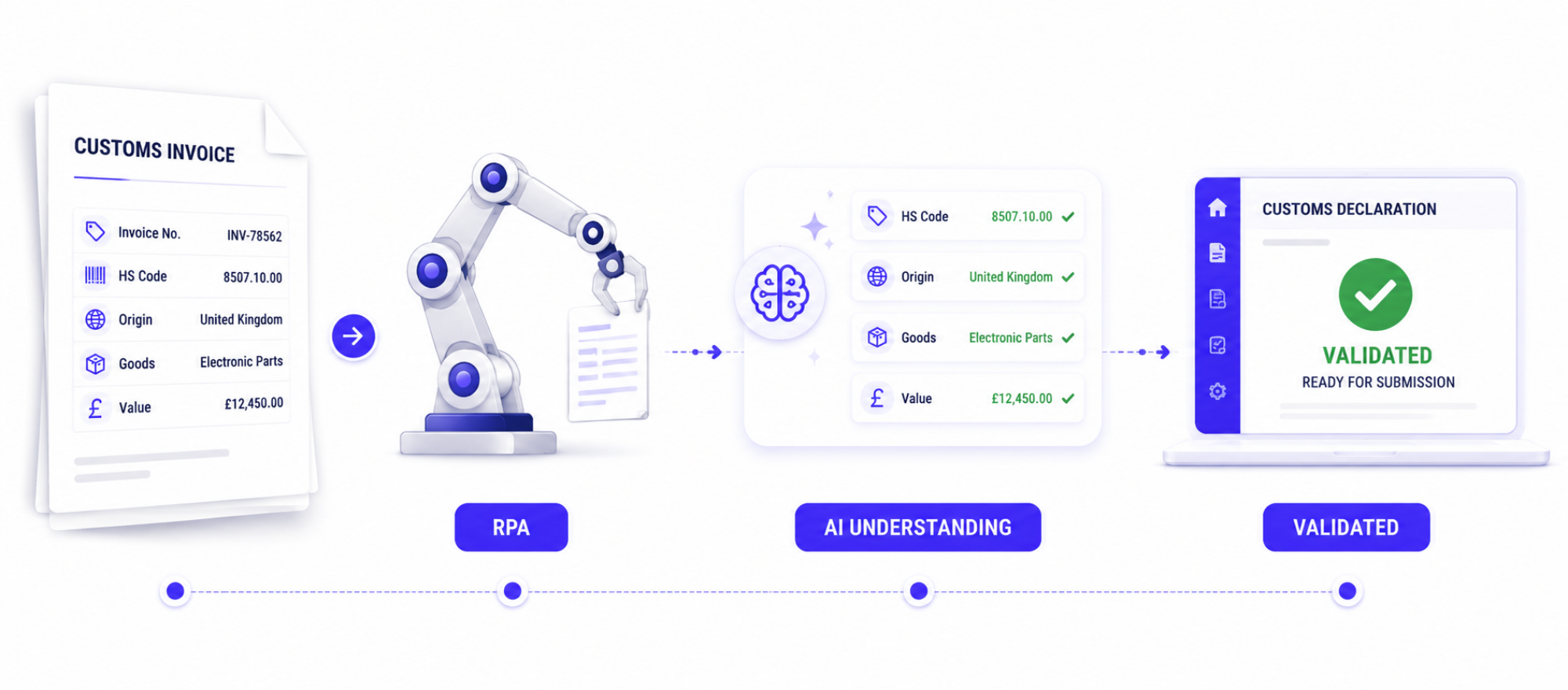
By using AI-driven customs declaration software, customs agents are able to input, analyse, and validate data quickly and more accurately.
Manual Customs Brokerage vs. AI-Powered Customs Brokerage

| Dimension | Manual Customs Brokerage | AI-Powered Customs Brokerage (iCustoms) |
|---|---|---|
| Data Entry | Manual data input from invoices and documents, high risk of human error and delays | Automated data extraction using AI and intelligent document processing with high accuracy and speed |
| HS Classification | Manual classification based on experience, prone to inconsistency and errors | AI HS code classification with confidence scoring and contextual analysis for higher accuracy |
| CDS Filing | Manual submission via HMRC CDS portal, time-consuming and error-prone | Automated CDS filing via API integration with real-time validation and faster processing |
| ENS Filing | Manual ENS submission with repetitive data entry and risk of delays | Automated ENS filing with bulk processing and rapid submission through integrated systems |
| NCTS Transit | Manual transit declaration handling with multiple checkpoints and delays | Automated NCTS processing with real-time tracking and seamless data flow |
| IOSS Compliance | Manual VAT calculations and reporting, high risk of misdeclaration and penalties | AI-driven IOSS compliance with automated VAT calculation, validation, and reporting |
| Error Detection & Compliance | Reactive checks after submission, higher chance of penalties | Proactive AI validation with real-time compliance checks and anomaly detection |
| Processing Speed | Slow, dependent on workforce capacity and working hours | High-speed processing with 24/7 automation and near-instant turnaround |
| Operational Scalability | Limited by team size and manual workload capacity | Scalable operations capable of handling high-volume customs declarations without additional staff |
| System Integration | Disconnected systems with manual data transfer between platforms | Seamless integration with ERP, APIs, and logistics systems for end-to-end automation |
The key ways AI is transforming customs brokerage
1. Real-time data flow and document automation
In customs, time is everything; delays in clearance can result in supply chain disruptions. One of AI’s most immediate impacts is the elimination of manual data entry and documentation issues.
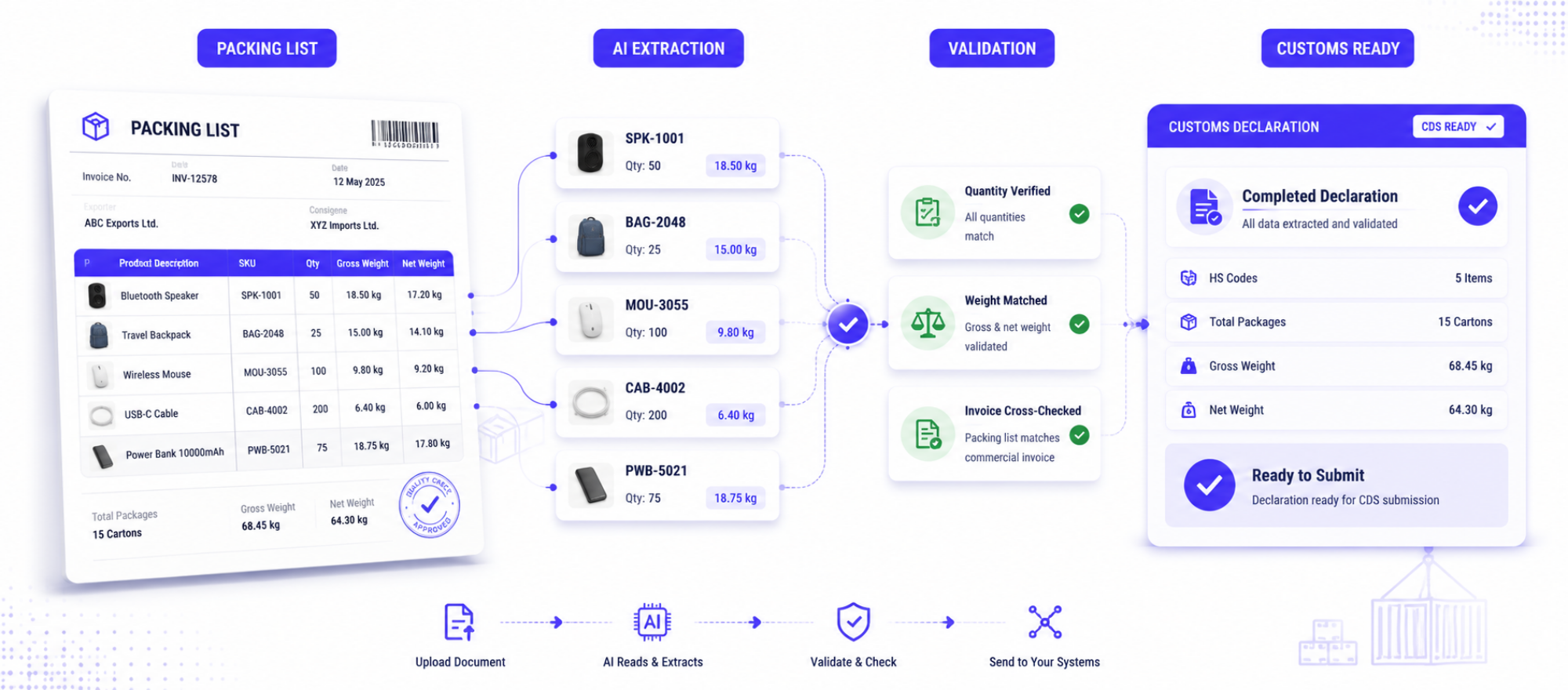
AI-powered systems now extract and process data from invoices, packing lists, bills of lading, and import/export declarations in real time. These tools pull files from shared drives, cloud platforms, APIs, and even email, processing them instantly with high accuracy.
This dramatically reduces clearance delays, prevents document loss, and eliminates backlogs. Brokers benefit from increased speed and transparency, and clients enjoy faster, more predictable trade flows.
For UK customs brokers, iCustoms delivers real-time document automation through two products working together. iCustoms IDP (Intelligent Document Processing) extracts data from commercial invoices, packing lists, air waybills, and bills of lading, converting unstructured documents into structured declaration data. For safety and security ENS requirements, iWiz handles individual S&S GB and ICS2 Entry Summary Declarations with pre-departure validation, while iZap enables batch filing of S&S GB ENS declarations for freight operators managing high shipment volumes. Together, these tools eliminate the manual document handling step that accounts for most clearance delays and data entry errors in traditional customs brokerage.
Try our AI-driven IDP for document automation!
2. Advanced error detection and compliance checks
Customs compliance cannot be neglected at any cost. Even minor data inaccuracies, such as a wrong HS code, a mistyped importer name, or an incorrect origin country, can trigger penalties or shipment holds.
AI systems use machine learning algorithms and business rules to perform deep error detection. These tools not only identify missing fields or anomalies but also verify data based on jurisdiction-specific regulations, customs codes, and documentation standards.
By flagging discrepancies in real time, AI reduces the risk of non-compliance and ensures brokers maintain regulatory excellence.
3. Enhanced operational agility and 24/7 performance
Unlike human teams, AI systems operate around the clock, processing thousands of documents per hour without getting tired. This always-on functionality empowers customs brokerages to scale their operations without increasing team members.
More importantly, brokers can now reallocate human resources toward higher-value activities, such as client relationship management, strategic consulting, trade agreement analysis, and duty optimisation planning.
This shift in roles leads to greater employee satisfaction and increased business value.
4. Seamless integration with enterprise systems
AI systems for customs agents are no longer isolated tools. They are built for seamless integration across platforms.
This integration ensures that every piece of data flows smoothly through an ecosystem, from document capture to regulatory compliance to declaration filing.
AI models can also read complex formats like scanned documents, handwritten invoices, and diverse vendor templates, offering end-to-end automation. This connected infrastructure makes customs brokerage operations more responsive, accurate, and scalable.
iCustoms integrates with the business systems UK brokers already use. For brokers and importers running SAP or Microsoft Dynamics, the iCustoms API feeds customs data (commodity codes, duty calculations, declaration status) directly into financial workflows without manual re-entry. For ecommerce operators using Shopify or WooCommerce, iCustoms API integration enables automated duty calculation and TARIC code assignment at the product level, so customs costs are visible before orders are shipped. For businesses operating warehouse management systems, the iCustoms API connects classification and declaration data to inventory workflows, ensuring customs codes are consistent across procurement, storage, and export processes.
5. IOSS Compliance Automation for Customs Brokers Serving Ecommerce Clients
As ecommerce cross-border trade grows, customs brokers are increasingly asked to handle IOSS (Import One Stop Shop) compliance for their ecommerce clients. IOSS allows sellers to pre-collect EU VAT on goods valued under EUR 150 shipped to EU consumers, removing the point-of-import VAT charge. For customs brokers, managing IOSS compliance means tracking VAT rates across 27 EU member states, verifying IOSS registration numbers, and, from July 2026, generating full 10-digit EU TARIC codes for every IOSS shipment.
AI customs automation tools significantly reduce the manual burden of IOSS compliance. Automated IOSS compliance software calculates the correct VAT rate for each destination country, validates the seller’s IOSS registration number, and assigns the correct 10-digit TARIC code for each product category. iCustoms supports IOSS compliance automation as part of its EU-facing customs capability, enabling customs brokers to offer IOSS compliance as a service without proportionally scaling their compliance team headcount.
The July 2026 TARIC code requirement is the most pressing IOSS compliance deadline for customs brokers with ecommerce clients. Brokers who have not yet implemented automated TARIC code assignment for IOSS shipments should audit their current process now and assess whether manual 6-digit HS classification is being used where 10-digit TARIC codes will be legally required.
AI-Powered Customs Brokerage Tools: iCustoms Products for UK Brokers
AI-driven tools and platforms are redefining modern customs brokerage. These products are not generic automation systems; they’re built specifically for customs and international trade workflows.
1. Customs declaration software (CDS)
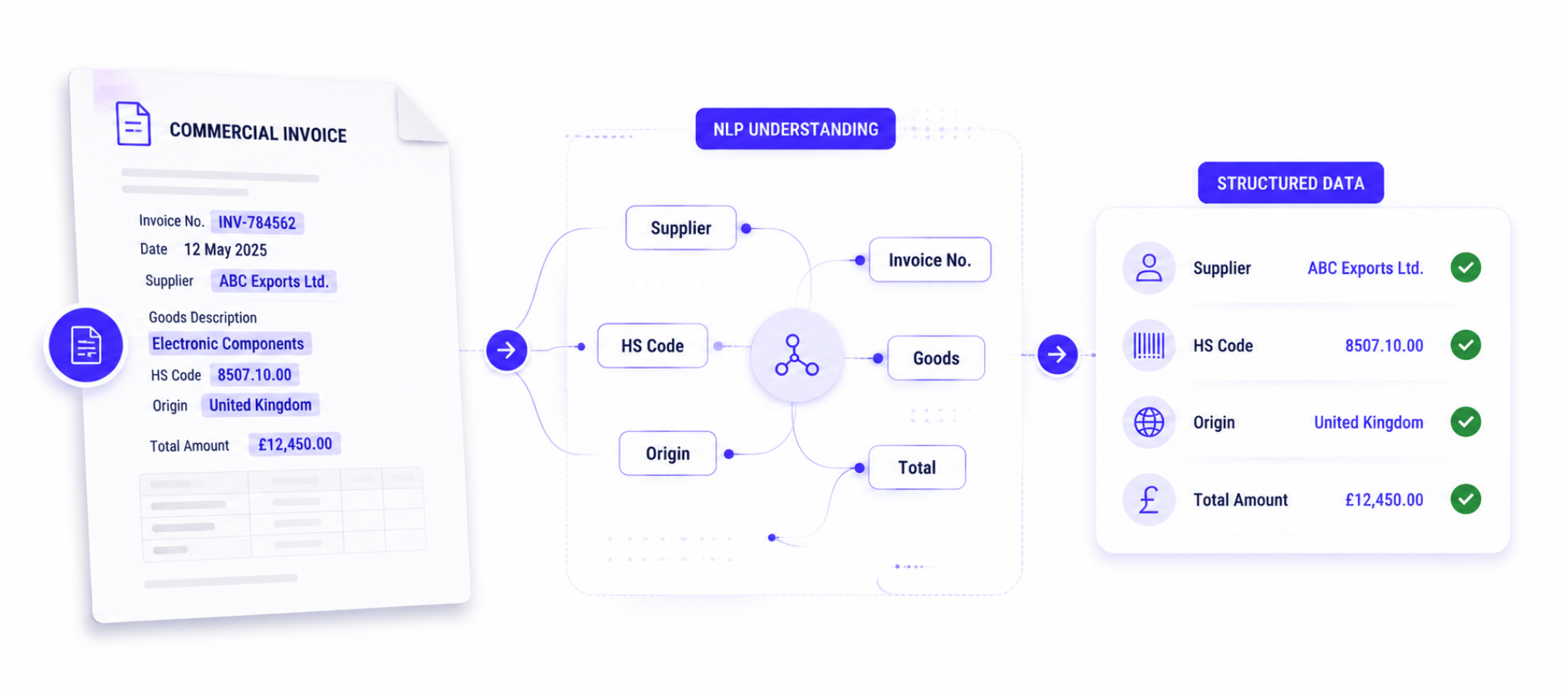
Today’s smart customs declaration systems go beyond form submission. They use AI to extract relevant information from commercial documents and match goods to correct HS codes using pattern recognition and contextual analysis.
This platform also populates customs forms with near-perfect accuracy, validates against national customs databases, and updates in real time.
Moreover, this dramatically shortens declaration turnaround time and improves filing accuracy.
What features does customs declaration software have?
- Natural language understanding for interpreting product descriptions
- Dynamic rules engines for evolving regulations
- AI-powered classification suggestions (i.e., iClassification systems)
- Auto-filling of repetitive fields and smart error prompts
For UK customs brokers, iCustoms provides two CDS-facing products. iWiz handles S&S GB Entry Summary Declarations and ICS2 ENS filings, with direct connection to HMRC’s pre-lodgement system for goods entering Great Britain from the EU. For CDS import and export declarations, iCustoms connects directly to the HMRC CDS API, submitting declarations in real time and returning MRNs without routing through a third-party gateway. This direct connection removes an intermediary layer that can introduce latency and additional failure points in time-sensitive clearance workflows.
2. Intelligent Document Processing (IDP)
IDP platforms are increasingly being adopted by freight forwarders and customs brokers to automate extraction and classification of structured and unstructured documents.
These tools can:
- Recognise hundreds of document formats (PDFs, scans, handwritten notes)
- Capture data from invoices and bills
- Match and cross-check values for reconciliation
- Feed clean data directly into the customs declaration form
iCustoms IDP processes the specific document types that customs brokers handle daily. Commercial invoices (PDF or scanned) are extracted to obtain line-item descriptions, declared values, EORI numbers, and country of origin. Air waybills (HAWB and MAWB) are read to extract consignor and consignee details, cargo descriptions, and flight data for S&S GB ENS pre-population. Packing lists are processed for package count, weight, and item-level data. Certificates of origin and EUR.1 movement certificates are read to support rules of origin verification for preferential duty rate claims. All extracted data is output in a format compatible with HMRC CDS import declarations.
AI-driven IDP reduces dependency on manual review and improves data accuracy by up to 99%.
3. iClassification: The AI Classification Tool for Customs Brokers
Misclassification of goods is one of the most common causes of delays, penalties, and compliance risks. The AI HS code finder, such as iClassification, solves this by intelligently suggesting accurate codes based on product descriptions, keywords, and contextual information.
How it works:
- Uses machine learning models trained on thousands of product datasets
- Understand the product description you provide
- Suggests the most likely HS code based on customs history and classification rules
iClassification is built specifically for UK customs requirements. Unlike global classification tools that suggest 6-digit WCO HS codes, iClassification outputs 10-digit UK commodity codes as required for HMRC CDS import declarations. For EU-bound shipments, iClassification also generates 10-digit EU TARIC codes, covering both UK and EU declaration requirements from a single classification session. Each suggestion carries a confidence score so brokers can immediately see which classifications are high-certainty and which require specialist review.
This tool reduces the risk of human error, accelerates classification, and enhances customs compliance.
4. AI tax and duty calculator
Understanding landed cost is critical for customs brokers and their clients. The AI-powered tax and duty calculator, such as iTariff, instantly computes customs duties, taxes, and applicable fees based on the product’s classification, origin, and destination.
Key capabilities:
- Real-time tax and duty calculations based on up-to-date tariffs
- Support for multiple jurisdictions and preferential trade agreements
- Integration with declaration software for end-to-end visibility
Landed cost calculation is particularly important for customs brokers advising import clients on the true cost of a shipment. iTariif calculates not only UK import duty and VAT but the full landed cost including applicable preferential duty rates under UK trade agreements, anti-dumping duties where applicable, and excise duty for controlled goods. For ecommerce clients, iTariif calculates the expected duty and VAT liability per EU destination country for IOSS shipments, giving sellers accurate landed costs before goods are dispatched.
This tool empowers brokers to provide cost transparency to clients while avoiding miscalculations that could result in underpayment or fines.
How to Choose AI Customs Brokerage Automation Software: A Checklist for UK Brokers
Choosing AI customs automation software involves assessing five capability areas against your specific brokerage operation. This checklist helps frame the evaluation.
First: Does the software cover your declaration types? UK customs brokers need coverage across CDS import declarations, CDS export declarations, S&S GB Entry Summary Declarations, and NCTS transit declarations. Confirm which declaration types are natively supported before evaluating any platform.
Second: Does it classify to 10-digit UK commodity code level? AI classification tools that only suggest 6-digit WCO HS codes require additional manual steps before a UK CDS declaration can be filed. iClassification outputs 10-digit UK commodity codes directly.
Third: Does it process the document formats you receive? Your suppliers send invoices, packing lists, air waybills, and certificates of origin in PDF, scanned image, and electronic format. Your document processing tool must handle all of these reliably without manual template configuration for each new supplier.
Fourth: Does it integrate with your existing systems? If you use an ERP for financial management or an ecommerce platform for order data, your customs automation software should connect via API rather than requiring parallel data entry. Check whether the vendor provides documented API endpoints and pre-built connectors for your specific systems.
Fifth: Does it support the regulatory requirements you will face next? For brokers with ecommerce clients, IOSS TARIC code automation is required by July 2026. For brokers handling transit movements, NCTS automation reduces manual MRN management. For brokers with clients importing from sanctioned countries, compliance screening is a mandatory capability. Map your upcoming regulatory requirements against the platform’s roadmap before committing.
The Future of AI Customs Brokerage: What UK Brokers Should Do Now
AI customs brokerage automation is not a future state. It is available today, and the brokers who adopt it earliest are building a structural cost and accuracy advantage over those who continue with manual workflows. The question for UK customs brokers in 2026 is not whether to adopt AI automation but where to start.
The most impactful starting point depends on your operation. For brokers handling high document volumes, iCustoms IDP and iZap batch ENS filing reduce manual processing time fastest. For brokers whose biggest risk is classification accuracy, iClassification directly addresses the HS code error rate that drives most HMRC queries. For brokers with ecommerce clients approaching the July 2026 IOSS TARIC deadline, IOSS compliance automation is the most urgent near-term requirement.
iCustoms provides all of these capabilities in a single platform, built specifically for UK customs compliance. The platform connects directly to HMRC’s CDS API, outputs 10-digit UK commodity codes and EU TARIC codes, and integrates with the ERP and ecommerce systems your clients already use.
Frequently Asked Questions
What is AI customs brokerage automation?
AI customs brokerage automation uses artificial intelligence, machine learning, and intelligent document processing to replace or accelerate manual tasks in customs brokerage workflows. These tasks include extracting data from commercial documents, classifying goods to HS and commodity codes, validating declaration data against HMRC rules, calculating duty and VAT liability, and filing declarations electronically via the HMRC CDS API. iCustoms provides an integrated suite of AI customs automation tools built specifically for UK customs brokers and in-house compliance teams.
How does AI help customs brokers avoid HMRC penalties?
AI compliance tools validate declaration data against HMRC CDS rules, commodity code restrictions, and sanctions lists before a declaration is submitted. Errors caught at the pre-submission stage do not result in HMRC rejection queries or potential penalties under Finance Act 2008 Schedule 41. iCheck from iCustoms performs compliance screening as part of the declaration workflow, and iClassification confirms commodity code accuracy before codes are entered into declarations.
Which AI classification tool is best for UK customs brokers?
For UK customs brokers, iClassification from iCustoms is the AI classification tool built specifically for 10-digit UK commodity codes and EU TARIC codes. It processes product descriptions from commercial invoices or direct input, returns a classification with a confidence score, and flags low-certainty results for human expert review. Unlike general AI tools that suggest 6-digit HS codes, iClassification outputs the full 10-digit code required for HMRC CDS declarations.
Can AI customs software integrate with SAP and other ERP systems?
Yes. iCustoms provides an open API that connects its customs automation platform to ERP systems including SAP and Microsoft Dynamics, as well as ecommerce platforms (Shopify, WooCommerce) and warehouse management systems. API integration enables customs data (commodity codes, duty calculations, declaration status, MRN updates) to flow automatically into financial and logistics workflows without manual re-entry.
What is IOSS compliance automation and why do customs brokers need it?
IOSS (Import One Stop Shop) compliance automation handles the customs and VAT requirements for goods shipped to EU consumers under the IOSS scheme. From July 2026, all IOSS shipments must include 10-digit EU TARIC codes. Customs brokers serving ecommerce clients need IOSS automation to calculate the correct VAT per destination country, validate IOSS registration numbers, and assign TARIC codes at scale without increasing manual classification headcount. iCustoms supports IOSS compliance automation as part of its EU-facing customs capability.
How does AI customs software reduce clearance delays?
Clearance delays are most commonly caused by declaration data errors, missing fields, or incorrect commodity codes that trigger HMRC rejection queries. AI customs automation reduces these causes in three ways. First, IDP extracts data from source documents automatically, eliminating transcription errors from manual data entry. Second, AI classification confirms commodity codes against the live UK Global Trade Tariff before the declaration is filed. Third, pre-submission validation checks data completeness and consistency against CDS rules before the declaration reaches HMRC. Together these steps mean fewer rejections, faster acceptance, and faster clearance.
Can an IOSS number be shared publicly on shipping labels?
No. An IOSS number should not be printed on parcel labels or visible documents. It must be transmitted securely through the electronic customs declaration system to prevent misuse.
You may also like:
Simplify Customs with our Powerful Customs Management Software

Automate declarations, track shipments, & ensure compliance.
About iCustoms
iCustoms is an all-in-one solution helping businesses automate customs processes more efficiently. With AI-powered and machine-learning capabilities, iCustoms is designed to streamline your all customs procedures in a few minutes, cut additional costs and save time.
Simplify Customs with our Powerful Customs Management Software
Automate declarations, track shipments, & ensure compliance.