
GVMS and ENS: How They Work Together for UK Imports
- John Hall
- Customs Specialist at iCustoms.ai
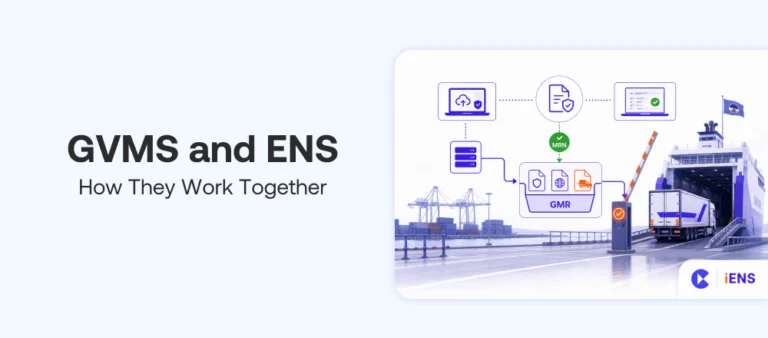
GVMS and ENS are two separate UK border systems that meet at the port. The ENS (Entry Summary Declaration) is your pre-arrival safety and security declaration, filed through S&S GB. GVMS (the Goods Vehicle Movement Service) is the system that lets a goods vehicle board and cross. They connect through a reference number: the ENS Movement Reference Number (MRN) can be added to your Goods Movement Reference (GMR) in GVMS.
This integration guide is for freight forwarders, customs agents, hauliers and carriers who have to make both systems line up for a single movement. For a full explainer of the movement service itself, see our GVMS guide, and for the declaration, our S&S GB ENS pillar guide.
What is the difference between GVMS and ENS?
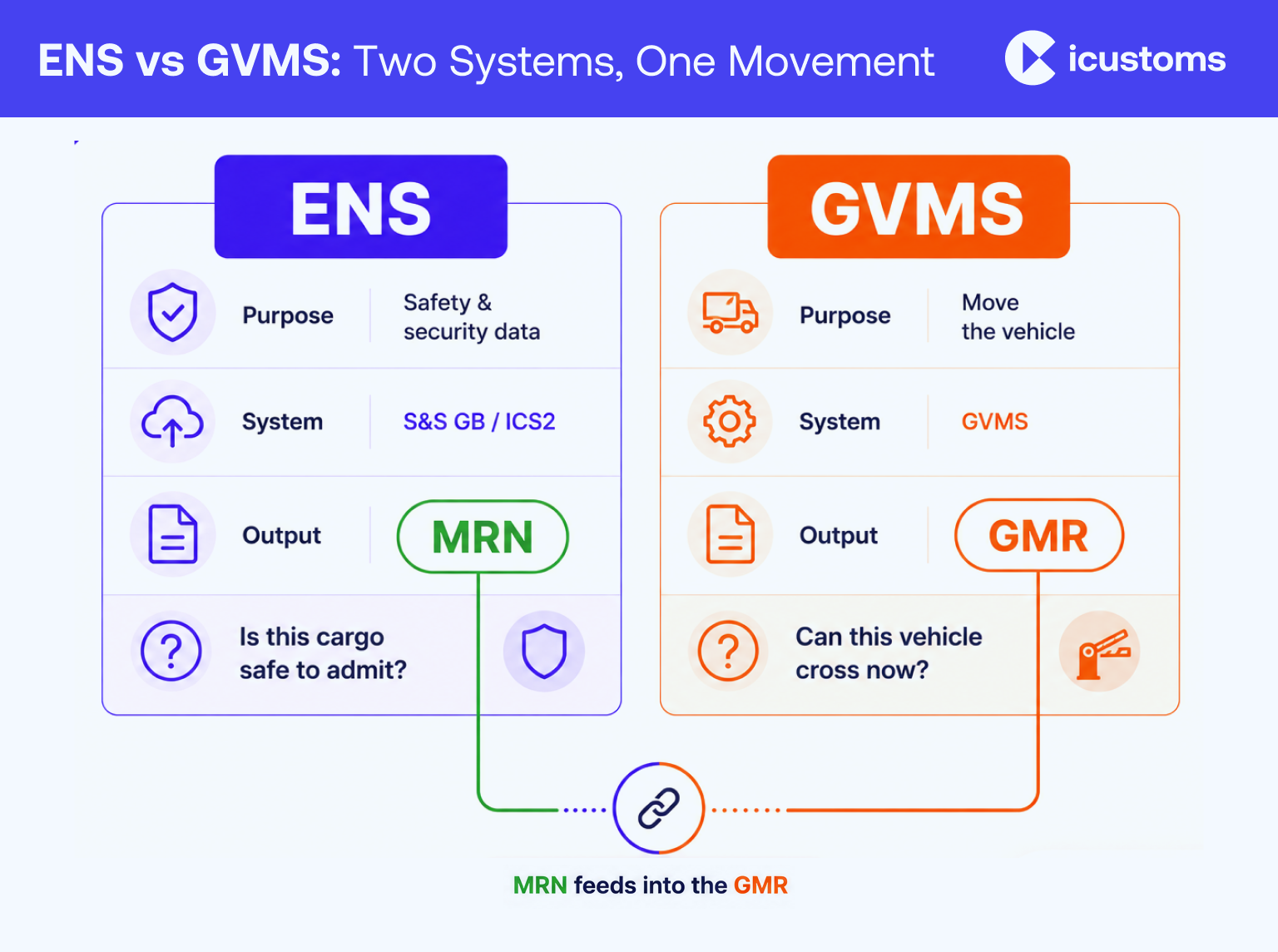
They answer two different questions. The ENS answers is this cargo safe to admit? GVMS answers can this vehicle cross now? You often need both for the same lorry, and they are produced by different parties at different points.
| Aspect | ENS (Entry Summary Declaration) | GVMS (Goods Vehicle Movement Service) |
|---|---|---|
| Purpose | Pre-arrival safety and security risk data | Controls goods vehicle movements at RoRo ports |
| System | S&S GB (Great Britain); ICS2 (EU and Northern Ireland) | GVMS |
| Output reference | Movement Reference Number (MRN) | Goods Movement Reference (GMR) |
| Who acts | The carrier lodges it (a freight forwarder or customs agent may file on the carrier’s behalf) | The haulier or driver creates the GMR |
| Timing | Before arrival, by the applicable transport mode’s deadline | Before check-in and boarding |
The MRN and the GMR: how they link
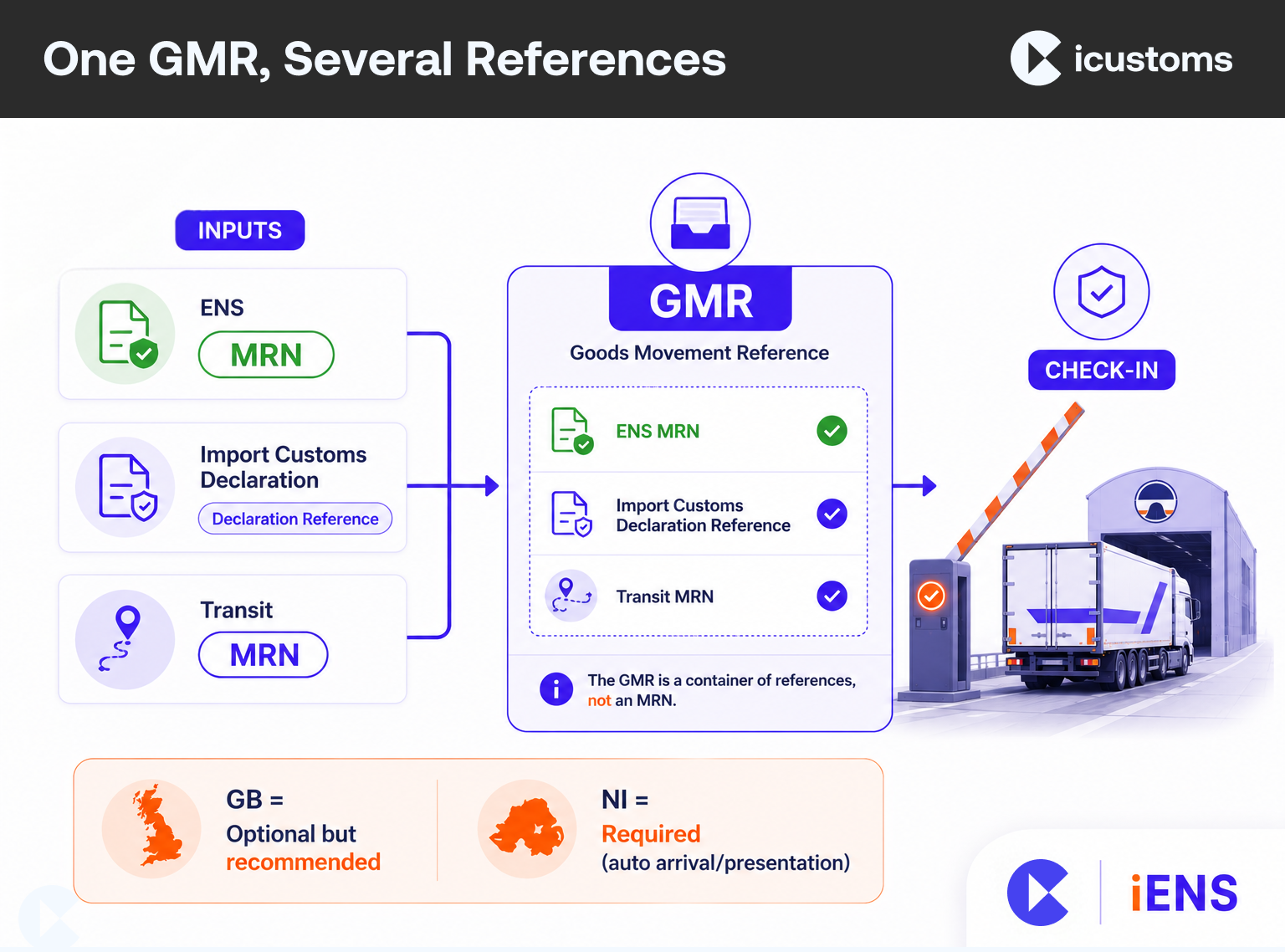
The ENS MRN is not the same as the GMR. The MRN is the reference S&S GB issues when your ENS is accepted. The GMR is a container reference you build in GVMS that bundles all the customs references for one vehicle, the import declaration reference, any transit MRN, and the ENS MRN, so Border Force can see everything tied to that crossing in one place.
So the link is simple: you file the ENS, receive the MRN, then add that MRN to the GMR alongside your other references. One vehicle, one GMR, potentially several MRNs inside it.
How ENS and GVMS work together, step by step
- File the customs and safety declarations. Lodge the import customs declaration and the ENS through S&S GB before arrival.
- Collect your references. The ENS returns an MRN on acceptance; your customs declaration and any transit movement return their own references.
- Create the GMR. In GVMS, build a Goods Movement Reference for the vehicle.
- Add the references. Attach the import declaration reference, any transit MRN, and the ENS MRN to the GMR.
- Present at check-in. The driver shows the GMR to board. GVMS checks that the references are valid.
- Cross and clear. On arrival, GVMS tells the driver whether to proceed or report for a check.
Great Britain vs Northern Ireland: when the ENS MRN is required in the GMR
For imports into Great Britain, adding the ENS MRN to the GMR is optional, but recommended. It keeps every reference for the movement together. For imports into Northern Ireland, adding the ENS MRN to the GMR is required, and doing so means your arrival and presentation notifications are submitted automatically, which removes a manual step under the Windsor Framework.
Note the systems also differ by destination: Great Britain uses S&S GB, while Northern Ireland movements use ICS2. GVMS sits over both at the ports that use it.
Timing: file the ENS before check-in closes
When you include the ENS MRN in a GMR, HMRC expects the ENS to be submitted by whichever comes first: the mode’s minimum timing requirement, or before check-in closes. In practice that means the ENS has to be accepted, and the MRN in hand, before you can complete the GMR and board. Work backwards from check-in, not from arrival. Our ENS deadlines by transport mode guide has the full timings.
Who does what
- Carrier: holds the legal duty to lodge the ENS and receive the MRN.
- Freight forwarder or customs agent: often files the ENS and the customs declaration on the carrier’s behalf and passes the references on.
- Haulier or driver: builds the GMR, adds the MRN, and presents it at check-in.
When several parties are involved, agree who supplies which reference in advance, or a GMR ends up incomplete at the barrier. See who is responsible for filing the ENS for the responsibility split.
Common mistakes at GVMS ports
- Building the GMR before the ENS is accepted, so there is no valid MRN to add.
- Leaving the ENS MRN out of a Northern Ireland GMR, where it is required.
- Filing the ENS to the mode deadline but missing the earlier check-in close.
- Different parties assuming someone else added a reference, so the GMR is incomplete.
How iENS fits into a GVMS workflow
The ENS is the step most likely to hold up a GMR, because it depends on clean data arriving in time. iENS from iCustoms reads the shipping documents, validates the data, and files through S&S GB or ICS2 ahead of check-in, returning the MRN ready to drop into the GMR. That keeps the vehicle moving and the GMR complete. See how it works on the iENS Entry Summary Declaration.
Frequently Asked Questions
Is the ENS MRN the same as the GMR?
No. The ENS MRN is the reference S&S GB issues when your Entry Summary Declaration is accepted. The GMR is a Goods Movement Reference in GVMS that bundles several references, including the ENS MRN, for one vehicle.
Do I have to add the ENS MRN to my GMR?
For imports into Great Britain it is optional but recommended. For imports into Northern Ireland it is required, and it triggers your arrival and presentation notifications automatically.
What is the difference between GVMS and ENS?
The ENS is the pre-arrival safety and security declaration filed through S&S GB. GVMS is the system that lets a goods vehicle board and cross at a RoRo port. You often need both for the same movement.
When must the ENS be filed if I use GVMS?
By whichever is earliest: the transport mode's minimum timing requirement, or before check-in closes. The MRN must be accepted before you can complete the GMR.
Which ports use GVMS?
Many UK RoRo ports, such as Dover and Holyhead, use GVMS. Where GVMS is in use, a valid GMR is needed to board.
You may also like:
Struggling to Extract, Catagorise & Validate Your Documents?

Capture & Upload Data in Seconds with AI & Machine Learning
Subscribe to our Newsletter
About iCustoms
iCustoms is an all-in-one solution helping businesses automate customs processes more efficiently. With AI-powered and machine-learning capabilities, iCustoms is designed to streamline your all customs procedures in a few minutes, cut additional costs and save time.
Struggling to Extract, Catagorise & Validate Your Documents?
Capture & Upload Data in Seconds with AI & Machine Learning