
Understanding CHEDs: Common Health Entry Documents and Establishment Codes
- John Hall
- Customs Specialist at iCustoms.ai
A Common Health Entry Document (CHED) is the digital entry declaration for regulated consignments arriving at an EU border control post. Submitted through TRACES NT before the goods arrive, it tells officials what is coming, where it comes from and which approved establishments handled it. Since 14 December 2019, no consignment of animals, animal products, plants or high-risk food and feed enters the EU without one.
This guide explains the four CHED types, the submission process, and the detail that causes most refusals: the establishment codes inside the document. By the end, you will know exactly which CHED your consignment needs and how to get it right first time.
What is a Common Health Entry Document?
The CHED exists because EU officials need advance notice of regulated imports. Under the Official Controls Regulation (EU) 2017/625, the operator responsible for a consignment must notify the border control post before arrival, and the CHED is that notification. It replaced the older CVED when TRACES NT took over from TRACES Classic.
The document works in two parts. Part 1 comes from you: consignment details, origin, health certificate references and establishment approval numbers. Part 2 comes from the authorities: the outcome of their documentary, identity and physical checks, and the final decision on the goods. Both parts live in TRACES NT, visible to every party.
Who submits the CHED, and when?
Responsibility sits with the operator responsible for the consignment, in practice usually the importer or their customs agent. Submission must happen before arrival at the border control post, and many BCPs set minimum notice periods. Late submission is itself a common reason for delay, so build the CHED into your pre-shipment routine rather than your arrival checklist.
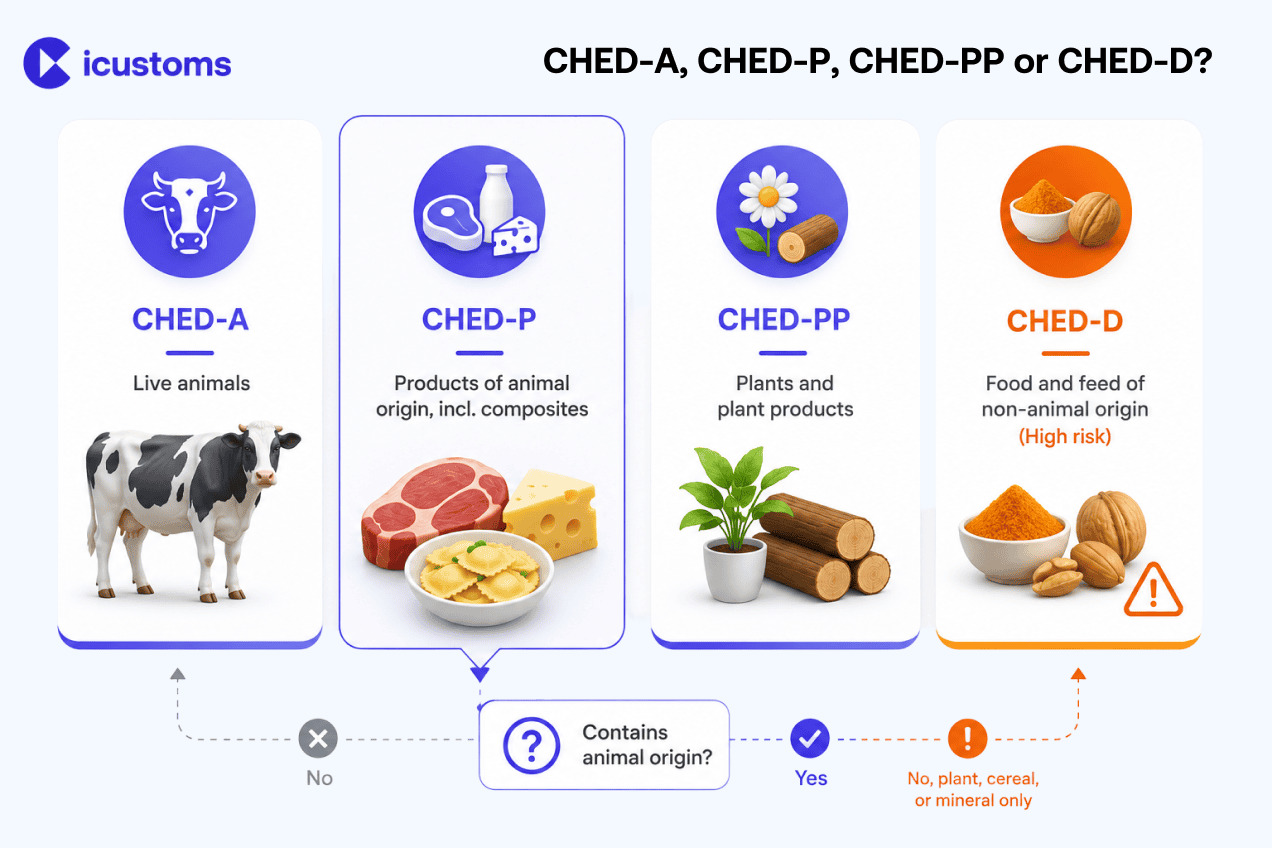
The four CHED types explained
| Type | Covers | Typical Consignments |
|---|---|---|
| CHED-A | Live animals. | Cattle, horses, poultry, and pets transported for commercial purposes. |
| CHED-P | Products of animal origin. | Meat, dairy products, fish, eggs, and composite products containing animal ingredients. |
| CHED-PP | Plants and plant products. | Cut flowers, seeds, timber, fruit, vegetables, and other regulated plant materials. |
| CHED-D | High-risk food and feed of non-animal origin. | Selected spices, nuts, cereals, and other products subject to increased official controls. |
CHED-P or CHED-D: which one applies?
The distinction is origin. Anything containing material of animal origin, including composite products such as filled pasta or chocolate with dairy, points to CHED-P. Food and feed of non-animal origin only needs CHED-D when it appears on the EU’s increased-controls lists, which change with risk assessments. When in doubt, classify the product properly first; the HS code usually settles the question.
How to submit a CHED in TRACES NT
- Step 1: Register on TRACES NT with an operator role, as covered in our registration guide.
- Step 2: Create a new CHED of the correct type and complete Part 1 with consignment, origin and transport details.
- Step 3: Reference the health certificates and enter the establishment approval numbers for every facility in the chain.
- Step 4: Submit before arrival, respecting your border control post’s notice period.
- Step 5: Track the BCP’s decision in Part 2, and quote the CHED reference number in your customs declaration.
That final step matters more than most guides admit: the CHED reference must align with the customs declaration, or clearance stalls even after the health checks pass.
CHEDs and establishment codes: the link most traders miss
Part 1 of every CHED-P asks for the establishment approval numbers of the facilities that produced, processed or stored the goods. Officials verify each one against the official TRACES establishment lists during the documentary check. Consequently, a delisted supplier or a mistyped TRACES establishment code refuses the CHED before anyone opens the container.
This is the quiet dependency in the whole system: your CHED is only as valid as the weakest code inside it. Codes change without notice, and the TRACES portal will not warn you. For this reason, validating every establishment code before you submit, ideally in bulk across the whole consignment, is the single highest-value habit in CHED preparation.
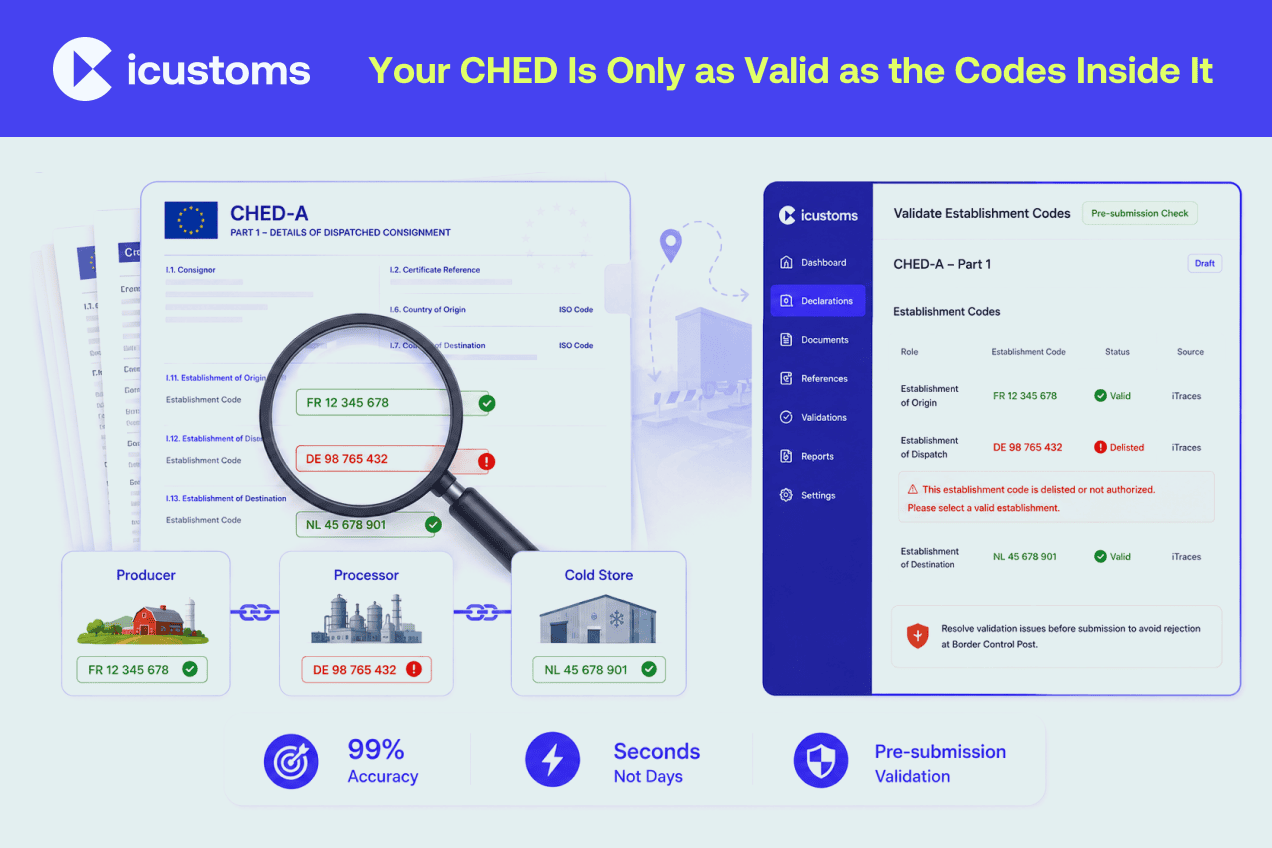
Still Checking CHED Establishment Codes Manually? iTraces validates every code in your consignment against the official TRACES EU database in seconds. |
What happens at the border control post
Once the consignment arrives, officials work through the three official controls. The documentary check verifies the CHED, certificates and establishment codes; every consignment receives it. The identity check matches seals and labels to the paperwork. The physical check, applied to a proportion of consignments based on risk, involves inspection and possible sampling.
The decision lands in Part 2 of the CHED: accepted, accepted with channelling, or refused. A refusal means re-export, destruction or transformation under supervision, and it stays visible in TRACES to authorities across the EU. Our guide to shipments held at EU border control covers what to do when that happens.

Common CHED errors, and how to avoid them
- Wrong CHED type: composite products filed as CHED-D instead of CHED-P; classify first, then choose
- Late submission: missing the BCP’s notice period queues your goods behind everyone who planned ahead
- Invalid establishment codes: delisted or mistyped numbers, the leading documentary failure
- Certificate mismatches: quantities, dates or names that differ between certificate, invoice and CHED
- Reference gaps: CHED numbers missing from the customs declaration
Amendments are possible while the CHED sits with you, but after the BCP records its decision the document is fixed. In other words, accuracy before submission beats correction after it, every time.
Why choose iCustoms for CHED-ready consignments
Every error in the list above is a data error, and iCustoms AI removes them at the source. Intelligent Document Processing extracts certificate and invoice data with 99% accuracy, so CHED fields match their sources character for character. iTraces validates the establishment codes inside the consignment in bulk before submission. And iCustoms files the customs declaration with the CHED reference intact, across the UK, Ireland and 22 EU nations.
The compliance dashboard then keeps the evidence: every code checked, every document validated, every declaration filed, with an audit trail behind it. iCustoms customers cut manual effort by 80% and stop treating border control as a lottery.
One workflow from certificate to clearance
The CHED sits between your trade documents and your customs declaration, which is exactly the territory iCustoms automates. With iClassification settling the CHED-P versus CHED-D question through correct HS codes, and the platform connecting documents, codes and declarations, logistics leaders such as Kerry Logistics, Ziegler and Woodside Logistics Group clear regulated goods without the manual scramble.
Make Every CHED Right First Time
Book a demo and see iCustoms validate the codes and data behind your next consignment, live.
Frequently Asked Questions
What is a Common Health Entry Document?
It is the digital entry declaration for regulated consignments entering the EU, submitted through TRACES NT before arrival at a border control post. It notifies officials of the consignment and records their inspection decision, as required by the Official Controls Regulation (EU) 2017/625.
What are the different types of CHED?
Four: CHED-A for live animals, CHED-P for products of animal origin, CHED-PP for plants and plant products, and CHED-D for high-risk food and feed of non-animal origin under increased controls.
Is a CHED mandatory?
Yes. Since 14 December 2019, regulated animals and goods cannot enter the EU without a CHED issued through TRACES NT. Arriving without one, or with an incomplete one, means the consignment waits.
Who is responsible for submitting a CHED?
The operator responsible for the consignment, which in practice means the importer or the customs agent acting for them. Submission must happen before the goods arrive at the border control post.
What is an establishment code in a CHED?
It is the approval number of each facility that produced, processed or stored the goods, entered in Part 1 of the CHED. Officials verify these against the official TRACES lists, so validating them beforehand, for example with iTraces from iCustoms, prevents documentary refusals.
Can a CHED be amended after submission?
You can amend it while it remains on your side, but once the border control post records its decision in Part 2, the document is final. Getting the data right before submission is therefore the only reliable strategy.
You may also like:
Struggling to Extract, Catagorise & Validate Your Documents?

Capture & Upload Data in Seconds with AI & Machine Learning
Subscribe to our Newsletter
About iCustoms
iCustoms is an all-in-one solution helping businesses automate customs processes more efficiently. With AI-powered and machine-learning capabilities, iCustoms is designed to streamline your all customs procedures in a few minutes, cut additional costs and save time.
Struggling to Extract, Catagorise & Validate Your Documents?
Capture & Upload Data in Seconds with AI & Machine Learning