
How to Complete a TRACES Application Form: aPVP, EAC and the 3-Day Rule
- John Hall
- Customs Specialist at iCustoms.ai
A TRACES application form is the paper you complete so your vet can raise the export certificate in TRACES NT. You do not submit it to the EU platform yourself. Instead, you return the completed form to your authorised Private Veterinary Practitioner (aPVP) or Export Assembly Centre (EAC) operator at least 3 working days before the proposed export, and they create the Intra-Trade Animal Health Certificate (ITAHC) in the system.
This guide follows the official DAERA application form and its notes for guidance box by box, explains the roles behind the acronyms, and covers the Northern Ireland port bookings at Larne and Belfast that catch out first-time exporters.
What is a TRACES application form?
For animal exports from Northern Ireland, DAERA (the Department of Agriculture, Environment and Rural Affairs) provides the TRACES EXA NI application form. It gathers everything the certifying vet needs: consignor, consignee, origin premises, transport and consignment details. The vet then enters that data into TRACES NT, where the certificate lives digitally.
Two versions exist, so pick the right one. The standard application form covers commercial exports of animals and products, including cattle and sheep. A separate form covers the commercial export of pets (dogs, cats and ferrets) to the EU, or to third countries transiting the Republic of Ireland. Both follow the same 3-working-day rule.
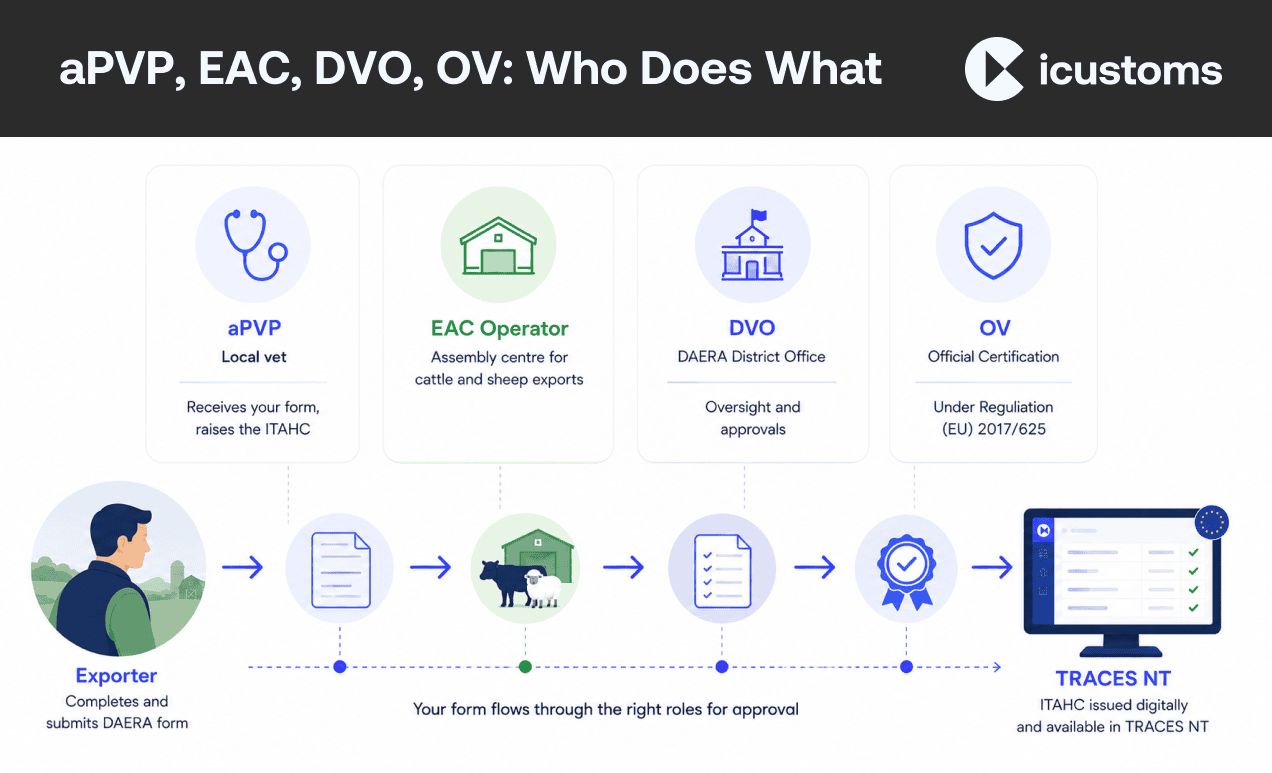
Who's who: aPVP, EAC, DVO and the Official Veterinarian
| Role | What They Do |
|---|---|
| aPVP (Authorised Private Veterinary Practitioner) | A local veterinarian authorised by DAERA to certify exports. They receive the completed application form and create the Intra Trade Animal Health Certificate (ITAHC) in TRACES NT. |
| EAC (Export Assembly Centre) Operator | For cattle and sheep exports, manages an approved Export Assembly Centre where animals are assembled before export and can receive the application form instead of the aPVP. |
| DVO (District Veterinary Office) | DAERA’s local office responsible for overseeing animal health controls, export approvals, and veterinary compliance within each district. |
| Official Veterinarian (OV) | The state-appointed veterinarian who carries out official inspections, certifications, and regulatory checks under the Official Controls Regulation (EU) 2017/625. |
In short: you complete the form, the aPVP or EAC turns it into a TRACES NT certificate, and the official control system takes it from there.
The 3-day rule, and what happens if you miss it
The headline requirement sits on the front of the form: return it at least 3 working days in advance of the proposed export. That window gives the vet time to inspect where required, complete certification and lodge the TRACES NT message before your animals move.
- Late forms: miss the window and the export date slips; the rule counts working days, not calendar days
- Incomplete forms: DAERA guidance is blunt: incomplete, illegible or unsigned application forms will be returned, and the clock restarts
- Changed plans: if the departure date, time or vehicle changes, you must notify your aPVP, who updates the certificate so a replacement TRACES NT message goes out
- Cancellations: tell your aPVP immediately so they cancel the certificate in TRACES NT; a live certificate for a dead movement causes queries later
Complete the form fully and in block letters, exactly as the guidance asks. Most returned forms fail on legibility and missing signatures rather than anything complicated.
How to complete the TRACES application form, box by box
Part 1 of the form describes the consignment. The boxes below follow the official DAERA notes for guidance.
- Box I.1 Consignor: the person dispatching the consignment: name, address, postcode, telephone, email and the registered premises number of the holding.
- Box I.2 Consignee: the person responsible for receiving the consignment in the destination country, with full name and address.
- Box I.3 Place of export or origin: where the animals or products originate; circle the correct premises type and give its name, address and approval or registration number.
- Date and time of departure, and method of transport: road, sea or air, plus transporter details such as vehicle registration, airline and flight number, or shipping company and sailing reference.
- Place of loading: for animal consignments, the town and postcode where the animals are loaded.
Premises types in Box I.3
| Premises Type | When It Applies |
|---|---|
| Holding | A farm or other premises where agricultural activities and the keeping of animals take place. |
| Assembly Centre | Used only for porcine, ovine and caprine animals, and equidae, where animals are gathered before movement or export. |
| Approved Body | Officially approved zoos, institutes, and research centres operating under Directive 92/65/EEC. |
| Semen Centre | Approved semen collection and storage centres operating under Directive 2003/43/EC. |
| Embryo Team | Approved embryo collection and storage teams or facilities operating under Directive 89/556/EEC. |
| Establishment | Applies only to products and animal by-products of animal origin, such as food processing or manufacturing establishments. |
The approval and registration numbers in Box I.3 matter most: they anchor the certificate to premises the authorities recognise, so copy them exactly from official records rather than from memory.

Larne and Belfast: the Northern Ireland port bookings
Exports through a Northern Ireland customs port need transport arrangements squared away alongside the application. First, book the crossing with the ferry company. What happens next depends on the port.
- Larne: telephone the DAERA Portal office (028 28 260021) with your route, sailing time, vehicle registration mark and consignment details. That call creates the booking for export checks and issues your Portal booking reference number, which the paperwork expects.
- Belfast: no Portal booking reference number is needed for exports from Belfast port; the office number is 028 90 378555 for queries.
Small detail, real consequence: a Larne sailing without the Portal reference is the kind of gap that surfaces at the worst possible moment, with animals already loaded.

Still Managing Export Paperwork by Hand?
iCustoms automates the customs data around your animal exports, from documents to declarations.
What happens after you hand the form over
Your aPVP checks the form, carries out any required inspection, and creates the certificate in TRACES NT. For live animal movements to the EU, that certificate is the ITAHC, which our next guide covers in detail. The TRACES NT message travels ahead of the consignment, so authorities along the route and at destination see the certified details before the animals arrive.
From that point the movement runs on data accuracy: the certificate, the transport booking and the customs paperwork must all tell the same story. One mismatched vehicle registration or premises number pulls the consignment into queries.
Where iCustoms fits for NI and GB traders
The veterinary side of the form belongs to your aPVP and DAERA; the trade compliance around it is where iCustoms earns its place. Intelligent Document Processing extracts and validates the consignment data flowing between forms, certificates and invoices with 99% accuracy, so the story stays consistent. iCustoms files customs declarations across the UK, Ireland and the EU, with dedicated Northern Ireland support for GB-NI movements. And for consignments of animal products, iTraces validates establishment codes against the official TRACES EU database before anything ships.
iCustoms customers cut manual compliance effort by 80%, which for a mixed export business means the paperwork keeps pace with the animals rather than the other way round.
One Movement, One Consistent Data Story
Book a demo and see how iCustoms keeps your export documents, declarations and codes aligned.
Frequently Asked Questions
What is the TRACES application form?
It is the DAERA form you complete and return to your authorised Private Veterinary Practitioner or Export Assembly Centre operator so they can raise the export certificate in TRACES NT. You never submit it to the EU platform directly.
What is an aPVP?
An authorised Private Veterinary Practitioner: a local vet authorised by DAERA to certify exports. The aPVP receives your application form, inspects where required, and creates the ITAHC in TRACES NT.
What is the 3-day rule for TRACES applications?
The completed form must reach your aPVP or EAC operator at least 3 working days before the proposed export. The window covers inspection, certification and lodging the TRACES NT message.
What happens if the application is late or incomplete?
Incomplete, illegible or unsigned forms are returned under DAERA guidance, and late forms push the export date back. Block letters, full answers and a signature solve most rejections.
How do I book export checks at Larne or Belfast?
Book the ferry first. For Larne, phone the DAERA Portal office on 028 28 260021 to receive a Portal booking reference number. Belfast exports need no Portal reference; the port office is 028 90 378555.
What if my departure details change after submission?
Notify your aPVP straight away. They update the certificate so a replacement TRACES NT message issues, and they cancel it entirely if the consignment is called off.
You may also like:
Struggling to Extract, Catagorise & Validate Your Documents?

Capture & Upload Data in Seconds with AI & Machine Learning
Subscribe to our Newsletter
About iCustoms
iCustoms is an all-in-one solution helping businesses automate customs processes more efficiently. With AI-powered and machine-learning capabilities, iCustoms is designed to streamline your all customs procedures in a few minutes, cut additional costs and save time.
Struggling to Extract, Catagorise & Validate Your Documents?
Capture & Upload Data in Seconds with AI & Machine Learning