
Customs Warehouse Software vs Manual Excel Records: What's the Real Cost?
- John Hall
- Customs Specialist at iCustoms.ai
The difference between customs warehouse software and manual Excel records is not mainly speed. It is that several things HMRC requires of a bonded warehouse stock account cannot be done in a spreadsheet at all, however carefully it is maintained.
That is a more useful place to start than an efficiency argument, because efficiency is arguable and capability is not. This page sets out what manual records structurally cannot do, where the time actually goes, what the exposure looks like when it goes wrong, and the honest answer to whether Excel is ever enough.
Why this is not an efficiency argument
Search customs warehouse software vs manual operations and you will find a familiar list: efficiency, accuracy, compliance, scalability, cost-effectiveness. Every vendor in the category publishes a version of it, which is precisely why none of them persuade anybody. The claims are unfalsifiable and the reader knows it.
One thing we are deliberately not going to do You will find a human error rate quoted widely in this market, commonly around 4% for manual picking and record-keeping. We are not using it. Trace those figures and they lead to warehouse automation vendors citing each other rather than to primary research, and an undefendable statistic on a compliance page is worse than no statistic. If someone quotes you an error rate for your own operation, ask where the number came from before you build a business case on it. |
There is a stronger argument available, and it does not need invented numbers. HMRC sets specific, published requirements for what a bonded warehouse stock account must do. Compare a spreadsheet against those requirements rather than against a software feature list, and the gaps are not matters of degree. They are things that cannot be done.
Five things manual records cannot do
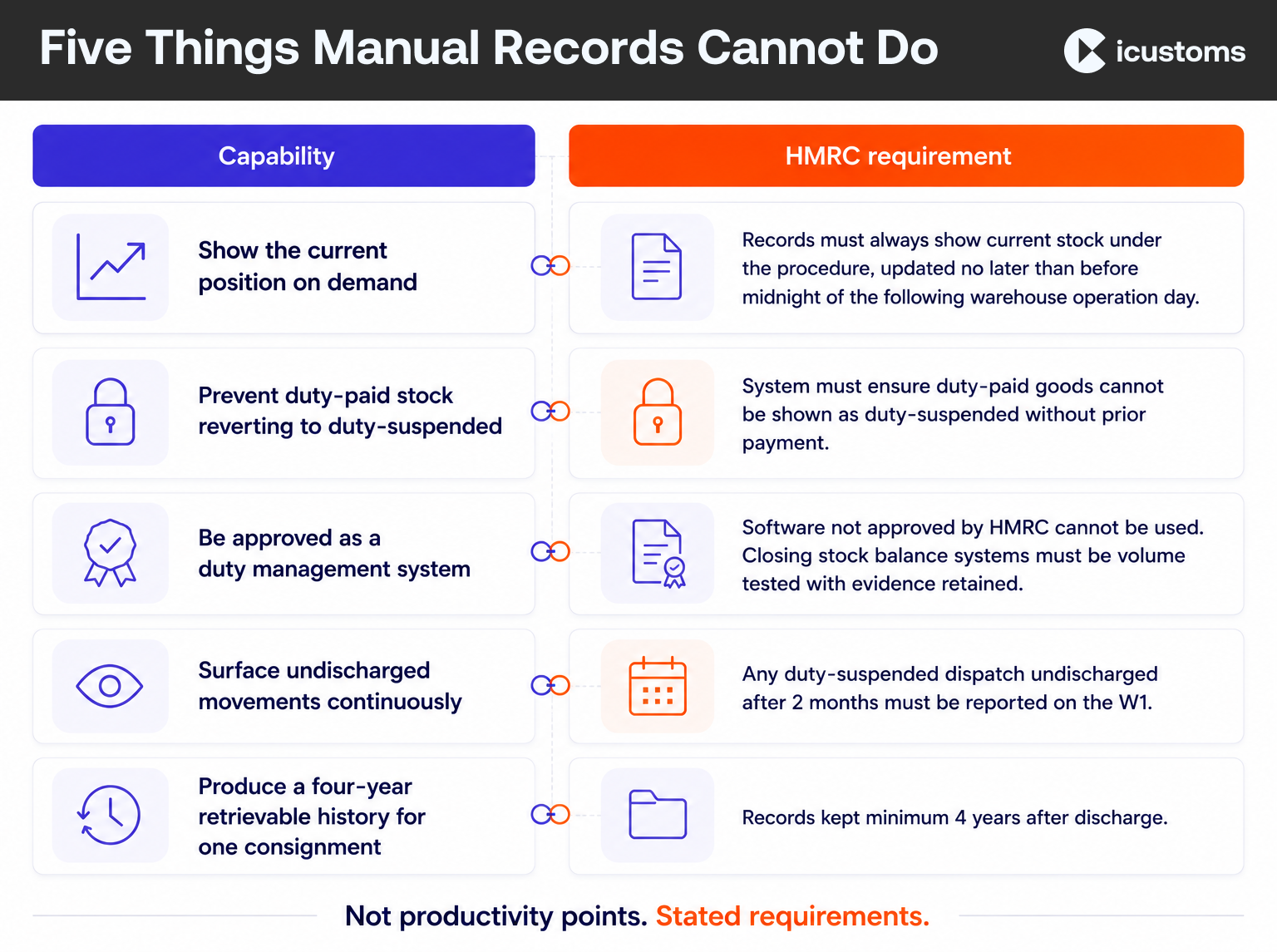
- Show the current position on demand. The standard requirement is that customs warehouse stock records must always show the current stock under the procedure, and you must be able to facilitate updating those records at an officer’s request so they can see the current position. Where a system supports commercial records, updates are due as soon as information becomes available and no later than before midnight of the following warehouse operation day. A spreadsheet reconciled weekly, or updated when someone gets to it, is not capable of meeting that. It is not slower at meeting it. It cannot.
- Prevent duty-paid stock reverting to duty-suspended. Where duty-suspended and duty-paid goods share a site under co-storage, HMRC requires that the system identifies the location and duty status of all goods at all times, and makes sure duty-paid goods cannot be shown as duty-suspended without prior payment of duty. That is an enforced control with a logged transition. A spreadsheet column is editable by anyone with the file open, and the previous value is gone.
- Be approved as a duty management system. HMRC guidance states that software which has not been approved cannot be used, and a duty management system that does not meet the requirements will not be approved for customs warehousing purposes. Before a closing stock balance system is authorised it must also be tested to confirm it can handle the proposed volume, with the warehousekeeper providing evidence that testing took place. A spreadsheet cannot be volume tested in any meaningful sense, and cannot be evidenced as having been.
- Surface undischarged movements continuously. Any duty-suspended dispatch not discharged after two months must be reported on the W1 excise warehouse return. Finding those requires knowing, at any moment, which movements are open and how long they have been open. In a manual system that information exists only in the act of looking for it, which is why it tends to be discovered while the return is being prepared rather than before.
- Produce a four-year retrievable history for one consignment. Customs warehouse records must be kept for a minimum of four years after the goods have been discharged. The test is not storage, it is retrieval: producing the full history of one named consignment, including who changed what and when, years later. Spreadsheet versions overwrite. Email threads get archived. The people involved leave.
None of those five is a productivity point. Each is a stated requirement that a manual record either meets or does not, and the honest answer in each case is that it does not.
Manual against automated, by task
Set the two side by side against what is actually required and the pattern is consistent.
| Task | Manual: spreadsheet and paper | Automated: duty management system | What HMRC requires |
|---|---|---|---|
| Recording a receipt | Keyed from paperwork, often in a batch later | Captured against the consignment as it arrives | Records updated as soon as information becomes available |
| Current stock position | Accurate as at the last reconciliation | Current continuously | Always shows current stock under the procedure |
| Duty status | A column that can be edited | An enforced attribute with a logged transition | Duty-paid cannot revert to duty-suspended without payment |
| Monthly return | Reconstructed at period end | Built from the record already held | Return received within 14 days of period end |
| Open movements | Found by looking | Visible without asking | Undischarged after 2 months must be reported |
| One consignment history | Assembled from files and memory | Retrieved | Records kept minimum 4 years after discharge |
| Adding a site or client | A new spreadsheet and a new routine | A configuration change | New goods must be covered by the authorised system |
Table: customs warehouse software against manual records, by task, with the HMRC requirement each task sits under. No error-rate or time-saving figures are quoted, because none could be sourced defensibly.
Where the time actually goes
The time cost of manual bonded records is real, but it is rarely where people look for it. It is not in the daily keying, which most teams absorb comfortably. It is concentrated in three places.
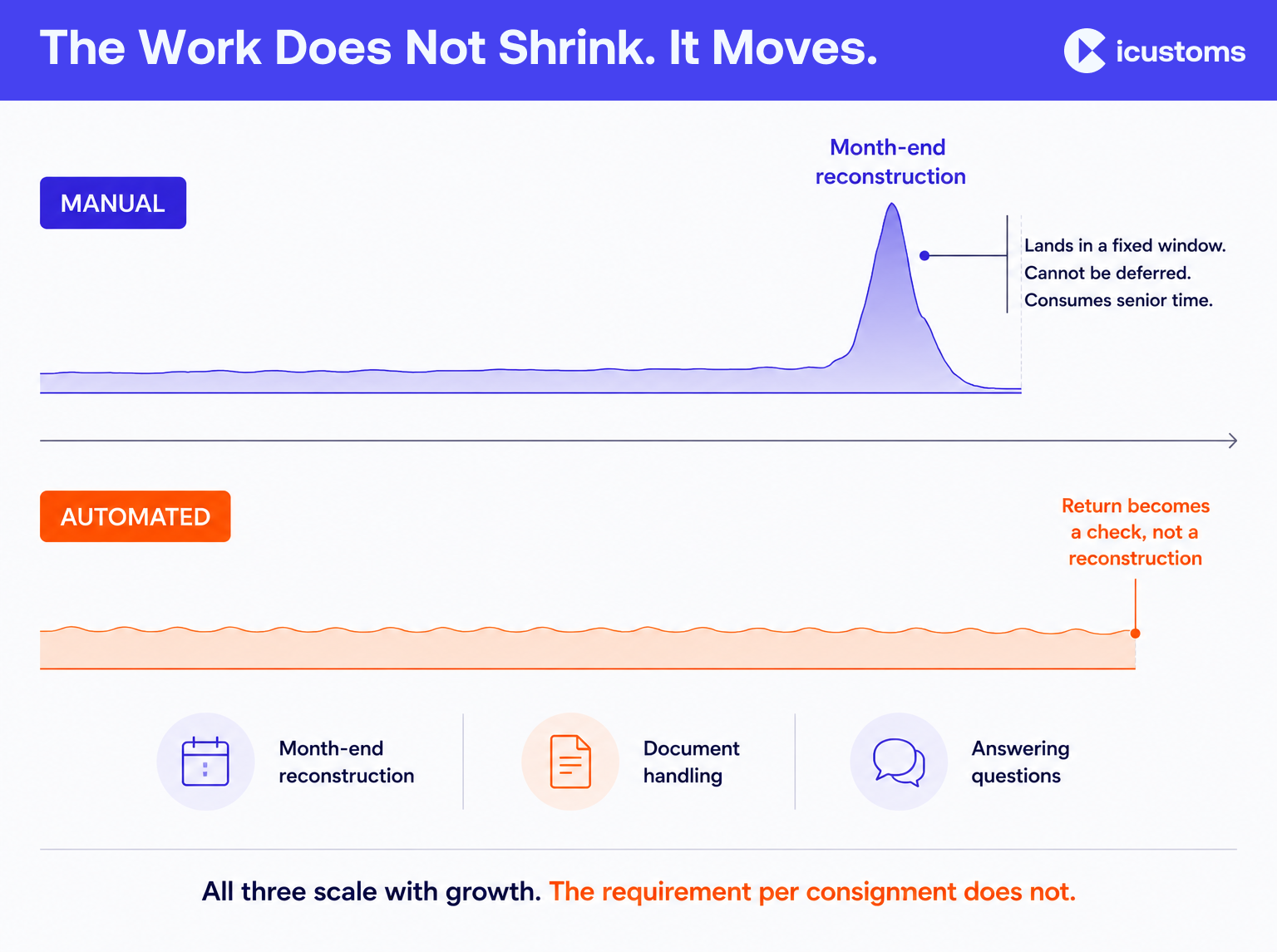
Month-end reconstruction. If the position is not maintained continuously, the return has to be assembled from receipts, removals and adjustments after the fact. That work scales with transaction volume, lands in a fixed window, and cannot be deferred, which is why it consumes senior time rather than junior time.
Document handling. Every consignment brings paperwork in whatever format the supplier or client sends it. Under bond that documentation has to be relatable to specific goods rather than filed by date. The work per consignment is broadly fixed, so it scales linearly with volume and with client count.
Answering questions. A client asking what they hold in bond, or an officer asking about one consignment, triggers a search rather than a lookup. Individually these are minor. Cumulatively, in a multi-site or multi-client operation, they are a role.
The pattern worth noticing is that all three scale with growth while the compliance requirement stays constant per consignment. Manual bonded records do not fail at low volume. They fail at the point the business becomes successful enough to be worth auditing, which is the worst possible moment.
The real cost of manual customs warehouse records
Manual customs warehouse records risk is usually described as the risk of errors. The more accurate framing is the risk of not being able to explain an error, because that is what determines the outcome.
Where goods cannot be accounted for, the starting assumption is that duty-suspended goods have entered the market without duty being paid, and the duty becomes due. A genuine, evidenced loss recorded at the time may attract relief. The same loss found later with no supporting record is a shortage, and shortages attract duty. The difference between those two outcomes is entirely a records difference.
Beyond the duty itself, the exposure includes financial penalties, claims against any guarantee you have provided, and in serious or persistent cases the withdrawal of your authorisation and approval. That last one is the tail risk nobody prices. Losing the authorisation does not increase your costs, it removes a service line and, for a 3PL, potentially the client relationships built on it.
It is worth being precise about the shape of that compliance risk, because it is asymmetric in a way ordinary operational risk is not. A picking error in general warehousing costs you a re-ship. The same error under bond can become a duty assessment, and the amount is set by the duty at stake on the stock rather than by the value of the mistake. So the exposure does not scale with how badly you got it wrong. It scales with what you happen to be holding at the time.
That asymmetry is why compliance risk on manual bonded records is so easily underestimated. For years the observed cost is nil, because nothing has been tested. The distribution has a long flat stretch and a short expensive tail, and it is the flat stretch that people budget against.
Which is why automation ROI on a bonded compliance system is not primarily an efficiency calculation. The efficiency saving is real and modest. The material return is the removal of an unpriced tail risk, plus the ability to sell bonded storage as a service with confidence. Those are the two figures worth putting in a business case.
Is Excel enough for a small bonded warehouse?
Sometimes, briefly, and it is worth being honest about that rather than pretending otherwise.
At genuinely low volume, on a single site, with one owner’s goods, a small number of commodity codes and no excise exposure, a carefully maintained spreadsheet plus a competent broker can hold together. Plenty of operations start there. The question is not whether it works today but which of the following is about to become true:
- You take on stock belonging to someone else, so ownership and owner records become a requirement rather than a formality.
- You add excise goods, which brings movement records, discharge tracking and periodic returns for each set of premises.
- You add a second site, at which point movements between your own locations start needing records of their own.
- Your commodity mix widens to include anything with a preference, quota or licensing restriction, which must be identified and evidenced before removal.
- Volume rises to the point where the current position is never actually current.
- An HMRC visit is scheduled, and you discover the difference between having records and being able to produce them.
Any two of those together is usually the point at which the spreadsheet stops being a cost saving and starts being the largest single risk in the operation.
What changes when you switch
The shift is less about doing the same work faster and more about the work changing shape.
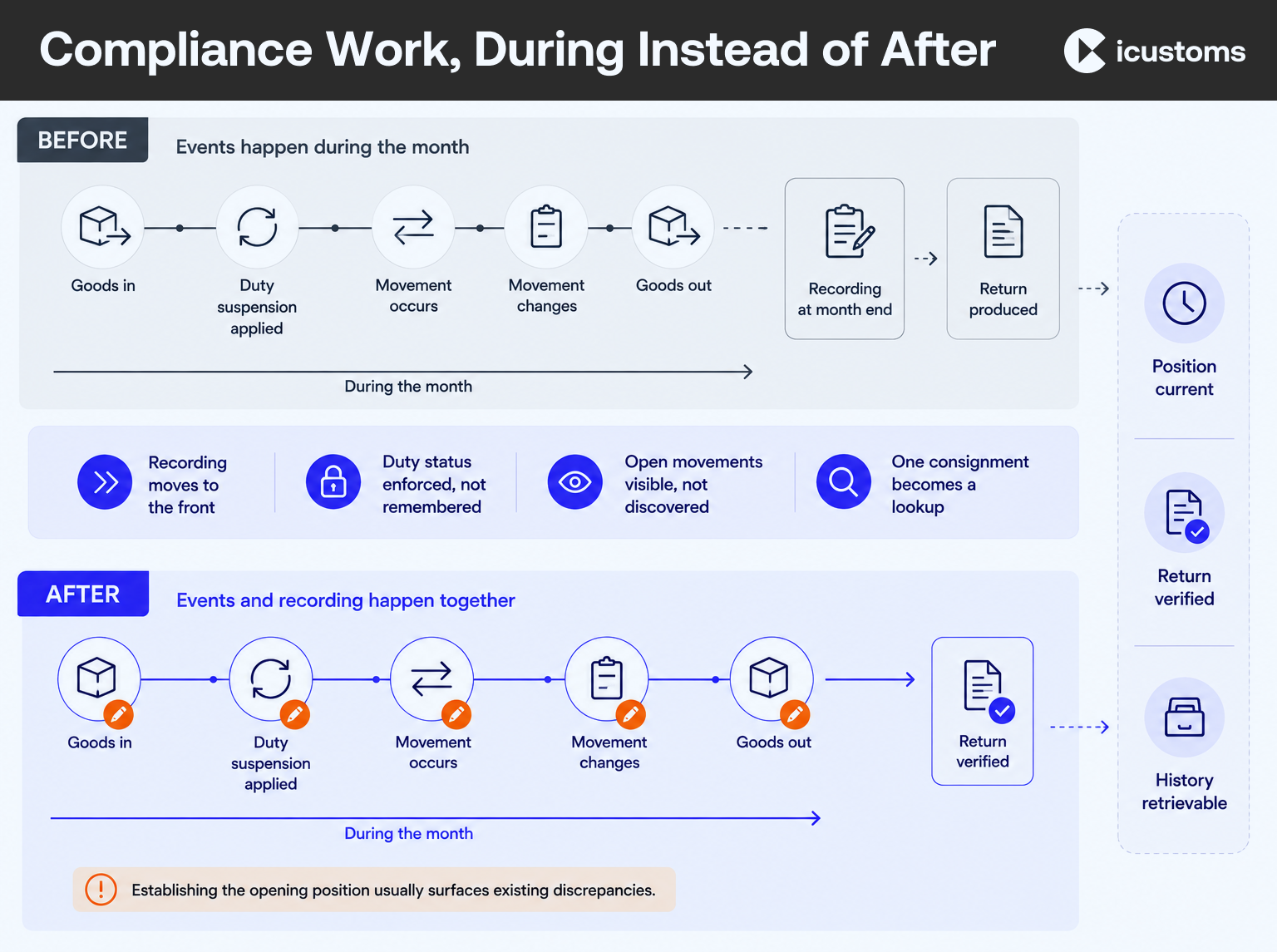
Recording moves to the front of the process rather than the end of it. Because the stock account is maintained as things happen, the monthly return becomes a check rather than a reconstruction, which is what makes it possible to automate excise warehouse returns rather than merely produce them faster. Duty status stops being something people remember and becomes something the system enforces. Open movements stop being a monthly discovery. And answering a question about one consignment becomes a lookup.
HMRC compliance automation in this context is not about removing people. It is about moving the compliance work from after the event to during it. iWarehouse is built for that: it keeps the bonded stock position and movement history together, holds duty status against stock, attaches supporting documents to the consignment they belong to, and reconciles the period so what you report matches what your records support. If you are ready to switch from spreadsheets to iWarehouse, that is the change you are buying.
One realistic note on transition. Moving from manual records means establishing an accurate opening position, and that exercise usually surfaces discrepancies that were already there. Better found during an implementation, on your own timetable, than during a visit.
Making The Decision
Three things worth doing before committing budget. Read what HMRC actually checks, in our guide to bonded warehouse audits, and test your own records against it. Work out the cash flow position, using the duty deferral and cash flow guide, because the working capital effect often dwarfs the administrative saving. Then evaluate systems properly against the criteria in our bonded warehouse software buyer’s guide, which sets out nine criteria drawn from HMRC requirements rather than feature lists.
If you are earlier than that and still working out which approvals you need, start with what a bonded warehouse is, or see how iWarehouse handles customs and excise stock together.
Frequently Asked Questions
What are the risks of manual customs warehouse records?
The principal risk is not making an error but being unable to explain one. Where goods cannot be accounted for, the duty becomes due. An evidenced loss recorded at the time may attract relief, while the same loss found later without records is a shortage that attracts duty. Exposure also includes penalties, claims against your guarantee, and in serious or persistent cases withdrawal of your authorisation.
How much time does customs warehouse software save?
We will not quote a figure, because any honest answer depends on your transaction volume, number of sites and client count. What is predictable is where the saving lands: month-end reconstruction, document handling, and answering questions about specific consignments. Those three scale with growth while the compliance requirement per consignment stays constant.
What happens if HMRC finds errors in a manual audit trail?
It depends on whether the error was recorded and explained or simply discovered. Unaccounted stock is treated as duty-suspended goods released without duty, so the duty becomes due. A documented, evidenced loss is a manageable compliance event. The audit trail is what separates those two outcomes.
Is Excel enough for a small bonded warehouse?
At genuinely low volume, on one site, with your own goods, few commodity codes and no excise exposure, it can hold together. It stops being adequate when you take on third-party stock, add excise goods, add a second site, widen your commodity mix to include restricted or preferential goods, or reach volumes where the position is never current.
Can a spreadsheet be approved as a duty management system?
HMRC guidance states that software which has not been approved cannot be used for customs warehousing, and that a system failing the requirements will not be approved. It must permit a full audit, identify goods carrying preference, quota or licensing restrictions, and be updated no later than before midnight of the following warehouse operation day. A closing stock balance system must also be volume tested with evidence retained, which a spreadsheet cannot satisfy.
You may also like:
Struggling to Extract, Catagorise & Validate Your Documents?

Capture & Upload Data in Seconds with AI & Machine Learning
Subscribe to our Newsletter
About iCustoms
iCustoms is an all-in-one solution helping businesses automate customs processes more efficiently. With AI-powered and machine-learning capabilities, iCustoms is designed to streamline your all customs procedures in a few minutes, cut additional costs and save time.
Struggling to Extract, Catagorise & Validate Your Documents?
Capture & Upload Data in Seconds with AI & Machine Learning