

CDS Simplified Declaration UK: How It Works & Who Qualifies
- John Hall
- Customs Specialist at iCustoms.ai
For clients who import regularly, a CDS simplified declaration UK approach can free up cash flow and speed goods through the border. In short, it lets approved traders release goods with less data up front, then file the full detail later. This guide takes a compliance-first view. It explains what the Simplified Declaration Procedure is, who qualifies, how to apply, and how the two-step process works, so you can advise clients with confidence.
What is the Simplified Declaration Procedure (SDP)?
The Simplified Declaration Procedure, often shortened to SDP customs UK teams use, is an HMRC authorisation. It lets approved businesses submit a simplified frontier declaration with reduced data, obtain release, and then send a fuller supplementary declaration afterwards. As a result, a simplified customs declaration UK importers rely on splits one entry into two stages: a quick release now and full reporting later.
This simplified uk customs declaration route is a genuine time-saver, yet it comes with responsibility. Because you report duty later, HMRC expects strong records and reliable systems before it grants access.
SDP versus EIDR
HMRC offers two main simplifications. Under SDP, you file a reduced frontier declaration through CDS. Under Entry in Declarant’s Records (EIDR), you instead record the goods in your own system at the point of release. Both feed a later supplementary declaration, so the Simplified Customs Declaration Process is similar, but the frontier step differs.
Why clients ask about Simplified Declaration Procedure (SDP)
Most clients raise SDP for one reason: cash flow. By accounting for duty later, they keep working capital for longer. Alongside that, faster release keeps supply chains moving. The main benefits include the points below:
- Improved cash flow, since duty is paid through a monthly deferment
- Faster release at the border with less data up front
- Fewer delays for regular, predictable shipments
- Better planning across high volumes of entries
Who can use it? Who qualifies
Not every trader qualifies. HMRC customs authorisation depends on your compliance history and your systems. Typically, an applicant needs to meet the following conditions:
- An established business presence in the UK
- A good customs and tax compliance record
- A Duty Deferment Account to settle duty and import VAT
- Reliable records that can support a later supplementary declaration
- Often, a Customs Comprehensive Guarantee, although waivers can apply
Agents can file under a client’s authorisation, or hold their own, depending on the setup. Therefore, confirm who holds the SDP authorisation before you file, since that decides responsibility.
Compliance responsibilities
With the benefit comes duty. Because you report and pay later, HMRC expects you to keep accurate records, meet every supplementary deadline, and maintain your authorisation conditions. Fail on these, and HMRC can suspend or revoke access. Therefore, treat SDP as an ongoing commitment rather than a one-off setup.
How to apply
Applying takes planning, so start early. Broadly, the route runs as follows:
- Check eligibility against HMRC’s conditions and fix any compliance gaps first.
- Set up a Duty Deferment Account if the client does not already hold one.
- Apply for the SDP authorisation through HMRC, with supporting details about your records and systems.
- Arrange a Customs Comprehensive Guarantee, or a waiver, where required.
- Once approved, configure your CDS software to file simplified entries.
Approval is not instant. HMRC may review your records and processes, so a clean compliance history speeds things along.
Plan for several weeks from application to approval. In the meantime, tidy your records and confirm your Duty Deferment Account has enough headroom, because HMRC checks both.
Step-by-step Simplified Declaration Procedure process
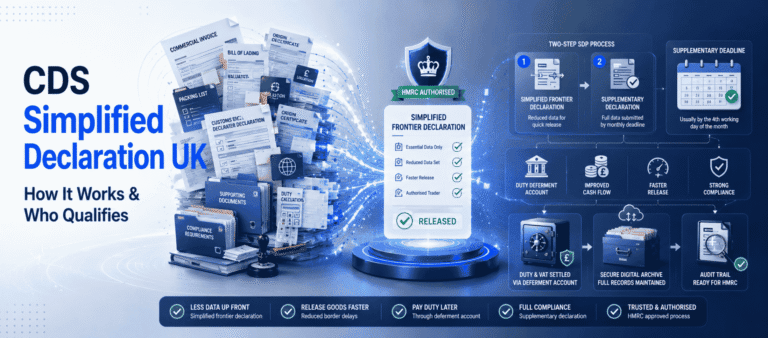
Once authorised, the day-to-day flow is a two-step process. Here is how a single movement runs:
- File a simplified frontier declaration with the reduced data set as the goods arrive or before.
- Obtain release once HMRC accepts the entry.
- Record the movement accurately in your systems.
- Submit the supplementary customs import declaration with the full data by the deadline.
- Pay the duty and import VAT through your Duty Deferment Account.
The same model supports the export customs declaration process for approved exporters, though import users are the most common. Get the commodity and procedure codes right at the frontier stage, because they carry through to the supplementary entry. See our procedure codes guide for detail.
Throughout, keep evidence for each release. HMRC customs officers can ask to see how a frontier entry links to its supplementary declaration, so a clear audit trail protects you.
Supplementary declarations
The supplementary declaration is where the full detail lands. Usually, you must submit it by the fourth working day of the month after the goods were released, though you should confirm the exact deadline for your authorisation. Miss it, and you risk penalties and a mark against your compliance record.
Because the supplementary entry drives the duty calculation, accuracy matters as much here as at the frontier. In practice, good software carries the frontier data forward, which reduces rekeying and error.
Keep a simple monthly rhythm. First, reconcile the month’s frontier entries. Next, complete each supplementary customs import declaration. Finally, check the duty totals against your deferment statement before the deadline.
Difference from a full declaration
A full declaration captures everything in one submission at the border. A simplified entry splits that into two. The table below compares the two side by side.
| Aspect | Full Declaration | Simplified Declaration Procedure (SDP) |
|---|---|---|
| Data at the Border | Complete customs data set submitted before or at the time of import or export. | Reduced data set submitted initially, with remaining information provided later. |
| Steps | Single customs declaration submitted to complete the process. | Two-stage process: a simplified frontier declaration followed by a supplementary declaration. |
| Duty Accounted For | Customs duty and import VAT are accounted for when the declaration is submitted. | Duty is finalised and accounted for through the later supplementary declaration. |
| Authorisation | No specific HMRC authorisation is required beyond standard customs registration. | Requires prior HMRC authorisation to use the Simplified Declaration Procedure (SDP). |
Understanding the customs declaration process in the UK helps you judge the trade-off. SDP speeds release and eases cash flow, yet it adds a reporting duty. For high-volume, compliant importers, that trade is usually worth it.
How iCDS supports simplified declarations
iCustoms iCDS is built to handle both the frontier and the supplementary stages of the Simplified Customs Declaration Process. It validates each simplified uk customs declaration before submission, carries data forward to the supplementary entry, and helps you meet monthly deadlines. As a result, your team keeps the cash-flow benefit of SDP without the compliance risk.
Frequently Asked Questions
What is a CDS simplified declaration UK?
It is a two-step customs entry for authorised traders. You file a reduced simplified frontier declaration for release, then a full supplementary declaration later.
Who qualifies for SDP customs UK authorisation?
Established UK businesses with a good compliance record, a Duty Deferment Account, and reliable records. HMRC customs may also require a guarantee.
What is the uk customs declaration form for SDP?
At the frontier you file a simplified uk customs declaration form with reduced data through CDS, followed by a fuller supplementary declaration.
Does SDP cover exports too?
Yes. Approved exporters can apply the same simplified route to the export customs declaration process, although importers use it most.
When is the supplementary declaration due?
Usually by the fourth working day of the month after release. Always confirm the exact deadline set in your SDP authorisation.
Is SDP the same as EIDR?
No. SDP files a reduced frontier declaration through CDS, while EIDR records goods in your own records. Both still need a later supplementary declaration.
You may also like:
Struggling to Extract, Catagorise & Validate Your Documents?

Capture & Upload Data in Seconds with AI & Machine Learning
Subscribe to our Newsletter
About iCustoms
iCustoms is an all-in-one solution helping businesses automate customs processes more efficiently. With AI-powered and machine-learning capabilities, iCustoms is designed to streamline your all customs procedures in a few minutes, cut additional costs and save time.
Struggling to Extract, Catagorise & Validate Your Documents?
Capture & Upload Data in Seconds with AI & Machine Learning