
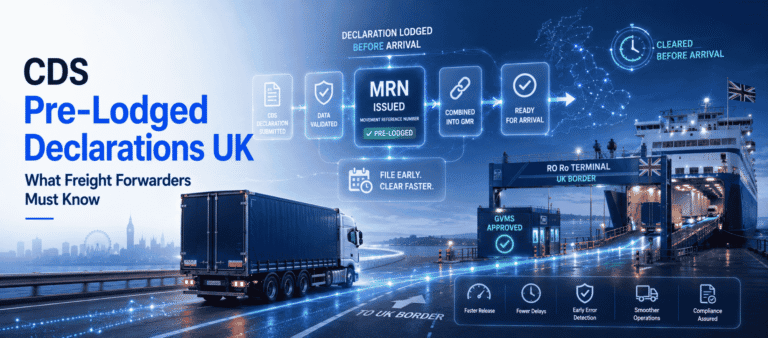
CDS Pre-Lodged Declarations UK: What Freight Forwarders Must Know
- John Hall
- Customs Specialist at iCustoms.ai
For agents moving goods through fast-turnaround ports, a CDS pre-lodged declaration UK teams file in advance is often essential. In short, you submit the declaration before the goods reach the border, so clearance can happen the moment they arrive. This guide is written for forwarders who are actively filing. It covers what pre-lodgement means, when you must use it, the exact steps, the data you need, and the mistakes that cause hold-ups at the frontier.
What is a pre-lodged declaration?
A pre-lodged declaration is a customs entry you submit to CDS before the goods physically arrive in the UK. Because of that timing, people also call it a pre-arrival customs declaration UK importers rely on. When you pre-lodge CDS entries, HMRC validates the data early and returns a Movement Reference Number (MRN). The declaration then sits in a pre-lodged state until the goods arrive, at which point it becomes ‘arrived’ and moves to clearance.
This differs from an ‘arrived’ declaration, which you file only once the goods are already at the frontier. For roll-on roll-off traffic, however, pre-lodgement is usually the only workable option.
| Aspect | Pre-lodged | Arrived |
|---|---|---|
| When Filed | Before the goods arrive at the UK border. | After the goods have reached the frontier. |
| Typical Use | Commonly used for Roll-on/Roll-off (RoRo) movements and ports operating under the Goods Vehicle Movement Service (GVMS). | Typically used at inventory-linked ports where goods are presented to customs upon arrival. |
| MRN Issued | Yes, a Movement Reference Number (MRN) is issued before the goods arrive. | Yes, an MRN is generated when the declaration is submitted. |
| Clears When | Once the goods arrive and the arrival notification is successfully submitted. | Immediately after submission, provided the declaration is complete and passes HMRC validation checks. |
In practice, most RoRo movements use the pre-lodged route, while inventory-linked sea and air ports often use arrived entries. Knowing which model your port follows tells you how to file.
Why pre-lodge?
Pre-lodgement keeps goods moving. For time-critical freight, that speed protects your schedule and your client relationships. The main benefits include the points below:
- Faster release, since HMRC checks the data before the goods arrive
- Fewer hold-ups at RoRo ports, where there is no time to file on the spot
- Early warning of errors, so you can fix them before the goods land
- A ready MRN to combine into a movement reference where required
- Smoother planning for hauliers and drivers
Above all, pre-lodgement shifts the customs work away from the moment of arrival. As a result, a small error becomes a quick fix at your desk rather than a stranded lorry at a busy port.
When can you pre-lodge?
You can pre-lodge most import declarations. At some locations, though, you must. The rule depends on how the port controls goods.
Pre-lodgement at UK RoRo ports
Many UK RoRo ports run on the Goods Vehicle Movement Service (GVMS) rather than an inventory system. At these GVMS locations, you must pre-lodge the declaration, then combine the MRN into a Goods Movement Reference (GMR) before the vehicle boards. Without a valid GMR, the driver cannot check in. Therefore, pre-lodgement is not optional at these UK RoRo ports; it is simply the process.
RoRo to Ireland and the PBN
If your goods travel by RoRo into Ireland, a different rule applies. Irish Revenue uses a Pre-Boarding Notification rather than GVMS. In that case, the customs RoRo PBN links your declarations before the ferry departs. Keep the two systems clearly apart: GVMS and a GMR for GB arrivals, and a PBN for movements into Ireland.
How early can you file?
You can usually pre-lodge well ahead of arrival, often several days in advance. File too early, though, and details such as the vessel or the arrival date may still change. Therefore, most agents pre-lodge once the routing is confirmed, then amend the entry only if plans move.
The pre-lodgement CDS process step by step
The pre-lodgement CDS process is straightforward once your data is ready. Follow these steps in order:
- Prepare the full declaration data, exactly as you would for a standard entry.
- Set the declaration to pre-lodged, not arrived, in your CDS software.
- Submit it to HMRC ahead of the goods’ arrival.
- Receive and record the MRN that HMRC returns.
- For GVMS ports, add the MRN to a Goods Movement Reference before the vehicle travels.
- Send the arrival notification when the goods reach the frontier, or let the port system trigger it.
- Track the entry through to clearance and release.
Get the commodity and procedure codes right at step one, because a pre-lodged entry carries the same detail as any full declaration. If you need a refresher, see our procedure codes guide.
Required data fields
The data for a pre-lodged entry matches a standard CDS declaration. In practice, the pre lodge customs declaration requirements cover these core fields:
- Importer and exporter EORI numbers
- The commodity code for each item
- The customs value and the valuation method
- The customs procedure code and any additional procedure code
- The country of origin and country of dispatch
- Transport and location details, including the expected port
- Any licences or supporting document references
Because you file before arrival, double-check the expected arrival location. An incorrect port reference is a frequent reason a pre lodge customs declaration fails to match at the frontier.
| Data Group | What It Covers |
|---|---|
| Parties | Importer and exporter EORI numbers, declarant details, and the type of customs representation (direct or indirect). |
| Goods | Commodity code, goods description, customs value, quantity, weight, and other item-specific declaration details. |
| Procedure | The customs procedure code (CPC), additional procedure code (APC), and any special customs procedures being claimed. |
| Movement | Expected port of arrival or departure, transport method, conveyance details, and the anticipated arrival date. |
Group your data this way and the entry comes together faster. Moreover, a clear structure makes it easier to spot a missing field before you submit.
Common mistakes
A few errors show up again and again. Avoid these to keep goods moving:
- Filing as ‘arrived’ when the port needs a pre-lodged entry
- Forgetting to build the MRN into a GMR before travel
- A wrong expected arrival port or date
- Missing the arrival notification, so the entry never progresses
- Mismatched data between the declaration and the movement reference
How iCDS handles pre-lodging
iCDS is built for this operational reality. It lets you pre-lodge CDS declarations in advance, validates every data element before submission, and returns the MRN you need for a GMR. Moreover, it flags mismatches early, so your drivers are not stuck at the port. For high-volume RoRo work, that automation removes most of the manual risk.
In day-to-day use, iCDS helps your team:
- Pre-lodge single or bulk entries ahead of arrival
- Validate every data element before it reaches HMRC
- Return MRNs that are ready to drop into a GMR
- Flag port or date mismatches before the vehicle travels
Frequently Asked Questions
What is a CDS pre-lodged declaration?
It is a customs entry submitted to CDS before the goods arrive in the UK. HMRC validates it early and issues an MRN, and it clears once the goods arrive.
Is a pre-lodged declaration the same as a pre-arrival declaration?
Yes. A pre-arrival customs declaration UK agents file is simply another name for a pre-lodged CDS entry.
Do I have to pre-lodge at RoRo ports?
At GVMS-controlled UK RoRo ports, yes. You must pre-lodge and combine the MRN into a Goods Movement Reference before the vehicle boards.
What is the difference between GVMS and a PBN?
GVMS and a GMR apply to GB arrivals. A customs RoRo PBN applies to movements into Ireland. They are separate systems, so do not mix them.
What are the pre lodge customs declaration requirements?
You need the same data as a full CDS entry, plus the correct expected arrival location, so the entry matches when the goods reach the frontier.
How early can I pre-lodge a CDS declaration?
You can pre-lodge several days before arrival. Most agents file once the routing is confirmed, then amend only if the vessel or date changes.
Does a pre-lodged declaration need an arrival notification?
Yes. The entry stays pre-lodged until an arrival notification is sent or triggered by the port. Only then does it move to clearance.
You may also like:
Struggling to Extract, Catagorise & Validate Your Documents?

Capture & Upload Data in Seconds with AI & Machine Learning
Subscribe to our Newsletter
About iCustoms
iCustoms is an all-in-one solution helping businesses automate customs processes more efficiently. With AI-powered and machine-learning capabilities, iCustoms is designed to streamline your all customs procedures in a few minutes, cut additional costs and save time.
Struggling to Extract, Catagorise & Validate Your Documents?
Capture & Upload Data in Seconds with AI & Machine Learning