
T1 vs T2 Document: What's the Difference in UK and EU Transit?
- John Hall
- Customs Specialist at iCustoms.ai
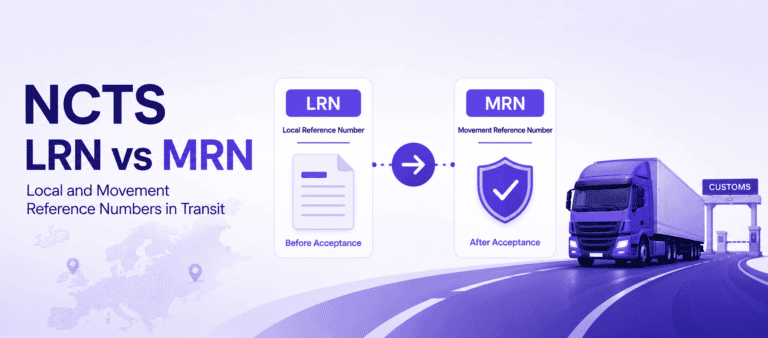
T1 and T2 are the two customs statuses used on a transit declaration, and the difference comes down to one question: have the goods already been released into free circulation in the EU? T1 covers goods that have not, known as non-Union goods. T2 covers goods that have, known as Union goods. Declaring the wrong one does not stop a movement, but it changes the duty position waiting at the end of it.
This guide covers what determines T1 or T2 status, what each one means in practice, and where getting it wrong causes problems that only surface later.
What Determines T1 or T2 Status
Status is not a choice. It is a fact about the goods, decided by whether they have already cleared into free circulation somewhere in the EU. Goods that have not, whether because they arrived from outside the EU and are moving onward, or because they are sitting in a customs warehouse, take T1 status. Goods that have already cleared, and are simply passing through a non-EU territory such as the UK or an EFTA state on their way to another EU destination, take T2 status.
The declaration does not create the status. It records it, and it needs evidence to back the claim, particularly for T2.
T1: Non-Union Goods in Transit
T1 applies to non-Union goods: anything that has not been released into free circulation in the EU. This covers goods imported from outside the EU and moved onward under transit rather than cleared immediately, and goods that were in free circulation but have since left it, for example by entering a customs warehouse or an inward processing arrangement.
Duty and import VAT on T1 goods are suspended for the duration of the movement and become due, if at all, at the office of destination once the goods are declared for free circulation there. This is the default status for most transit movements into the EU or UK from outside, and it is the status assumed unless there is specific evidence the goods already hold Union status. Our T1 document guide covers how a T1 declaration is completed in full.
T2: Union Goods Moving Without Losing Status
T2 applies to Union goods, meaning goods already in free circulation in the EU, when they need to pass through a country outside the EU customs territory to reach another EU destination. The UK, Switzerland, Norway and the other Common Transit Convention territories all sit outside that territory, so Union goods routed through any of them need a T2 declaration to arrive at the next EU point without being treated as a fresh import.
Without it, goods that never lost their Union status would otherwise face import formalities they do not need, simply because the route happened to leave EU territory briefly. The T2 declaration exists to prevent that.
A related but separate document is worth knowing about here. A T2L or T2LF is proof of Union status issued outside a transit movement, typically for goods travelling directly between EU points by sea or air without needing the transit procedure at all. It proves the same thing a T2 transit declaration does, but it is not itself a transit declaration.
T1 vs T2 at a Glance
| Aspect | T1 | T2 |
|---|---|---|
| Goods status | Non-Union goods | Union goods |
| Typical use | Goods from outside the EU moving onward under transit, or goods that left free circulation | EU-status goods routed through a non-EU CTC territory to another EU destination |
| Duty outcome at destination | Due once the goods are declared for free circulation | None, provided Union status is confirmed on arrival |
| Evidence needed | The transit declaration itself | The transit declaration plus supporting evidence of Union status |
Why Getting the Status Wrong Costs Money
A groupage load moving from a UK warehouse into the EU is a common place for this to go wrong. If part of the load is genuinely Union status, perhaps goods that cleared into free circulation in Rotterdam before being consolidated in the UK, and part is non-Union stock bought in from outside the EU, declaring the whole load as T1 puts duty on goods that should not owe any, while declaring the whole load as T2 without evidence understates a liability that will surface at an audit rather than at the border.
Neither mistake gets caught by the system at the point of filing, because NCTS validates that a status has been declared, not that it is the correct one. The cost shows up later: an overpayment nobody claims back, or an assessment raised well after the movement is closed.
How Status Is Declared and Checked
Customs status is declared at consignment or house consignment level within the transit declaration itself, alongside the structure covered in our guide to creating an NCTS transit declaration. For T2, the declarant needs to be able to support the claim on request, typically with commercial evidence showing where the goods were released into free circulation and that they have not left it since.
This is worth checking before the declaration is built, not while it is being filled in. A groupage consignment with mixed status needs that split resolved at the planning stage, because the house consignment structure itself has to reflect it rather than papering over it with one status applied to everything.
NCTS and T1/T2: Same System, Different Outcome
NCTS handles T1 and T2 declarations through the same message flow. The system does not treat a T2 movement differently in how it is submitted or tracked; the status only changes what is expected to happen once the movement reaches its office of destination. Our NCTS Phase 5 guide and EU customs transit procedure guide cover that message flow and office network in full.
Frequently Asked Questions
What is the difference between T1 and T2 in customs transit?
T1 covers non-Union goods, which have not been released into free circulation in the EU. T2 covers Union goods moving through a non-EU territory to another EU destination without losing that status.
How do I know if my goods are T1 or T2?
Check whether the goods have already been released into free circulation somewhere in the EU. If they have and are simply passing through a non-EU territory, they are T2. If they have not, or have since left free circulation, they are T1.
What is a T2L document and is it the same as a T2 transit declaration?
No. A T2L or T2LF is proof of Union status used outside the transit procedure, typically for direct EU-to-EU movements by sea or air. A T2 transit declaration proves the same status but is filed as part of an actual transit movement.
What happens if Union status goods are declared T1 by mistake?
The goods are treated as non-Union for the movement, and duty may be charged at the destination on goods that should have moved free of it. Correcting this after the fact usually means reclaiming an overpayment rather than a straightforward fix.
Do UK to EU movements use T1 or T2?
It depends on the goods, not the route. Non-Union goods moving from the UK into the EU use T1. Union-status goods that are simply transiting the UK on their way to another EU destination use T2.
What evidence proves Union status for a T2 declaration?
Commercial documentation showing where and when the goods were released into free circulation in the EU, and that they have not left it since, such as prior import records or a T2L where one was issued.
Does the customs status affect the guarantee needed?
The guarantee covers the duty and VAT at risk during the movement. T1 movements typically carry a higher duty exposure, since the goods have not yet had duty settled, which is a factor in how much cover a guarantee needs to provide.
Can a single consignment mix T1 and T2 goods?
Not within the same goods item. Where a load genuinely contains both non-Union and Union goods, each needs to be declared under the correct status at consignment or house consignment level, not combined under one.
You may also like:

Guessing Whether a Consignment Is T1 or T2?

iCustoms flags the correct customs status on every transit declaration before you submit.
Subscribe to our Newsletter
About iCustoms
iCustoms is an all-in-one solution helping businesses automate customs processes more efficiently. With AI-powered and machine-learning capabilities, iCustoms is designed to streamline your all customs procedures in a few minutes, cut additional costs and save time.
See AI Customs Automation in Action
Turn trade documents into structured data with intelligent automation.