
NCTS LRN and MRN Explained: Local and Movement Reference Numbers in Transit
- John Hall
- Customs Specialist at iCustoms.ai
An NCTS LRN and an NCTS MRN are two different reference numbers attached to the same transit movement. The Local Reference Number (LRN) identifies a declaration before customs has processed it. The Movement Reference Number (MRN) is issued once that declaration is accepted, and it stays with the movement from departure to discharge. Confusing the two is a common source of delay when tracking a shipment through the common transit procedure.
NCTS LRN vs NCTS MRN: What Each Number Actually Does
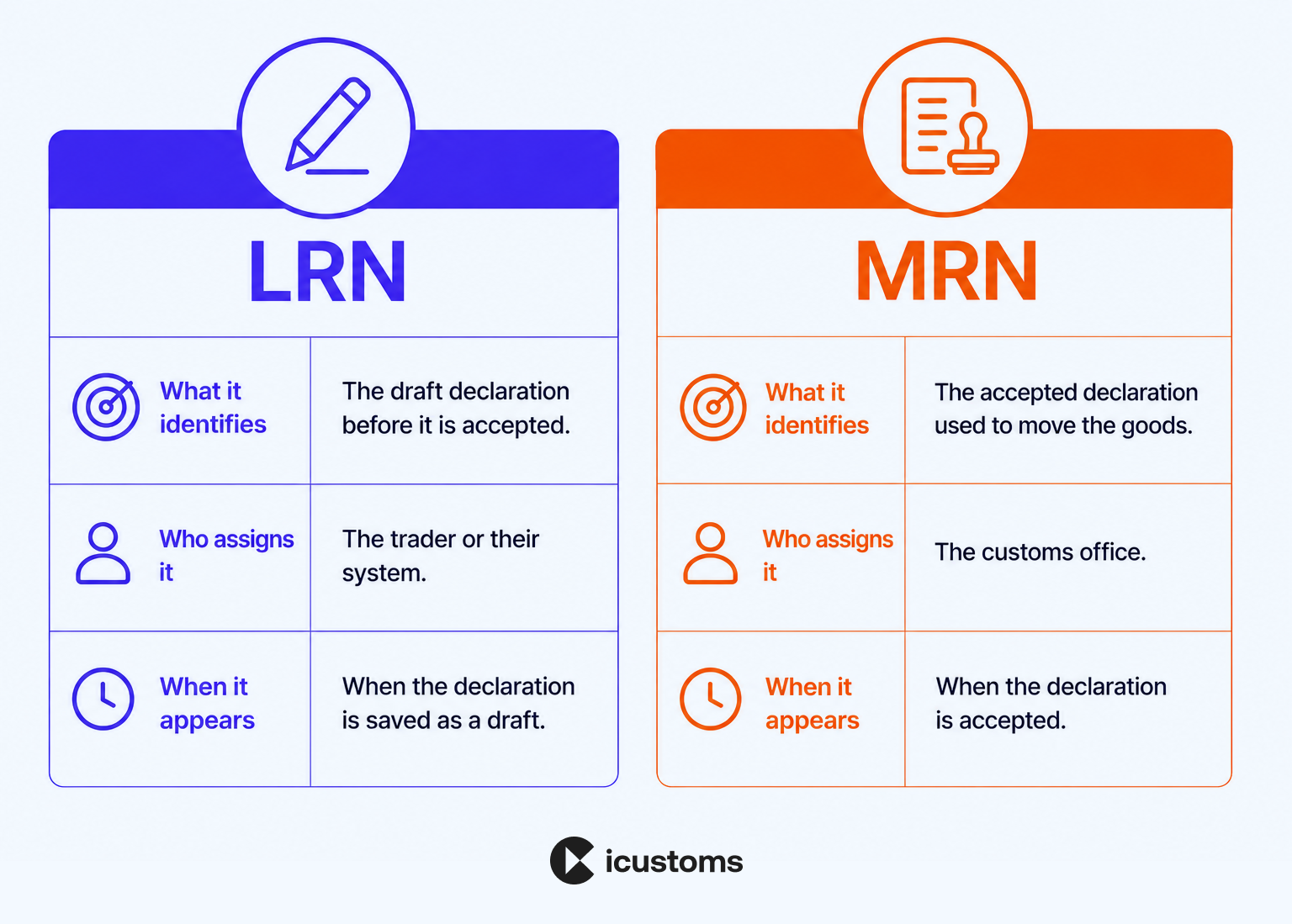
The Local Reference Number and the Movement Reference Number sit at different points in the same declaration’s life. The table below sets out what each one identifies, who assigns it, and when it appears.
| Aspect | NCTS Local Reference Number (LRN) | NCTS Movement Reference Number (MRN) |
|---|---|---|
| What it identifies | A single declarant on a single consignment | The accepted movement, tracked across the whole journey |
| Who assigns it | Generated by NCTS and transmitted to the trader or haulier before acceptance | Issued by NCTS once the declaration is registered |
| When it appears | Before the departure office validates the declaration | After acceptance, and printed on the transit accompanying document |
| Reuse | A fresh LRN is needed for every declaration, though one LRN can cover multiple consignments grouped into a single declaration | Unique to that movement; never reused |
In practice, the LRN is only useful to the person who submitted the declaration, since it exists purely to identify the record before customs allocates anything permanent. Once the MRN is issued, that is the number every other party (the office of transit, the office of destination, and the guarantor) will reference for the rest of the movement.
How the NCTS MRN Links to Your Guarantee
Every transit declaration also needs a Guarantee Reference Number (GRN), and NCTS checks it against the principal’s own identification details and an access code before the declaration is accepted. Get the GRN or access code wrong and the declaration is rejected before an MRN is even issued, regardless of how accurate the rest of the entry is.
A GRN can point to one of three guarantee types: a comprehensive guarantee (which can be topped up if a movement runs close to the limit), a guarantee waiver (which cannot be combined with another guarantee on the same declaration), or an individual guarantee or voucher covering a single movement. Whichever type sits behind the GRN, the guarantee amount is what NCTS reduces the moment the MRN is issued, and what it restores once that MRN is properly discharged.
This NCTS MRN guarantee link is the part most businesses underestimate. The guarantee is not a one-off check at submission; it stays committed against that specific MRN for as long as the movement is open, which is exactly why an MRN that never discharges keeps eating into a guarantee limit long after the goods themselves have arrived.
The NCTS IE045 Message: How a Movement Gets Discharged
Discharge is the point where NCTS confirms a movement has ended and releases the guarantee amount tied up against it. Under the common transit procedure, that confirmation normally arrives as the NCTS IE045 message: an electronic NCTS notification of discharge sent once the office of destination has confirmed the goods arrived and matched the declaration.
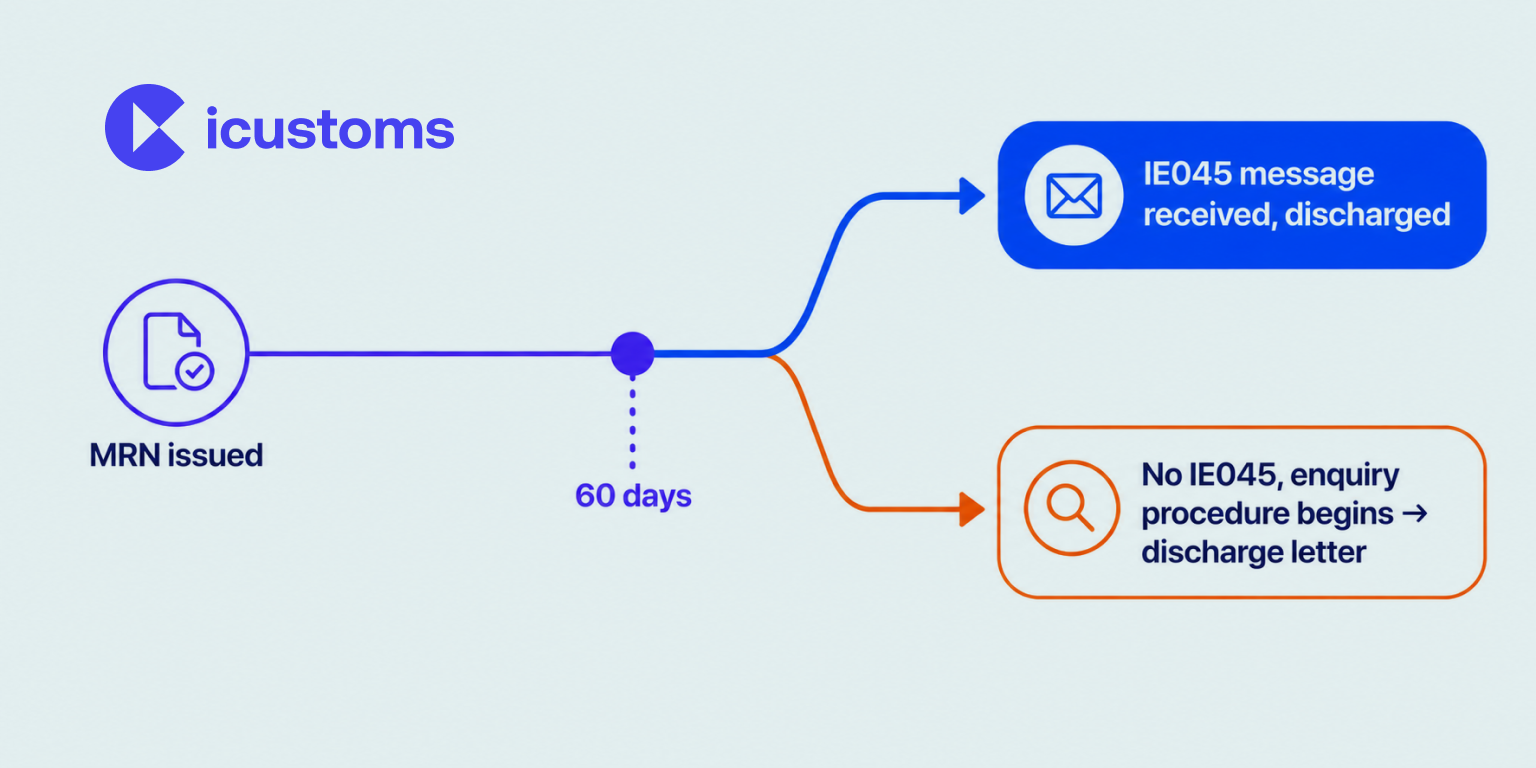
If a movement discharges within 60 days, the IE045 message is what closes it out automatically. If 60 days pass without that notification of discharge, the movement moves into an enquiry procedure, and instead of an electronic message, the principal receives an NCTS discharge letter once the enquiry concludes. Either route ends the same way: the guarantee amount against that MRN is released.
NCTS Monitoring In-Use MRNs: What HMRC Expects From Traders
HMRC’s own guidance puts the responsibility for monitoring in-use MRNs on the trader, not on HMRC. If a movement has not produced an IE045 message and no discharge letter has followed an enquiry, the MRN is treated as still open, and the guarantee behind it stays reduced. Traders are expected to monitor every instance where their Guarantee Reference Number is being used, rather than waiting for a problem to surface as a blocked declaration.
HMRC has also confirmed it will not respond to bulk requests for the status of multiple MRNs. If a business needs to confirm the discharge of a specific MRN, the request has to go to HMRC individually, along with proof of the end of the transit procedure, such as documentation the destination office holds confirming the goods were presented and matched. Businesses running more than a handful of transit movements a month tend to find this the hardest part of the process to manage by email and spreadsheet alone.
Checking Your Guarantee Balance Before It Blocks a Movement
A guarantee that looks fine on paper can still be exhausted by MRNs that are technically open but have not yet discharged. HMRC’s guarantee balance checker tool lets a guarantor or principal check the balance remaining on a guarantee waiver, an individual guarantee with multiple usage, or a customs comprehensive guarantee, using the EORI number, the Guarantee Reference Number and an access code.
For a haulier or forwarder running several transit movements a week, checking that balance manually before every new declaration is realistic for a while and then stops being realistic the moment volume grows. This is exactly the kind of exposure that catches businesses out: a new transit declaration gets rejected not because anything about the goods or the route is wrong, but because a handful of older MRNs never discharged and the guarantee amount they are still holding has quietly eaten into what is left. A logistics team running multiple client accounts through one comprehensive guarantee can end up with dozens of MRNs open at once, each one invisible until the balance runs out and a declaration bounces back with no obvious cause.
iCustoms software surfaces guarantee usage and MRN status alongside the declaration itself, so a shrinking balance shows up before it blocks a movement rather than after. That matters most for customs agents and forwarders managing guarantees on behalf of several clients, where a single undischarged MRN buried in one client’s account can otherwise stall an unrelated declaration for another.
Where LRN and MRN Fit Within the Common Transit Procedure
The common transit procedure is the framework, built on the Customs Transit Convention between the EU and the other contracting parties, that makes a single MRN and a single guarantee valid across every office of transit a movement passes through. The LRN, the MRN and the GRN are the three reference numbers that make that framework workable in practice: one to identify the declaration before acceptance, one to track the movement after it, and one to secure the duty at risk throughout. HMRC’s Transit Manual Supplement sets out the full detail behind the discharge and enquiry procedure summarised above, for businesses that need the underlying rules rather than the practical summary.
Frequently Asked Questions
What is the difference between an NCTS LRN and an NCTS MRN?
The LRN is generated by NCTS and given to the trader to identify a declaration before it is accepted. The MRN is issued once the declaration is accepted and stays with the movement until discharge.
What is a Guarantee Reference Number used for?
The GRN identifies which guarantee is covering a transit movement. NCTS validates it against the principal's identification details and an access code before accepting the declaration.
How do I know if my transit movement has been discharged?
NCTS sends an IE045 notification of discharge within 60 days of the movement ending. After 60 days without one, an enquiry procedure begins, and a discharge letter follows once that concludes.
What happens if an MRN never discharges?
The MRN stays in use and the guarantee amount against it stays reduced. HMRC expects traders to monitor this themselves rather than relying on HMRC to flag it, and will not handle bulk status requests.
How do I check my transit guarantee balance?
HMRC's guarantee balance checker tool shows the balance on a guarantee waiver, individual guarantee or customs comprehensive guarantee, using the EORI number, the Guarantee Reference Number and an access code.
What proof do I need if a specific MRN hasn't discharged automatically?
You need to contact HMRC individually with proof of the end of the transit procedure, generally documentation confirming the destination office presented and matched the goods.
You may also like:
Tired of Chasing LRNs, MRNs and Guarantee Balances Manually?

iCustoms tracks every reference number and guarantee balance against your transit movements automatically, so nothing goes undischarged without you knowing.
Subscribe to our Newsletter
About iCustoms
iCustoms is an all-in-one solution helping businesses automate customs processes more efficiently. With AI-powered and machine-learning capabilities, iCustoms is designed to streamline your all customs procedures in a few minutes, cut additional costs and save time.