
NCTS Penalties and Errors: What Happens When Your Transit Declaration Goes Wrong
- John Hall
- Customs Specialist at iCustoms.ai
Not every problem with a transit declaration is a penalty. Most are rejections: NCTS refusing to validate the declaration until a specific field is corrected, with no financial consequence beyond the delay. A civil penalty is a separate, later action from HMRC, triggered by a pattern of inaccurate or non-compliant declarations rather than a single validation error. This guide covers both: why declarations get rejected, and when a rejection or an error can turn into an actual fine.
Rejection Is Not a Penalty
A rejected declaration is validation doing its job before the movement is released. NCTS returns a functional error message if the data does not validate, refuses release if the office of departure will not accept the movement, or refuses the guarantee itself if that fails its own checks. None of these cost money on their own. They cost time, and the fix is almost always correcting the field the error points to and resubmitting.
The most common causes are the same handful every time: a goods item with no house consignment above it, a commodity code that is blank or short of six digits, a guarantee reference that is wrong, expired or lacking cover, an office of destination that is not recognised, or an incomplete safety and security dataset once one has been claimed. None of these are compliance failures in themselves. They are data problems, caught exactly where they are meant to be caught.
Our guide to creating an NCTS transit declaration and our NCTS Phase 5 guide cover the specific error codes and the most common causes behind them in detail.
When a Rejection Becomes a Compliance Problem
The distinction that matters is between an error caught at filing and an inaccuracy found afterwards. A rejection happens before the movement is released, so nothing has gone wrong yet from HMRC’s perspective; it is simply corrected. A civil penalty concerns declarations that were accepted and acted on, but were later found to be inaccurate, non-compliant with an authorisation’s conditions, or part of a repeated pattern that a warning letter already flagged.
This is also where volume becomes relevant in a way it is not for rejections. A single rejected declaration is routine. The same underlying error appearing across multiple accepted declarations, discovered during a compliance check, is a different conversation.
Timing matters here too. A rejection happens in seconds, before anything is committed. A compliance concern can surface months after the movement discharged, once an audit or a routine check looks back over a run of declarations rather than a single one. By then the guarantee has already been released and the goods have long since arrived, so the only thing left to assess is whether the paperwork trail holds up.
The Civil Penalty Framework: What Actually Happens
HMRC’s civil penalty regime for customs contraventions, set out in Customs Notice 301 and applied to transit through the Transit Manual Supplement, splits contraventions into two kinds: civil evasion, meaning offences involving dishonesty, and regulatory contraventions, meaning failures to comply with regulations, authorisation conditions, or accurate declarations without any dishonesty involved. Most transit-related issues sit in the second category.
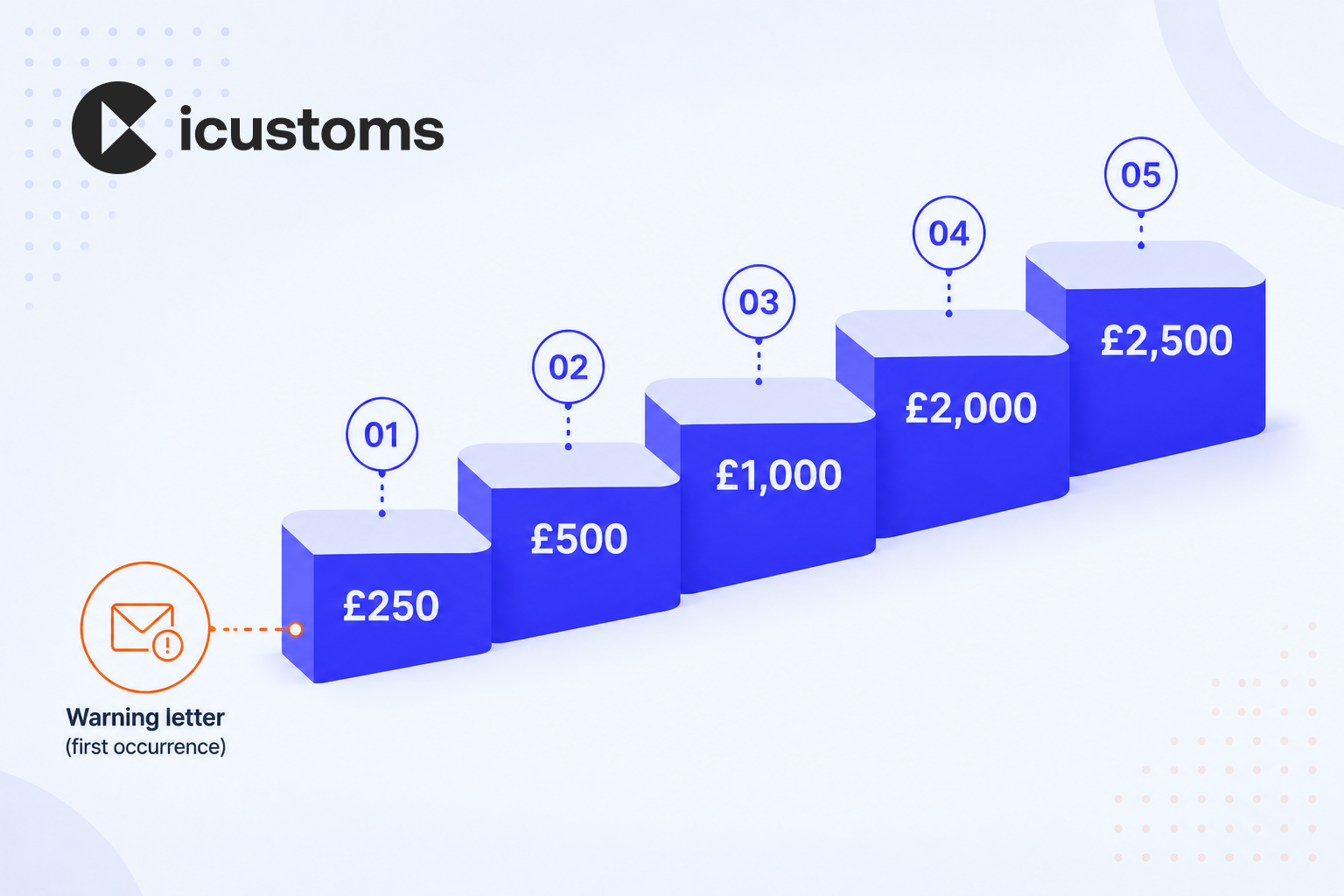
For most regulatory contraventions, HMRC does not go straight to a penalty. A first occurrence typically brings a warning letter or a compliance visit rather than a fine. A penalty follows if a similar contravention happens again within two years of that warning. From there, penalties escalate: HMRC’s published scale runs from a minimum of £250, through £500, £1,000 and £2,000, up to a maximum of £2,500 for serious irregularities, or £1,000 for others, increasing for each further repeat.
HMRC’s Transit Manual Supplement sets this policy out directly, under the heading “Civil penalty action for contraventions of Transit regulations” in its chapter on Contraventions and Civil Penalties (CPs):
“Borders & Trade Group recommends that trader education is more appropriate than civil penalty action in the case of a first contravention of the Transit regulations. The person concerned should receive an educational letter or visit from a compliance officer advising that a contravention has occurred and setting out the action that needs to be taken to improve compliance with the regulations. Civil penalties may then be appropriate if the person concerned continues to repeat the contravention despite a previous educational letter or visit.”
There are exceptions that can bring a penalty on a first occurrence: a serious error with significant revenue impact, generally undeclared duty or import VAT above £10,000, or £25,000 for delayed declarations, failing to follow written instructions HMRC has already given, or non-compliance with the conditions attached to an authorisation such as authorised consignor or consignee status. These figures come from HMRC’s current published guidance and are worth confirming against Notice 301 directly, since penalty levels can be updated.
HMRC’s guidance is also explicit about what does not reduce a penalty once one is due. The fact that little or no duty was actually lost is not, on its own, grounds for mitigation. What does count is genuine cooperation with a compliance check, a reasonable degree of care taken before the error, and whether the business has a pattern of prompt correction rather than repeated, unaddressed contraventions. If a business disagrees with a penalty once issued, HMRC’s standard review and appeal process applies, the same route used for other customs decisions.
What a Compliance Check Actually Looks For
A compliance check is not usually triggered by one rejected declaration. It looks at whether accepted declarations were accurate, whether the business held valid guarantee cover for the movements it released, and whether any authorisation, such as authorised consignor or consignee status, was used within the conditions it was granted under. The gap between what the declaration said and what the records show is what a check is actually testing.
This is why record-keeping matters as much as the declaration itself. A business that can show which commodity codes were used, why a particular customs status was applied, and how a guarantee balance was managed is in a materially different position from one that can only reproduce the declarations themselves.
Voluntary Disclosure Changes the Outcome
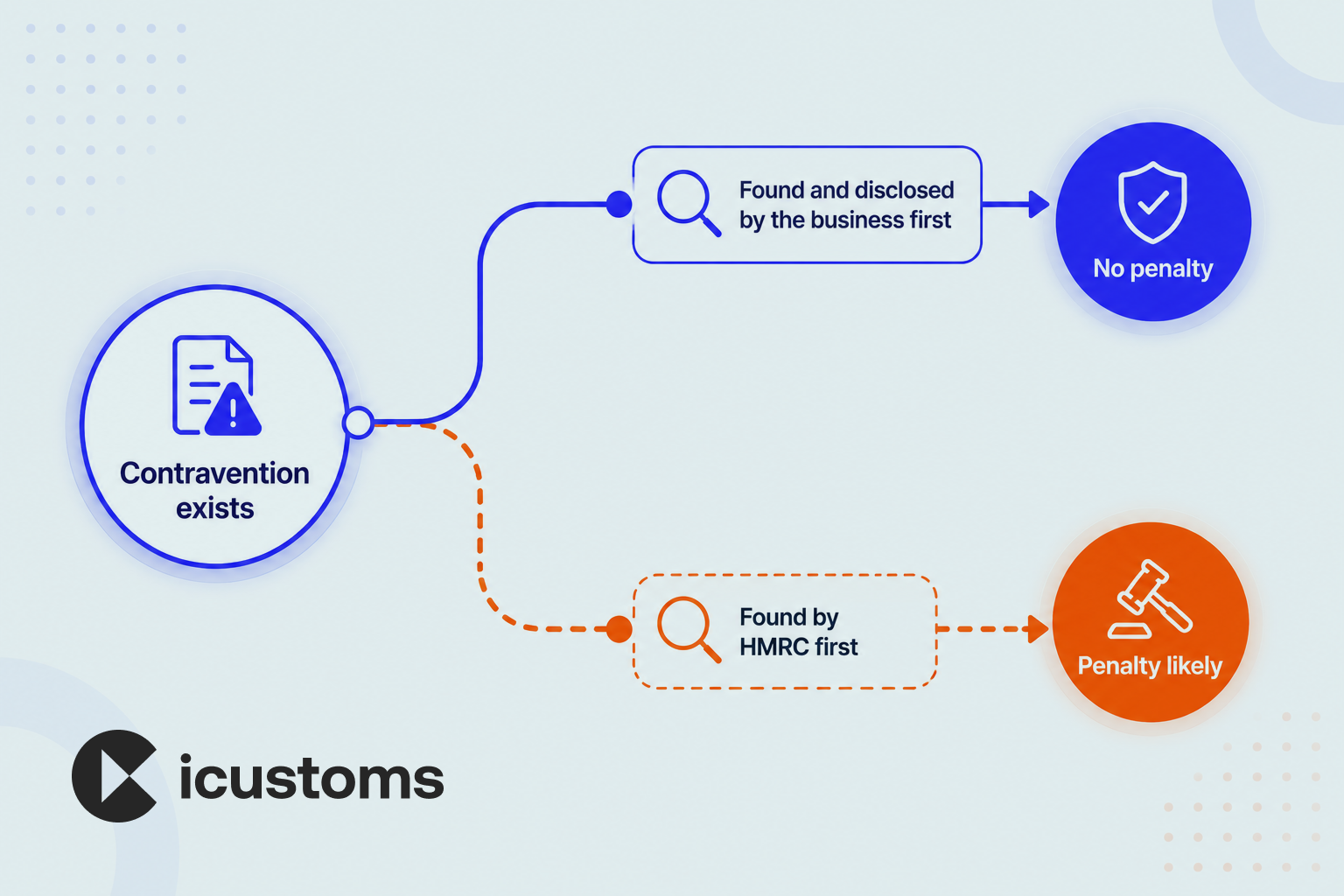
The clearest lever a business controls is disclosure. HMRC states that a contravention found and disclosed voluntarily, in writing, before any HMRC enquiry has started, does not result in a penalty. Finding the same issue during an HMRC compliance check, after it was already sitting in your own records, is a materially worse position than raising it first.
This is why the internal habit of recording what went wrong and why, mentioned in our guide to creating a declaration, matters beyond speeding up the next filing. A record of a corrected error, kept and reviewed, is what lets a business spot a repeating pattern and disclose it before HMRC does.
Reducing the Risk Before It Reaches HMRC
- Validate structure, commodity codes and guarantee details before submission rather than relying on NCTS to catch them.
- Keep a record of every rejection and its cause, not just the fix, so a repeating pattern is visible internally before it is visible to HMRC.
- Review the conditions attached to any authorisation, such as authorised consignor or consignee status, on a schedule rather than assuming they still apply as originally granted.
- Disclose a discovered inaccuracy in writing as soon as it is found, rather than waiting to see if it gets picked up.
- Treat a warning letter as a deadline, not a formality. Any similar error after that point is what moves a business from the warning stage into the penalty scale.
Frequently Asked Questions
Is a rejected NCTS declaration the same as a customs penalty?
No. A rejection happens during validation, before a movement is released, and costs time rather than money. A civil penalty is a separate action HMRC can take over an accepted declaration later found to be inaccurate or non-compliant.
What triggers an NCTS or customs civil penalty?
Typically a regulatory contravention that repeats after a warning letter, a serious error involving significant undeclared duty or VAT, failing to follow written HMRC instructions, or breaching the conditions of a customs authorisation.
How much is a customs civil penalty for a transit declaration error?
HMRC's published scale runs from £250 up to a maximum of £2,500 for serious irregularities, or £1,000 for others, rising for repeated contraventions. Always check Notice 301 for the current figures, as levels can change.
Will I be penalised for a first-time error?
Usually not. Most contraventions bring a warning letter or compliance visit first, with a penalty only following a similar error within two years. Serious errors or breaches of written instructions can be an exception.
What counts as a serious error under HMRC's civil penalty rules?
Generally an error involving undeclared Customs Duty or import VAT above £10,000, or £25,000 where the declaration itself was delayed.
Does voluntary disclosure avoid a penalty entirely?
HMRC states it will not charge a penalty where a contravention is discovered and disclosed voluntarily, in writing, before an HMRC enquiry begins.
Can non-compliance with a guarantee or authorisation condition lead to a penalty?
Yes. Failing to meet the conditions attached to an authorisation, such as authorised consignor or consignee status, is one of the situations that can bring a penalty even on a first occasion.
What is the difference between civil evasion and a regulatory contravention?
Civil evasion involves dishonesty. A regulatory contravention is a failure to comply with rules, conditions or accurate declarations without dishonesty being involved, and is the category most transit-related issues fall into.
You may also like:
Worried a Repeated Error Could Turn Into a Penalty?

iCustoms validates every field before submission and keeps a record of what was corrected and why. |
Subscribe to our Newsletter
About iCustoms
iCustoms is an all-in-one solution helping businesses automate customs processes more efficiently. With AI-powered and machine-learning capabilities, iCustoms is designed to streamline your all customs procedures in a few minutes, cut additional costs and save time.
See AI Customs Automation in Action
Turn trade documents into structured data with intelligent automation.