

Re-Exporting Products of Animal Origin to the EU: Certificate 8461 Guide
- John Hall
- Customs Specialist at iCustoms.ai
When a shipment of imported seafood, dairy, or meat arrives in Great Britain from a third country and traders subsequently dispatch it to the European Union, the transaction becomes a re-export. Consequently, those who re-export products of animal origin must follow a completely different certification path from a standard export. Instead of a routine export health certificate (EHC) covering UK-produced goods, the consignment specifically requires Certificate 8461, a dedicated re-export EHC that the Animal and Plant Health Agency (APHA) issues. Understanding the rules, and the paperwork that underpins them, is therefore essential for any importer, trader, or logistics operator handling POAO on behalf of EU buyers.
What Does Re-Exporting Products of Animal Origin Mean?
Naturally, the term ‘re-export’ carries a precise legal meaning in food and animal-product trade. Specifically, a POAO enters the re-export category when a trader originally brought it into Great Britain from a third country — or from the EU, which functions as a third country for GB customs since Brexit — held it under official controls in a bonded warehouse or approved cold store, and then dispatched it onward to the European Union without substantially processing or transforming it on GB soil.
The critical distinction, therefore, is origin. A standard EHC certifies that goods were produced or processed in Great Britain and consequently meet EU requirements on that basis. A re-export certificate, by contrast, confirms that goods arrived from an already-approved foreign source, that the facility stored them correctly in GB, and that traders are now forwarding them in the same condition and with their original certification still valid. As a result, the two certificates carry different official declarations, and EU border authorities verify them in fundamentally different ways.
What Is Certificate 8461?
APHA issues Certificate 8461 specifically as the official re-export EHC for products of animal origin leaving Great Britain for the EU. In fact, it belongs to a numbered library of EHC forms in the EHC Online system, and each form targets a specific commodity type, destination, and trade scenario.
Notably, Certificate 8461 performs two functions simultaneously. First, it carries over the animal health and food safety assurances from the original health certificate, confirming that the goods originated in an approved third-country establishment on the EU’s approved register. Second, it provides fresh assurance from a GB Official Veterinarian (OV) that storage conditions on GB soil were properly maintained — that the facility upheld temperature requirements, that original seals remained intact without justification for breaking, and that the consignment met its declared specification throughout. Furthermore, without a valid Certificate 8461 signed by an APHA-appointed OV, the EU Border Control Post (BCP) must refuse the consignment entry.
Which Products of Animal Origin Can Be Re-Exported to the EU?
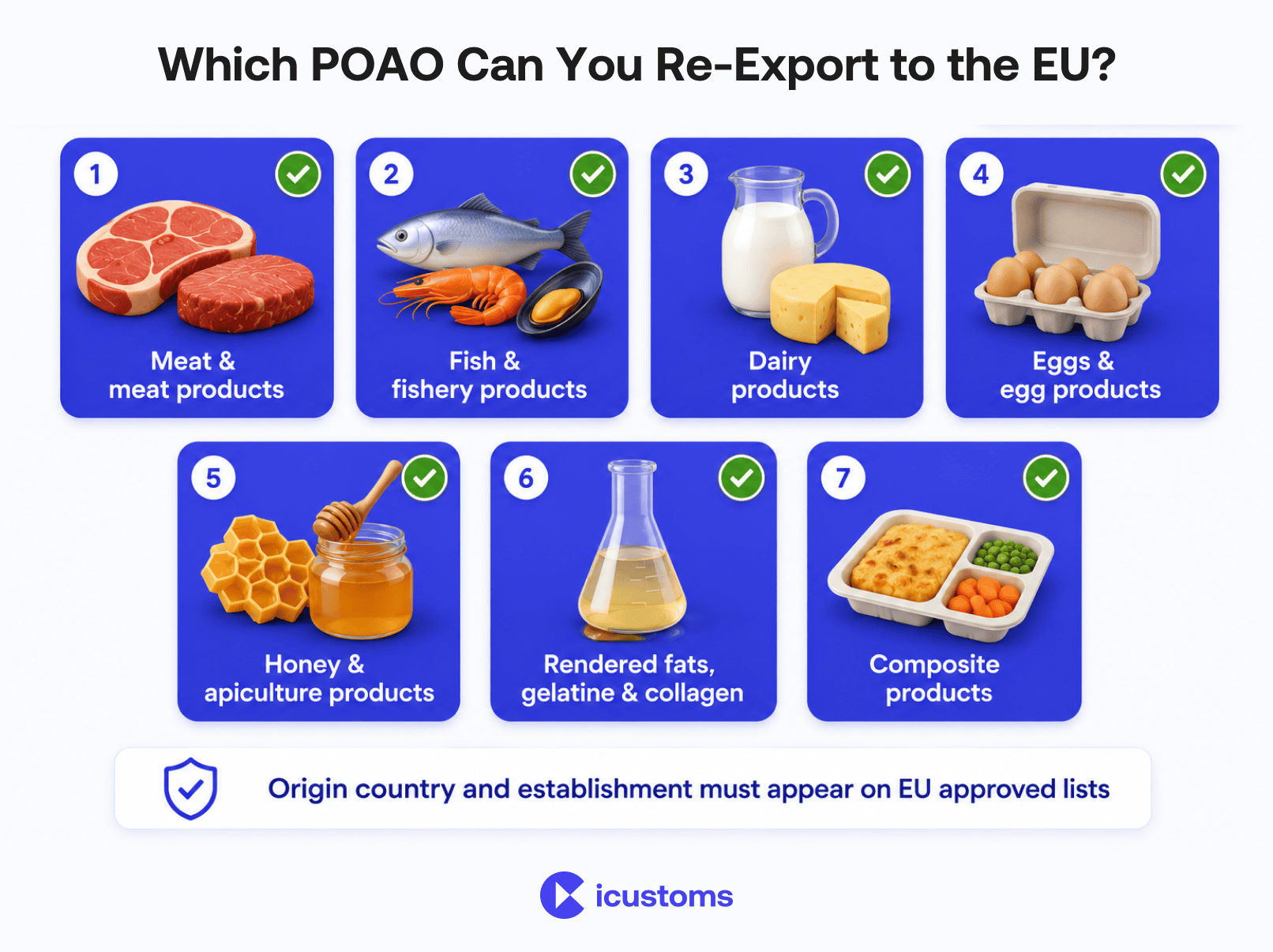
Specifically, Certificate 8461 covers the broad range of POAO categories that Regulation (EU) 2017/625 and associated implementing rules regulate. The table below therefore sets out the main commodity groups and typical examples.
| POAO Category | Examples |
|---|---|
| Meat and meat products | Beef, pork, poultry, lamb, venison, cured and processed meats |
| Fish and fishery products | Fresh, chilled or frozen fish, shellfish, crustaceans and aquaculture products |
| Dairy products | Milk, cheese, butter, cream, milk powder and whey protein |
| Eggs and egg products | Shell eggs, liquid egg, dried egg and albumin |
| Honey and apiculture products | Raw honey, beeswax, royal jelly and propolis |
| Rendered fats, gelatine and collagen | Lard, tallow, gelatine and collagen-based products |
| Composite products | Ready meals, sauces and goods with significant products of animal origin (POAO) content |
However, not every POAO category is automatically eligible for EU entry. Additionally, the originating country and the specific establishment where goods received processing must both appear on the EU’s approved third-country and establishment lists at the time of re-export. If an EU safeguard measure or import ban applies to a product or origin country, traders cannot re-export to the EU regardless of what Certificate 8461 states.
The Re-Export Process: Six Steps to Certificate 8461
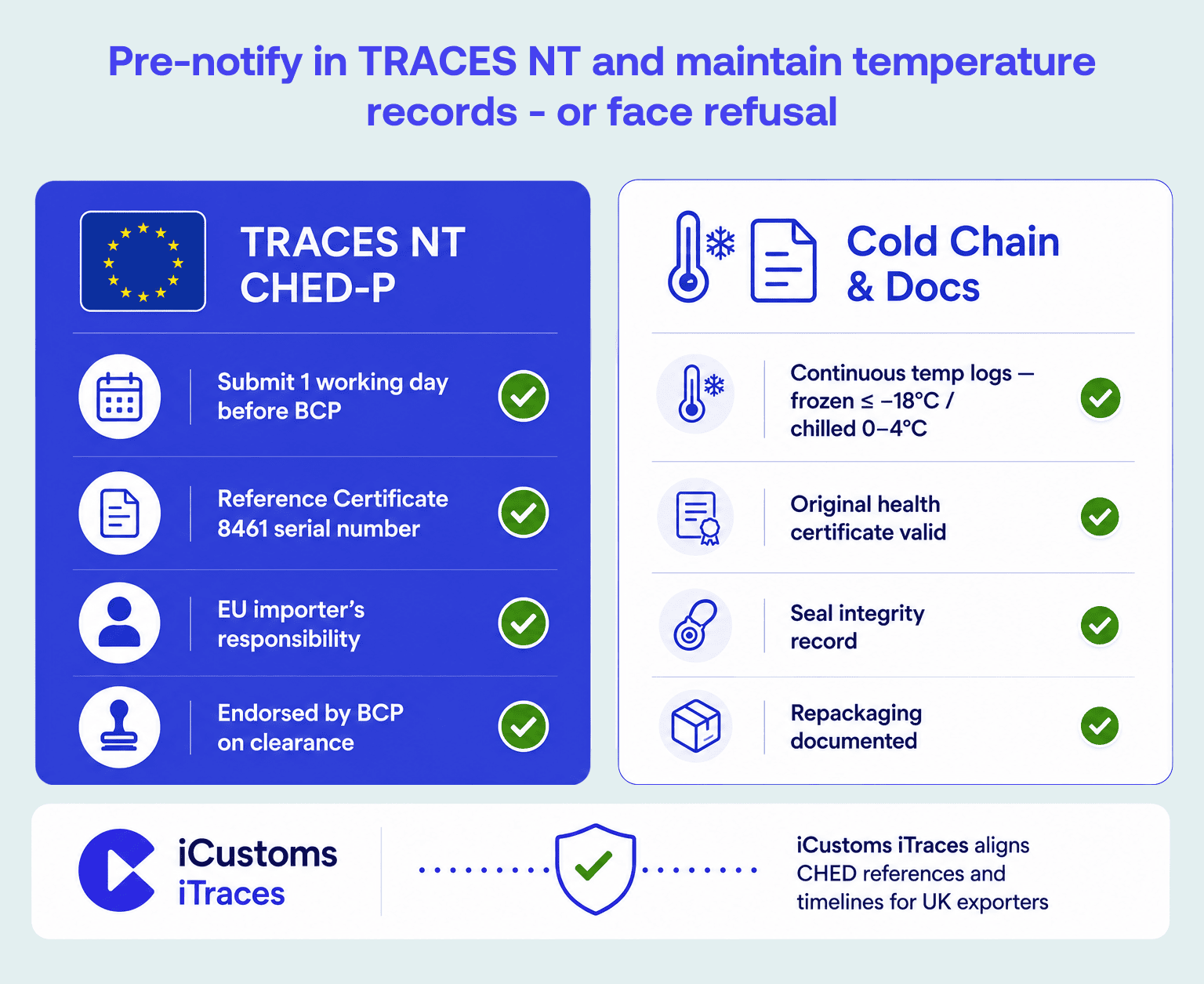
Overall, re-exporting products of animal origin involves a structured sequence that traders must complete before the lorry or container departs GB. The following steps outline the entire process, from initial eligibility check through to EU border clearance.
Step 1: Confirm eligibility and locate original documentation
Before approaching APHA, confirm that the originating country and establishment remain on the EU’s approved lists and that no safeguard measures apply to the product. Additionally, retrieve the original health certificate — or a certified true copy — that accompanied the consignment on first importation into GB. APHA cannot issue Certificate 8461 without it; the OV must reference the original certificate’s serial number and the issuing competent authority.
Step 2: Apply through EHC Online
Submit an EHC application through EHC Online, selecting Certificate 8461 as the applicable form. Specifically, provide commodity type, volume and weight, storage facility address, intended EU BCP, and a copy of the original health certificate. iCustoms‘ iTraces module helps exporters manage TRACES-related references and document sets, consequently reducing the risk of submission errors at this stage.
Step 3: Official Veterinarian inspection
An APHA-appointed OV then visits the storage facility to inspect the consignment. The OV verifies that the original certificate is valid and corresponds to the goods, that temperature and storage records confirm conditions remained consistent throughout, that original packaging seals are intact (or that the facility fully documented any authorised breach, such as a customs examination), and that the goods are otherwise in conformity with their declared specification.
Step 4: Certificate 8461 signed and issued
Once the OV finds everything in order, they sign and stamp Certificate 8461. The certificate also carries a unique serial number, the OV’s APHA authorisation number, and a cross-reference to the original health certificate. Subsequently, EHC Online returns the signed certificate to the exporter electronically, and the exporter prints it and adds it to the consignment’s document pack.
Step 5: Pre-notification via TRACES NT (CHED-P)
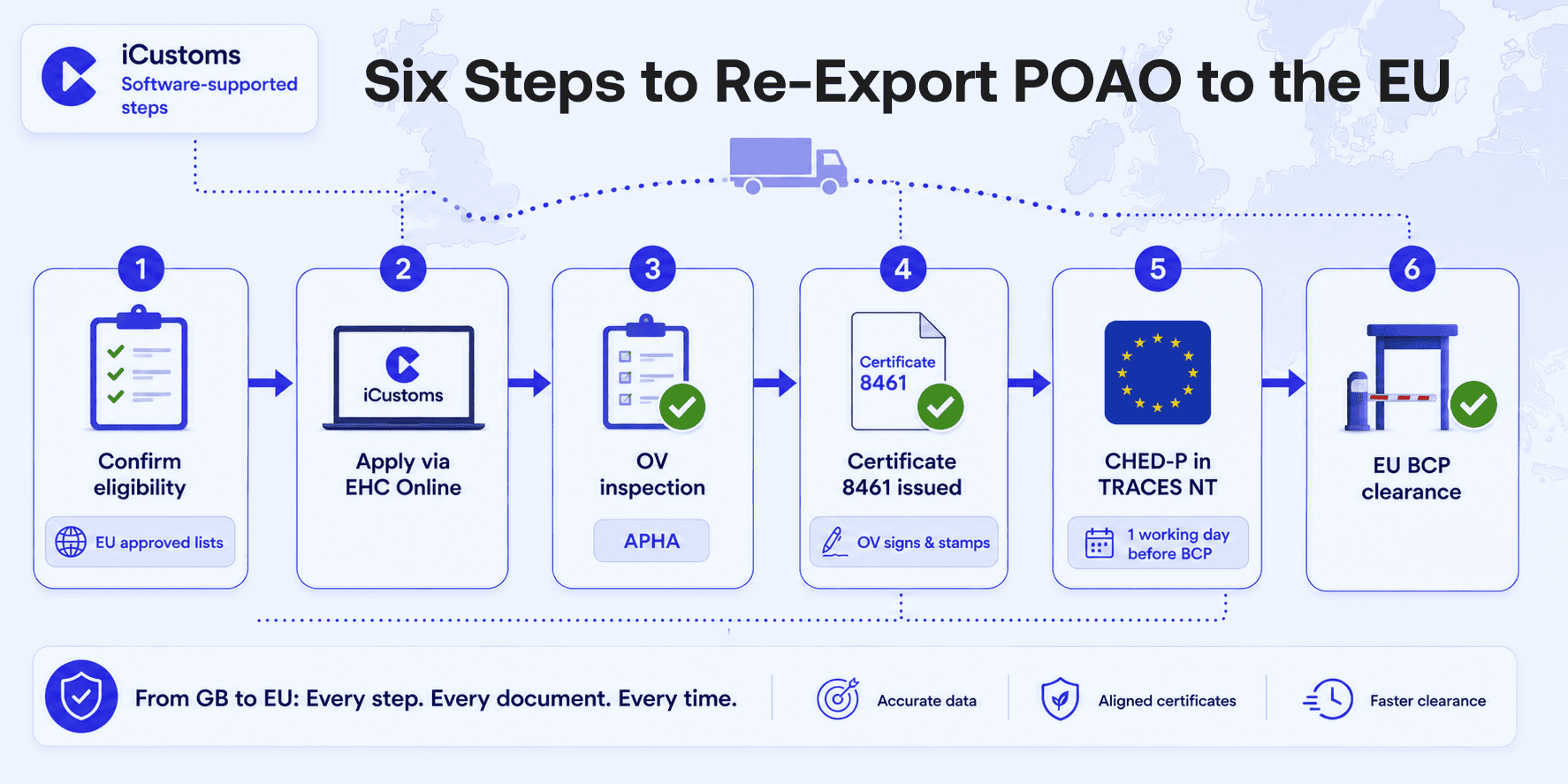
Before the consignment leaves GB, the EU-based importer or their nominated customs agent must pre-notify the expected arrival by submitting a CHED-P (Common Health Entry Document for Products of Animal Origin) in TRACES NT. Specifically, this notification must reach the system at least one working day before the consignment arrives at the designated EU Border Control Post, and it must reference the Certificate 8461 serial number.
Step 6: EU border clearance
At the BCP, EU officials conduct documentary checks — reviewing Certificate 8461 alongside the original certificate — and identity checks confirming that seals, marks, and vehicle details match the CHED-P. Where necessary, the BCP additionally carries out physical checks including temperature measurement and sampling. The BCP subsequently endorses the CHED-P in TRACES NT, and the consignment proceeds to its final EU destination.
TRACES NT and the CHED-P: Your EU Partner's Responsibilities
TRACES NT — the Trade Control and Expert System New Technology — is the European Commission’s centralised platform for managing the movement of animals and animal products into and within the EU. Consequently, for any POAO consignment entering the EU from Great Britain, a pre-notification via CHED-P in TRACES NT is a legal requirement under Regulation (EU) 2017/625.
Importantly, the CHED-P is the responsibility of the EU-based importer, not the GB exporter. However, GB exporters benefit from understanding the process, because a CHED-P submitted late or with incorrect details can delay or block BCP clearance even when Certificate 8461 is in perfect order. Furthermore, the CHED-P records the expected date and point of EU entry, the nature and quantity of goods, the serial number of Certificate 8461, and the details of the originating establishment. Once the BCP clears the consignment, the authority endorses the CHED-P in TRACES NT, consequently creating a traceable audit trail from the original exporting country through to the EU destination. iCustoms’ iTraces platform therefore supports UK exporters in co-ordinating CHED references and pre-notification timelines with their EU counterparts.
Storage Conditions and Documentation Requirements
EU rules are uncompromising about the chain of custody for re-exported POAO. Specifically, the OV cannot issue Certificate 8461 unless the following records are available and satisfactory:
- Temperature records: the approved GB storage facility must provide continuous temperature logs covering the entire storage period and confirming that prescribed conditions held — for example, ≤ −18 °C for frozen goods, or 0–4 °C for chilled meat
- Seal integrity: the facility must additionally maintain a record of whether original seals placed by the exporting country were intact on arrival in GB and throughout storage; any seal breaks subsequently require documentation with an official explanation
- Original health certificate: the certificate from the originating third country’s competent authority must remain valid at the point of re-export, or the goods must otherwise demonstrate continued compliance with EU requirements
- Repackaging records: if the facility transferred goods to new packaging during GB storage — for example, to remove damaged outer cartons — the OV records the event, the reason, and the new packaging details, all of which appear directly on Certificate 8461
- Storage facility approval: the cold store or warehouse must be an APHA-approved facility for the relevant POAO category; unapproved premises consequently disqualify the consignment from re-export certification
There is no fixed maximum period a POAO consignment may remain in GB storage before re-export. However, the longer the storage period, the more critical it becomes that temperature records are complete and uninterrupted, and that the original certificate remains within its validity window.
Ready to Streamline Your POAO Re-Export Documentation?
iCustoms automates customs declarations, CHED reference management, and HS code validation for products of animal origin — keeping your re-exports compliant and on schedule.
How iCustoms Supports POAO Re-Exports
Re-exporting products of animal origin requires precise co-ordination across two regulatory systems — APHA’s EHC Online on the GB side and TRACES NT on the EU side — as well as customs declarations, HS code classification, and cold-chain documentation management. Moreover, a single data entry error in any one of these systems can stall the entire chain at the BCP.
See iCustoms in Action — Book a Free Demo
From HS code classification to CHED reference management, iCustoms gives your team the tools to handle POAO re-exports with confidence and precision.
Frequently Asked Questions
What is re-exporting products of animal origin?
Re-exporting POAO means traders send goods they previously imported into Great Britain from a third country onward to the European Union, without substantially processing or transforming them on GB soil. Consequently, the goods retain their original provenance and require fresh re-export certification before EU entry.
What is Certificate 8461?
Specifically, Certificate 8461 is the Export Health Certificate that APHA issues for re-exporting products of animal origin from GB to the EU. An Official Veterinarian signs it after confirming that the original documentation is valid and that the facility correctly maintained storage conditions during the goods' time in the UK.
When do I need Certificate 8461 rather than a standard EHC?
You need Certificate 8461 whenever the POAO you are sending to the EU did not originate in Great Britain. Specifically, if goods came from a third country, a trader imported them into GB, and they are now heading to the EU without substantial transformation, Certificate 8461 is the correct form — not a standard commodity-specific EHC.
How does re-exporting POAO differ from a standard export?
Notably, a standard EHC certifies UK origin and compliance with EU requirements for goods that GB businesses produced. Certificate 8461, by contrast, certifies that goods from an already-approved foreign source arrived intact in GB, that the facility stored them correctly, and that traders are forwarding them without transformation. As a result, the OV's declarations and the EU border checks differ materially between the two routes.
What types of POAO can traders re-export to the EU?
Specifically, Certificate 8461 covers meat and meat products, fish and fishery products, dairy products, eggs and egg products, honey and apiculture products, rendered fats, gelatine, collagen, and composite products with significant POAO content. However, eligibility also requires the origin country and establishment to appear on EU approved lists.
Who issues Certificate 8461?
APHA issues Certificate 8461, and an APHA-appointed Official Veterinarian must sign it. Additionally, APHA serves as the competent authority for England, Scotland, and Wales. Businesses in Northern Ireland should, however, contact DAERA, because different arrangements apply under the Windsor Framework.
What does the Official Veterinarian check before signing?
Specifically, the OV verifies that the original health certificate is valid and matches the goods, that temperature and storage records confirm conditions remained consistent throughout, that original seals are intact (or that documented reasons exist for any seal break), that the facility recorded any repackaging, and that the goods are otherwise in conformity with their declared specification.
What is the CHED-P and who submits it?
The CHED-P (Common Health Entry Document for Products of Animal Origin) is a pre-notification that the EU-based importer or their customs agent submits in TRACES NT. They must lodge it at least one working day before the consignment arrives at the EU Border Control Post, and it must additionally reference the Certificate 8461 serial number.
You may also like:

Struggling to Extract, Catagorise & Validate Your Documents?

Capture & Upload Data in Seconds with AI & Machine Learning
Subscribe to our Newsletter
About iCustoms
iCustoms is an all-in-one solution helping businesses automate customs processes more efficiently. With AI-powered and machine-learning capabilities, iCustoms is designed to streamline your all customs procedures in a few minutes, cut additional costs and save time.
Struggling to Extract, Catagorise & Validate Your Documents?
Capture & Upload Data in Seconds with AI & Machine Learning