
PHEATS: The Plant Health Exports Audited Trader Scheme Explained
- John Hall
- Customs Specialist at iCustoms.ai
If you export fruit, vegetables, cut flowers or ware potatoes from England or Wales to the EU or Northern Ireland, every shipment needs a phytosanitary certificate. Under the standard route, that means waiting for an Animal and Plant Health Agency (APHA) inspector to visit, carry out the inspection and issue the certificate before your goods can move. For businesses operating on tight schedules, however, that wait can be costly.
PHEATS removes the wait. Under the Plant Health Exports Audited Trader Scheme, eligible businesses appoint their own trained inspectors, carry out inspections on site and apply for phytosanitary certificates without scheduling an official APHA visit. This guide explains what PHEATS is, who can join, how the audit process works and what it costs.
What is the Plant Health Exports Audited Trader Scheme?
PHEATS stands for Plant Health Exports Audited Trader Scheme. It is a trade facilitation scheme run by APHA that lets approved businesses conduct their own export inspections for fruit, vegetables, ware potatoes and cut flowers going to the EU or Northern Ireland. In exchange for meeting strict biosecurity and audit requirements, members can certify consignments through their own Authorised Person rather than waiting for a government inspector.
The scheme sits alongside the standard phytosanitary certification route, not outside it. It does not remove the requirement for a phytosanitary certificate; what it changes is who carries out the inspection, and when. Because the member’s own Authorised Person inspects the consignment on site, goods can move as soon as they are ready rather than waiting for an official visit.
Who can join PHEATS?
The scheme is open to businesses registered as a company or sole trader that export eligible goods from England and Wales to the EU or Northern Ireland. Private citizens cannot join; APHA updated its guidance in April 2026 to confirm this explicitly. Furthermore, Scotland and Northern Ireland operate under separate plant health authority arrangements, so the scheme in its current form applies only to exporters in England and Wales.
Before applying, a business must already be registered as a professional operator with APHA. If that registration is not yet in place, it is therefore the first step to take.
What goods does PHEATS cover?
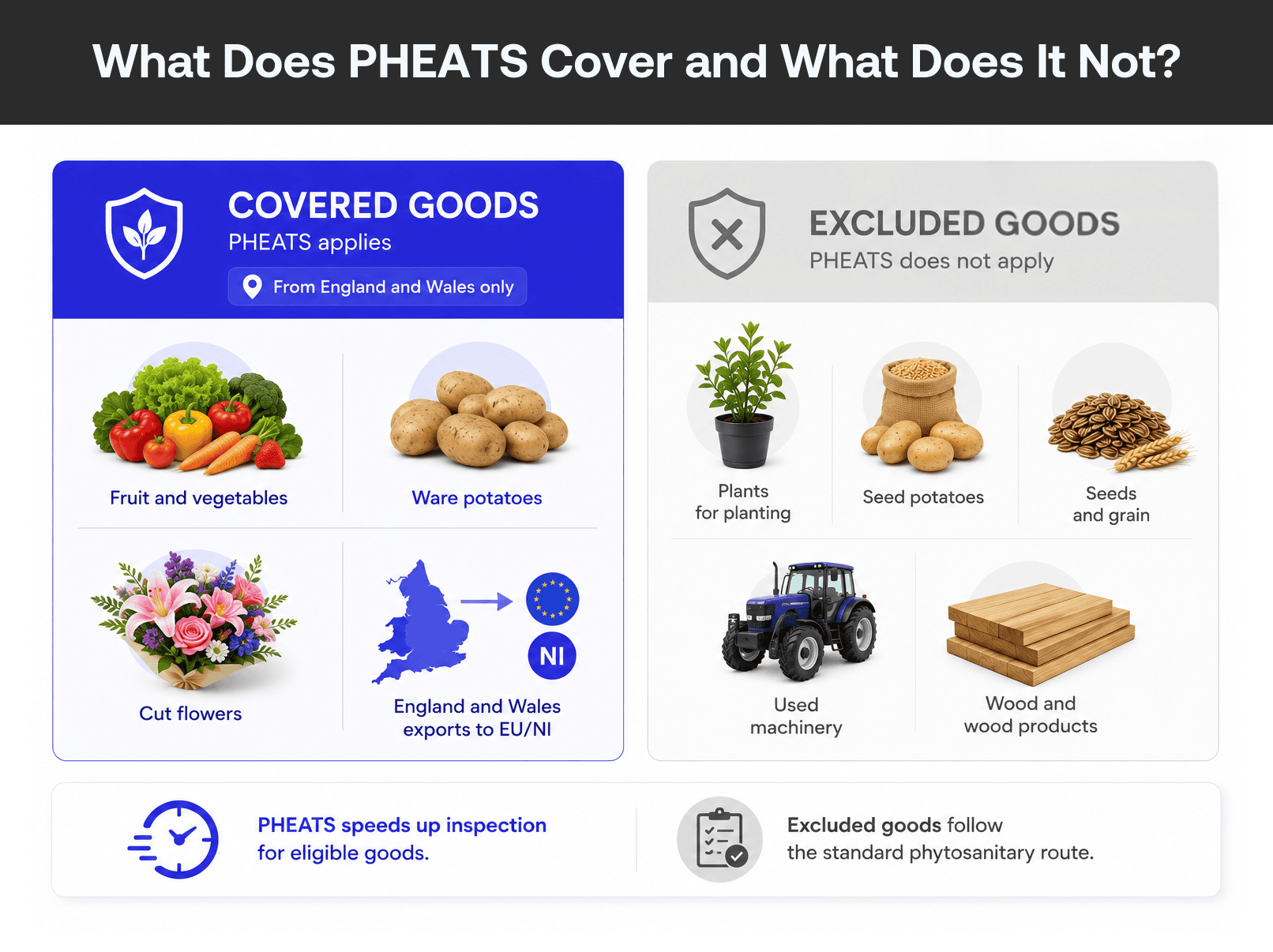
The scheme covers four categories of goods exported from England and Wales to the EU or Northern Ireland. However, a number of goods fall outside it entirely.
| What PHEATS Covers | What PHEATS Does Not Cover |
|---|---|
| Fruit and vegetables | Plants for planting |
| Ware potatoes (eligible since 9 September 2024) | Seed potatoes |
| Cut flowers | Plant products, seeds and grain |
| Exports from England and Wales to the EU or Northern Ireland | Used farm or forestry machinery |
For goods the scheme does not cover, exporters must instead follow the standard phytosanitary certification route. Our guide to phytosanitary certificates covers the rules that apply to all regulated plant exports, including fees, the application process and the GB-to-Northern-Ireland route.
How does PHEATS work?
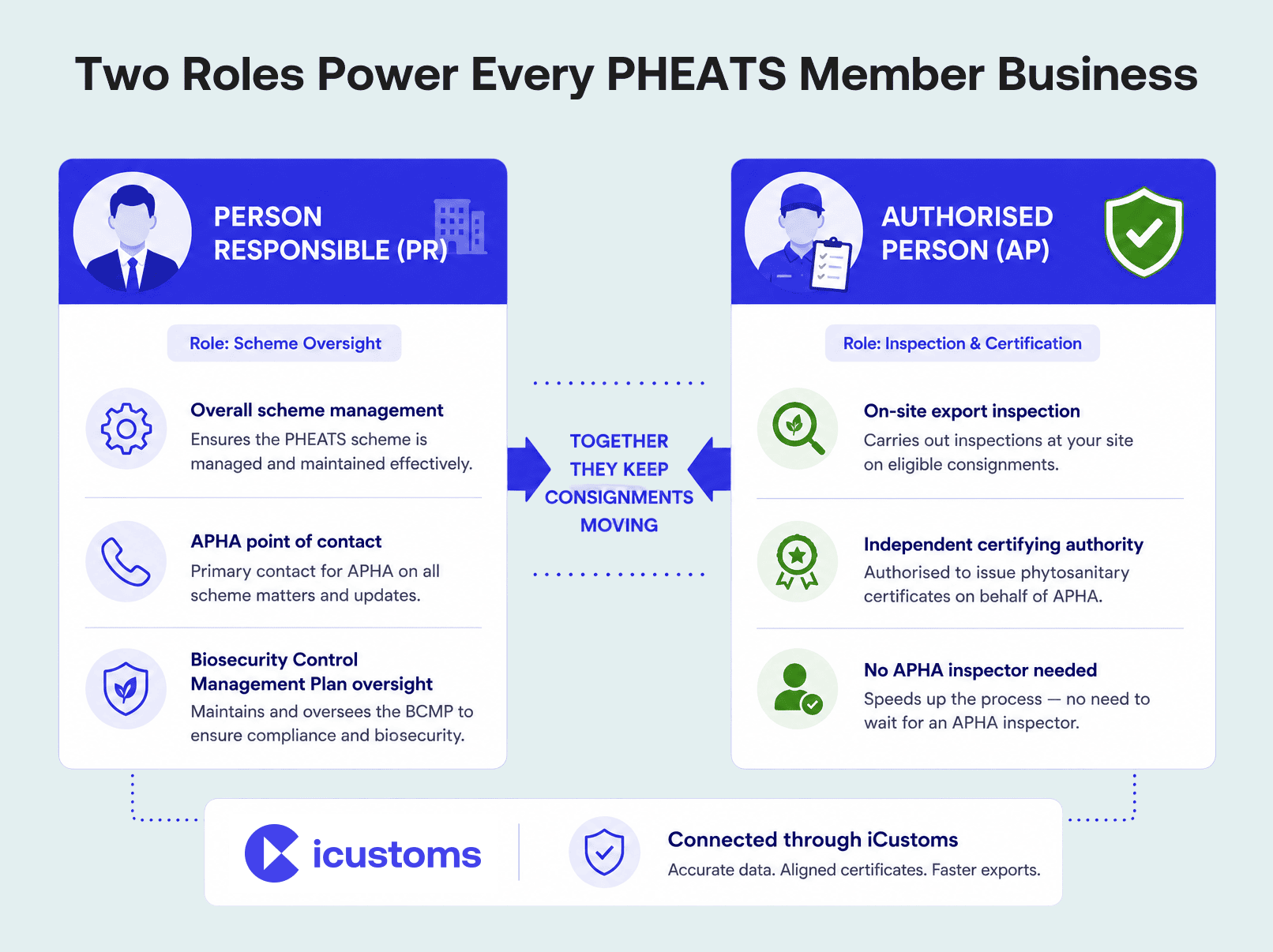
The scheme operates through two key roles within each member business.
The Person Responsible (PR) manages the scheme overall. They also act as the point of contact with APHA, oversee compliance and ensure that the Biosecurity Control Management Plan is in place and followed at all times.
The Authorised Person (AP) is the individual on site who carries out the official export inspections. Because the AP must first complete APHA training and pass an assessment, they can then inspect consignments independently, without an APHA inspector present. The business subsequently applies online for the phytosanitary certificate, and APHA emails a scanned copy promptly, with the original arriving by first-class post.
Because the AP works on the business’s own premises and on its own schedule, just-in-time logistics become far more practical for members than under the standard inspection route.
The Biosecurity Control Management Plan
Every member must create, implement and monitor a Biosecurity Control Management Plan (BCMP). The BCMP is the documented framework that governs how the business manages plant health risk: how goods are received, stored and inspected, how any pest or disease findings are recorded and reported, and also how records are maintained for audit purposes.
APHA provides a checklist of everything the BCMP must include, set out in the PHEATS User Guide on the Plant Health Portal. Members must therefore keep the BCMP current and demonstrate compliance whenever APHA carries out an audit.
How to apply for PHEATS: the registration steps
Registration follows a structured sequence. Each step should be complete before you move to the next.
- Register as a professional operator with APHA if you have not already done so.
- Download and complete the PHEATS application form from the Plant Health Portal.
- Identify your Person Responsible and nominate your Authorised Person(s).
- Create your Biosecurity Control Management Plan in line with the APHA checklist.
- APHA reviews your application and arranges the initial site visit, which covers training, assessment and authorisation of your Authorised Person.
Only after the initial site visit and formal authorisation can the Authorised Person begin conducting inspections under the scheme.

Still Waiting for Inspectors Before Every Shipment?
See how iCustoms keeps your plant export declarations accurate alongside PHEATS, so that nothing stalls at the border.
PHEATS fees
The following fees apply for businesses in England and Wales.
| Item | Fee |
|---|---|
| Initial site visit (training, assessment and authorisation) | £313.24 per authorisation |
| Auditing and monitoring visit | £178.92 per audit |
| Phytosanitary certificate | £25.52 per certificate |
Notably, members do not pay the per-consignment inspection fees that apply under the standard route, which run to a minimum of £127.60 for the first 30 minutes of inspection time, plus £63.80 for every further 15 minutes. Instead, ongoing compliance is checked through periodic audits at a flat rate. Consequently, for exporters sending frequent consignments, the scheme is often significantly more cost-effective over the course of a season.
Does PHEATS replace a phytosanitary certificate?
No. The scheme does not remove the requirement for a phytosanitary certificate. Every consignment exported under PHEATS still needs one. What it changes is who carries out the inspection and how the certificate is applied for. See our full guide to the phytosanitary certificate for the complete picture of when this document is required.
Under the standard route, an APHA inspector visits, inspects the consignment and issues the certificate directly. Under PHEATS, however, the Authorised Person inspects on site, and the business applies online through the plant export service. APHA issues the certificate on the basis of that self-inspection record, and it remains an official document that must travel with the consignment to its destination.
Why plant exporters trust iCustoms alongside PHEATS
PHEATS speeds up the inspection side of a plant export. However, the customs declaration, HS classification and compliance documentation still need to be accurate, and that is where errors most often surface at the border control post.
iCustoms works alongside PHEATS to keep the data layer correct. Its Intelligent Document Processing extracts information from trade documents and checks it for consistency. iClassification confirms HS codes across 32 countries and more. Additionally, iTraces validates TRACES NT establishment codes and CHED references against the EU database, so that the pre-notification your receiver submits matches the phytosanitary certificate exactly. Teams using iCustoms cut manual effort by up to 80% and consequently achieve 99% accuracy. Logistics leaders including Kerry Logistics, Ziegler and Woodside Logistics Group already run their customs operations this way.
For plant exporters, combining PHEATS self-inspection with iCustoms data accuracy means shorter turnaround times and fewer surprises at the border. For cross-border movements involving Northern Ireland, see our dedicated Northern Ireland page and our broader guide on what the EU TRACES system is and how it supports cross-border plant trade.
Ready to Ship Plant Exports Faster?
Join the exporters who combine PHEATS self-inspection with iCustoms to keep every consignment on track.
Frequently Asked Questions
What is PHEATS?
PHEATS (Plant Health Exports Audited Trader Scheme) is a trade facilitation scheme run by APHA that lets approved businesses in England and Wales carry out their own export inspections for fruit, vegetables, ware potatoes and cut flowers destined for the EU or Northern Ireland, and subsequently apply online for phytosanitary certificates.
What does PHEATS stand for?
PHEATS stands for Plant Health Exports Audited Trader Scheme.
Who can join the Plant Health Exports Audited Trader Scheme?
Businesses registered as a company or sole trader that export eligible goods from England and Wales to the EU or Northern Ireland. Private citizens cannot join. Furthermore, Scotland and Northern Ireland operate under separate plant health arrangements, so the scheme in its current form applies only to exporters in England and Wales.
How does PHEATS work?
Each member business appoints a Person Responsible and one or more Authorised Persons. APHA trains and assesses the Authorised Person, who then carries out official export inspections on site without waiting for an APHA inspector. The business subsequently applies online for the phytosanitary certificate, and APHA issues it on the basis of the self-inspection record.
What are the benefits of PHEATS?
Members inspect their own consignments on their own schedule, which removes the wait for an APHA inspector and therefore supports just-in-time logistics. They apply for phytosanitary certificates online, and APHA emails a scanned copy promptly. Moreover, there are no per-consignment inspection fees; ongoing compliance is checked through periodic audits at a flat rate instead.
How do I apply for PHEATS?
First, register as a professional operator with APHA. Then complete the PHEATS application form on the Plant Health Portal, nominate your Person Responsible and Authorised Person(s), create your Biosecurity Control Management Plan, and APHA will arrange the initial site visit for training, assessment and authorisation.
Does PHEATS replace a phytosanitary certificate?
No. Every consignment still requires an official phytosanitary certificate issued by APHA. The scheme changes who carries out the inspection, not whether a certificate is needed. The Authorised Person inspects the goods on site, the business applies online, and APHA issues the certificate on that basis.
Is PHEATS mandatory?
No. The scheme is voluntary. Eligible exporters can continue to use the standard phytosanitary certification route instead, where an APHA inspector visits and certifies the consignment directly.
You may also like:

Struggling to Extract, Catagorise & Validate Your Documents?

Capture & Upload Data in Seconds with AI & Machine Learning
Subscribe to our Newsletter
About iCustoms
iCustoms is an all-in-one solution helping businesses automate customs processes more efficiently. With AI-powered and machine-learning capabilities, iCustoms is designed to streamline your all customs procedures in a few minutes, cut additional costs and save time.
Struggling to Extract, Catagorise & Validate Your Documents?
Capture & Upload Data in Seconds with AI & Machine Learning