IOSS Customs Declaration: How CN Classification Can Turn €3 EU Import Duty into €9?
- John Hall
- Customs Specialist at iCustoms.ai
The €3 Rule Is Not a Parcel Fee – It Is a Product Classification Fee
IOSS (Import One Stop Shop) is the interim €3 EU import duty, effective 1 July 2026, applies per tariff sub-heading for low value parcels under €150. While sellers interpret this as a flat €3 parcel charge, EU customs authorities apply it based on product classification depth at Combined Nomenclature CN level. That distinction fundamentally changes landed cost exposure.
What is IOSS Customs Declaration for Low Value Imports?
The IOSS customs declaration (Import One Stop Shop) for EU bond low value imports with a value up to €150. Non-EU sellers must be registered and include their up to 12-digit IOSS number to avoid VAT fee from EU customs authorities. IOSS ensures faster customs declaration by charging VAT at the point of sale, not at the border.
€3 Per Tariff Sub-Heading Customs Duty | Not Per Box
The €3 levy is triggered by customs tariff structure, not packaging structure. A single parcel containing goods falling under different CN codes will attract multiple customs charges. The customs declaration determines exposure, not how the parcel is physically assembled or commercially presented. That highlights the accuracy at the Intelligent Document Processing level.
Why Extended Classification Now Drives Fiscal Outcome
The EU applies the interim charge at sub-heading level, which corresponds to 8-digit CN classification. Two items sharing the same 6-digit HS code may diverge at CN level and therefore generate multiple €3 customs duties. Items classification precision now directly controls duty charges.
How a €3 Customs Charge for Low Value Parcels Could Become €9 in Practice
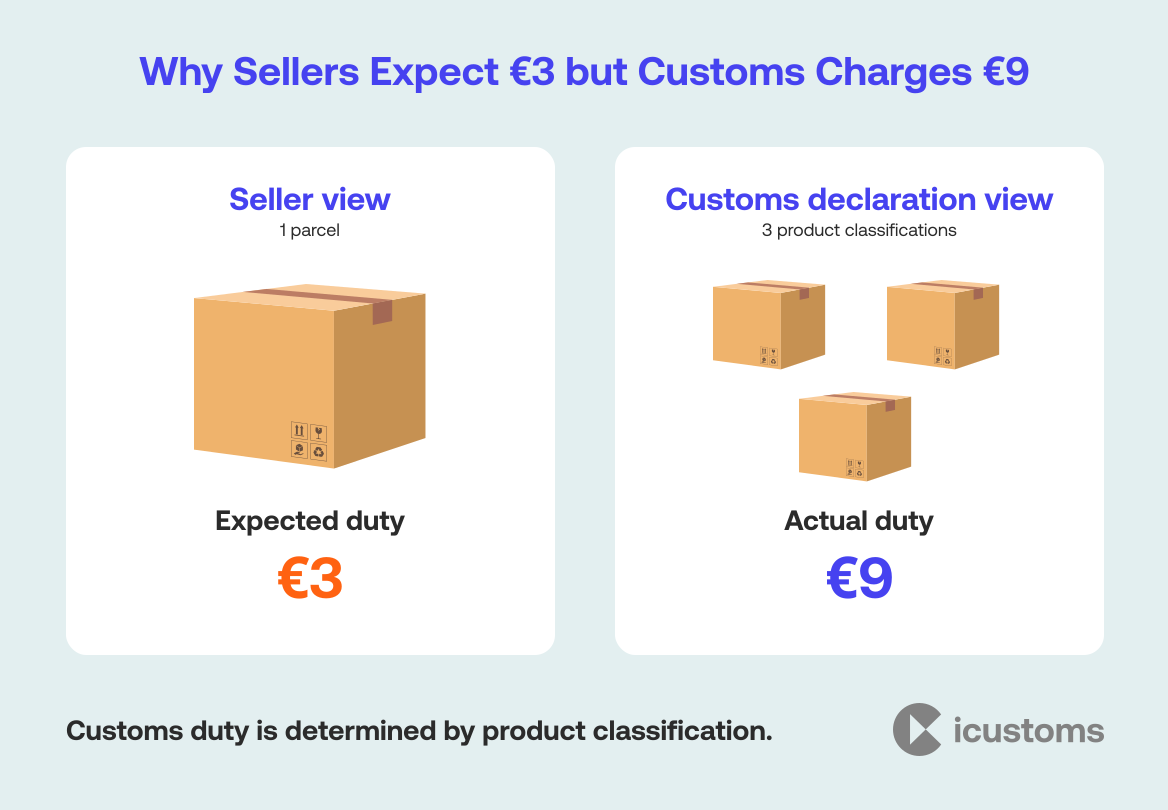
The multiplier effect arises when a €150 low value parcel contains multiple product types falling under separate tariff sub-headings. Under the interim rule, customs duty is levied per classification, not per parcel. For freight forwarders managing high-volume low value e-commerce flows, this introduces duty variability that sellers often fail to model in their checkout pricing.
Example: Multi-Item Consumer Electronics Shipment
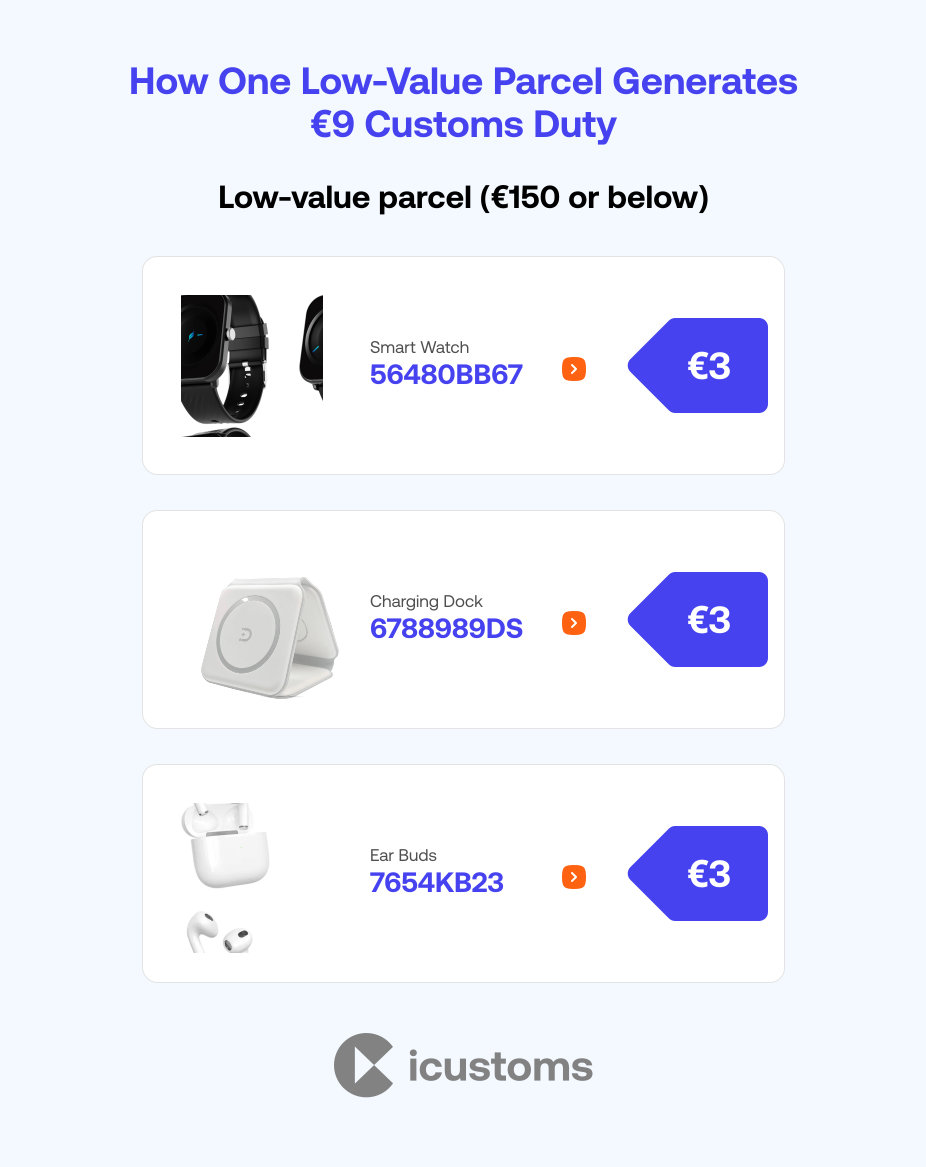
Consider a low value parcel containing:
• A smartwatch
• A USB charging dock
• A wireless earbud set
Each item falls under a distinct tariff sub-heading within the EU Combined Nomenclature. Customs therefore identifies three separate fiscal item classifications.
Result:
€3 × 3 sub-headings = €9 customs duty for 1 parcel.
From the seller’s perspective, this is one customer order.
From customs authorities perspective, it is three independently classified product categories.
The financial delta becomes the responsibility of the declarant if pricing assumptions were inaccurate.
When €3 Becomes €9 Due to Misclassification at Customs Declaration
The more serious risk is not intentional multi-item bundling, it is inconsistent or incorrect tariff assignment.
Example: Accessory vs. Independent Device Classification
Assume a parcel contains:
• A Bluetooth keyboard
• A detachable tablet cover
If both items are incorrectly grouped under a single broad 6-digit HS heading without reviewing the extended 8- or 10-digit classification level, the declaration may initially reflect one sub-heading for customs duties calculation.
However, upon customs validation at extended CN level, customs authorities may determine that:
• The keyboard qualifies as an input unit under one tariff sub-heading
• The protective cover qualifies as a separate accessory under the another tariff sub-subheading
The low-value parcel is therefore reclassified into two tariff sub-headings.
Result:
€3 × 2 = €6 instead of €3.
If three similar inconsistencies occur within a larger consolidated parcel, the exposure escalates proportionally.
Want to understand how UK port systems like Destin8 connect with CDS declarations and impact your filings? Read our complete guide to Destin8 login codes and port community systems.
Why Product Misclassification Risk Is Operationally Sensitive
Unlike ad valorem duty, the €3 levy is structural and cumulative. Errors do not merely adjust percentage rates, they multiply fixed charges.
In high-volume environments, fragmented product classification governance can lead to:
• Over-collection of duty
• Under-collection followed by post-clearance adjustment
• Seller–broker dispute over liability
• Reputational strain between marketplace and logistics partner
Under the interim regime, accurate product classification is no longer a compliance formality. It becomes a cost-control discipline.
The difference between €3 and €9 is not theoretical, it is embedded in how tariff sub-headings are assigned at extended digit level.
Consolidated Shipments Amplify Items Classification Fragmentation
Parcel operators frequently consolidate multi-SKU marketplace orders. Where SKU governance is inconsistent, similar products may be declared under adjacent but separate tariff codes. Minor product classification variance can multiply €3 customs charges unnecessarily across thousands of parcels per month resulting in over charging, revenue loss and reputational damage.
Why Customs Teams Will Be Asked to Justify the Outcome
When landed cost exceeds seller expectation, disputes will not be directed at the EU Council. They will reach the customs declarant. Operational teams will increasingly need to explain tariff logic to sellers unfamiliar with CN-level precision.
Sellers Price at Checkout - Brokers File at CN Depth
Many marketplace sellers will advertise “€3 EU import charge” as a simplified figure. Once parcels generate €6 or €9 duty, pricing assumptions collapse. The customs broker becomes the interpreter of classification depth and the visible point of escalation.
Reputational Pressure Shifts Downstream
In a high-volume e-commerce environment, even compliant declarations may generate commercial friction. Customers and sellers often misunderstand tariff mechanics. Brokers must therefore maintain defensible classification records capable of withstanding both audit scrutiny and commercial questioning.
Accurate Product Classification Governance for Customs Declaration Becomes a Cost-Control Mechanism
Under previous duty relief, minor misclassification had limited fiscal consequence. After 1 July 2026, each additional sub-heading has a defined monetary value. Governance shifts from technical accuracy to direct cost management.
6-Digit HS Code Is No Longer Operationally Sufficient
The Harmonised System (HS code classification) provides a 6-digit international base for the collection of customs duties, taxes and regulations. The EU’s Combined Nomenclature extends this to 8 digits, defining duty logic. Two similar products may share HS structure but diverge at CN level, triggering distinct €3 applications per classification.
Product Sets and Component Classification Sensitivity
Retail sets introduce further complexity. A DIY home lighting kit containing LED strips, power adapters and connectors may fall under separate tariff sub-headings unless composite classification rules are correctly applied. Each separated heading generates another €3 customs charge.
The China–EU Trade Volume Reality Magnifies the Impact
In 2024, EU imports from China reached approximately €519 billion, with manufactured goods representing nearly 97% of imports. Low-value e-commerce parcel flows continue expanding rapidly. Even marginal product classification inconsistencies become significant when applied across millions of low-value consignments.
Here’s what to expect:
High-Frequency Imports Create Cumulative Exposure
Low-value imports are repetitive and SKU-driven. Where classification databases are manually maintained or inconsistently applied, the same product may be declared differently across filings. Under a per-heading duty model, repetition transforms minor errors into structural cost leakage.
Operational Scale Turns €3 into a Governance Metric
A freight forwarder or a shipment company processing 20,000 parcels monthly with average two-heading exposure already manages €120,000 in interim duty per year. If product/item classification inconsistency inflates exposure to three headings on just 30% of shipments, cumulative financial impact escalates rapidly.
Where Workflows Will Break First
The vulnerability does not lie in VAT collection through Import One Stop Shop (IOSS). It lies in fragmented data handling between SKU listings, invoices and customs declarations. Where structured governance is weak, the €3 rule exposes internal inconsistencies.
SKU-Level Data Inconsistency
Marketplace descriptions, supplier invoices and customs declarations frequently use non-identical terminology. Without structured mapping, similar goods may be allocated to adjacent CN codes. Under the interim reform, that variance translates directly into multiplied duty exposure.
Multi-System Filing Misalignment
Low-value imports interact with IOSS VAT reporting, ICS2 security filings and national customs systems. If classification or commodity description differs across submissions, customs systems may elevate scrutiny, increasing validation cycles and clearance unpredictability.
From Simplified Low-Value Treatment to Structured Enforcement
The €3 rule is transitional until the EU Customs Data Hub becomes operational in 2028. At that point, the €150 duty threshold will be abolished and full tariff logic will apply to all imports, regardless of value.
The Direction of Reform Is Clear
The EU is moving from threshold-based simplification toward harmonised, data-driven enforcement. Classification depth will increasingly intersect with centralised risk profiling and cross-system data comparison. Low-value imports will no longer operate in a semi-simplified compliance environment.
Customs Teams Move from Filing to Governance
The competitive advantage for brokers will shift from speed alone to consistency, defensibility and structural data control. Filing accuracy becomes commercially material. Classification governance becomes a measurable operational discipline.
Frequently Asked Questions
Why can a €3 EU import duty become €9 under the new EU rules?
The €3 interim customs duty applies per tariff sub-heading, not per parcel. If a low-value parcel contains products classified under three different CN sub-headings, the total duty becomes €9 (€3 × 3 classifications).
Does the €3 customs duty apply per parcel or per product classification?
The €3 charge applies per tariff sub-heading identified in the customs declaration. A single parcel containing multiple product categories may attract multiple €3 charges.
What is the role of CN classification in the €3 EU import duty rule?
Combined Nomenclature (CN) classification determines how many tariff sub-headings are present in a declaration. Different CN classifications can result in additional €3 charges even when products are shipped in the same parcel.
Can incorrect product classification increase customs duty on low-value imports?
Yes. If customs authorities determine that products belong to separate tariff sub-headings rather than a single classification, additional €3 duties may apply, increasing the total customs cost.
Why is the 8-digit CN code more important than the 6-digit HS code after July 2026?
The interim €3 customs duty is linked to tariff sub-headings at the CN level. Products sharing the same 6-digit HS code may still fall under different 8-digit CN classifications, resulting in multiple duty charges.
You may also like:
Struggling to Extract, Catagorise & Validate Your Documents?

Capture & Upload Data in Seconds with AI & Machine Learning
Subscribe to our Newsletter
About iCustoms
iCustoms is an all-in-one solution helping businesses automate customs processes more efficiently. With AI-powered and machine-learning capabilities, iCustoms is designed to streamline your all customs procedures in a few minutes, cut additional costs and save time.
Struggling to Extract, Catagorise & Validate Your Documents?
Capture & Upload Data in Seconds with AI & Machine Learning