EU €3 Customs Duty on Low-Value Imports & IOSS: 2026 Guide
- John Hall
- Customs Specialist at iCustoms.ai
The EU low-value import framework is changing, and businesses using the Import One Stop Shop (IOSS) need to understand the distinction between VAT treatment and customs duty. The interim €3 customs duty mechanism introduced from 1 July 2026 makes tariff classification more operationally important for qualifying low-value consignments, while IOSS continues to address VAT collection and reporting.
This guide explains how IOSS declaration fits into the EU low-value import framework, how the €3 customs duty mechanism works, why multiple tariff sub-headings matter, how IOSS differs from customs duty, and how businesses can prepare for the wider reform.
Quick Answer: What Changed for EU Low-Value Imports in 2026
The interim reform described in the existing article applies a €3 customs duty mechanism by tariff sub-heading to qualifying low-value consignments. The key point is that the charge is not simply €3 once per parcel. Where a consignment contains goods falling under multiple applicable tariff sub-headings, the duty exposure can increase.
IOSS remains a VAT mechanism. It allows eligible businesses to collect VAT at the point of sale and report it through the IOSS framework. It does not replace the customs declaration, tariff classification, customs valuation, origin requirements, security filings, or other customs obligations.
| Question | Short answer |
|---|---|
| What is IOSS? | An EU VAT scheme for eligible distance sales of imported low-value goods. |
| Is IOSS the same as customs duty? | No. IOSS concerns VAT; customs duty is governed by customs rules. |
| What is the €3 rule? | An interim customs duty mechanism based on tariff sub-headings for qualifying low-value consignments. |
| Is it €3 per parcel? | No. The relevant tariff sub-heading count can affect the amount. |
| Why does classification matter? | Classification determines the tariff sub-heading used in the customs process. |
What Is the Import One Stop Shop (IOSS)?
The Import One Stop Shop, or IOSS, is an EU VAT scheme designed to simplify VAT collection and reporting for eligible distance sales of imported goods to EU consumers. When IOSS is used, VAT is collected at checkout rather than collected from the customer when the goods are imported, subject to the scheme’s eligibility conditions.
IOSS should therefore be understood as a VAT simplification mechanism rather than a replacement for customs clearance. The import still requires the relevant customs data, including product description, classification, value and other information required for the applicable customs process.
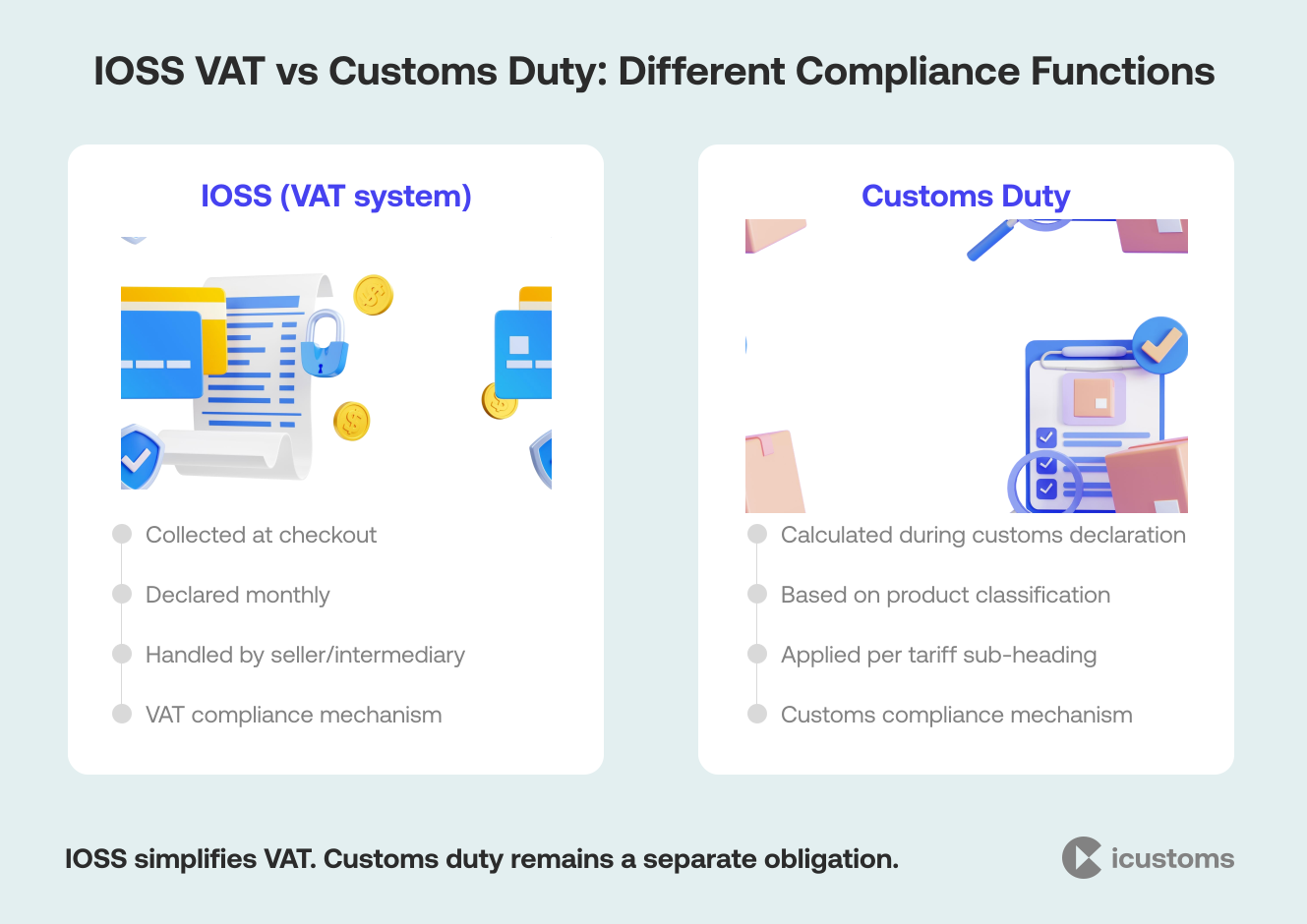
IOSS VAT vs Customs Duty: What Is the Difference?
One of the most important concepts in the low-value import reform is the separation between VAT and customs duty. IOSS affects how eligible import VAT is collected and reported. Customs duty is determined through customs rules and depends on factors such as classification, origin, customs value and applicable measures.
| IOSS / VAT | Customs duty |
|---|---|
| Collected at point of sale when IOSS is used | Determined through customs rules |
| Reported through the IOSS framework | Recorded through the customs declaration |
| Uses the IOSS VAT identification number | Uses classification and other customs data |
What Is the €3 EU Customs Duty Rule for Low-Value Imports?
From 1 July 2026, the supplied source content describes an interim €3 customs duty mechanism for qualifying consignments within the low-value threshold. The key operational feature is that the duty is applied by tariff sub-heading rather than simply once per parcel.
This makes product classification more important in high-volume e-commerce. A shipment containing products that fall under more than one applicable tariff sub-heading can have more than one €3 charge under the interim mechanism.
How Does the €3 Duty Work When a Parcel Has Multiple Tariff Sub-Headings?
Consider a parcel containing two categories of goods that are classified under two different tariff sub-headings. Under the model described in the existing article, the interim duty exposure would be €3 multiplied by the number of relevant tariff sub-headings.
| Example | Tariff sub-headings | Illustrative duty |
|---|---|---|
| Single classification | 1 | €3 |
| Two classifications | 2 | €6 |
| Three classifications | 3 | €9 |
The detailed calculation mechanics should be checked against the applicable customs legislation and current Commission guidance before publication. This hub should explain the concept while the dedicated classification article covers complex tariff scenarios.
Why Product Classification Matters More in the Low-Value Reform
The reform makes classification more directly connected to the financial exposure of low-value consignments. The Harmonised System provides the international six-digit foundation, while the EU Combined Nomenclature extends classification to eight digits. Further national tariff structures can add additional detail for specific customs purposes.
- HS codes provide the international classification foundation.
- EU CN codes extend the classification structure for EU customs purposes.
- The relevant tariff sub-heading determines how goods are treated in the customs process.
- Inconsistent classification can create inconsistent duty treatment across repetitive shipments.
- Bundled or multi-product consignments require particular attention to classification logic.
HS Codes, CN Codes and Tariff Classification
HS classification begins with a six-digit international structure. The EU then uses the Combined Nomenclature at eight digits for EU customs and tariff purposes. The classification process is therefore more detailed than simply identifying a six-digit HS code.
For this hub page, the focus should remain on why classification matters to the reform. Readers who need detailed 8-digit CN and 10-digit tariff guidance should be directed to the dedicated iCustoms classification and TARIC articles rather than repeating those articles here.
What Happens to the €150 Low-Value Threshold?
The existing article positions the €3 mechanism as a transitional measure during 2026–2028 and describes a later transition in which the €150 customs-duty treatment changes as the EU customs reform develops.
Because the precise legal implementation timeline and wording are regulatory matters, the final published version should use the latest European Commission and Council wording rather than relying solely on older explanatory language.
What Is the EU Customs Data Hub?
The EU Customs Data Hub forms part of the broader EU customs reform described in the source material. Its direction is toward more centralised customs data processing, common risk analysis and greater interoperability across customs information.
- More structured customs data.
- Greater integration of customs information.
- More consistent risk analysis.
- Improved visibility of inconsistencies between trade datasets.
For businesses, the practical implication is that customs data cannot be managed as isolated fields. Product information, tariff classification, customs values, security data and VAT references increasingly need to remain consistent across the transaction lifecycle.
How IOSS, ICS2 and Customs Declarations Interact
Low-value imports can pass through several digital data environments. IOSS handles the VAT side of eligible transactions, while ICS2 supports advance security and risk data, and the import customs declaration software provides the formal customs information required for clearance.
Operational risk arises when the same shipment is represented differently across these systems. Differences in commodity descriptions, quantities, values, classification or IOSS references can create additional validation or reconciliation work.
- Marketplace or e-commerce transaction data
- Commercial invoice data
- ICS2 / ENS security data
- Import customs declaration
- IOSS VAT reporting data
Common Low-Value Import Compliance Risks in 2026
- Incorrect or inconsistent tariff classification
- Multiple tariff sub-headings within one consignment
- Incorrect IOSS number transmission
- Invoice values that do not match customs declaration values
- Inconsistent commodity descriptions between systems
- Manual re-entry of repetitive shipment data
- Disconnected marketplace, carrier, broker and customs workflows
The common theme is data consistency. The reform does not make IOSS responsible for every customs problem. Instead, it increases the need for businesses to keep VAT, customs and security information aligned.
IOSS Registration and the IOSS Number
Businesses using IOSS must follow the applicable registration process and, where required, work through an EU-established intermediary. The resulting IOSS VAT identification number is used within the customs process for eligible IOSS shipments.
An IOSS number should not be confused with a domestic VAT number, and it should not be treated as a substitute for customs classification or other declaration data.
For detailed IOSS registration, IOSS number transmission and double-VAT scenarios, link to the dedicated IOSS number article rather than turning this hub into a second registration guide.
Is the €3 Customs Duty the Same as the EU Handling Fee?
No. The existing article distinguishes the interim customs duty mechanism from a separate EU handling-fee concept. These should not be presented as interchangeable charges.
The final published article should clearly label any handling-fee discussion as a separate measure and update it against the latest official status before publication.
Who Is Affected by the EU Low-Value Import Reform?
- E-commerce sellers shipping goods to EU consumers
- Online marketplaces and deemed suppliers
- Customs brokers and declarants
- Freight forwarders and logistics providers
- Carriers and postal operators
- Importers managing high-volume low-value shipments
- Technology providers handling customs, VAT and trade data
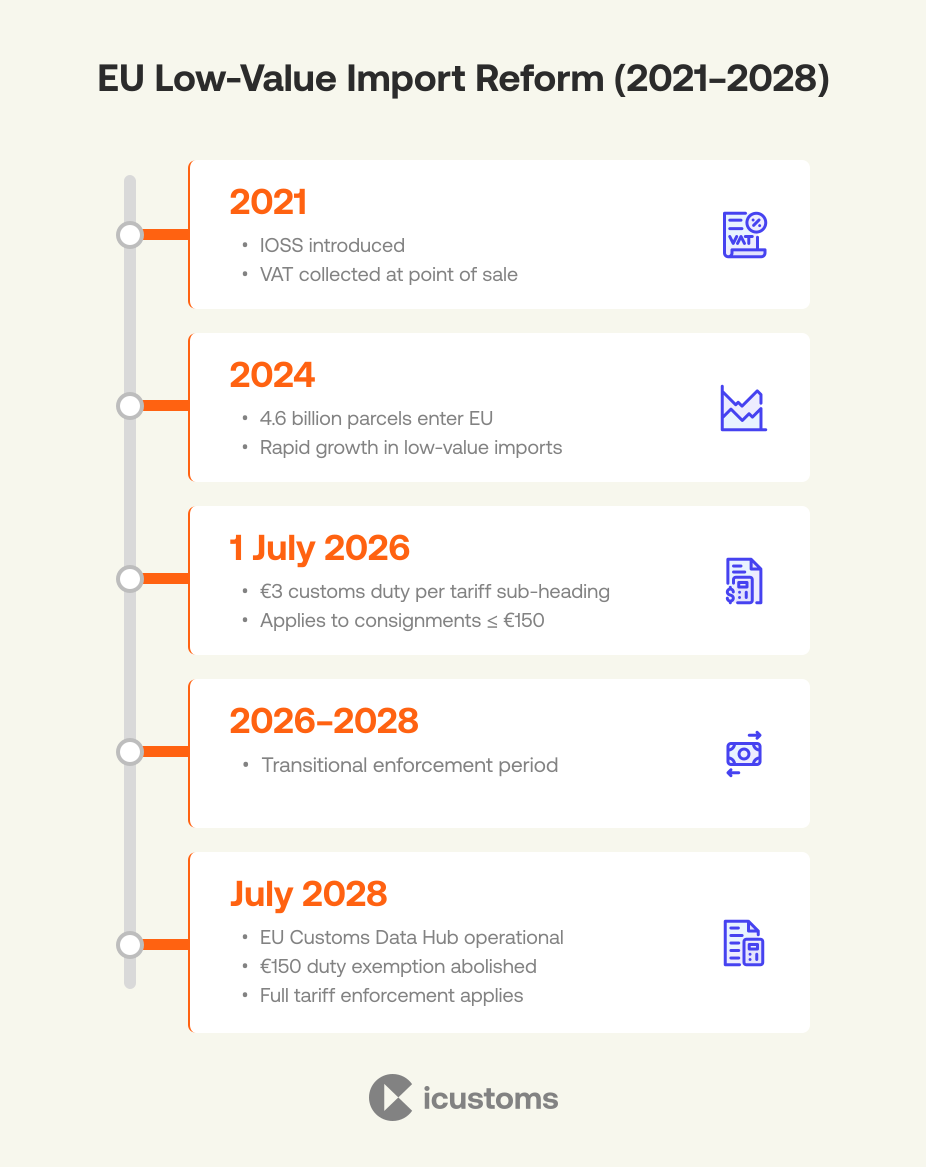
2026–2028 EU Low-Value Import Reform Timeline
- 2021 → IOSS introduced as an EU VAT simplification mechanism.
- 1 July 2026 → Interim €3 customs duty mechanism begins under the applicable rules.
- 2026–2028 → Transitional period described in the existing article.
- 2028 → Broader EU customs reform and Customs Data Hub transition become increasingly important.
How Businesses Can Prepare for the 2026 Low-Value Import Rules
- Review which products and shipment types fall within the relevant low-value and IOSS eligibility conditions.
- Audit product classification and identify SKUs that are frequently classified inconsistently.
- Review how IOSS numbers move from the selling platform to the carrier, broker and customs declaration.
- Compare product descriptions, quantities, values and identifiers across invoices, security filings and import declarations.
- Identify consignments that can contain multiple tariff sub-headings.
- Review manual re-entry points and high-volume data handoffs.
- Maintain an audit trail for classification decisions, declaration amendments and IOSS-related exceptions.
- Monitor official EU guidance as the 2026–2028 reform develops.
Where Customs Automation Fits
Automation is most useful when it improves data consistency before a declaration is submitted. For high-volume low-value imports, relevant capabilities include structured document extraction, product classification, declaration validation, data reuse and system interoperability.
- Intelligent Document Processing can convert invoice information into structured customs data.
- Classification tools can standardise product-to-code mapping.
- Validation rules can identify missing or inconsistent declaration data.
- API and EDI integrations can reduce manual re-entry.
- Audit trails can support post-clearance review and exception management.
iCustoms can be referenced here as the technology layer supporting these workflows, but the article should remain primarily educational.
IOSS and EU Low-Value Imports: 2026 Compliance Checklist
- Confirm IOSS eligibility.
- Confirm the correct IOSS registration and intermediary structure.
- Validate IOSS number transmission.
- Review product classification and tariff sub-heading consistency.
- Identify multi-product consignments that may involve multiple tariff sub-headings.
- Check invoice and customs value consistency.
- Align relevant ICS2 / ENS and import declaration data.
- Reduce manual re-keying.
- Maintain records for classification and declaration decisions.
- Monitor official EU customs and VAT guidance.
Conclusion
The EU low-value import environment is becoming more dependent on structured customs data. IOSS remains important for VAT collection and reporting, but it does not replace customs processes. The 2026 interim €3 customs duty mechanism makes tariff classification and shipment-level data consistency more important for businesses managing high volumes of low-value imports.
The practical priority is to connect IOSS, customs classification, security data and import declarations through consistent workflows. Businesses that understand the distinction between VAT and customs duty, control their tariff data and reduce fragmented manual processing can better manage the 2026–2028 transition.
Frequently Asked Questions
What is IOSS in customs declaration?
IOSS is an EU VAT scheme used for eligible distance sales of imported goods. The IOSS reference is transmitted through the customs process, but IOSS does not replace the customs declaration.
How does the €3 EU customs duty rule work?
The source article describes an interim €3 customs duty mechanism applied by tariff sub-heading for qualifying low-value consignments. The final calculation should be checked against the current legal framework before publication.
Is the €3 customs duty charged per parcel?
No. The key distinction is that the mechanism is applied by tariff sub-heading rather than simply once per parcel.
Does IOSS eliminate customs duty?
No. IOSS concerns VAT collection and reporting. Customs duty and classification remain separate customs matters.
What is the difference between IOSS VAT and customs duty?
IOSS VAT is collected at checkout under the IOSS framework. Customs duty is determined through customs rules using classification and other customs data.
Why is tariff classification important for IOSS imports?
Classification determines the tariff sub-heading used in the customs process and is therefore particularly relevant where the interim duty mechanism is calculated by sub-heading.
What is the EU Customs Data Hub?
It is a central component of the wider EU customs reform and is intended to support more integrated customs data processing and risk analysis.
Is the EU handling fee the same as the €3 customs duty?
No. The existing article treats the handling fee as a separate concept from the interim customs duty.
What is an IOSS number?
An IOSS number is the VAT identification number associated with a business or deemed supplier using IOSS. It is distinct from a domestic VAT number.

Customs Operations and EU IOSS Reforms
See how iCustoms automates EU IOSS declarations for low-value imports.
You may also like:
Struggling with Accurate Product Classification?

Classify products more consistently with AI-powered customs technology
Subscribe to our Newsletter
About iCustoms
iCustoms is an all-in-one solution helping businesses automate customs processes more efficiently. With AI-powered and machine-learning capabilities, iCustoms is designed to streamline your all customs procedures in a few minutes, cut additional costs and save time.
Simplify Your EU Customs Declarations
Streamline customs filing and improve data consistency across import operations.