

Commercial Export of Pets to the EU: Dogs, Cats and Ferrets via TRACES
- John Hall
- Customs Specialist at iCustoms.ai
The commercial export of pets to the EU follows a completely different rulebook from taking your own dog on holiday. The moment an animal moves for sale, breeding or a change of ownership, it stops being a pet in the eyes of the law and becomes a commercial consignment. Consequently, it needs an Export Health Certificate, an official veterinarian and a notification through TRACES NT before it can cross a border.
This guide explains what counts as a commercial movement, which animals qualify, the health rules every dog, cat and ferret must meet, and how the paperwork flows from your application to the EU border control post. Because a single missing signature can turn animals away at the border, we also cover the timing rules that catch exporters out.
What counts as a commercial export of pets?
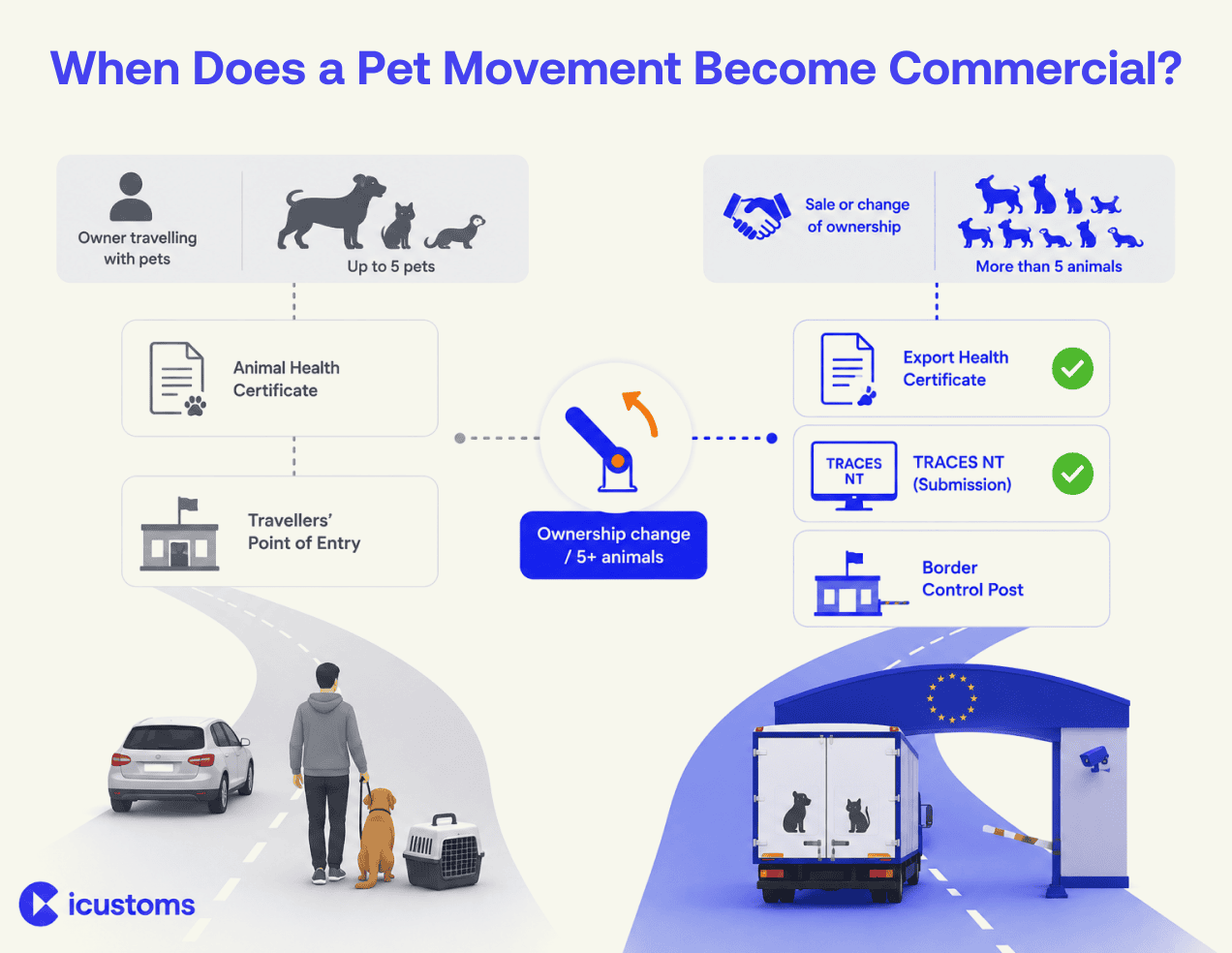
Non-commercial movement covers an owner travelling with up to five of their own animals. Anything beyond that is commercial. In practice, three situations tip a movement into the commercial category, and each one changes the documents you need.
| Situation | Category | What It Needs |
|---|---|---|
| You travel with up to five of your own pets. | Non-commercial | An Animal Health Certificate (AHC), with the owner or authorised person accompanying the animals. |
| The animal is sold or ownership changes. | Commercial | An Export Health Certificate (EHC) issued through the appropriate certification process and managed in TRACES NT where applicable. |
| More than five animals are moved (unless travelling to a registered competition, exhibition, sporting event, or training for one). | Commercial | An Export Health Certificate (EHC) issued through the appropriate certification process and managed in TRACES NT where applicable. |
Breeders, rescues rehoming animals abroad, and anyone moving puppies or kittens to a new owner therefore fall squarely into the commercial route. The distinction matters because commercial consignments must enter through an approved border control post and be pre-notified in TRACES NT, whereas a private pet can use a simpler travellers’ point of entry.
Which pets can be exported commercially to the EU?
The commercial pet rules apply to three species: dogs, cats and ferrets. These are the companion animals covered by the EU’s pet movement framework, and you can move each one commercially provided it meets the same core health conditions. Other animals, such as rabbits or birds, fall under separate livestock or wildlife rules and are outside the scope of this guide.
Crucially, the species is only the starting point. Every individual animal in the consignment must satisfy the health requirements below on its own, so a single unvaccinated puppy can hold up an entire shipment.
The health requirements every animal must meet
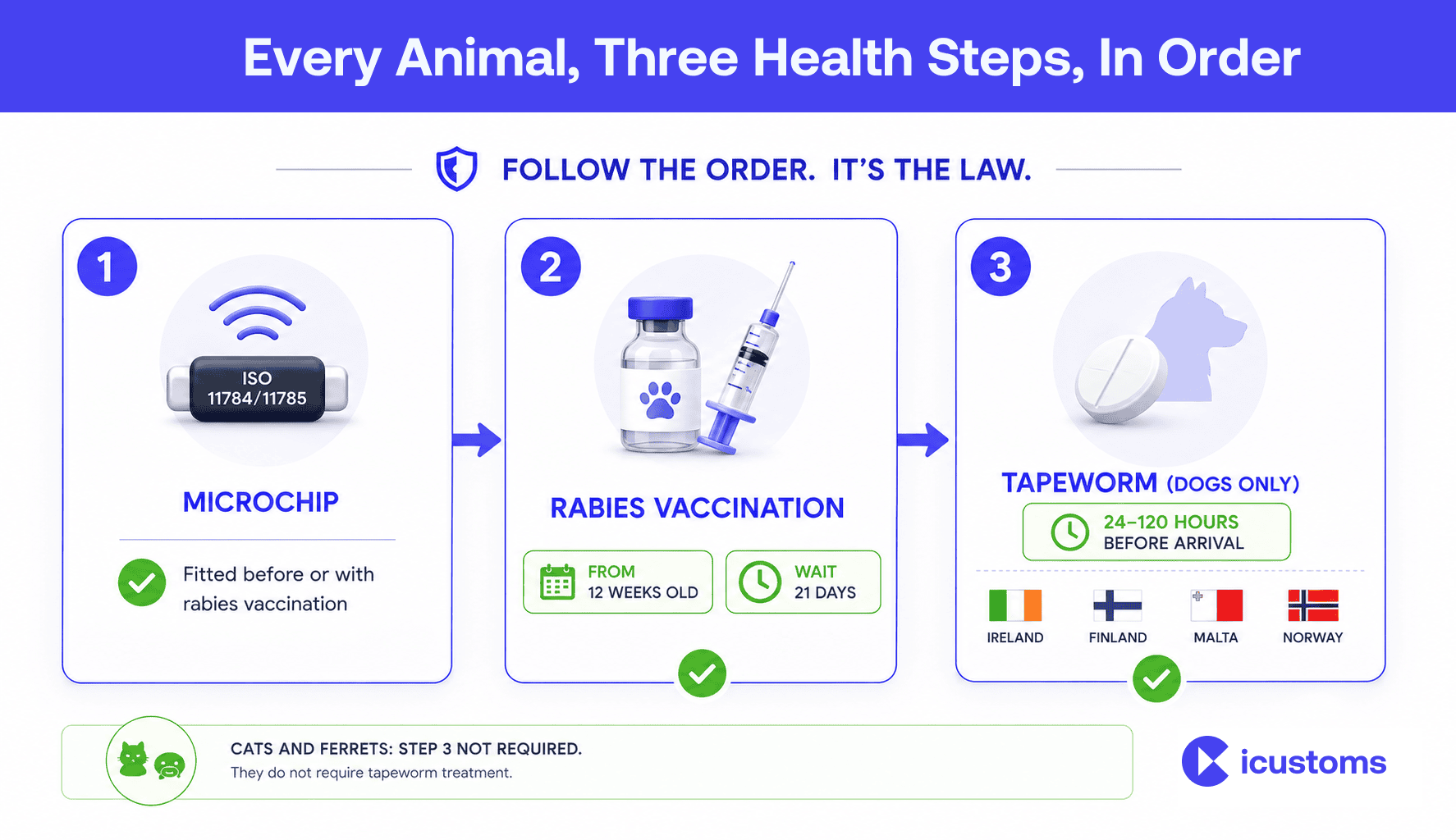
Three veterinary steps sit at the heart of every commercial pet export, and they must happen in the right order.
First, microchip identification. Each animal needs a microchip that meets ISO standards, fitted before or at the same time as its rabies vaccination. If the chip goes in afterwards, the vaccination no longer counts and the animal must be done again.
Second, the rabies vaccination. A vet can only vaccinate an animal once it is at least 12 weeks old, and the animal cannot travel until at least 21 full days have passed after the primary vaccination. As a result, a young litter needs planning weeks in advance of any move.
Third, tapeworm treatment for dogs travelling to certain destinations, including Ireland, Finland, Malta and Norway. An official vet must administer a treatment against Echinococcus multilocularis and record it, usually between 24 and 120 hours before arrival. Cats and ferrets do not need this step.
Alongside these, the official veterinarian carries out animal welfare checks and confirms each animal is fit to travel before signing anything.
The documents: Export Health Certificate and TRACES NT
A commercial consignment cannot move on a pet passport or an ordinary animal health certificate. Instead, it needs an Export Health Certificate (EHC) issued by an official veterinarian. For movements from Northern Ireland into the EU, this takes the form of an Intra-Trade Animal Health Certificate raised electronically in TRACES NT.
TRACES NT is the EU’s digital certification platform, and it is the current version of the EU Trade Control and Expert System. The certificate created there travels ahead of the animals and generates the Common Health Entry Document (CHED) that border officials check on arrival. Meanwhile, your EU-based import agent must notify the border control post at least 24 hours before the consignment arrives.
The official veterinarian owns the veterinary side of this process. They inspect the animals, confirm each animal meets the health conditions, and validate the certificate in TRACES NT. You cannot submit the certificate to the EU platform yourself.
The pet export application form and the 3 working day rule
Before the vet can certify anything, you complete a pet export application form and submit it to your official veterinarian. This is where timing bites: the form must reach the vet at least three working days before the intended movement. Forms that are incomplete, illegible or unsigned are returned, and a returned form means a missed sailing.
The application captures the consignor and consignee, the premises involved, the species and numbers, and the destination. For a step-by-step walkthrough of each box, see our TRACES application form guide. Getting these details right the first time is the single biggest thing an exporter can control, because everything downstream depends on consistent data.
Border control post: what happens on arrival
Every commercial pet consignment must arrive at an EU border control post approved for live animals, or at an approved point of entry in Northern Ireland. Not all posts accept live animals, so you must confirm the route in advance.
At the post, officials check the animals against the certificate and the CHED. If everything matches, the consignment clears. However, if an animal fails inspection for animal or public health reasons, it can be destroyed. For other failures, the post notifies your agent, who decides whether to return the consignment to Great Britain. In short, the border is where paperwork errors become expensive, physical problems.
Still Managing Pet Export Paperwork by Hand?
Keep every certificate, code and declaration aligned across TRACES and your customs entry with iCustoms.
How the commercial pet export process works, step by step
Bringing the pieces together, a compliant commercial export of pets follows five stages.
- Prepare the animals. Microchip, vaccinate against rabies, and treat dogs for tapeworm where the destination requires it.
- Submit the application. Send the pet export application form to your official veterinarian at least three working days before the move.
- Certify in TRACES NT. The official vet inspects the animals and raises the Export Health Certificate electronically.
- Notify the border. Your EU or Northern Ireland import agent pre-notifies the border control post at least 24 hours ahead.
- Move and clear. The animals travel to the approved post, officials verify the CHED, and the consignment enters the EU.
Each stage depends on the accuracy of the one before it, which is why exporters increasingly manage the data centrally rather than in scattered spreadsheets and email threads. This single-source approach is exactly what iCustoms is built around.

Why choose iCustoms for pet export compliance?
A commercial pet movement is not only a veterinary task; it is also a customs and data task. The same consignment that needs an Export Health Certificate also needs a correct customs declaration and consistent information across every document. When those details disagree, consignments stop.
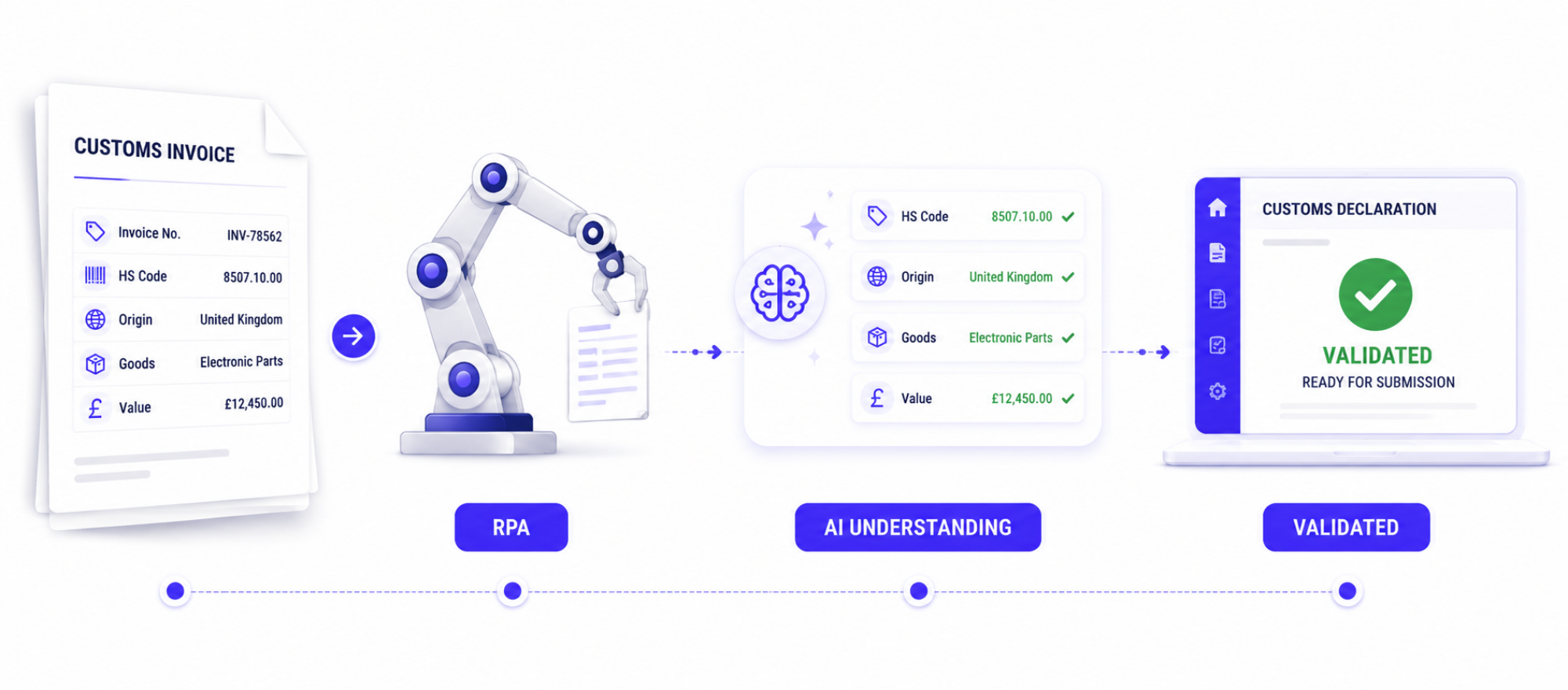
iCustoms keeps that data story consistent. Its Intelligent Document Processing extracts and verifies information from your trade documents, iTraces validates establishment and TRACES-related codes against the official EU database, and iClassification confirms HS codes across 32 countries and more. As a result, teams cut manual effort by up to 80% and work far faster, with 99% accuracy. Logistics leaders such as Kerry Logistics, Ziegler and Woodside Logistics Group already run their customs operations this way.
The veterinary certification stays with your official vet, exactly as the rules require. What iCustoms adds is confidence that the customs and data layer around the movement, especially for movements from Northern Ireland, is accurate before anything reaches a border.
One Movement, One Consistent Data Story
See how iCustoms AI keeps your pet export documents aligned from application to border clearance.
Frequently Asked Questions
How do I export pets commercially to the EU?
Microchip and vaccinate the animals, submit a pet export application form to your official veterinarian at least three working days ahead, have them raise an Export Health Certificate in TRACES NT, and arrive at an approved border control post with 24 hours' advance notice given by your import agent.
What is the difference between commercial and non-commercial pet movement?
Non-commercial movement is an owner travelling with up to five of their own animals. A movement becomes commercial when the animal is sold or changes ownership, or when more than five animals move for reasons other than a registered event. Commercial consignments need an Export Health Certificate through TRACES NT.
Can dogs be exported commercially to the EU?
Yes. Dogs, cats and ferrets can all be exported commercially, provided each animal is microchipped, vaccinated against rabies, and, for dogs heading to certain countries, treated for tapeworm.
Does a commercial pet export require an Export Health Certificate?
Yes. Every commercial consignment of dogs, cats or ferrets needs an Export Health Certificate issued by an official veterinarian. For Northern Ireland to EU movements, this is an Intra-Trade Animal Health Certificate raised in TRACES NT.
What vaccinations are required for commercial pet exports?
A valid rabies vaccination is mandatory for every animal. The animal must be at least 12 weeks old when vaccinated, and it cannot travel until at least 21 full days after the primary vaccination.
What is the 3 working day rule for pet exports?
The pet export application form must reach your official veterinarian at least three working days before the intended movement. Incomplete, illegible or unsigned forms are returned, which can cause the animals to miss their scheduled departure.
You may also like:

Struggling to Extract, Catagorise & Validate Your Documents?

Capture & Upload Data in Seconds with AI & Machine Learning
Subscribe to our Newsletter
About iCustoms
iCustoms is an all-in-one solution helping businesses automate customs processes more efficiently. With AI-powered and machine-learning capabilities, iCustoms is designed to streamline your all customs procedures in a few minutes, cut additional costs and save time.
Struggling to Extract, Catagorise & Validate Your Documents?
Capture & Upload Data in Seconds with AI & Machine Learning