IOSS Customs Declaration Errors Go Beyond Filing Mistakes
- John Hall
- Customs Specialist at iCustoms.ai
From 1 July 2026, low-value imports under €150 declared through the Import One Stop Shop no longer operate in a simplified customs environment. The interim €3 customs duty per tariff sub-heading will shift financial exposure away from parcel value and toward classification depth.
In parallel, structured validation under ICS2 and increasing centralisation toward the EU Customs Data Hub mean classification variance is no longer an isolated filing error. It becomes a measurable financial variable. AI product classification for customs duty collection is no longer an optimisation tool. It is margin protection infrastructure.
Why Product Classification Determines IOSS Duty Exposure
Under the EU customs framework, every imported product must be assigned a commodity code under the Harmonised System and the EU Combined Nomenclature. These codes determine customs duty, trade measures and regulatory controls. In the IOSS environment, product classification directly determines how the €3 per tariff sub heading rule applies, because duty is calculated according to the TARIC classification assigned to the goods rather than the parcel value alone.
Why July 2026 Turns Product Classification into a Financial Risk Variable
Under the new €3 rule, customs duty is applied per tariff sub-heading keeping in view commodity codes, not per parcel. Two identical-value parcels may generate materially different duty exposure depending solely on how goods are classified at 8- and 10-digit level.
At the same time, structured validation environments compare historical filing patterns. Repeated variance across identical SKUs becomes statistically visible. The result is a dual exposure environment:
- Overpayment through inconsistent fragmentation
- Underpayment through incorrect consolidation
In both cases, product classification precision directly affects financial outcome.
The Two Financial Risks Most Operators Ignore
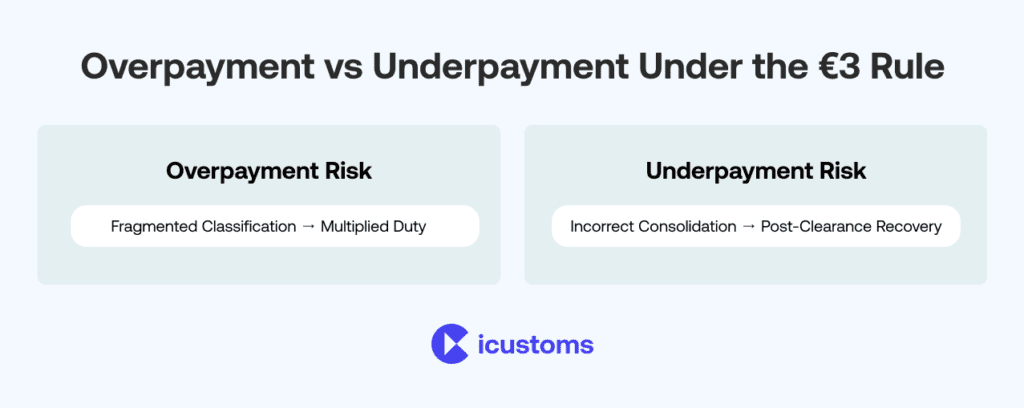
After July 2026, product classification errors are not symmetrical. Some inflate duty and erode profit silently, while others understate liability and trigger recovery action. In a structured enforcement environment, both outcomes create measurable financial risk.
Overpayment of Duty through Fragmented Classification
In high-volume IOSS environments, SKU descriptions often evolve independently across systems. Slight variations in product naming, material composition recording, or accessory treatment can lead to adjacent CN assignments.
Where one SKU is occasionally split across two or three sub-headings instead of one, duty exposure multiplies. Under a per-heading model, small inconsistencies scale rapidly across thousands of consignments. Overpayment does not trigger an alert. It quietly erodes margin.
Underpayment and Post-Clearance Recovery Risk
The inverse problem is equally serious. Where composite goods are incorrectly consolidated, or where accessory logic is misapplied, customs authorities may reclassify the product at a more granular level. Under the July 2026 regime, this does not simply adjust an ad valorem rate. It can multiply fixed duty exposure and trigger post-clearance recovery.
Underpayment creates:
- Entry amendments
- Administrative penalties
- Increased scrutiny under risk-based systems
In a centralised enforcement model, repetition increases audit probability.
How Manual Classification Creates Systemic Variance at Scale
Manual classification works when volumes are low and SKU diversity is limited. In a multi-platform IOSS environment, it introduces interpretive drift. Common sources of variance include:
- Spreadsheet-maintained classification databases
- Staff-dependent interpretation of CN notes
- Inconsistent treatment of bundled goods
- Delayed updates following annual CN revisions
Under ICS2 validation environments, structured commodity fields are compared pre-arrival. Variance is no longer contained within a single Member State filing system. It becomes part of a cross-jurisdiction dataset. Consistency is therefore no longer optional.
AI Product Classification as a Financial Control Layer
AI product classification should not be understood as automation for speed only. Its primary value is deterministic consistency. By analysing product attributes, historical assignments, material composition and TARIC measures, AI-driven systems standardise classification outcomes across repetitive filings. This reduces both inflationary and recovery risk. The objective is not aggressive minimisation of duty. It is structured, defensible precision.
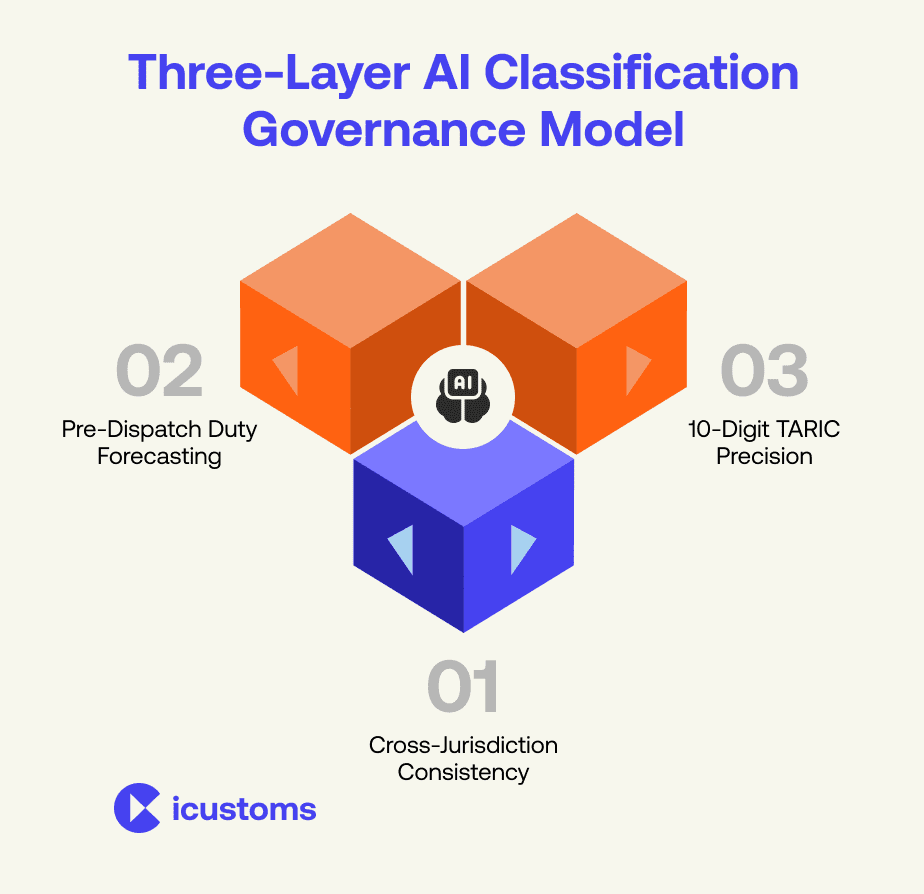
Layer 1 – Deterministic 10-Digit TARIC Precision
AI classification engines continuously validate against updated CN and TARIC datasets. They apply consistent logic to repetitive SKUs, ensuring identical goods are not treated differently across filings.
This prevents:
- Fragmented duty multiplication
- Inadvertent trade defence activation
- Misapplication of anti-dumping measures
Precision at 10-digit level becomes a financial safeguard.
Layer 2 – Pre-Dispatch Duty Forecasting
Before goods are declared, AI systems can simulate duty exposure under current classification logic. This enables:
- Accurate Delivered Duty Paid modelling
- Landed cost prediction
- Scenario analysis for bundled goods
Pre-dispatch forecasting reduces pricing disputes and improves checkout transparency under IOSS flows.
Layer 3 – Continuous Cross-Jurisdiction Consistency
Under the emerging EU Customs Data Hub, identical SKUs declared across Member States will be statistically comparable. AI governance ensures:
- The same SKU receives the same classification
- Variance is detected internally before submission
- Filing behaviour remains defensible across borders
Consistency reduces enforcement friction.
How AI Classification Aligns with ICS2 and EU Digital Enforcement
Since January 2026, ICS2 has been fully operational for relevant transport flows entering the EU customs territory, requiring pre-arrival Entry Summary Declarations and triggering automated risk analysis before border processing (French Customs Smart Border ICS2 Update, February 2026).
This environment prioritises structured data consistency. Classification inconsistencies are no longer administrative details; they directly influence risk scoring and routing decisions.
The direction of reform outlined by the European Commission and aligned with digital customs principles of the World Customs Organization confirms that high-quality electronic data underpins modern enforcement. AI classification strengthens structured data integrity before submission.
Why AI Product Classification Governance Is Now a Competitive Advantage
In post-2026 EU trade, customs accuracy influences:
- Margin protection
- Clearance predictability
- Customer experience under DDP models
- Audit exposure
Operators capable of demonstrating consistent, AI product classification logic will experience fewer disruptions under risk-engine environments. Classification governance is therefore no longer clerical. It is strategic.
The iCustoms Financial Accuracy Architecture
iCustoms approaches classification as compliance infrastructure.
Our architecture integrates:
- AI-driven 10-digit TARIC validation
- Intelligent Document Processing for structured data extraction
- ENS and import declaration alignment
- Secure API, EDI and AS4 interoperability
- ISO 27001 and ISO 9001 governed controls
Recognised by HM Revenue & Customs and Irish Tax & Customs, and recipient of Innovation in Trade and Cross-Border Trade awards, iCustoms is positioned within the institutional customs ecosystem rather than outside it.
In a €3 per sub-heading environment supported by structured risk engines, consistent classification governance protects both financial performance and regulatory standing.
Conclusion: Classification Accuracy Is Now Margin Infrastructure
The July 2026 reforms have transformed classification from a technical requirement into a financial determinant.
- Overpayment erodes margin quietly
- Underpayment escalates recovery and scrutiny
- Manual variance becomes statistically visible
- Structured enforcement is already live
- AI classification standardises duty logic at scale
As low-value imports transition toward full integration into the EU Customs Data Hub, businesses that treat classification as infrastructure rather than clerical input will operate predictably.
Prepare your EU IOSS classification governance before structured enforcement converts variance into measurable financial exposure.
Frequently Asked Questions
How does the EU EUR 3 per tariff sub-heading rule change the financial impact of product classification for IOSS imports?
Under the interim IOSS customs duty model, duty is applied per tariff sub-heading rather than ad valorem per parcel. A single shipment carrying goods across multiple CN headings attracts duty on each heading separately. This means classification errors no longer carry only regulatory consequences but direct financial ones. Incorrect fragmentation inflates duty exposure, while over-consolidation understates liability, both at a per-filing scale that multiplies rapidly across high-volume IOSS operations.
What is the difference between IOSS duty overpayment and underpayment, and why does each create a distinct compliance risk?
Overpayment arises when SKUs are fragmented across more CN sub-headings than necessary, generating unnecessary duty charges per consignment that erode margin silently at scale. Underpayment occurs when composite goods are incorrectly consolidated, causing customs authorities to reclassify the product and trigger post-clearance duty recovery, entry amendments, and potentially increased audit scrutiny. Unlike overpayment, underpayment can escalate into enforcement action under structured EU risk-based customs systems.
How does manual product classification create systemic data variance in multi-platform IOSS environments?
Manual classification introduces interpretive drift at scale. In multi-platform IOSS environments, staff-dependent interpretation of CN notes, spreadsheet-maintained classification databases, inconsistent treatment of bundled goods, and delayed updates following annual CN revisions all produce variance across filings. Under ICS2 validation and the EU Customs Data Hub, structured commodity fields are compared pre-arrival across jurisdictions, so variance is no longer contained within a single Member State filing system.
Why does 10-digit TARIC precision matter for preventing financial exposure on IOSS imports?
At 10-digit TARIC level, each additional digit refines duty rates, trade defence measures, and applicable restrictions. Misassignment at this depth directly affects how the EUR 3 per sub-heading rule applies to each consignment. AI classification engines validate continuously against updated TARIC datasets, applying consistent logic across repetitive SKUs. This prevents inadvertent anti-dumping measure activation, fragmented duty multiplication, and the misapplication of trade defence instruments that manual classification systems are prone to.
How does AI-driven pre-dispatch duty forecasting improve Delivered Duty Paid accuracy for IOSS shipments?
Pre-dispatch duty forecasting uses AI classification logic to simulate duty exposure before goods are declared. For IOSS operators offering Delivered Duty Paid pricing, this enables accurate landed cost prediction, pricing model validation, and scenario analysis for bundled goods. By calculating duty against current TARIC classifications before submission, operators reduce checkout pricing disputes, prevent margin erosion from unexpected duty, and improve shipment-level financial predictability across high-volume EU import flows.

Stop IOSS Duty Errors Before Filing
Use AI product classification to prevent duty overpayment and underpayment in EU imports.
You may also like:
Struggling to Extract, Catagorise & Validate Your Documents?

Capture & Upload Data in Seconds with AI & Machine Learning
Subscribe to our Newsletter
About iCustoms
iCustoms is an all-in-one solution helping businesses automate customs processes more efficiently. With AI-powered and machine-learning capabilities, iCustoms is designed to streamline your all customs procedures in a few minutes, cut additional costs and save time.
Struggling to Extract, Catagorise & Validate Your Documents?
Capture & Upload Data in Seconds with AI & Machine Learning