
UK Post-Brexit Transit Customs: What Freight Forwarders Must Know in 2026
- John Hall
- Customs Specialist at iCustoms.ai
There is a laminated sheet on the wall of almost every forwarding office in Kent. It went up in early 2021, it explains how to move a trailer from GB to the EU, and by 2026 nearly every line on it is wrong.
The system it describes has been replaced. The declaration platform it names has been switched off. The grace periods it relies on have expired, the Northern Ireland arrangement it assumes has been renegotiated, and the transit system it references has moved to a data model that rejects the exact process the sheet recommends.
None of that happened in a single announcement. UK post-Brexit transit customs settled in slowly, one deadline at a time, and the teams that struggle in 2026 are usually the ones who learned it once in 2021 and never went back.
This guide is the replacement sheet. What actually applies now, which systems talk to which, where guarantees quietly cost you money, and where movements still fail.
What "Post-Brexit Transit Customs" Actually Means Now
Start with the thing most operational teams still get slightly wrong.
The Trade and Cooperation Agreement gives qualifying UK and EU goods zero tariffs and zero quotas. It does not remove customs. A GB to EU movement is an export from one customs territory and an import into another, and it needs the full apparatus: declarations, commodity classification, origin evidence, safety and security data, and, where the goods are not clearing immediately at the frontier, a transit procedure.
Transit is the part that gets least attention and causes the most disruption. It is the mechanism that lets goods travel from a UK inland site to a customer in Poland without duty and import formalities landing at the first EU border they touch. Duties are suspended, covered by a guarantee, and settled at the destination.
That mechanism is the Common Transit Convention, and the UK remains a contracting party in its own right. The EU acts as one territory, joined by the EFTA states and by North Macedonia, Serbia, Türkiye, Ukraine and Moldova. One declaration, one guarantee, one movement, across as many of those territories as the route crosses.
Understanding this is the difference between quoting a job correctly and discovering at Sevington that you needed a procedure you never set up.
The Systems That Replaced the Ones You Learned in 2021
CHIEF Has Gone. CDS Is the Only Route
Customs Handling of Import and Export Freight ran UK declarations for thirty years and no longer exists. Everything now goes through the Customs Declaration Service.
CDS is not a rebadged CHIEF. It uses a different data model, different data element numbering, different procedure code logic and a different financial account structure. Duty deferment accounts, postponed VAT accounting and cash accounts are all administered through the CDS financial dashboard, and authority for an agent to use a client’s deferment account has to be granted there explicitly.
The practical consequence for transit work is that your import and export data now has to be good enough for CDS validation before it is good enough for anything else. Teams that cleaned up their commodity code discipline for CDS found the NCTS Phase 5 transition far less painful than teams that did not.
GVMS and the Goods Movement Reference
At roll-on roll-off ports operating the pre-lodgement model, including the short straits, the physical movement is controlled by the Goods Vehicle Movement Service.
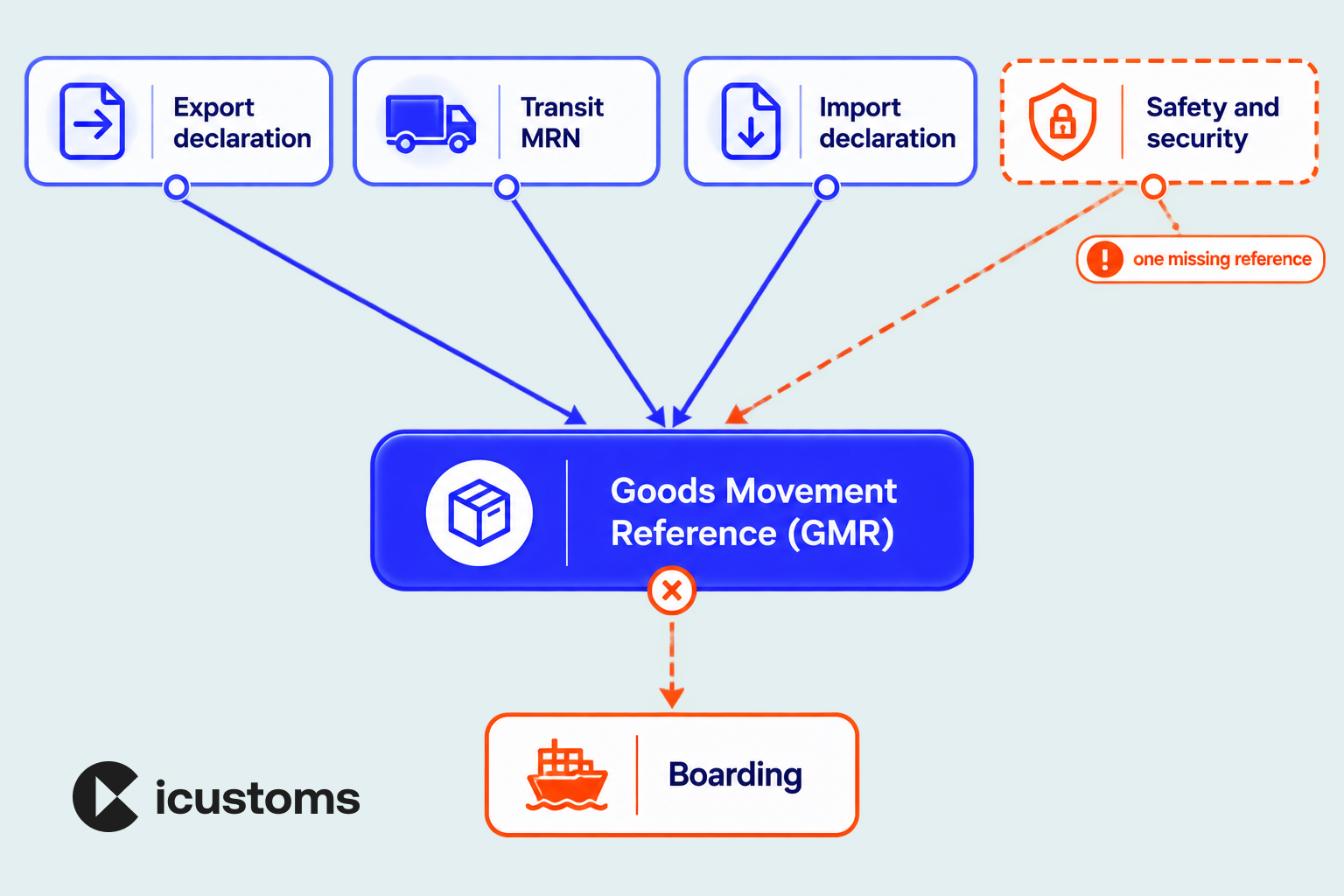
The logic is simple and unforgiving. Every declaration relating to what is on the trailer, including the transit MRN, is linked into a single Goods Movement Reference. The driver presents the GMR at check-in. No GMR, no boarding. A GMR missing one of the underlying references will fail, and it fails at the port, with the vehicle already there.
This is where groupage goes wrong. One late transit declaration among fourteen consignments holds the whole trailer, because the GMR cannot be completed until every reference exists.
NCTS Phase 5
The transit system itself moved to Phase 5, and the change was structural rather than cosmetic. Declarations now use a three-level structure of consignment, house consignment and goods item. Six-digit commodity codes are mandatory at item level. Safety and security data can be carried inside the transit declaration. Incidents in transit are reported electronically to an office of incident rather than endorsed by hand on paper.
If your team is still filing transit the way it did before Phase 5, that is where the rejections are coming from.
The Documents Every GB to EU Transit Movement Needs
Four things have to exist before a trailer moves, and they have to be consistent with each other.
An EORI number. A GB EORI for GB customs activity, and a separate XI EORI where the business needs to be identified for Northern Ireland purposes. The EORI on the transit declaration must match the EORI holding the guarantee, or the declaration is refused.
A transit declaration, T1 or T2. T1 covers non-Union goods, meaning goods that have not been released into free circulation in the EU. T2 covers Union status goods. Choosing the wrong one is not a formality; it changes the duty position at destination.
A Transit Accompanying Document. Issued once the office of departure releases the movement, the TAD carries the Movement Reference Number as a barcode and travels physically with the goods. Every office along the route reads it.
Safety and security data. Entry summary declaration requirements apply to movements into the EU, filed into the EU’s Import Control System, and equivalent requirements apply on the UK side. Phase 5 lets qualifying movements carry this data inside the transit declaration rather than filing separately, but only if the full dataset is populated.
Still assembling GMRs, transit declarations and CDS entries in three different places?
See how iCustoms links declaration, transit and movement data in one workflow so a missing reference is caught in the office, not at the port.
Guarantees: The Post-Brexit Cost Nobody Budgeted For
This is the part of UK post-Brexit transit customs that surprises finance teams rather than operations teams.
Every transit movement must be covered by a financial guarantee for the duty and VAT at risk while the goods are suspended. In practice that means a comprehensive guarantee arranged through a bank or insurer, identified by a guarantee reference number, with an amount committed each time a movement is released and freed only when the movement is discharged at destination.
Two things follow from that, and both cost money.
The first is capacity. A comprehensive guarantee has a ceiling. Every open movement sits against it. A forwarder running high-value loads can exhaust available cover partway through a day, at which point every further declaration fails for insufficient guarantee. The usual cause is not volume, it is undischarged movements: loads that arrived weeks ago but were never closed out at the office of destination.
The second is authorisation. A guarantee waiver, which reduces or removes the amount you have to secure, depends on holding the right approvals. So does the ability to start and end movements at your own premises rather than at a customs office, which is what authorised consignor and authorised consignee status give you. Those authorisations, along with AEO status, are the difference between a trailer that leaves your yard sealed and a trailer that queues at an office of departure first.
Forwarders who invested in these authorisations early spend far less time at border facilities than those still moving goods office to office five years on.
Rules of Origin: The Tariff You Thought Brexit Removed
Zero tariff under the Trade and Cooperation Agreement is conditional, and the condition is origin.
Goods only qualify if they meet the product-specific rules of origin, and the claim has to be supported: a statement on origin from the exporter, or importer’s knowledge, backed by supplier declarations where materials were sourced from elsewhere. Goods that merely passed through the UK do not become UK origin, and goods assembled from non-originating components may not qualify however much work was done here.
This bites specifically in transit and distribution work. A consignment brought into a UK warehouse from Asia and then moved on to the EU is not a preferential UK export. It is a non-Union good, it moves under T1, and full duty applies at destination unless a customs procedure such as customs warehousing or inward processing is in place.
Origin errors do not surface at the border. They surface in an audit two years later, with retrospective duty, and the forwarder is very often the one holding the correspondence.

Northern Ireland: The Windsor Framework in Practice
Movements from GB to Northern Ireland sit under their own arrangement – see our full guide to NCTS for Northern Ireland for the lane system and Ireland-specific detail.
The Windsor Framework replaced the original Protocol arrangements with a lane-based system. Goods staying in the UK internal market move through the simplified lane with reduced information requirements, provided the business is authorised under the UK Internal Market Scheme. Goods at risk of onward movement into the EU go through the full customs lane with complete declarations and, where applicable, duty.
Authorisation is the pivot. Without UKIMS, goods default to the full treatment. With it, the same movement is dramatically lighter.
The Trader Support Service exists to help businesses handle NI declarations, and many smaller traders still rely on it. Larger forwarders generally file directly, which means the NI-specific data requirements sit inside their own systems and have to be maintained there.
Northern Ireland is also where EORI confusion causes the most damage, because a business may legitimately need both a GB and an XI EORI and needs to know which applies to which leg.
Where Movements Actually Fail in 2026
Five years of data points at the same handful of causes.
- A GMR completed before every underlying reference exists. Usually one late consignment in a groupage load.
- Guarantee exhausted by undischarged movements. Nobody chased the discharge notification, so the cover is still committed.
- Wrong transit type. T2 claimed on goods that never entered free circulation in the EU.
- Origin claimed without evidence. No statement on origin, no supplier declarations, no fallback procedure.
- Phase 5 data gaps. Missing house consignment level, or commodity codes below six digits.
- EORI mismatches. The declarant, the guarantee holder and the party on the declaration are not the same entity, or the wrong EORI variant was used for a Northern Ireland leg.
Not one of those is a border problem. All six are data problems that became border problems because nothing checked them earlier.
Ready to replace the laminated sheet?
iCustoms handles CDS declarations, NCTS transit and movement references in one platform, validating every field before submission so the failures above never reach a port.
Frequently Asked Questions
What is UK post-Brexit transit customs?
It is the set of procedures governing goods moving between the UK and other customs territories under duty suspension since the UK left the EU customs union. The core mechanism is the Common Transit Convention, operated through the New Computerised Transit System, supported by CDS declarations and, at roll-on roll-off ports, the Goods Vehicle Movement Service.
Do I still need customs declarations if there are no tariffs?
Yes. The Trade and Cooperation Agreement removes tariffs on qualifying goods, not customs formalities. Export and import declarations, classification, origin evidence and safety and security data are all still required.
What is the difference between a T1 and a T2 transit declaration?
T1 covers non-Union goods, meaning goods that have not been released into free circulation in the EU. T2 covers goods with Union status. The choice determines the duty treatment at the office of destination.
What is a GMR and when do I need one?
A Goods Movement Reference links all the declarations covering a vehicle's load into a single reference, required at roll-on roll-off ports using the pre-lodgement model. The driver cannot check in without it, and it cannot be completed until every underlying declaration reference exists.
Why does my transit guarantee keep running out?
Almost always because movements that physically arrived were never discharged at destination. Committed amounts are only released when the discharge notification comes back, so undischarged movements hold your cover indefinitely.
Does the Windsor Framework mean no customs process for Northern Ireland?
No. It creates a lane-based system where goods remaining in the UK internal market face reduced requirements, but only for businesses authorised under the UK Internal Market Scheme. Goods at risk of moving into the EU still require full declarations.
Can I move goods from a UK warehouse to the EU tariff-free?
Only if the goods themselves meet the rules of origin. Goods imported into the UK from a third country and re-exported do not acquire UK origin. They move as non-Union goods under T1, and duty applies at destination unless a procedure such as customs warehousing or inward processing applies.
What authorisations reduce friction the most?
Authorised consignor and authorised consignee status, which let movements start and end at your own premises rather than a customs office, and a guarantee waiver, which reduces the cover you must secure. AEO status supports both and carries wider recognition.
You may also like:
Ready to replace the laminated sheet?

iCustoms handles CDS declarations, NCTS transit and movement references in one platform, validating every field before submission so the failures above never reach a port.
Subscribe to our Newsletter
About iCustoms
iCustoms is an all-in-one solution helping businesses automate customs processes more efficiently. With AI-powered and machine-learning capabilities, iCustoms is designed to streamline your all customs procedures in a few minutes, cut additional costs and save time.
See AI Customs Automation in Action
Turn trade documents into structured data with intelligent automation.