Low Value EU Imports: How €3 Customs Duty Rule Creates Pricing & Classification Risk for Hauliers
- John Hall
- Customs Specialist at iCustoms.ai
From 1 July 2026, low value EU imports valued at €150 or below will be subject to a €3 customs charge per tariff sub-heading, with duty applied per commodity code. This €3 customs duty rule fundamentally changes how EU customs duty is calculated, declared, and enforced across member states. Sellers will continue to determine checkout pricing using simplified duty assumptions, but EU customs authorities determine duty based on tariff classification and customs declaration data, not commercial pricing logic. This structural separation exposes pricing assumptions that previously remained invisible under duty exemption thresholds.
Why the €22 and €150 Duty Exemptions Previously Shielded Logistics Providers from Pricing Errors
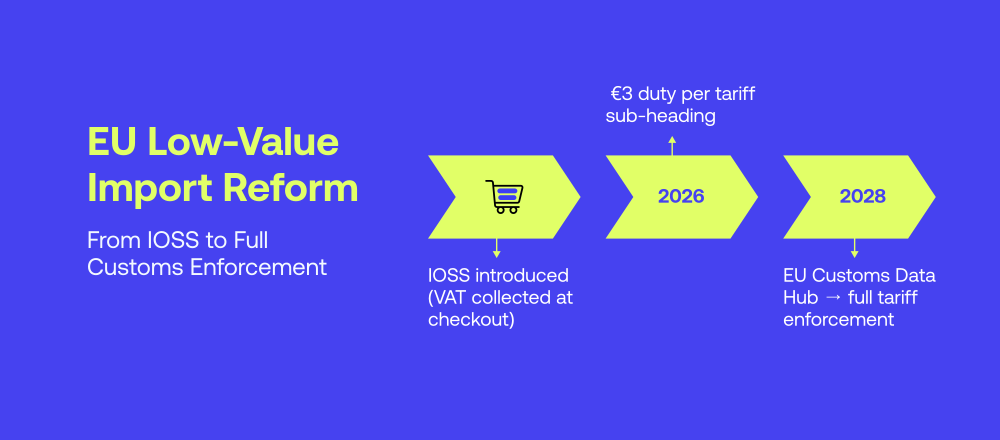
Prior to July 2021, imports under €22 were fully exempt from VAT and customs duty. Although VAT exemption was removed and replaced with IOSS, customs duty exemption under €150 remained. The €3 duty rule introduces structured duty exposure for low-value imports, making tariff classification accuracy operationally critical for logistics providers.
Because logistics providers submit the official EU customs declaration, they become responsible for the regulatory outcome. When pricing assumptions underestimate tariff complexity, logistics providers must explain duty outcomes, resolve disputes, and ensure compliance accuracy. This establishes logistics providers customs liability EU imports as a core operational responsibility, not simply an administrative function.
Why EU Import Pricing Errors Will Increase After the €3 Customs Duty Rule Begins
The €3 duty rule introduces a fixed fiscal consequence per tariff sub-heading, making product classification structure directly determine duty exposure. Previously, duty exemptions masked classification inaccuracies. After July 2026, each tariff sub-heading generates a measurable duty obligation, exposing structural differences between seller pricing assumptions and customs enforcement logic.
This shift does not change how sellers price goods immediately. Instead, it exposes inaccuracies during customs clearance. As a result, EU import pricing errors and customs duty exposure will increasingly surface operationally, forcing freight forwarders and logistics providers to manage disputes, explain duty calculations, and ensure customs declaration accuracy.
Seller Pricing Logic and Customs Duty Determination Operate Independently
Seller checkout pricing reflects commercial optimisation, not regulatory duty calculation. Customs duty is determined by tariff classification customs duty EU logic, based on item classification codes (HS and HTS codes) assigned during declaration. This distinction is fundamental to understanding logistics provider responsibility.
Key Differences Between Seller Pricing and Customs Duty Determination
| Seller Pricing Model | EU Customs Duty Determination Model |
| Based on commercial product grouping | Based on formal tariff sub-heading classification |
| Optimised for conversion and competitiveness | Optimised for regulatory compliance |
| Controlled by seller or marketplace systems | Controlled by customs declaration submitted during clearance |
| Assumes simplified duty outcomes | Applies classification-based duty calculation |
Because logistics providers submit customs declarations, they become responsible for operationalising goods classification logic and ensuring declaration accuracy.
Product Classification Now Directly Controls Duty Outcomes
Under the €3 EU import duty rule, goods classification depth directly determines customs duty exposure. This makes product classification accuracy operationally critical for logistics providers managing EU imports.
How Product Classification Structure Changes Customs Duty
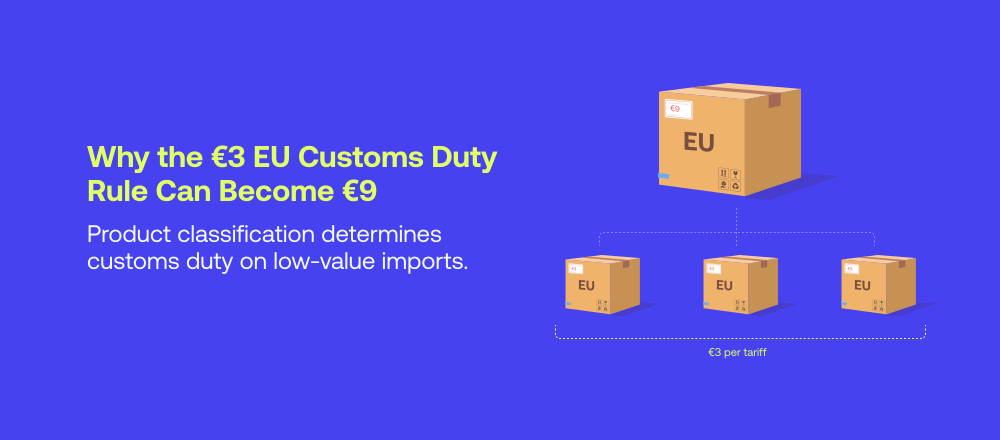
After 1st July 2026, a parcel declared as a single accessory by the seller may be classified into multiple (three) tariff sub-headings during customs declaration. This increases duty from €3 to €9. Logistics providers must explain and justify this difference, even though they did not determine the seller’s original pricing.
| Shipment Description | Tariff Sub-Headings | Customs Duty Outcome |
| Single electronic accessory | 1 | €3 |
| Electronic bundle containing charger, cable, and accessory | 3 | €9 |
From a seller perspective, this is one product bundle. From a customs perspective, it represents multiple classification units, increasing duty liability managed by logistics providers.
Logistics Providers Become the Last Line of Defence in EU Customs Compliance
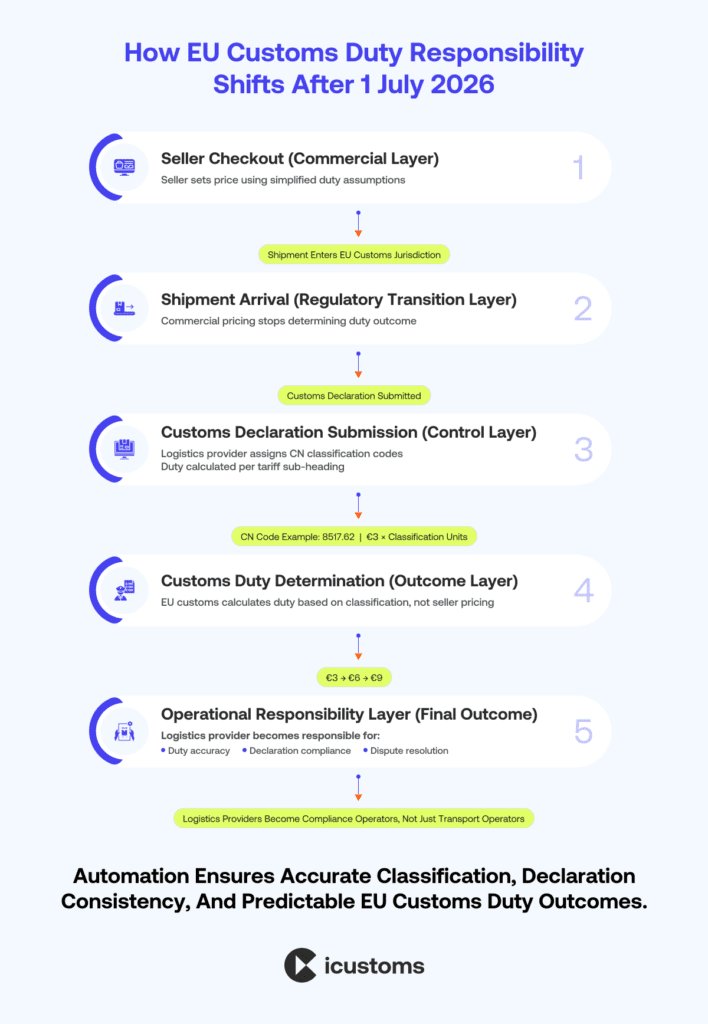
Customs authorities rely entirely on the import declaration submitted during clearance to calculate duty and validate compliance. This establishes logistics providers as the final compliance checkpoint between commercial product data and regulatory enforcement.
When duty outcomes differ from seller expectations, logistics providers must:
- Interpret tariff classification logic
- Verify classification accuracy
- Respond to customs validation queries
- Resolve declaration discrepancies
This transforms logistics providers from administrative facilitators into operational compliance operators responsible for ensuring customs declaration integrity.
Delivered Duty Paid and Delivered Duty Unpaid Determine Who Inherits Pricing Risk
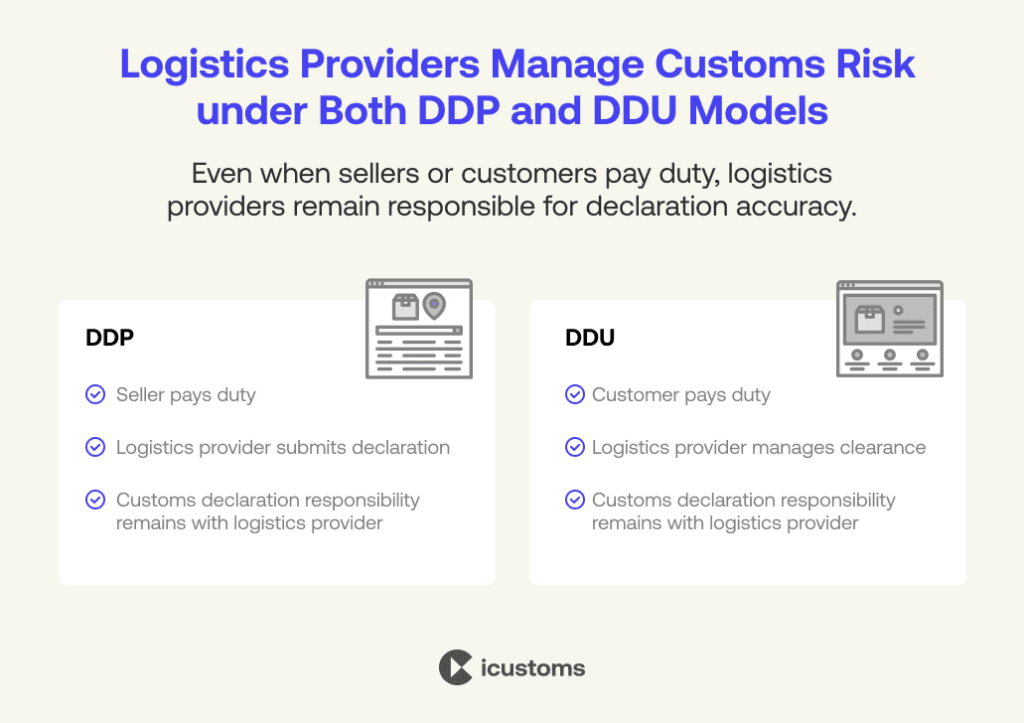
The choice between Delivered Duty Paid (DDP) and Delivered Duty Unpaid (DDU) determines financial liability, but logistics providers remain operationally responsible for managing customs clearance under both models.
Delivered Duty Paid Transfers Financial Liability to the Seller
Under Delivered Duty Paid, the seller pays customs duty and VAT before delivery. This creates a predictable customer experience but does not eliminate compliance responsibility for logistics providers.
Logistics providers must still:
- Submit accurate customs declarations
- Assign correct tariff classification codes (HS and HTS)
- Calculate duty exposure based on classification
- Resolve declaration discrepancies when duty differs from seller assumptions
Customs declaration service software plays a critical role in ensuring item classification accuracy and preventing duty miscalculation.
Delivered Duty Unpaid Transfers Financial Liability to the Customer
Under Delivered Duty Unpaid, the customer pays customs duty upon import. While this shifts financial liability to the customer, logistics providers remain responsible for declaration accuracy and clearance processing.
Operational challenges include:
- Managing customer disputes related to unexpected duty charges
- Resolving clearance delays caused by classification discrepancies
- Ensuring declaration compliance with EU customs requirements
Regardless of payment responsibility, logistics providers must ensure declaration accuracy and regulatory compliance.
Customs Declarations Legally Establish Duty Liability
The customs declaration becomes the official legal record used by EU customs authorities to determine duty exposure and validate regulatory compliance. Customs authorities do not rely on seller checkout pricing. They rely entirely on the structured data submitted during declaration.
This means classification accuracy directly determines:
- Duty calculation
- Clearance approval
- Compliance validation
- Audit traceability
Logistics providers must ensure structured declaration accuracy because declaration data determines regulatory outcomes.
Common EU Customs Import Duty Calculation Errors Affecting Logistics Providers
When customs duty exceeds seller expectations, logistics providers become the first operational point of escalation. Sellers and customers contact logistics providers because they control declaration submission and customs clearance processes.
Operational scenarios that trigger customs duty discrepancies
- Sellers underestimate classification complexity
- Marketplace product descriptions lack technical precision
- Bundled shipments contain multiple classification units
- Incorrect assumptions about duty exemption eligibility
These scenarios require logistics providers to resolve declaration discrepancies while maintaining compliance integrity.
Product Classification Accuracy Is Now a Core Logistics Compliance Requirement
Product classification accuracy now directly determines duty exposure, import clearance speed, and regulatory compliance outcomes. Under the €3 customs duty rule, classification inconsistency creates measurable operational consequences for logistics providers managing EU imports.
Maintaining consistent tariff classification enables logistics providers to ensure EU customs compliance, reduce duty variability, and deliver predictable and defensible clearance outcomes. Accurate classification also reduces validation queries and improves regulatory alignment.
Classification Inconsistency Creates Measurable Operational and Financial Risk
Classification inconsistency introduces operational uncertainty and increases regulatory scrutiny. Logistics providers must maintain classification consistency to ensure operational stability. Operational risks created by classification inconsistency:
- Increased customs duty exposure
- Clearance delays caused by customs validation queries
- Increased operational workload resolving disputes
- Increased regulatory scrutiny under EU enforcement systems
Maintaining structured classification consistency reduces these risks and improves clearance predictability.
ICS2 and the EU Customs Data Hub Will Increase Logistics Provider Accountability
The EU is implementing centralised enforcement systems including ICS2 and the EU Customs Data Hub. These systems analyse declaration data, items classification codes, and shipment information across multiple filings.
This enables customs authorities to detect classification inconsistencies, declaration discrepancies, and compliance risks using structured data analysis.
Regulatory Systems That Require Consistent Import Data
The following systems rely on accurate and structured declaration data:
- Entry Summary Declarations submitted under ICS2
- Import declarations submitted to customs authorities
- VAT and IOSS reporting references
- EU Customs Data Hub risk analysis systems
Logistics providers must ensure consistent data alignment across these systems to maintain compliance.
CBAM Expands Logistics Provider Responsibility beyond Customs Duty
The Carbon Border Adjustment Mechanism demonstrates how import compliance is expanding beyond traditional customs duty enforcement. CBAM requires structured import declaration data to support carbon emissions reporting and regulatory compliance.
Because CBAM relies on customs declaration data, classification accuracy and declaration consistency now influence both customs compliance and carbon reporting requirements simultaneously. This transforms customs declaration data into critical regulatory infrastructure.
Manual Customs Filing Cannot Sustain Post-2026 Import Volumes
Manual customs declaration processes were designed for lower volumes and simplified duty structures. Under the €3 duty rule, classification depth directly affects duty exposure. Manual filing introduces inconsistency, operational risk, and financial unpredictability. Automation becomes essential infrastructure rather than optional efficiency.
Automation Is Becoming Essential for Managing Customs Compliance at Scale
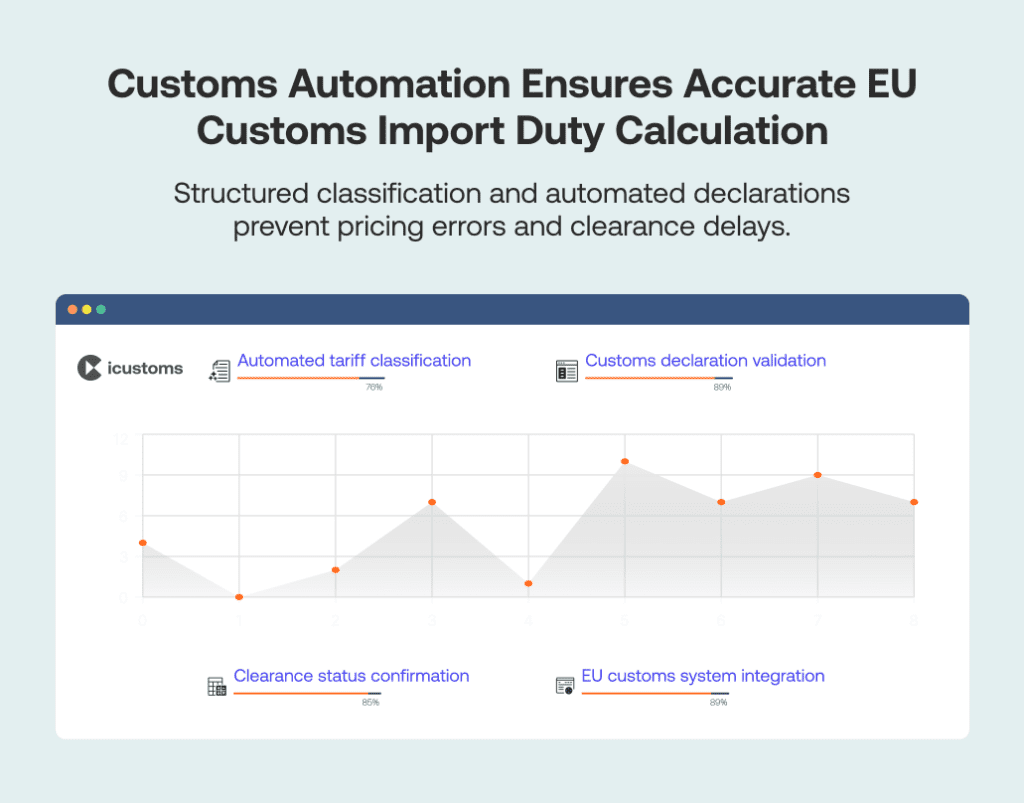
Manual declaration processes cause goods classification issues and compliance risk. Automation enables structured classification consistency and improves declaration accuracy.
Automated declaration systems support:
Consistent tariff classification
Structured declaration creation
Audit traceability
Regulatory compliance validation
Automation enables logistics providers to maintain compliance accuracy and operational efficiency at scale.
Compliance Benefits of Customs Automation for Logistics Providers
Automation provides measurable operational benefits:
Consistent tariff classification across shipments
Reduced duty variability and pricing disputes
Improved customs clearance speed and predictability
Structured audit trail supporting regulatory compliance
Automation ensures declaration accuracy and reduces operational risk.
Conclusion: Logistics Providers Are Becoming EU Customs Compliance Infrastructure
The €3 EU customs duty rule shifts duty determination from seller pricing to tariff classification and customs declaration accuracy. This exposes classification inconsistencies previously hidden under the €150 duty exemption. As enforcement expands through ICS2, the EU Customs Data Hub, and CBAM, logistics providers submitting declarations are now responsible for ensuring accurate duty calculation and EU customs compliance.
Why Automated Customs Infrastructure Is Now Essential for Logistics Providers
Maintaining classification consistency and declaration accuracy manually is unreliable at scale. Fragmented product data and classification variability increase duty exposure, trigger clearance delays, and elevate regulatory risk for logistics providers.
iCustoms provides automated customs infrastructure through AI-driven classification, Intelligent Document Processing, and automated declaration software, ensuring accurate duty calculation and compliant submissions. Direct integration via API, EDI, and AS4 protocols enables faster clearance, reduced duty errors, and audit-ready compliance across EU import operations.

Eliminate €3 Customs Duty Classification Risk
Automate tariff classification, ensure code accuracy, and maintain compliant EU declarations under the €3 duty rule.
Frequently Asked Questions
How to accurately calculate customs duty on EU imports?
To accurately calculate EU customs import duty, you must determine the correct tariff classification code (HS and CN code), customs value, and origin of goods. Under the €3 customs duty rule effective 1 July 2026, duty is applied per tariff sub-heading, not per parcel. This means each classification unit creates a separate duty obligation.
Manual calculation increases the risk of classification errors and incorrect duty exposure. iCustoms automates tariff classification, validates customs declaration data, and calculates duty accurately, ensuring compliance and preventing unexpected duty discrepancies.
Is customs duty the same as import tax?
No. Customs duty and import tax are different regulatory charges.
- Customs duty is calculated based on tariff classification, origin, and customs value.
- Import tax (VAT) is calculated based on the total value of goods, including duty and transport costs.
IOSS simplifies VAT collection but does not eliminate customs duty obligations. iCustoms ensures both duty calculation accuracy and declaration compliance, preventing misalignment between VAT and customs filings.
How Delivered Duty Paid (DDP) affects logistics providers after 1 July 2026?
Under Delivered Duty Paid (DDP), the seller pays customs duty and VAT before delivery. However, freight forwarders remain responsible for submitting accurate customs declarations and ensuring correct duty calculation.
If duty is underestimated due to incorrect tariff classification, logistics providers must resolve declaration discrepancies and ensure compliance. iCustoms declaration automation software ensures accurate duty calculation and classification consistency, preventing DDP-related pricing disputes and clearance delays.
How can iCustoms help avoid customs duty calculation errors after 1 July 2026?
After 1 July 2026, duty exposure depends on tariff classification structure. Incorrect classification can multiply duty exposure and create pricing disputes.
iCustoms prevents duty calculation errors through:
- AI-powered tariff classification validation
- Automated customs duty calculation
- Structured customs declaration generation
- Real-time compliance validation
This ensures accurate customs declarations, predictable duty outcomes, and regulatory compliance.
How does customs automation software reduce customs calculation errors?
Customs automation software eliminates manual classification inconsistencies and declaration errors by standardising customs data processing.
iCustoms automation provides:
- Consistent tariff classification across shipments
- Accurate duty calculation based on classification structure
- Automated declaration validation
- Structured audit trail for compliance verification
This reduces duty miscalculation risk and improves clearance predictability.
How can manual customs declaration damage brand reputation after 1 July 2026?
Manual customs declaration increases the risk of duty miscalculation, clearance delays, and customer disputes. When duty charged at import differs from seller pricing, customers often blame logistics providers and retailers.
After the €3 duty rule begins, classification errors directly increase duty exposure. iCustoms automation ensures declaration accuracy and duty predictability, protecting brand reputation and preventing customer disputes.
What is tariff classification per heading for EU imports?
Tariff classification assigns a structured code to each product based on the EU Combined Nomenclature system. Each tariff sub-heading determines customs duty treatment.
Under the €3 duty rule, duty applies per tariff sub-heading, meaning multi-component shipments generate multiple duty charges. iCustoms AI-powered classification software ensures accurate tariff classification, preventing classification errors and unnecessary duty exposure.
What is the €3 EU customs duty rule and how does it impact freight forwarders?
From 1 July 2026, a €3 customs duty applies to each tariff sub-heading in consignments valued at €150 or below. This increases classification sensitivity and duty exposure.
Freight forwarders become responsible for submitting accurate declarations and explaining duty outcomes when classification affects duty exposure.
iCustoms enables freight forwarders to automate classification and declaration processes, ensuring compliance and predictable duty calculation.
How does IOSS help reduce customs declaration errors for low-value imports?
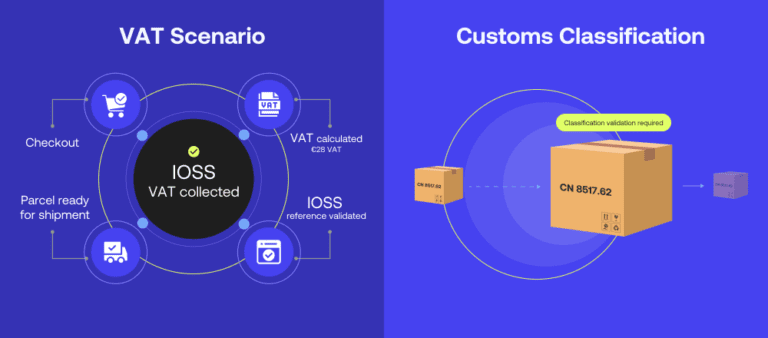
IOSS simplifies VAT reporting by allowing sellers to collect VAT at checkout and submit a single monthly return. However, IOSS does not determine customs duty.
Customs duty is calculated separately based on tariff classification and declaration data. iCustoms ensures accurate customs declaration alignment with IOSS data, preventing declaration discrepancies and clearance delays.
How does Intelligent Document Processing improve customs declaration accuracy?
Intelligent Document Processing extracts structured customs data directly from commercial invoices and shipping documents.
iCustoms Intelligent Document Processing provides:
- Automated extraction of product descriptions
- Classification-ready customs data formatting
- Validation of declaration consistency
- Reduced manual data entry errors
This enables highly accurate customs declaration submission and improves compliance reliability.
What is the importance of customs automation under the €3 EU customs duty rule?
The €3 duty rule increases sensitivity to classification accuracy. Manual classification inconsistency can multiply duty exposure and create operational risk.
Customs automation ensures:
- Consistent tariff classification
- Accurate duty calculation
- Faster clearance processing
- Reduced compliance risk
iCustoms automation enables logistics providers to maintain compliance accuracy and prevent duty calculation errors at scale.
How does iCustoms product classification software using API, EDI, and AS4 improve customs clearance?
iCustoms integrates directly with customs authorities and logistics systems using API, EDI, and AS4 protocols, enabling automated and structured declaration submission.
This provides:
- Real-time classification validation
- Automated customs declaration submission
- Faster clearance processing
- Reduced declaration errors
This integration ensures accurate duty calculation, prevents pricing discrepancies, and improves customs clearance efficiency.
You may also like:
Struggling to Extract, Catagorise & Validate Your Documents?

Capture & Upload Data in Seconds with AI & Machine Learning
Subscribe to our Newsletter
About iCustoms
iCustoms is an all-in-one solution helping businesses automate customs processes more efficiently. With AI-powered and machine-learning capabilities, iCustoms is designed to streamline your all customs procedures in a few minutes, cut additional costs and save time.
Struggling to Extract, Catagorise & Validate Your Documents?
Capture & Upload Data in Seconds with AI & Machine Learning