Import One Stop Shop Update: How Multiple Commodity Codes Increase EU Customs Charges

The €3 customs duty per tariff heading is no longer theoretical. From 1 July 2026, the Import One Stop Shop Update will apply it to low-value parcels under €150 declared through IOSS. EU customs reforms shift duty exposure from parcel value to commodity code depth, increasing compliance pressure on freight forwarders and hauliers that rely on manual classification.

Parcels containing multiple commodity codes face separate €3 charges per CN or TARIC heading, raising costs and clearance complexity for e-commerce operators, customs brokers, and 3PL warehouses. Although aimed at B2C e-commerce, the impact extends to cross-border B2B logistics and consolidators.

The EU Customs Union now prioritises precise commodity code declaration, structured VAT processing under IOSS, and national handling fee integration, accelerating a shift toward data-driven customs enforcement where AI-supported classification protects compliance, reduces delays, and preserves margins.

IOSS Update is Structural Shift From Value-Based Control to Classification-Based Duty

The IOSS Update introduces a flat €3 charge per tariff sub-heading for low-value consignments, shifting customs supervision from parcel value to product classification depth. Duty exposure now depends on declared commodity codes rather than simplified value thresholds used previously.

Under IOSS, VAT is collected at checkout while customs duty is assessed separately at clearance. This creates a new risk variable, the number of tariff headings within one parcel, making classification accuracy central to compliance.

As the European Commission has repeatedly emphasised in its customs reform communications, the future model is built around “data-driven risk management and harmonised digital enforcement across Member States.” In that environment, items classification inconsistency becomes visible immediately.
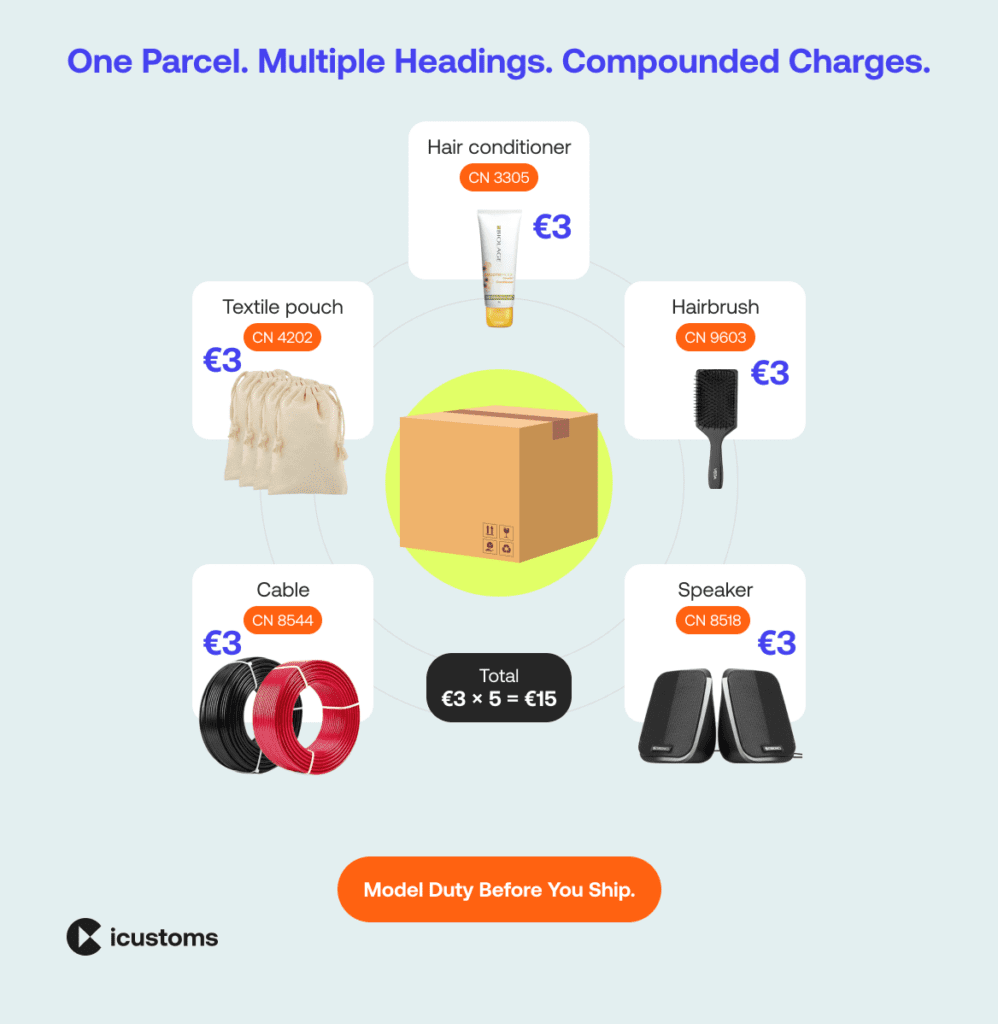
Why Multiple Commodity Codes Multiply €3 Customs Charges

The €3 rule applies per tariff sub-heading, not per shipment or per parcel. For consignments not exceeding €150 under the reformed low-value regime, a single parcel containing goods classified under two or three different CN codes may incur multiple €3 charges, even when the total intrinsic value remains below the threshold.

For logistics providers, this introduces three operational pressures:

  1. Duty calculation must align precisely with classification depth.
  2. IOSS VAT reporting must remain consistent with customs declarations.
  3. Unexpected duty multiplication can trigger disputes with sellers and marketplaces.

Accurate classification therefore becomes critical. Where goods are incorrectly fragmented across multiple tariff sub-headings, duty exposure may be artificially multiplied. In certain circumstances, composite goods or sets may lawfully qualify for single-heading treatment under the General Rules for the Interpretation of the Harmonised System.

AI-supported validation helps ensure interpretative rules are applied consistently and defensibly, reducing the risk of both overpayment and underpayment while maintaining full regulatory compliance. The following examples illustrate how this plays out in practice.

Example 1: Two Commodity Codes in One Parcel

Consider a beauty subscription box shipped under IOSS with an intrinsic value of €120.

Contents:

  • Hair conditioner (CN 3305)
  • Plastic hairbrush (CN 9603)

Although marketed as one “haircare kit,” customs authorities assess two separate tariff headings.

Duty calculation:

  • €3 for CN 3305
  • €3 for CN 9603

Total duty: €6

From a commercial perspective, this is one product bundle. From a customs perspective, it contains two fiscal classification units.

“In simulation models across our customer base, multi-SKU consignments consistently generate higher duty exposure than expected. Businesses that systemise classification early will protect both margin and delivery reliability.”
Freya Jane, Director of Customer Success, iCustoms.ai

Example 2: Three Commodity Codes in a Lifestyle Bundle

A consumer electronics bundle valued at €145 includes:

  • Bluetooth speaker (CN 8518)
  • USB charging cable (CN 8544)
  • Protective textile pouch (CN 4202)

Each item falls under a separate commodity code.

Duty calculation:

  • €3 × 3 headings = €9

If classification errors occur, additional trade defence measures or anti-dumping provisions could also apply depending on TARIC precision. IOSS VAT may be correctly collected, yet customs duty multiplies at clearance.

Example 3: Five Commodity Codes in a Promotional Gift Set

A promotional wellness hamper shipped under IOSS includes:

  • Herbal tea (CN 0902)
  • Ceramic mug (CN 6912)
  • Stainless steel spoon (CN 8215)
  • Cotton napkin (CN 6302)
  • Cardboard packaging with retail design (CN 4819)

Five tariff headings exist within one parcel.

Duty exposure:

  • €3 × 5 = €15

If shipped to Romania, an additional €5 national handling fee applies.
Total potential customs-related charges: €20

For a parcel valued at €150 or less, this significantly alters landed cost assumptions.

National Handling Fees Compound the Risk

Beyond the EU-wide €3 duty, certain Member States are introducing national levies.

Romania has enforced a €5 per parcel handling fee on low-value consignments. Italy applies a €2 customs administrative levy. France has proposed similar measures. The Netherlands is evaluating implementation pending system upgrades.

These fees apply in addition to the €3 per tariff sub-heading rule with different commodity codes in a single parcel. For logistics operators, this means that commodity code multiplication combined with national charges can materially increase clearance costs.

This environment reinforces the need for precise commodity code governance at declaration level.

IOSS Simplifies VAT, Not Customs Liability

IOSS remains an effective VAT simplification tool. It prevents VAT-at-door charges and improves delivery experience. However, it does not override customs classification requirements.

Under the post-2026 model:

  • IOSS governs VAT collection.
  • Commodity codes govern customs duty.
  • TARIC precision governs enforcement measures.

As the World Customs Organization has emphasised in its digital transformation framework, “structured and accurate data is the foundation of modern customs control.” When IOSS data and customs declaration data diverge, automated systems trigger validation queries.

For freight forwarders and brokers, this means that VAT compliance alone does not ensure smooth clearance.

How Product Misclassification Damages Brand and Operational Stability

Product misclassification under the €3 rule creates more than fiscal discrepancies. It creates reputational risk.

When duty exceeds seller expectations:

  • Customers blame the carrier.
  • Marketplaces question compliance accuracy.
  • Clearance delays increase operational workload.

Repeated inconsistencies may trigger enhanced customs scrutiny under ICS2 and the EU Customs Data Hub.

In a centralised enforcement environment, repeated classification variance becomes a measurable compliance indicator. As intelligence-led customs systems expand, structured accuracy becomes competitive advantage.

Why Product Classification Logic Must Be Systemised for IOSS Parcels

Manual product classification or spreadsheet-based commodity code management is no longer scalable. CN (Combined Nomenclature) codes update annually with major changes every 5-year. TARIC measures change dynamically. Anti-dumping provisions shift with trade policy.

For B2B logistics operators handling thousands of IOSS parcels daily, classification governance must be automated.

Systemised classification enables:

  • Pre-clearance validation of commodity codes
  • Automated detection of multi-heading bundles
  • Duty forecasting before shipment dispatch
  • Alignment between IOSS VAT reporting and customs declaration data

Accurate classification reduces workload. It prevents disputes. It accelerates clearance.

Automation as the Operational Control Layer

Automation in customs is not about speed alone. It is about consistency, traceability, and regulatory confidence. AI-driven commodity code validation ensures that:

  • 8-digit CN codes are correctly assigned
  • 10-digit TARIC codes activate applicable measures
  • Duty exposure per sub-heading is calculated pre-departure
  • ENS and import declarations remain aligned

Through secure API, EDI, and AS4 protocol integration, structured data flows directly between logistics systems and customs authorities. This ensures encrypted, interoperable, and audit-traceable compliance infrastructure across jurisdictions.

For IOSS consignments, this is particularly critical because VAT centralisation must coexist with duty multiplication logic.

Strategic Outlook: Bundling Strategy Is Now a Customs Decision

E-commerce sellers frequently bundle products for marketing purposes. After July 2026, bundling becomes a customs exposure variable.

Brokers and forwarders must assess:

  • Does this parcel contain multiple commodity codes?
  • Can classification be consolidated legally?
  • Is duty multiplication reflected in DDP pricing?
  • Are national handling fees applicable?

In many cases, restructuring packaging or separating shipments may reduce duty multiplication. Customs strategy now intersects with supply chain design.

Conclusion: IOSS Requires Structured Commodity Code Governance after July 2026

After July 2026:

  • IOSS centralises VAT.
  • Commodity codes determine duty multiplication.
  • TARIC precision activates enforcement measures.
  • National handling fees compound exposure.

In a €3 per tariff sub-heading environment, a single parcel can generate €6, €9, or €15 in duty before additional national charges apply. Classification depth is now a fiscal control lever.

For logistics providers, hauliers, and freight forwarders managing high-volume IOSS consignments, structured commodity code governance becomes compliance infrastructure.

How iCustoms Enables Scalable IOSS + Duty Accuracy

At iCustoms, classification is treated as a systemised compliance layer, not a clerical input.

Our AI-driven iClassification engine:

  • Detects multi-heading bundle exposure
  • Validates CN and TARIC codes in real time
  • Calculates duty per sub-heading before clearance
  • Aligns IOSS VAT references with customs declarations
  • Integrates with 200+ platforms and 8+ customs systems

Through secure API, EDI, and AS4 connectivity, iCustoms ensures interoperable and encrypted data exchange with customs authorities, marketplaces, ERPs, and carrier systems.

Enterprise-Grade Security and Quality Assurance Framework

Backed by ISO 27001 and ISO 9001 certification, iCustoms provides structured, audit-ready customs automation designed for the evolving EU enforcement landscape.

As the EU Customs Data Hub approaches 2028 implementation, classification inconsistency will become increasingly visible. Businesses that systemise commodity code governance will operate predictably. Those that rely on manual processes will experience multiplied duty exposure, validation queries, and reputational friction.

Let iCustoms secure your IOSS workflow against hidden duty multiplication.
Build a compliant, scalable, and future-ready EU customs operation today.

What is the €3 customs charge introduced for low-value imports under IOSS from July 2026?

From 1 July 2026, EU low-value import reform applies a flat €3 customs charge per CN tariff subheading for consignments under €150, including parcels declared through IOSS. The charge is classification-based, not value-based.

Does the €3 charge apply per parcel, per product, or per tariff code?

The €3 customs charge applies per CN tariff subheading declared in the customs entry. It is not calculated per parcel or product count. Multiple classification headings within one parcel multiply total duty exposure.

Does IOSS remove customs duty for goods under €150?

No. IOSS simplifies VAT collection through centralised monthly reporting but does not eliminate customs duties. From July 2026, low-value consignments may still incur €3 per CN subheading despite VAT being prepaid.

Why can multiple commodity codes in one parcel increase total customs charges?

Parcels containing goods classified under multiple CN tariff headings incur separate €3 charges per subheading. EU customs systems calculate duties based on classification depth rather than bundled packaging or retail product grouping.

What is the Combined Nomenclature and why does it matter for the €3 rule?

The EU Combined Nomenclature is an 8-digit goods classification system derived from the Harmonized System. Under the 2026 low-value reform, each CN subheading declared can trigger a separate €3 customs charge.

Can bundled or composite goods be classified under one tariff heading?

Composite goods or retail sets may qualify for a single tariff heading under Harmonized System interpretation rules if essential character criteria are met. Artificial grouping is prohibited, and incorrect consolidation may trigger multiple CN-based charges.

What happens if goods are misclassified under the new €3 regime?

Misclassification may cause duty overpayment, underpayment, or incorrect tariff treatment. Under ICS2 controls and EU Customs Data Hub oversight, repeated inconsistencies can trigger inspections, post-clearance recovery, financial penalties, and compliance risk.

Do national administrative or handling fees apply in addition to the €3 charge?

Some EU Member States apply additional administrative or handling fees for low-value imports. These charges may be imposed alongside the €3 per CN subheading customs fee, increasing total landed cost exposure.

How do TARIC codes relate to CN codes in low-value imports?

CN codes form the EU’s 8-digit base classification for customs declarations. TARIC extends CN to 10 digits, activating EU measures such as trade defence duties, quotas, or suspensions beyond the flat €3 classification charge.

How can freight forwarders assess their exposure before July 2026?

Freight forwarders should audit historical customs declaration data to identify multi-SKU parcels containing multiple CN subheadings. Exposure modelling helps forecast €3 charge multiplication, supporting pricing adjustments and improved classification governance.

Why is classification governance becoming more important after July 2026?

EU reforms shift low-value customs exposure from value thresholds to classification triggers. Digital enforcement through ICS2 and the EU Customs Data Hub increases visibility of inconsistent CN declarations, requiring structured classification governance.

Can packaging or bundling strategy affect customs exposure after July 2026?

Yes. Combining products with different tariff classifications into one parcel may increase €3 per CN subheading charges. Businesses should align SKU grouping, packaging strategy, and customs classification logic for IOSS consignments.

How does iCustoms.ai help manage €3 per tariff sub-heading exposure after July 2026?

iCustoms.ai uses AI-driven product classification to validate CN and TARIC codes, detect multi-heading parcels, and model €3 duty exposure before shipment. It aligns IOSS VAT data with customs declarations to prevent cost surprises.

Why is AI classification governance important under ICS2 and the EU Customs Data Hub?

Centralised EU customs enforcement increases detection of inconsistent declarations across Member States. AI-driven classification governance ensures audit trails, reduces validation errors, prevents duty miscalculation, and supports scalable compliance in high-volume IOSS trade.

What does ISO 27001 and ISO 9001 certification mean for iCustoms.ai clients?

ISO 27001 certification confirms internationally recognised information security controls. ISO 9001 ensures structured quality management and process consistency. Together, they provide secure data handling, operational reliability, and audit-ready digital customs compliance infrastructure.

iCustoms watch a demo

Stop €3 Duty Multiplication Before It Starts

Use AI classification to detect multi-code parcels and prevent unexpected EU customs charges.

You may also like:

Struggling to Extract, Catagorise & Validate Your Documents?

iDP Icon

Capture & Upload Data in Seconds with AI & Machine Learning

Subscribe to our Newsletter

About iCustoms

iCustoms is an all-in-one solution helping businesses automate customs processes more efficiently. With AI-powered and machine-learning capabilities, iCustoms is designed to streamline your all customs procedures in a few minutes, cut additional costs and save time.

Struggling to Extract, Catagorise & Validate Your Documents?

iDP Icon

Capture & Upload Data in Seconds with AI & Machine Learning