

Understanding the Difference: Harmonised System Code vs Harmonised Tariff Schedule
-
 Freya Jane
- Director of Customer's Success
International trade thrives in the linked world of today, enabling the trading of goods and services worth about $28.7 trillion USD yearly. To facilitate the seamless movement of this enormous quantity of goods across international boundaries, a uniform method for product classification is needed. This is where the harmonised system and harmonised tariff schedule step in.
The harmonised system of coding used to classify internationally traded goods plays a crucial role in streamlining cross-border transactions. However, things can become complicated when terminology like HTS code and HS code are used interchangeably, creating confusion among importers and exporters. Fear not, this blog will serve as your guide, clarifying the differences between HS and HTS codes and outlining their functions in the context of global trade.
What are HS codes?
A harmonised system code (HS code) is a standardised numerical system for classifying internationally traded goods. These codes are managed by the World Customs Organisation (WCO) and are currently in its 6th edition, i.e., 2022.
Structure and purpose
Heading and subheading: The HS system contains more than 5,000 headings and subheadings.
Classification: Each item is issued a unique six-digit code based on its type, composition, and intended purpose.
Breakdown of the code
Chapter: Initial 2 digits
Function: Broadly provide information about the goods.
Examples
Chapter 84: Machines and mechanical appliances
Chapter 85: Electrical machinery and equipment
Heading and subheading: Last 4 digits
Function: These digits provide detailed information about the material, function, and manufacturing procedure of the goods.
Example:
HS code 8414.90 means “air or vacuum pumps, air or other gas compressors, and fans; ventilating or recycling hoods incorporating a fan, whether or not fitted with filters.”
Curious to learn more about HS codes?
Read our guide: HS Code: A Comprehensive Guide for Importers and Exporters
What are HTS codes?
The Harmonised Tariff Schedule Code (HTS) is a further extension of the HS code that is specific to each country. It consists of a 6-digits HS code and an additional four digits that provide more detailed information about taxes and duties applied to each product. The additional digits may vary from country to country; for instance, the EU uses an 8-digit HTS code, while the US uses a 10-digit code.
Purpose
HTS code helps customs officials calculate the accurate amount of taxes and duties for every shipment. It is also used to determine any specific regulations or restrictions that apply to certain goods; for instance, to import some products, you need to obtain a permit or licence.
How is the HTS code different from the Schedule B code?
Although the Schedule B codes are a subset of the HTS codes, they are different from each other. Harmonised Tariff Schedule codes are used to classify goods for imports, while Schedule B codes classify exports.
Harmonised system code vs. harmonised tariff schedule
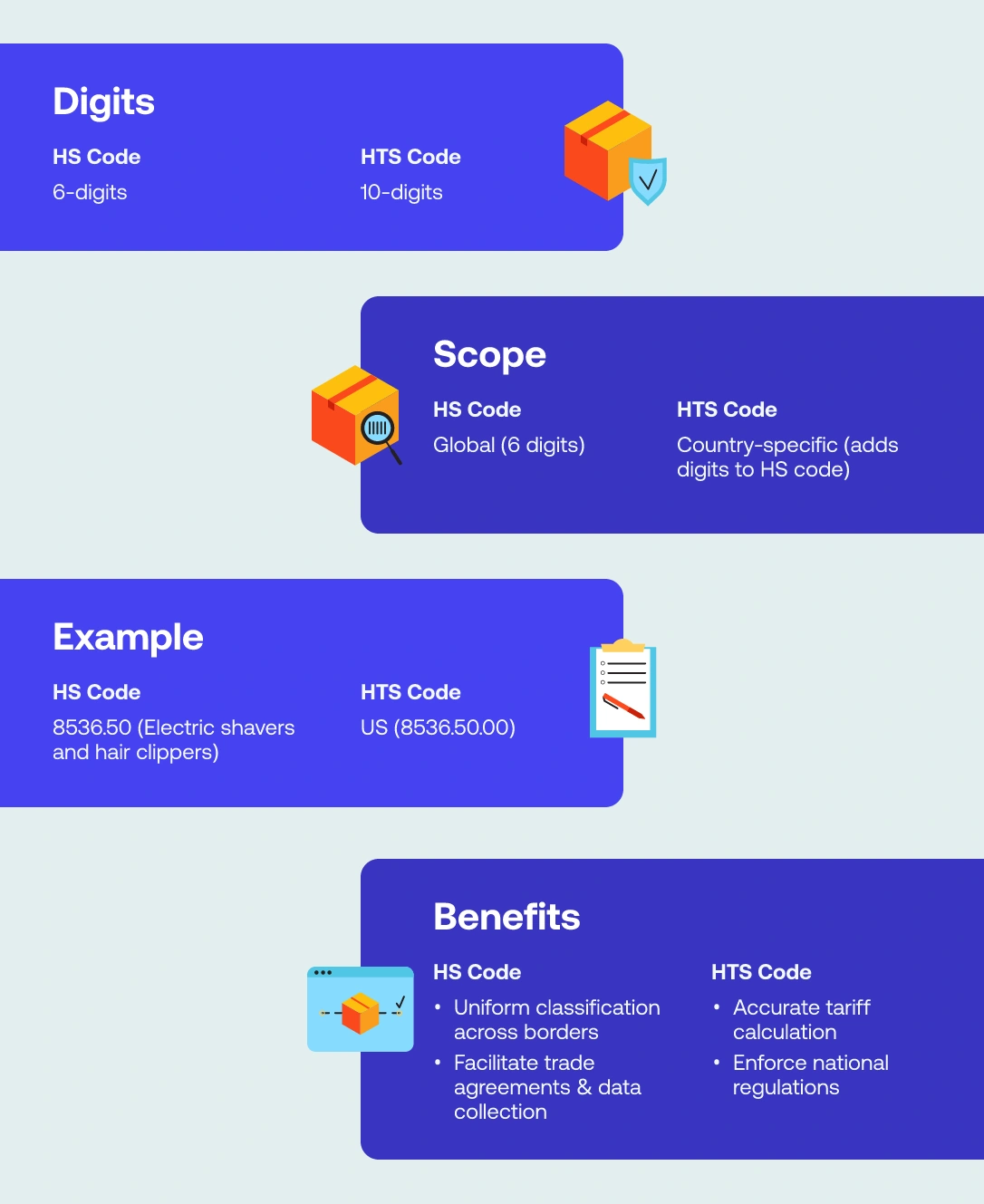
Both HS codes and HTS codes are used to classify traded goods, but they operate at different levels. The HS code is an internationally standardised 6-digit code managed by the World Customs Organization (WCO) and used by more than 200 countries as the shared foundation for product classification. The HTS code is a country-specific extension of that foundation, adding national digits to set tariff rates, enforce trade regulations, and collect detailed statistical data.
In practical terms: when goods cross any international border, the HS code determines what the product is. When goods enter a specific country, the national HTS code determines what the importer pays and what rules apply.
1. Global HS Code vs. Country-Specific HTS Systems
HS Code
Global standard: The HS code system is a globally recognised system maintained by the World Customs Organisation (WCO). By describing goods in a standardised language, it promotes international trade.
Uniform classification: More than 200 economies and countries utilise HS codes, which facilitate international communication about goods in trade agreements, trade data, and customs paperwork.
HTS Code
Country-specific: An expansion of the HS code that is specific to a given country is the HTS code. It has more digits than the first six that the HS code provides, enabling a more precise and in-depth classification that is necessary for national objectives.
Unique schedules: Every country creates a different tariff schedule on the basis of the HS code by adding extra digits to meet specific national requirements. Tariffs and levies on imported items are set using these schedules.
2. HS vs. HTS: Structure and Digits
HS code
6-digit system: This system is used to categorise commodities according to their intended application, composition, and type. This regulated system aids in the uniform classification of goods by customs agencies worldwide.
Division of the Digits:
The first two digits represent the chapter, which classifies products generally according to their nature (e.g., machinery, textiles).
The next two numerals, which represent the heading, provide more specific information about the item falling under that category.
The last two digits are called subheading, which provides even more specific information about the product.
HTS Code
Extended digits: The HTS code adds additional, nation-specific digits to the six-digit HS code. These enhancements make it possible to classify more precisely in order to comply with national tariff and regulation requirements.
Examples of extensions:
The HTS code is ten digits long in the United States. The 7th and 8th digits indicate additional subheadings that further define the products, while the ninth and tenth digits offer more national-level detail.
The seventh and eighth digits of the eight-digit code used by the European Union provide specificity within the context of the unified customs tariff.
3. HS vs. HTS: Purpose and application
HS code
- Product identification: In international trade, the HS code acts as a common language for product identification. This customs tariff classification guarantees that goods are consistently categorised across borders, promoting efficient trade operations.
- Trade data collection: In order to gather and analyse trade data, HS codes are necessary. They support governments and international organisations in keeping an eye on cross-border goods movements, economic trends, and trade patterns.
- Customs declarations: In order to guarantee correct categorisation and adherence to customs laws, businesses importing or exporting products must provide the relevant HS code on customs declarations and shipping documents.
HTS Code
Tax calculation: The HTS code is primarily used to ascertain the tariffs and duties that apply to imported products in a particular country. The extended digits in the HTS code provide the information necessary to apply the appropriate tariff rates.
Country-specific tariffs: The HS code and additional national digits are used by each country to determine its own tariff rates. This enables nations to regulate the flow of commodities, safeguard their own industries, and make money via import taxes.
HS Code vs HTS Code: Side-by-Side Comparison
| Feature | HS Code | HTS Code |
|---|---|---|
| Governing body | World Customs Organization (WCO) | National customs authority (e.g., USITC for the US) |
| Number of digits | 6 digits (internationally standardised) | 8 to 10 digits depending on the country |
| Scope | Used by 200+ countries worldwide | Country-specific; varies by jurisdiction |
| Primary purpose | Universal product identification and trade statistics | Duty calculation and national tariff enforcement |
| Updates | Every 5 years by the WCO | As needed by each country, aligned with WCO revisions |
| Example (laptops) | 847130 (universal) | 8471.30.0100 (US HTS) / 8471300000 (UK commodity code) |
Experience hassle-free HS code identification and reduce the risk of penalties with iClassification. Try Now!
4. HS vs. HTS: Compliance with Rules and Regulations
Regulatory compliance
Both HS and HTS codes are essential to guarantee adherence to various rules. These rules may cover intellectual property rights, environmental legislation, and health and safety restrictions.
Accurate product classification using HS and HTS codes helps customs authorities monitor and enforce compliance with these regulations and make sure that imported goods fit national and international standards.
Accurate classification
Correct application of HS and HTS codes guarantees accurate product classification, reducing the possibility of misclassification and enabling quick customs processing.
Accurate product classification is crucial for customs officials to apply the appropriate tariff rates and for businesses to avoid expensive mistakes and penalties.
Risk mitigation
By using the correct HS and HTS codes, importers and exporters can reduce the risk that comes with non-compliance.
Proper classification allows firms to precisely predict the taxes and charges they will incur, helping them manage their costs and pricing strategies.
How to Use the Harmonized Tariff Schedule
The Harmonized Tariff Schedule (HTS) is a structured reference document, not just a code list. Whether you are looking up a US HTS code via the USITC website or a UK commodity code through the UK Global Online Tariff, the method for finding the correct classification follows the same logical sequence. Knowing how to use the schedule accurately is a core skill for anyone involved in imports, exports, or customs compliance.
Most classification errors happen because traders start from the wrong place — searching by product name rather than working through the hierarchical structure of the schedule. The HTS is built to be navigated from broad to specific, and that is the only reliable way to use it.
Step-by-Step: How to Find the Right Code in the HTS
- Identify the product’s primary material or function. The HTS is organised by what a product is made of and what it does, not what it is called commercially. A “bamboo cutting board” is classified under Chapter 44 (wood and articles of wood), not under kitchen equipment.
- Find the correct Chapter (first 2 digits). The HTS opens with a Schedule of Sections and Chapters. Scan the chapter descriptions for the one that best matches your product’s primary characteristic. The chapter notes at the start of each chapter define exactly what is and is not covered.
- Narrow to a Heading (first 4 digits). Within the chapter, review the headings. Each heading has legal notes that clarify its scope. Read these carefully before selecting.
- Select the Subheading (6 digits). The subheadings progressively narrow the classification. At the 6-digit level you reach the internationally standardised HS subheading. This is as far as the WCO system goes.
- Apply national extensions. For US filings, continue to the 8th and 10th digits on the USITC HTS portal (hts.usitc.gov). For UK filings, use the UK Global Online Tariff (trade-tariff.service.gov.uk) to confirm the 10-digit commodity code. For EU filings, use the TARIC database (ec.europa.eu/taxation_customs/dds2/taric).
- Check duty rates and associated measures. Once you have the full code, the tariff schedule shows the applicable import duty rate, any trade agreement preferences, anti-dumping duties, quotas, and licensing requirements that apply to that specific classification.
If the product could plausibly fall into more than one heading, apply the WCO General Interpretive Rules (GIRs) in sequence. Rule 3 covers composite goods and sets out three methods for resolving classification disputes between headings.
US HTS Code vs HS Code: What Is the Difference?
For businesses importing goods into the United States, understanding the relationship between the US HTS code and the international HS code is essential. The US HTS code is a 10-digit code maintained by the United States International Trade Commission (USITC). It is built on the 6-digit WCO HS foundation and extended with 4 additional digits that are specific to the US tariff schedule.
Unlike the UK or EU, the United States also maintains a separate classification system for exports called the Schedule B code, administered by the US Census Bureau. Exporters from the US use Schedule B codes; importers into the US use HTS codes. Both share the same 6-digit HS base.
How the US Extends the HS Code to 10 Digits
| Digit Position | Code Level | Managed By | Purpose |
|---|---|---|---|
| 1 to 6 | HS Subheading | WCO (international) | Universal product identification |
| 7 to 8 | US Tariff Subheading | USITC | Further subdivision for US tariff rates |
| 9 to 10 | Statistical Suffix | US Census Bureau | Statistical tracking; not used for duty calculation |
The bottom line
Harmonised system code (HS) and harmonised tariff schedules both play crucial roles in international trade. While both have the same purpose of categorising goods, they cater to different needs. A harmonised system code is a globally recognised six-digit code, while a harmonised tariff schedule is a 10-digit, more country-specific code used for goods classification. Understanding the difference between the two helps importers and exporters steer the international trade process more smoothly and efficiently.
Ready to streamline HTS and HS code classification for your goods? Look no further than iCustoms! Our advanced AI-driven iClassification tool can ensure a seamless customs clearance process by quickly determining the relevant HS code for your product with a few clicks. To find out more, visit our website right now!
Frequently Asked Questions
What is an HS code and how is its 6-digit structure organised?
An HS code is a standardised six-digit numerical code managed by the World Customs Organisation (WCO) for classifying goods in international trade. The first two digits identify the chapter, providing a broad category such as machinery or electrical equipment. The next two digits define the heading, adding more specificity, and the final two digits form the subheading, describing the product's material, function, and manufacturing process in precise detail.
What is an HTS code and how does it extend the HS code?
A Harmonised Tariff Schedule (HTS) code is a country-specific extension of the six-digit HS code. It adds additional digits beyond the WCO standard to enable more precise classification tailored to national regulatory and tariff requirements. HTS codes allow customs authorities to calculate the exact duties and taxes applicable to imported goods and identify any specific licensing or permit requirements that apply at a national level for particular product categories.
Why is the HS code a global standard while HTS codes are country-specific?
The HS code is maintained by the World Customs Organisation and adopted by over 200 countries as a universal classification language for international trade. Its six-digit structure provides a common framework for trade data collection, customs paperwork, and trade agreements across borders. HTS codes build on this foundation by adding national digits that each country uses to set its own specific tariff rates, making the system both internationally consistent and locally precise.
How do HTS code digit structures differ between the United States and the European Union?
The United States uses a ten-digit HTS code. The seventh and eighth digits define additional subheadings for more detailed product identification, while the ninth and tenth digits provide further national-level classification. The European Union uses an eight-digit Combined Nomenclature code, where the seventh and eighth digits add specificity within the EU's unified customs tariff. Both systems share the same six-digit HS foundation but extend it differently to meet their respective national trade and regulatory frameworks.
What is the difference between an HTS code and a Schedule B code?
HTS codes and Schedule B codes are both extensions of the HS code, but they serve different purposes. HTS codes classify imported goods and are used by customs authorities to determine the appropriate tariff rates and import duties. Schedule B codes, by contrast, classify exported goods and are used for statistical reporting of exports. Although they share the same six-digit HS base and are related, importers and exporters must use the correct code relevant to their trade direction.
How do HS and HTS codes serve different purposes on customs declarations?
On customs declarations, HS codes function as the internationally recognised product identifier, ensuring consistent categorisation of goods across all trading partners. HTS codes go further, providing the specific information that customs authorities need to apply the correct national tariff rate and identify any product-specific import restrictions. Businesses must therefore include both the correct six-digit HS base and the appropriate extended national digits to satisfy the full declaration requirements of the importing country.
How do accurate HS and HTS codes reduce compliance risks for importers and exporters?
Accurate HS and HTS codes reduce compliance risk in two key ways. First, they ensure goods meet national and international regulatory standards, including health, safety, and environmental requirements that customs authorities enforce at the border. Second, correct classification allows businesses to predict their duty and tax liabilities accurately, avoiding the unexpected costs and penalties that arise from misclassification. Together, proper codes protect businesses from border delays, enforcement actions, and the financial consequences of non-compliance.

Facing slow and error-prone HTS code classification?
Let iClassification save you time and reduce the risks of errors!
You may also like




Reduced Compliance Risks

Ensure accurate HTS classification and minimise the risk of delays, fines, and penalties associated with non-compliance.
Subscribe to our Newsletter
About iCustoms
iCustoms is an all-in-one solution helping businesses automate customs processes more efficiently. With AI-powered and machine-learning capabilities, iCustoms is designed to streamline your all customs procedures in a few minutes, cut additional costs and save time.
Reduced Compliance Risks
Ensure accurate HTS classification and minimise the risk of delays, fines, and penalties associated with non-compliance.