Customs Tariff Headings & Commodity Codes: Why 10-Digit EU TARIC Codes Matter After July 2026 for IOSS Imports
- John Hall
- Customs Specialist at iCustoms.ai
From 1 July 2026, EU low-value imports under €150, including consignments declared under the IOSS (Import One Stop Shop) scheme, will face a €3 customs duty per tariff sub-heading. This reform does not introduce a flat parcel fee. It makes customs tariff headings and 10-digit EU tariff classification commodity codes the fiscal control point of low-value imports.
For logistics providers, customs brokers, and operators handling IOSS low-value consignments, understanding customs commodity codes, EU tariff classification codes, and the structure of HS vs CN vs TARIC is no longer technical background knowledge. It is the foundation of duty calculation, IOSS-aligned VAT reporting consistency, regulatory compliance, and digital risk assessment in a centralised EU enforcement environment.
What Are Customs Tariff Headings and Commodity Codes?
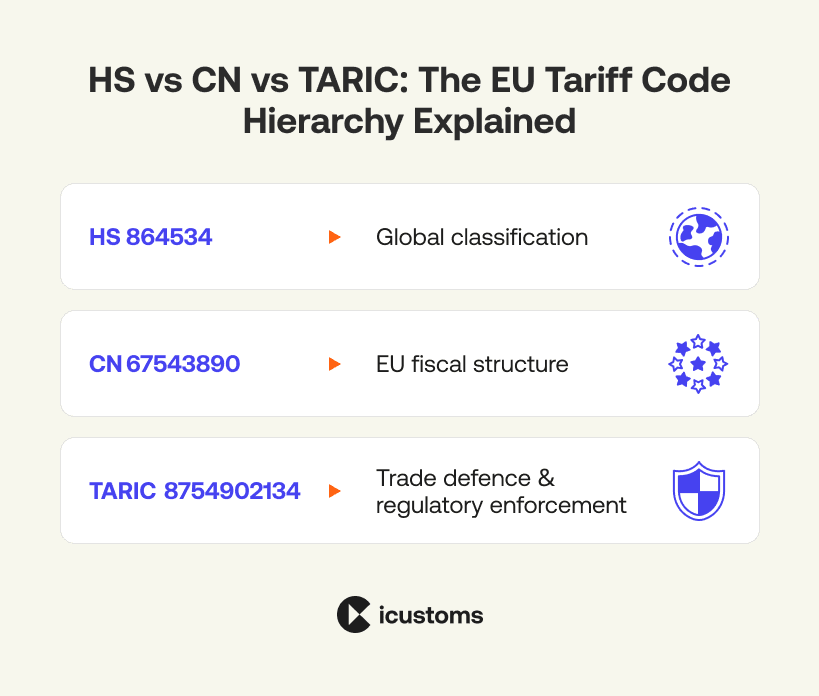
A commodity code (also called an HS code or customs tariff code) is the structured numerical classification used to identify goods for import and export. In the European Union, tariff classification follows a hierarchical model:
- 6-digit HS code (Harmonised System, managed by the World Customs Organization)
- 8-digit Combined Nomenclature (CN) code
- 10-digit TARIC code (EU Integrated Tariff)
EU customs tariff headings refer specifically to the first four digits of the Combined Nomenclature (CN), which define a product heading within a chapter.
Example Structure of EU Customs Tariff Codes
| Level | Digits | Function |
| Chapter | 2 digits | Broad product category |
| Tariff Heading | 4 digits | Product group |
| HS Subheading | 6 digits | Global classification |
| CN Code | 8 digits | EU-specific duty/statistics |
| TARIC Code | 10 digits | Trade measures & enforcement |
This tariff hierarchy determines:
Customs duty
VAT calculation
Anti-dumping measures
Quotas and suspensions
CBAM applicability
Statistical trade reporting
Product classification is not optional. The declarant is legally responsible for using the correct code.
HS vs CN vs TARIC: Why the Difference Matters in 2026
Customs classification is structured in layered code systems, each adding greater regulatory precision. Understanding how HS, CN, and TARIC differ is essential for accurate duty calculation, trade compliance, and IOSS import processing in 2026.
The 6-Digit Harmonised System (HS Code)
The Harmonised System (HS) is developed by the World Customs Organization (WCO). It standardises the first six digits of commodity codes globally.
The HS is revised approximately every five years. The next revision, HS 2028, will enter into force on 1 January 2028.
Current HS updates focus on:
- Hazardous waste (Basel Convention alignment)
- Chemical Weapons Convention monitoring
- Environmental and clean technology goods
However, HS alone is insufficient for EU customs duty precision.
The 8-Digit Combined Nomenclature (CN Code)
The Combined Nomenclature (CN) extends the HS to eight digits and is updated annually by the European Commission. The 2026 CN edition (Implementing Regulation (EU) 2025/1926) introduced:
- 27 new codes
- 13 codes removed or redefined
Key 2026 CN Updates by Chapter
- Chapter 28: New codes for lithium-nickel-manganese-cobalt oxides (NMC), lithium iron phosphate (LFP)
- Chapter 29: New subheadings for aromatic ethers and acids
- Chapter 38: Artificial graphite, photovoltaic wafers
- Chapter 73: Wind turbine towers
- Chapter 84 & 85: Hydrogen fuel cells, MPPT inverters, turbine components
- Chapter 95: Deletion of Additional Note 1 for Christmas articles
These updates reflect technological evolution and regulatory control priorities. Businesses must actively monitor CN updates. Codes change yearly, and sometimes mid-year.
The 10-Digit TARIC Code (EU TARIC Customs Code)
The TARIC database extends the 8-digit Combined Nomenclature to 10 digits. While CN defines the EU duty structure, TARIC activates additional regulatory measures at enforcement level. The final two digits determine:
- Anti-dumping and countervailing duties
- Preferential origin treatments
- Trade defence measures
- Quotas and regulatory restrictions
In practical terms, CN controls the fiscal framework. TARIC controls the regulatory consequences.
Important Clarification on Declarable Codes
In EU correlation tables:
- Codes ending in index 10 are intermediate lines and are not declarable
- Codes ending in index 80 are declarable TARIC codes for customs clearance
Using a non-declarable code does not simply create a formatting issue. It can invalidate the customs declaration.
Where the €3 Rule Fits
From 1 July 2026, the €3 customs duty applies per tariff sub-heading. This fiscal exposure is driven primarily by classification depth at CN level. TARIC precision then determines whether additional enforcement measures apply. Together, CN depth and TARIC precision define both duty exposure and regulatory risk.
Why 10-Digit Customs Codes Matter After July 2026
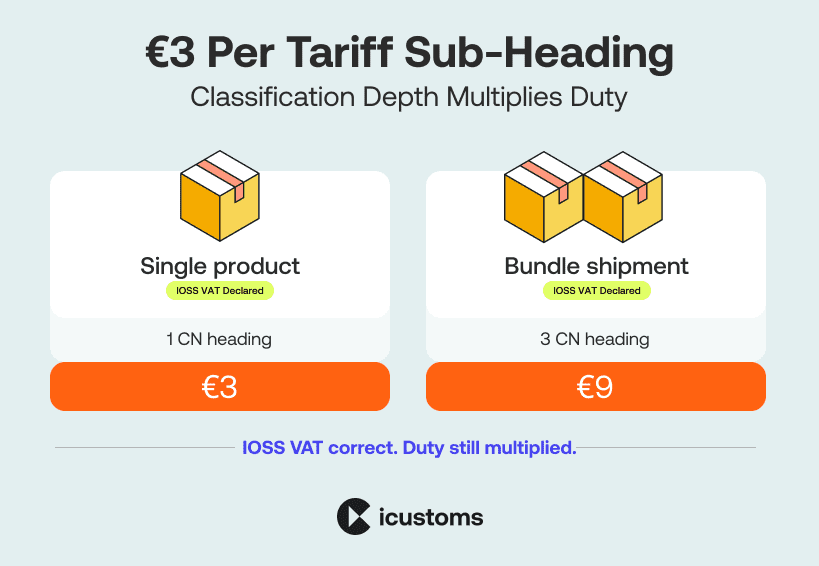
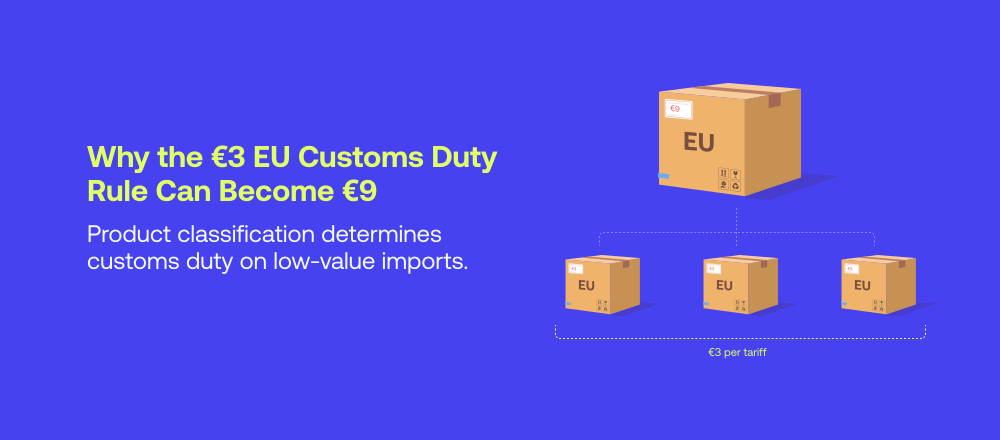
The €3 EU customs duty rule applies per tariff sub-heading, not per parcel. This means classification depth directly determines duty exposure. Example of duty exposure
| Classification Depth | Tariff Sub-Headings | Customs Duty Outcome |
| Single CN heading | 1 | €3 |
| Bundle across 3 headings | 3 | €9 |
Under this model:
- 6-digit HS grouping is insufficient for EU duty precision
- 8-digit CN depth defines fiscal exposure
- 10-digit TARIC precision defines enforcement treatment
Classification depth therefore becomes the control variable of customs liability. For IOSS consignments, this means VAT may be correctly declared at checkout while duty exposure still multiplies at clearance due to tariff classification depth.
How 10-Digit Tariff Codes Affect IOSS Shipments
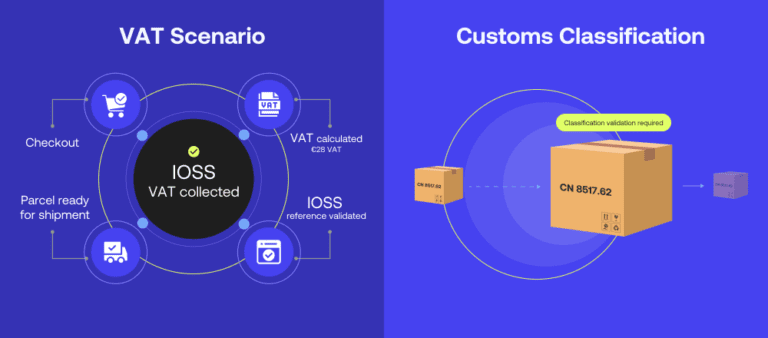
IOSS simplifies VAT collection for low-value consignments by allowing sellers to declare VAT centrally. However, IOSS does not determine customs duty.
Customs authorities still calculate duty based on 8-digit CN and 10-digit TARIC classification during clearance. Under the €3 per tariff sub-heading rule, an IOSS shipment may have correct VAT reporting but still generate multiplied duty exposure if classification depth is inaccurate.
In other words, IOSS governs VAT collection and reporting, but tariff classification governs customs duty liability and regulatory enforcement exposure.
How Incorrect 10-Digit Tariff Codes Increase EU Duty
Misclassification creates three risks:
- Overpayment of duty
- Underpayment and post-clearance recovery
- Regulatory penalties
Recent enforcement actions across EU jurisdictions demonstrate increasing scrutiny on:
- Origin declarations
- Classification precision
- Trade defence measure application
Customs authorities are shifting toward intelligence-led systems.
“The effectiveness of customs today is directly tied to the quality of its digital intelligence – structured data, early risk signals, and systems that connect authorities and operators in real time.”
Says CEO of iCustoms, Mr. Adnan Zaheer
10-digit inaccuracy is no longer a clerical error. It becomes a compliance risk indicator.
Ensure 10-Digit Tariff Code Accuracy Before It Becomes an Audit Trigger.
Let iCustoms’ AI-driven iClassification system validate HS, CN, and TARIC codes with structured precision.
Start Now and eliminate hidden duty exposure.
EU Customs Data Model, ICS2 and the EU Customs Data Hub
EU Customs Data Hub
By 2028, the EU Customs Data Hub will centralise customs declaration analysis.
This enables:
- Cross-Member State comparison
- Statistical anomaly detection
- Pattern recognition in classification behaviour
Incomplete 10-digit classification becomes visible across jurisdictions. Protecting global supply chains requires customs systems that can work across borders, not in isolation. Interoperability is now as critical as enforcement itself.
Commodity Code Responsibility and Legal Liability
The business submitting the declaration is legally responsible for correct commodity code usage.
Tools used across Europe include:
- TARIC database
- EU Access2Markets portal
- EUR-Lex Combined Nomenclature publication
- National tools (e.g., RITA in France)
- HS Tracker (WTO/WCO)
However, relying on manual lookup or spreadsheets creates risk.
Industry audits consistently show 30–40% of tariff codes used in declarations are incorrect.
This translates into:
- Millions in overpaid duties
- Clearance delays
- Post-clearance audits
- Litigation backlogs
Why Tariff Classification Governance Must Be Systemised
Classification is central to trade compliance because it affects:
- Customs duty
- VAT base
- CBAM scope
- Export controls
- Rules of origin
- Statistical reporting
With CN updates every January and interim amendments throughout the year, classification must be dynamically monitored. Manual re-keying and spreadsheet-based classification fail to scale.
Customs Automation as the Structural Solution
Automation in customs is not about speed alone. It is about consistency, traceability, and giving authorities the confidence to focus on genuine risk rather than routine trade. AI-driven customs classification systems provide:
- 10-digit TARIC precision
- Real-time CN updates
- Structured declaration alignment
- Audit trail documentation
- Cross-system interoperability (API, EDI, AS4)
This ensures:
- Accurate customs duty per tariff sub-heading
- Reduced misclassification risk
- Clearance predictability
- Regulatory confidence
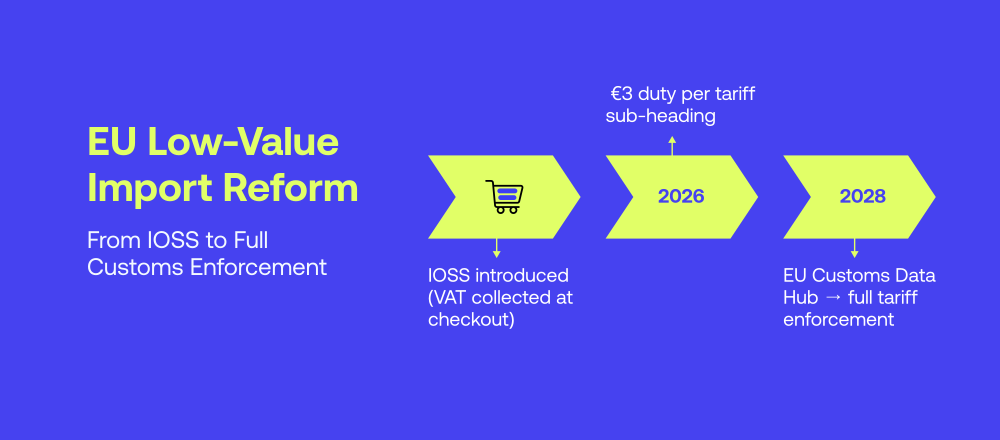
Strategic Outlook: Classification Depth Is Becoming the Control Variable
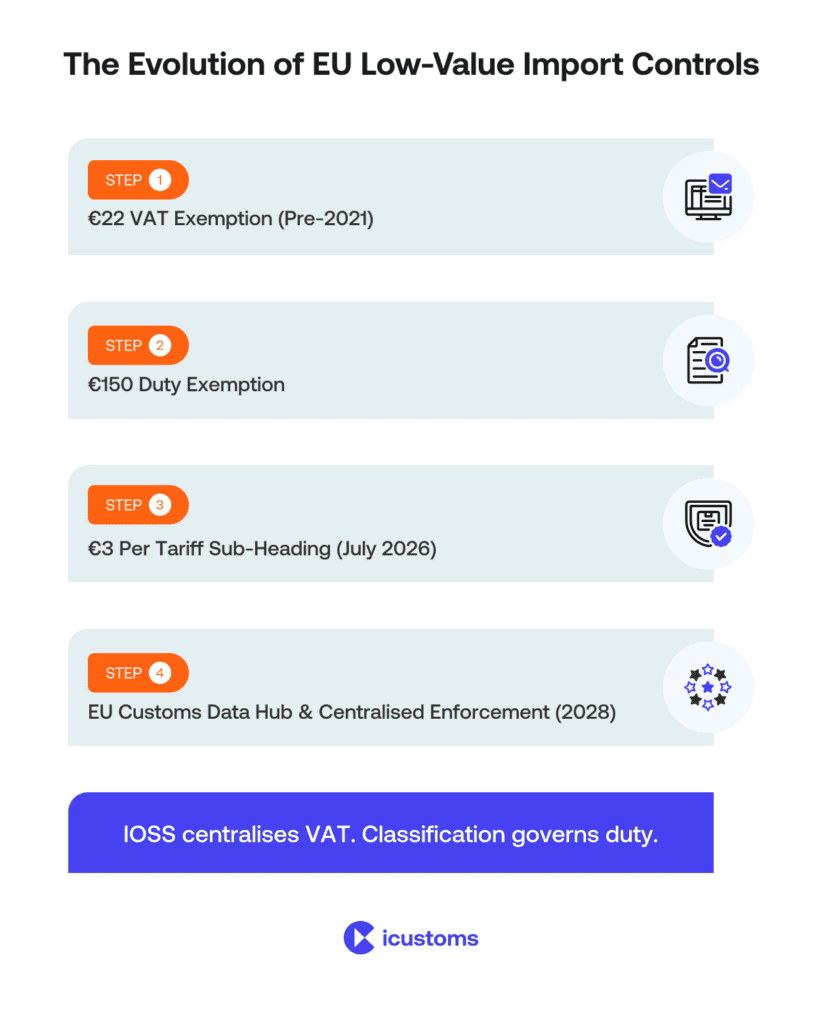
From:
- €22 VAT exemption (pre-2021)
To: - €150 duty exemption
To: - €3 per tariff sub-heading (2026)
To: - Full integration into centralised EU enforcement (2028)
The trajectory is clear.
Customs tariff headings are no longer statistical references. They are fiscal control levers. Digital transformation is one of the most effective forms of capacity building. It allows customs authorities to scale protection without scaling friction. Operators that invest in structured 10-digit classification governance now will not only avoid duty multiplication, they will be aligned with the future architecture of EU customs enforcement.
Conclusion: 10-Digit EU Tariff Classification Is Now Compliance Infrastructure
After July 2026:
- HS codes define the global language of trade.
- CN codes define the EU duty structure.
- TARIC 10-digit codes define enforcement precision.
- Classification depth defines fiscal exposure and regulatory visibility.
In a €3 per tariff sub-heading environment supported by ICS2 pre-arrival controls and the emerging EU Customs Data Hub, 10-digit tariff codes are no longer administrative details. They determine how customs systems calculate duty, apply trade defence measures, assess origin consistency, and flag risk patterns across Member States.
IOSS Centralises VAT, but 10-Digit Classification Governs Duty Exposure
For high-volume EU import operations, including IOSS-declared low-value consignments, classification accuracy must be structured, consistent, and digitally governed. Spreadsheet-based controls and manual interpretation cannot withstand cross-system validation, statistical enforcement, and intelligence-led customs supervision. As IOSS simplifies VAT centralisation, classification governance becomes the parallel control layer that protects duty accuracy and prevents post-clearance corrections.
How iCustoms Delivers Structured 10-Digit TARIC Governance Across EU Systems
At iCustoms, tariff classification is treated as core compliance infrastructure, not a data entry step.
Our AI-driven iClassification engine ensures:
- Consistent 10-digit TARIC accuracy
- Structured alignment across HS, CN, and TARIC layers
- Real-time validation before declaration submission
- Cross-system consistency between ENS, import declarations, and VAT references
Through secure API, EDI, and AS4 (Applicability Statement 4) protocol integration, iCustoms connects directly with customs authorities, ERPs, eCommerce platforms, and carrier systems, enabling interoperable, encrypted, and audit-traceable data exchange across jurisdictions.
Interoperable Customs Management Integrations for Real-Time EU Compliance
Explore how our Customs Management Software Integrations support 200+ platforms and 8+ customs systems, creating a unified, real-time compliance environment built for scalable and future-ready global trade.
ISO-Certified Information Security and Quality Governance for EU Customs Enforcement
Backed by ISO 27001 and ISO 9001 (certified information security management) and (certified quality governance), iCustoms delivers classification intelligence that meets the precision, traceability, and resilience requirements of modern EU customs enforcement.
Let iCustoms AI-powered iClassification secure your 10-digit TARIC accuracy before July 2026 exposes the risk.
Build a defensible, interoperable, and future-ready EU customs workflow today.

Eliminate €3 Customs Duty Classification Risk
Automate tariff classification, ensure code accuracy, and maintain compliant EU declarations under the €3 duty rule.
You may also like:
Struggling to Extract, Catagorise & Validate Your Documents?

Capture & Upload Data in Seconds with AI & Machine Learning
Subscribe to our Newsletter
About iCustoms
iCustoms is an all-in-one solution helping businesses automate customs processes more efficiently. With AI-powered and machine-learning capabilities, iCustoms is designed to streamline your all customs procedures in a few minutes, cut additional costs and save time.
Struggling to Extract, Catagorise & Validate Your Documents?
Capture & Upload Data in Seconds with AI & Machine Learning