
Customs Clearance for Animals and Animal Products: From CHED to Declaration
- John Hall
- Customs Specialist at iCustoms.ai
Customs clearance for animal products runs on two tracks at once. The SPS track proves the goods are safe: health certificates, CHED notifications and establishment codes. The customs track handles duty and admission: the declaration, the commodity code and the border release. Neither track clears the goods alone; release happens when both agree, reference for reference.
Most border delays in this trade come from the gap between the two tracks rather than a failure inside either one. Therefore, this guide walks the full journey on both the GB and EU sides, shows where clearances stall, and finishes with a pre-clearance checklist you can run before every consignment.
Why animals and animal products clear customs differently
A pallet of machine parts needs one thing at the border: a valid customs declaration. A pallet of cheese needs that plus the entire SPS apparatus, because food of animal origin carries health risk as well as fiscal duty. Consequently, the consignment must enter through a designated border control post, arrive pre-notified, and match its health paperwork before customs release even becomes a question.
In practice, that means two systems issue two references for one movement: an SPS notification reference (from IPAFFS in Great Britain, or TRACES NT in the EU) and a customs declaration reference. Officials reconcile them at the border, and every mismatch is a hold.
The GB import flow: from IPAFFS notification to release
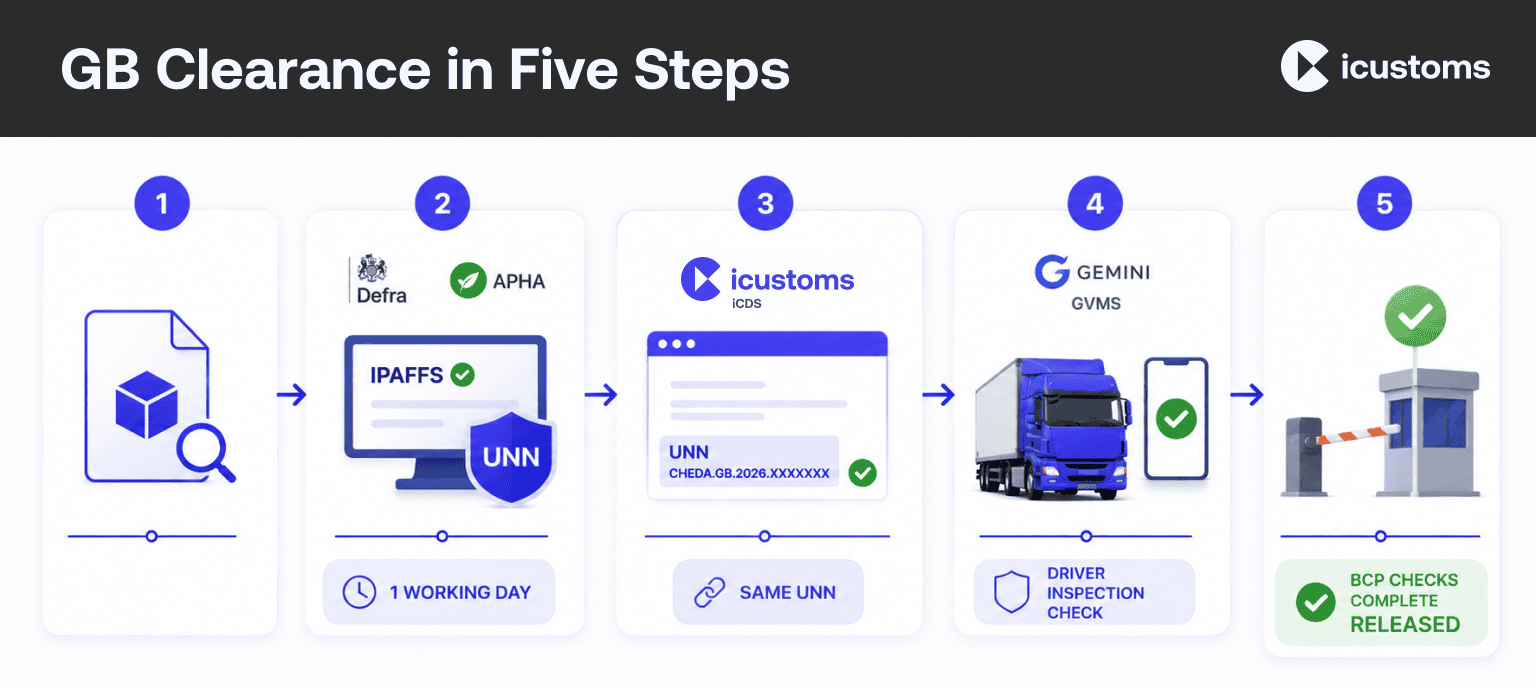
- Step 1: Classify the product. The commodity code drives the CHED type, the duty rate and the risk category under the Border Target Operating Model.
- Step 2: Notify on IPAFFS. Submit the CHED notification at least one working day before arrival, with the health certificate attached, and receive your unique notification number (UNN).
- Step 3: File the customs declaration. The declaration must carry data that reconciles with the notification, the certificate and the invoice.
- Step 4: Move the goods. Drivers using the Goods Vehicle Movement Service (GVMS) check the inspection notification service; others watch for the IPAFFS text and email sent roughly 2 hours before arrival.
- Step 5: Checks and release. The border control post completes any documentary, identity and physical checks, and customs releases the consignment once both tracks agree.
Where clearances stall
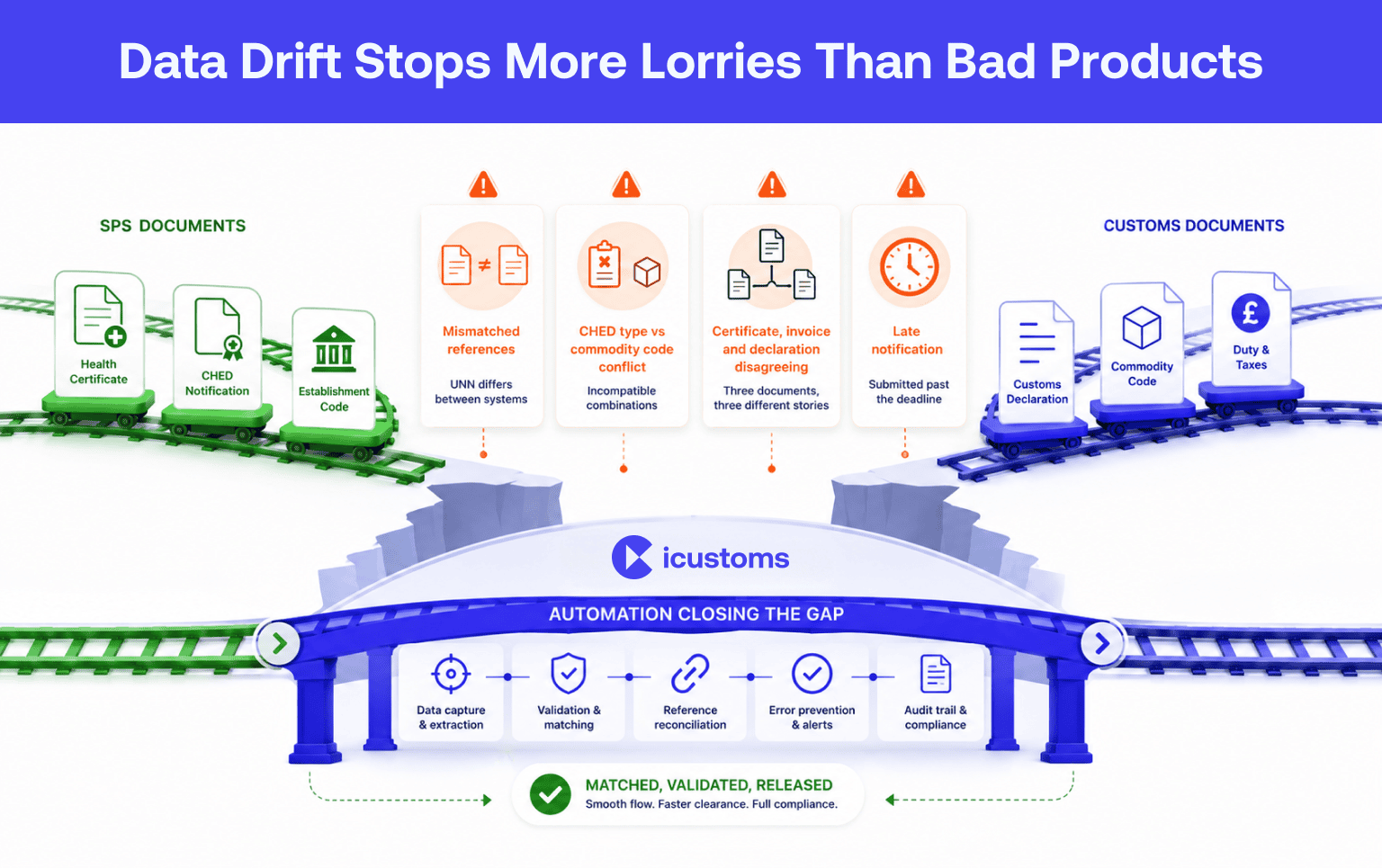
- References that do not reconcile between notification and declaration
- A commodity code pointing to one CHED type whilst the notification uses another
- Certificate, invoice and declaration data telling three slightly different stories
- Late SPS notification queueing the goods behind compliant traffic
Notice the pattern: none of these failures needs an unhealthy animal or a bad product. Data drift between systems does all the damage on its own.
The EU import flow: TRACES NT, CHEDs and establishment codes
The EU side mirrors the logic with its own machinery. The operator submits the Common Health Entry Document through TRACES NT before arrival, officials at the border control post run the three checks, and the CHED reference flows into the customs declaration. One extra dependency sharpens the risk here: Part 1 of the CHED carries the establishment codes of every facility in the chain, and a single delisted supplier refuses the document before the container opens.
For exporters and importers on this route, validating codes in bulk before booking is the cheapest insurance available. iTraces checks every establishment code against the official TRACES EU database in seconds, with 99% accuracy, which is why customs agents run it as a standing pre-shipment gate.
Still Reconciling SPS and Customs Paperwork Manually?
iCustoms validates the codes, extracts the data and files the declarations, so both tracks always agree.
GVMS, safety and security declarations, and the moving parts
Around the two main tracks sit the logistics systems that keep vehicles moving. GVMS links declarations to the vehicle so ports can clear lorries without stopping every one; the driver’s inspection check tells them whether to report to a BCP. Safety and security declarations add another filing on top for accompanied movements. Each system is manageable alone; together they multiply the references that must stay consistent for one lorry to roll off a ferry unchallenged.
A pre-clearance checklist for animal product consignments
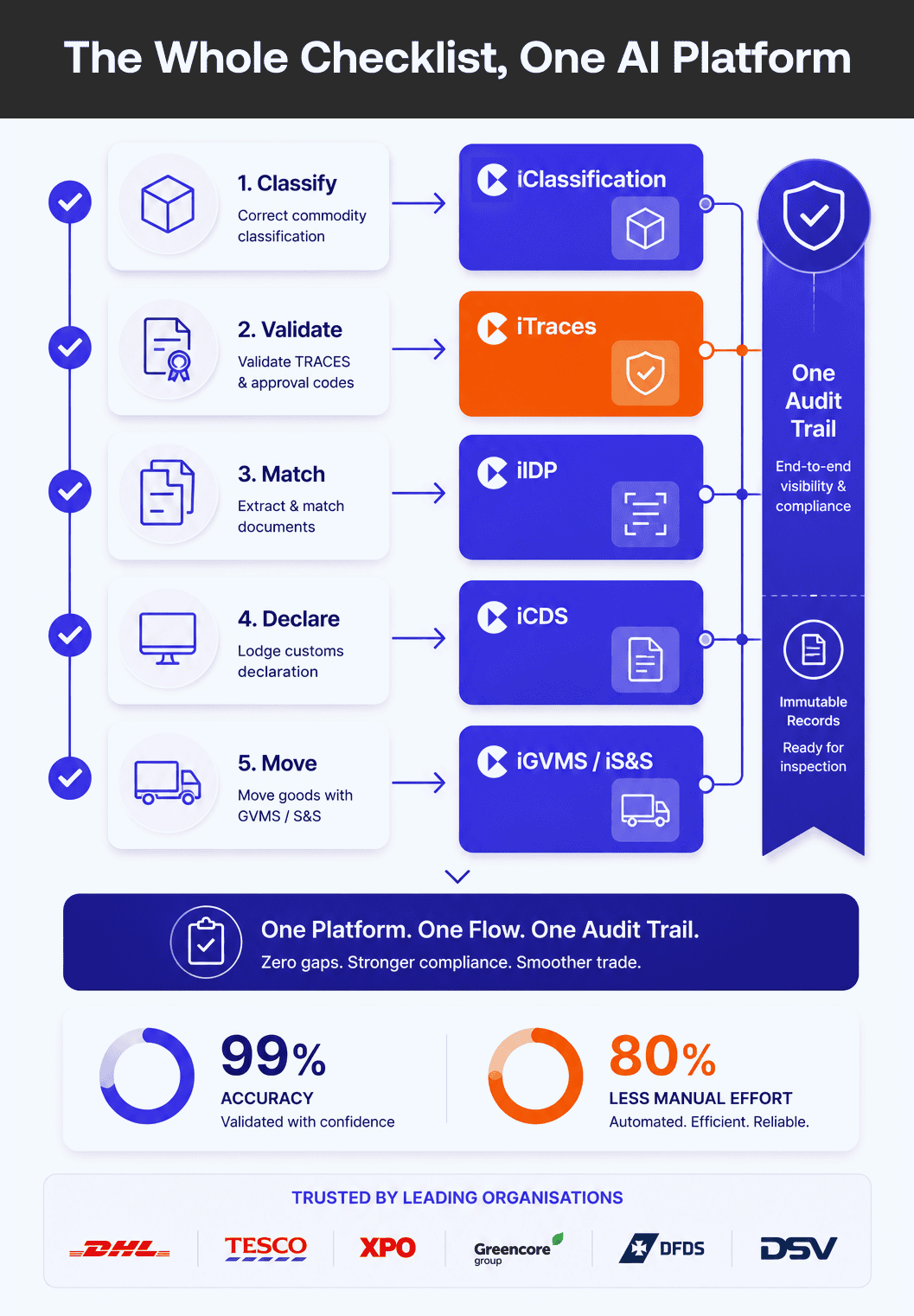
- Classify first: confirm the commodity code, because CHED type, duty and risk category all hang on it
- Validate establishment codes: run the whole consignment against the official lists before booking, not at the port
- Match the documents: certificate, invoice and packing list must agree on quantities, names and dates
- Notify on time: meet the one-working-day rule (GB) or your BCP’s notice period (EU)
- Reconcile the references: UNN or CHED number present and identical across notification and declaration
- Watch the messages: monitor IPAFFS or TRACES until the consignment clears, because final risk assessments can still call checks
Why choose iCustoms for customs clearance of animals and animal products
Every line of that checklist is a data task, and iCustoms automates the lot. iClassification confirms commodity codes across 32+ countries. iTraces validates establishment codes in bulk. Intelligent Document Processing extracts and cross-checks certificate, invoice and packing list data with 99% accuracy. iCDS files HMRC-recognised UK declarations, the platform covers Ireland and 22 EU nations, and GVMS and safety and security filings run from the same place.
That is the whole two-track problem handled by one AI platform, with an audit trail behind every step. Logistics leaders such as Kerry Logistics, Ziegler and Woodside Logistics Group clear regulated goods this way, cutting manual effort by 80% and keeping their teams on exceptions rather than re-keying.
One Consignment, Two Tracks, Zero Drift
Book a demo and watch iCustoms take an animal product consignment from classification to cleared, live.
Frequently Asked Questions
What is customs clearance for animal products?
It is the process of releasing animal-origin goods at the border, and it runs on two tracks: SPS controls (health certificates, CHED notifications, establishment codes) and the customs declaration. Goods release only when both tracks reconcile.
Do animal products need both a CHED and a customs declaration?
Yes. The CHED notification satisfies the health controls whilst the declaration satisfies customs, and the references must match. Neither document clears the consignment on its own.
What happens if the references do not match?
The consignment holds at the port whilst someone reconciles the records, with demurrage and storage costs accruing. Reference drift between systems is among the most common and most preventable causes of delay.
Where do establishment codes fit into clearance?
On the EU side, the CHED carries the approval codes of every facility in the supply chain, and officials verify them against the TRACES lists during the documentary check. Validating them in advance with iTraces from iCustoms prevents refusals.
How does GVMS affect animal product consignments?
GVMS links the customs declarations to the vehicle for port clearance, and the driver uses the inspection notification service to learn whether the consignment must report for SPS checks at the border control post.
How can I speed up customs clearance for animal products?
Remove the manual steps where drift begins: automate classification, establishment code validation, document data extraction and declaration filing. iCustoms customers run all four on one platform with 99% accuracy and 80% less manual effort.
You may also like:
Struggling to Extract, Catagorise & Validate Your Documents?

Capture & Upload Data in Seconds with AI & Machine Learning
Subscribe to our Newsletter
About iCustoms
iCustoms is an all-in-one solution helping businesses automate customs processes more efficiently. With AI-powered and machine-learning capabilities, iCustoms is designed to streamline your all customs procedures in a few minutes, cut additional costs and save time.
Struggling to Extract, Catagorise & Validate Your Documents?
Capture & Upload Data in Seconds with AI & Machine Learning