Your Complete Guide to Centralised Clearance for Imports
- John Hall
- Customs Specialist at iCustoms.ai
For businesses moving goods across the EU, dealing with multiple customs offices used to be a headache. Different ports, different rules, and duplicated paperwork often slowed shipments down, created compliance risks, and added unnecessary costs. Tracking shipments and managing multiple declarations across borders was time-consuming and error-prone — until CCI kicked in.
What Is CCI (Centralised Clearance for Import)?
Centralised Clearance for Imports (CCI) is a modern system designed to simplify and digitalise cross-border trade by enabling all import declarations to be managed from a single, central location.
The primary goal of CCI is to make import clearance across the EU automated, efficient, and more predictable. Through electronic information exchange between customs offices, the system reduces administrative burden for both businesses and customs authorities, streamlining the entire import process.
CCI Success Starts Here: Watch a Demo
How CCI Works
Gone are the days of filing import declarations at every port where goods arrive. With (CCI), customs offices can now share information electronically, cutting down on paperwork for both businesses and authorities.
Everything goes through the Supervising Customs Office (SCO), the main point of contact, while the local customs offices at the arrival points handle the processing and release of shipments, making the whole import process smoother and more efficient.
This centralised approach offers several benefits:
- Reduced administrative work: Eliminates the need to repeat the same forms at multiple locations.
- Faster customs clearance: Streamlined processing allows goods to move more quickly.
- Simplified operations: Logistics, compliance, and accounting can be managed in one place.
- Greater predictability: Fewer delays and a consistent process for every import.
Who Can Make the Most of CCI?
(CCI) is ideal for businesses that import large volumes of goods across multiple ports. It is particularly beneficial for businesses:
- With complex supply chains
- Large distributors and wholesalers
- Operate in multiple EU countries
- Manage large volumes of imports
- Expanding into new markets without adding operational complexity
By centralising import procedures, companies can focus less on paperwork and more on running and growing their business.
Imports, Simplified
(CCI) aligns with the Union Customs Code (UCC) and is part of the EU’s broader push toward digital and automated customs processes. With electronic communication between customs offices, businesses benefit from:
- Reduced manual intervention and errors
- Streamlined cross-border shipments
- Faster, more transparent clearance
- A fully digital workflow
CCI Rollout Across the EU
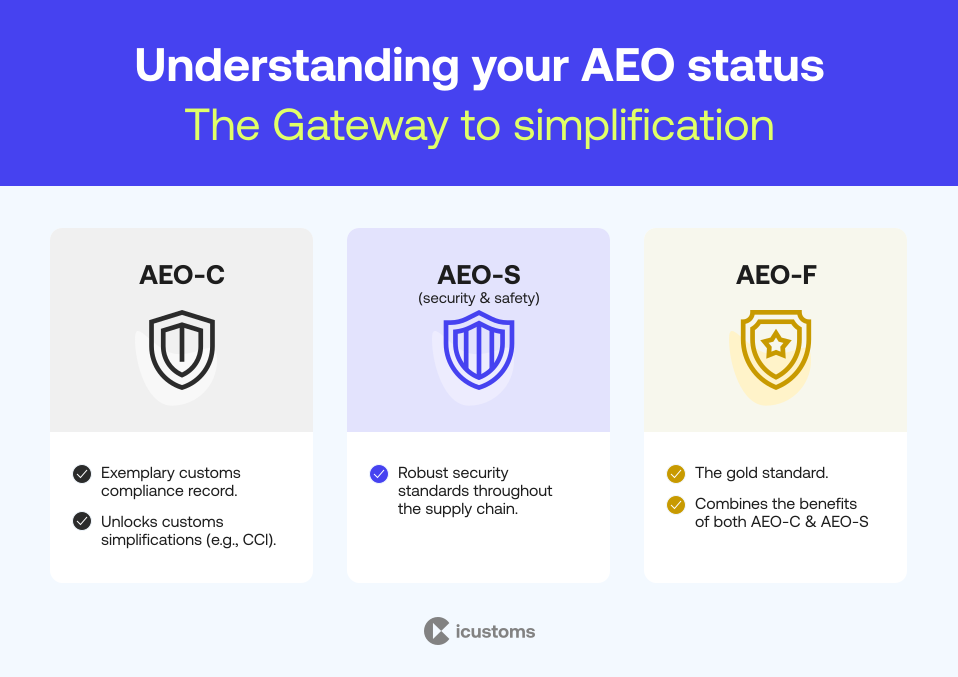
The implementation of (CCI) is being rolled out in phases across the EU. Several Member States are already live, while others are expected to join by 2026.
As more countries adopt the system, centralised clearance will become increasingly seamless and beneficial for businesses operating across borders.
This phased rollout ensures a smooth transition, giving customs authorities and importers time to adapt to the new digital processes while gradually expanding the reach and efficiency of centralised clearance.
Unlock CCI & AEO: See the Automation
How Technology Can Support CCI
Modern customs management platforms, like iCustoms, complement CCI by automating and centralising customs operations.
iCustoms AI allows businesses to:
- Submit accurate consolidated declarations
- Reduce manual data entry
- Track compliance in real time
- Scale operations efficiently as shipment volumes grow
Simplify your import operations and prepare for CCI. Watch Your iCustoms Demo
Clearing the Way for Smarter Trade
Centralised Clearance for Imports CCI isn’t just another customs procedure — it’s a smart way for businesses to simplify operations, lower costs, and grow faster.
Combined with modern digital solutions, CCI gives full visibility over shipments, keeps compliance on track, and lets teams focus on expanding globally instead of getting bogged down in paperwork.
With AI-powered customs tools like iCustoms AI, centralised clearance becomes even easier, helping reduce risk and lighten operational workload.
In short, CCI turns import procedures into a centralised, automated, and hassle-free process, making it simpler for businesses to stay efficient, control costs, and scale with confidence.

Ready to simplify your Centralised Clearance Imports process?
From accuracy to automation, iCustoms keeps your business compliant and ahead.
You may also like:
Struggling to Extract, Catagorise & Validate Your Documents?

Capture & Upload Data in Seconds with AI & Machine Learning
Subscribe to our Newsletter
About iCustoms
iCustoms is an all-in-one solution helping businesses automate customs processes more efficiently. With AI-powered and machine-learning capabilities, iCustoms is designed to streamline your all customs procedures in a few minutes, cut additional costs and save time.
Struggling to Extract, Catagorise & Validate Your Documents?
Capture & Upload Data in Seconds with AI & Machine Learning