Best IDP Software 2026: Comparison, Alternatives & Rankings
- John Hall
- Customs Specialist at iCustoms.ai
The IDP software market in 2026 contains more platforms than most enterprise buyers can practically evaluate. Every vendor claims industry-leading accuracy, seamless integration, and enterprise-grade scalability. Without a structured way to compare them, procurement teams risk selecting a platform that performs well in demos but fails under real operating conditions. This guide cuts through the noise with a direct comparison of the leading IDP platforms and a clear framework for choosing the right one for your use case.
Why Choosing the Right IDP Software Is Difficult
IDP platform selection is uniquely challenging because the tools look similar at the surface level. Most vendors offer OCR, machine learning, and API connectivity. The differences that matter, accuracy under document variation, scalability at peak load, and integration depth with specific enterprise systems, are not visible in a standard product demonstration.
Too Many Vendors with Similar Messaging
Nearly every IDP platform claims accuracy above 95 percent, support for multiple document types, and easy integration with enterprise systems. These claims are technically true in controlled conditions but rarely represent performance on the buyer’s actual documents, which vary in format, quality, and complexity in ways that vendor demo sets do not replicate.
Lack of Standardised Benchmarks
Unlike some software categories, IDP has no agreed industry benchmark for accuracy measurement. Vendors define accuracy differently: some measure at document level, others at field level, and some report only on their highest-performing document types. Without standardised benchmarks, headline accuracy figures from different vendors are not directly comparable.
Different Strengths for Different Use Cases
An IDP platform that excels at accounts payable invoice processing may perform poorly on air waybills, certificates of origin, or customs declarations. Use case fit matters more than general capability scores. A platform ranked first for financial document processing may be fourth for trade and logistics document workflows.
The most common buying risks in IDP platform selection include:
- Unclear feature differences between vendors that only emerge during post-deployment use
- Inconsistent accuracy claims across document types, measured against different internal standards
- Integration limitations discovered only after the procurement decision has been made
- Scalability concerns that surface when document volume exceeds the level tested during evaluation
What to Look for in Enterprise IDP Software
Before comparing specific platforms, define the evaluation criteria that matter for your organisation. The following five dimensions separate platforms that perform in enterprise environments from those that perform well only in controlled demonstrations.
Accuracy and Data Extraction Quality
Measure accuracy at the field level, not the document level, and test against your own documents rather than vendor-supplied samples. Request field-level accuracy data broken down by document type for commercial invoices, packing lists, transport documents, and supporting certificates separately.
Document Coverage
Confirm that the platform supports every document type in your processing pipeline with the same performance level as its primary document type. Coverage gaps in a procurement comparison become operational problems after deployment.
Integration Capabilities
Review the API documentation before the demo. Check endpoint structure, authentication model, and data schema. Identify which of your existing systems have pre-built connectors and which require custom integration, and get a realistic timeline and cost estimate for custom development.
Scalability and Performance
Ask for performance data at your projected peak volume, not average volume. Processing latency and accuracy under concurrent load are the metrics that determine whether a platform can be relied upon during high-volume periods without manual intervention.
Compliance and Validation Features
For regulated use cases, the platform must do more than extract data. It must validate extracted data against business rules, flag exceptions for human review, and maintain a complete, structured audit trail of every processing decision. Platforms without these features are not suitable for compliance-adjacent workflows.
Still Comparing IDP Platforms?
See how iCustoms automates customs and logistics documents without complex setup..
Watch a Demo
Top IDP Software Platforms in 2026
The following platforms represent the leading options in enterprise IDP software as of 2026. Each has distinct strengths and limitations. The right choice depends on your use case, integration requirements, and document complexity.
iCustoms - The Leading IDP Software in 2026 for Customs Declaration Service
iCustoms is a purpose-built AI document processing platform for trade, customs, and logistics workflows. Unlike general-purpose IDP platforms, iCustoms is trained on trade-specific document types including commercial invoices, packing lists, air waybills, bills of lading, and certificates of origin, and outputs structured data directly to customs declaration systems including HMRC CDS and ICS2 ENS.
Strengths: Out-of-the-box accuracy on trade documents without custom model training, direct output to CDS and ENS systems, built-in AI compliance validation logic, cross-document consistency checking, and high-volume processing designed for freight forwarding and customs brokerage operations.
Limitations: Niche positioning means it is the optimal choice specifically for trade and customs workflows rather than general enterprise document processing across other business functions.
ABBYY FlexiCapture / Vantage
ABBYY is one of the names in document processing, with a strong OCR foundation and a broad document type library. ABBYY Vantage, its cloud-native platform, offers pre-built skills for common document types and a marketplace for document-specific processing models.
Strengths: Strong OCR accuracy on clearly structured documents, extensive document type coverage, established enterprise customer base, pre-built connector library for common ERP and CRM systems.
Limitations: Trade and customs document support is limited compared to general enterprise document types with main focus for financial services (insurance claims, loan products , KYC). Implementation complexity is higher than newer cloud-native alternatives. Pricing reflects its enterprise heritage and may not suit mid-market buyers.
Kofax (Now Tungsten Automation)
Kofax has a long history in enterprise document and workflow automation, with a broad product portfolio that extends beyond IDP into RPA and process orchestration. Its IDP capability is embedded within a wider Kofax workflow automation deployment.
Strengths: Deep workflow automation capability, strong integration with enterprise back-office systems, established presence in banking and insurance, and a comprehensive process orchestration layer alongside document processing.
Limitations: Implementation complexity is high, and deployments typically require significant professional services investment. The platform is not purpose-built for trade and logistics document types. RPA customs document automation within Kofax requires additional configuration for customs-specific workflows.
HyperScience
HyperScience focuses on high-accuracy document processing for structured and semi-structured documents, with particular strength in financial services and government document workflows. Its accuracy on complex, multi-page structured documents is among the highest in the market.
Strengths: Very high accuracy on structured documents, strong supervised machine learning model, and a reputation for reliability in high-stakes financial document environments.
Limitations: Premium pricing positions it at the higher end of the enterprise cost range. Limited coverage for trade-specific documents such as certificates of origin and customs declarations. Integration complexity for logistics and customs systems requires custom development.
Rossum
Rossum is a cloud-native IDP platform focused primarily on accounts payable invoice processing. Its AI model is trained on a large invoice dataset, giving it strong out-of-the-box performance for invoice extraction workflows without extensive training or template configuration.
Strengths: Fast time to value for invoice processing, minimal setup required for standard commercial invoice extraction, strong AP workflow integrations, and a clean, user-friendly interface for reviewer teams.
Limitations: Document coverage beyond invoices is limited. Logistics documents, transport documents, and trade certificates require significant additional configuration. The platform is optimised for AP teams rather than customs and trade compliance workflows.
Google Document AI and Microsoft Azure Form Recogniser
Both Google and Microsoft offer cloud-based document processing APIs as part of their broader platform ecosystems. These tools provide strong general-purpose document extraction capability with the scalability and security of hyperscaler infrastructure. They are best suited to enterprises already heavily invested in Google Cloud or Azure and willing to build custom extraction workflows on top of the base API.
Strengths: Hyperscaler reliability and security, scalability without practical limits, strong developer ecosystems, and integration with other platform services. Suitable for enterprises with internal development capability who want to build bespoke IDP solutions.
Limitations: Neither platform provides out-of-the-box trade and customs document processing. Achieving production-ready accuracy for commercial invoices, packing lists, or air waybills requires substantial custom model training and workflow development.
IDP Platform Comparison: Strengths, Best Use Cases, and Limitations
| Platform | Primary Strength | Best Use Case | Key Limitation |
| iCustoms | Purpose built for trade and customs documents | Freight forwarders, customs brokers, and logistics operators | Optimised for trade and customs rather than general enterprise document functions |
| ABBYY Vantage | Strong OCR and broad document coverage | General enterprise document processing across multiple functions | Limited trade and customs document focus, higher implementation complexity |
| Kofax / Tungsten | Workflow automation and RPA integration | Enterprise operations with complex process orchestration requirements | High implementation cost, not purpose built for customs or logistics |
| HyperScience | Very high accuracy on structured financial documents | Financial services and government document processing | Premium pricing, limited trade document coverage, custom integration required |
| Rossum | Fast setup for invoice processing | Accounts payable teams processing high volumes of supplier invoices | Limited coverage beyond invoices, not suited to logistics or customs workflows |
| Google / Azure APIs | Hyperscaler scalability and developer ecosystem | Enterprises building custom IDP solutions on cloud platform infrastructure | No out of the box trade document models, requires significant custom development |
General-Purpose vs Trade-Specific IDP Solutions
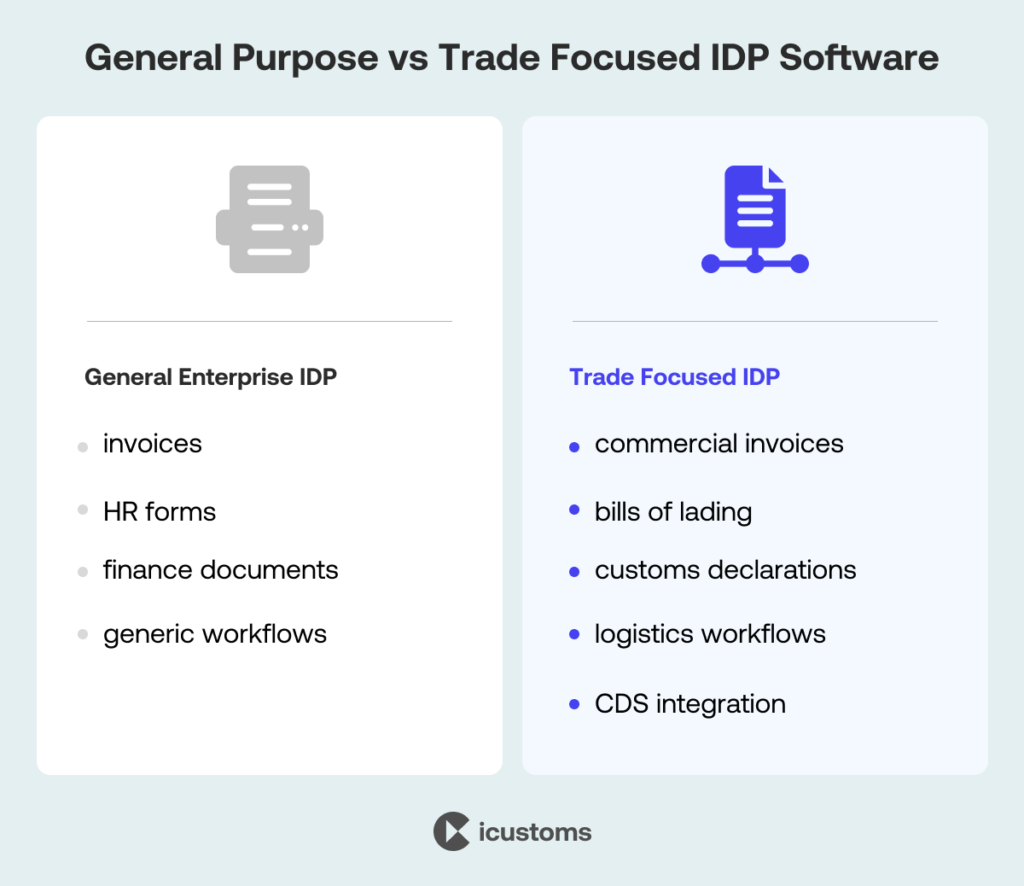
The most important distinction in IDP platform selection for logistics and customs operations is between general-purpose platforms and trade-specific platforms. This distinction determines how much configuration, training, and integration development is required before a platform delivers production-ready accuracy on the documents you actually process.
General Document Processing Tools
ABBYY, Kofax, HyperScience, Rossum, and the hyperscaler API solutions are general-purpose platforms. They process documents across many business functions but are not trained specifically on trade and logistics document structures. Achieving the accuracy required for customs declaration preparation typically requires custom model training, template configuration, or workflow development on top of the base platform, adding time, cost, and internal resource requirements before the platform is operational.
Trade and Customs-Focused Platforms
Trade-specific IDP platforms such as iCustoms are trained on the document types that freight forwarders, customs brokers, and logistics operators process daily. Commercial invoices with variable supplier layouts, air waybills in multiple carrier formats, certificates of origin from government authorities, and multi-page packing lists with complex line item structures all fall within the default extraction capability of a purpose-built trade platform. There is no custom training cycle required before the platform is processing real documents accurately.
Built for Trade Documents
Process invoices, packing lists, and customs documents with AI built for logistics workflows.
IDP Software Comparison by Use Case
Invoice Processing
For accounts payable invoice processing, Rossum and ABBYY Vantage are the strongest general-purpose choices. iCustoms is optimised for commercial invoice processing in the customs context, where the output must align with CDS declaration fields rather than AP system requirements.
Logistics Documents
Logistics document processing, covering air waybills, bills of lading, CMR consignment notes, and freight invoices, is not a primary use case for any of the general-purpose platforms without additional configuration. iCustoms processes all standard logistics document types out of the box, with extraction models trained on real carrier and freight forwarder templates.
Customs Declarations
None of the general-purpose IDP platforms provide direct output to customs declaration systems. Data extracted from documents must be mapped and transferred to CDS, ENS, or NCTS platforms through additional middleware. iCustoms outputs directly to HMRC CDS, ICS2 ENS, and NCTS-compatible formats as a standard capability, removing the middleware layer.
High-Volume Processing
For high-volume trade operations processing hundreds or thousands of documents per day, processing latency and accuracy under concurrent load are critical. iCustoms is designed for freight forwarding and customs brokerage scale. General-purpose platforms can be scaled to high volume but require more infrastructure configuration and typically higher per-document cost at logistics operator scale.
When to Choose iCustoms Over Other Platforms
iCustoms is the appropriate choice when document processing requirements are specifically centred on trade, customs, and logistics workflows. The following conditions indicate that a trade-specific platform will outperform a general-purpose alternative.
- Your documents are primarily trade documents: commercial invoices, packing lists, air waybills, bills of lading, certificates of origin, and customs declarations
- Your output must connect directly to HMRC CDS, ICS2 ENS, NCTS, or other customs filing systems without additional middleware or manual data transfer
- Your document set includes high format variation across suppliers, carriers, and countries that general-purpose platforms require custom training to handle
- Your operations require cross-document validation between invoice, packing list, and transport document before customs submission
- Your team processes high volumes under time pressure from pre-arrival filing deadlines where processing latency directly affects compliance
Reduce Manual Customs Processing
Automate extraction, validation, and declaration workflows from a single platform.
Common Mistakes When Comparing IDP Software
Focusing Only on OCR Accuracy
OCR accuracy measures how well the platform converts document images to text. Field-level extraction accuracy measures whether the right text is assigned to the right field. These are different metrics, and field-level accuracy in the context of your specific document types is the measure that matters for compliance and downstream system compatibility.
Ignoring Integration
A platform that extracts data accurately but cannot deliver that data to your customs declaration system, ERP, or freight management platform without significant custom development is not a complete solution. Integration capability is as important as extraction accuracy in determining real-world platform suitability.
Overlooking Use Case Fit
The best-reviewed platform in a general enterprise context is not necessarily the best platform for your use case. Platform selection for trade and customs operations requires evaluating tools specifically against trade document types and trade workflow requirements, not against general enterprise document processing benchmarks.
Not Testing with Real Documents
Every platform performs well on vendor-curated sample documents. The only test that provides meaningful procurement data is processing your own documents, including edge cases, low-quality scans, and non-standard supplier templates, before making a selection.
How to Evaluate IDP Platforms Before Buying
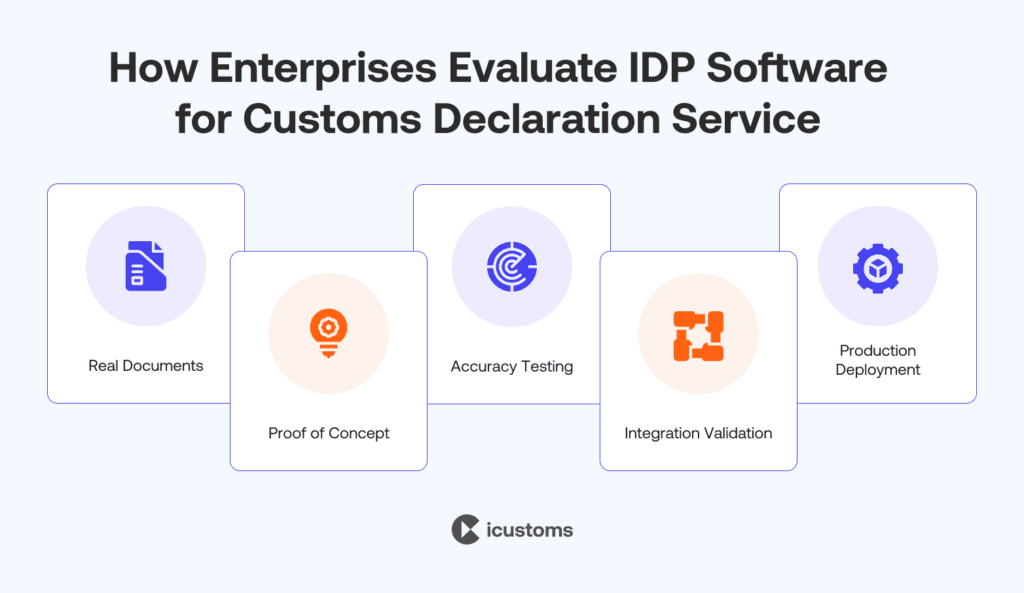
Run a Proof of Concept
Define a structured proof of concept using real operational data. Set measurable accuracy targets for each document type before the PoC begins. Evaluate results against those targets, not against vendor-provided benchmarks. A minimum four-week PoC gives meaningful performance data across normal and peak operating conditions. For a detailed enterprise IDP evaluation framework, see our IDP software integration guide.
Test Real Documents
Provide vendors with 20 to 50 documents drawn from your actual operations. Include format variation across suppliers and carriers, low-quality scanned images, and documents with handwritten annotations where these appear in your regular document stream.
Validate Output Data
Do not measure only whether the platform extracted data. Measure whether the extracted data is correct at the field level. For each test document, compare the extracted output against the source document for every relevant field including declared values, product descriptions, party identifiers, and reference numbers.
Measure Performance
Time the processing of a batch of 50 documents and request performance data for concurrent processing at your projected peak volume. For AI document processing use case details across invoice, waybill, and packing list workflows, see our AI document processing for trade guide.
Conclusion
The IDP software market in 2026 offers more options than most enterprise buyers need. The risk is not a lack of choice. It is selecting a platform that performs well in general enterprise contexts but underperforms on the specific document types and workflows that matter to your operation. Structured evaluation against your own use case, documents, and integration requirements is the only reliable basis for a procurement decision.
Key conclusions from this comparison:
- Many IDP platforms exist, each with genuine strengths in specific use cases and document types
- General-purpose platforms require significant configuration and custom training to perform on trade and customs documents
- Choosing the wrong platform creates implementation cost, accuracy risk, and compliance exposure that only appears after deployment
- Specialised platforms like iCustoms deliver better default results for trade and logistics workflows without the setup overhead of general-purpose alternatives
IDP Software Frequently Asked Questions
What is the best IDP software?
The best IDP software depends on the industry and document complexity. For customs, trade, and logistics workflows, iCustoms is purpose built for trade documents, automated validation, and direct customs system integration, reducing manual processing and compliance risk.
How does iCustoms IDP software compare?
iCustoms is designed specifically for customs and logistics workflows. It supports trade documents such as commercial invoices, packing lists, and customs declarations while combining AI extraction, validation, and customs workflow integration in one platform.
Which IDP platform is best for logistics and customs enterprises?
For freight forwarders, customs brokers, and logistics operators, iCustoms provides production ready document automation with AI powered extraction, validation, product classification, and customs filing integration.
Are all IDP tools the same?
No. IDP platforms differ in extraction accuracy, automation capability, integration depth, and industry focus. iCustoms is optimised specifically for trade and customs documents, delivering stronger performance for logistics and compliance workflows.
Does iCustoms support customs declaration systems?
Yes. iCustoms outputs structured data directly to customs systems including HMRC CDS, ICS2 ENS, and NCTS compatible workflows, reducing manual data transfer and middleware requirements.
What document types can iCustoms process?
iCustoms processes commercial invoices, packing lists, air waybills, bills of lading, certificates of origin, and other trade and logistics documents with AI driven extraction and validation.
Why is iCustoms suited to high volume trade operations?
iCustoms is designed for freight forwarders, customs brokers, and logistics operators processing large document volumes under strict filing deadlines. The platform combines automated extraction, validation, and cross document checks to improve speed and compliance accuracy.

Purpose Built for Customs Workflows
Move beyond generic OCR tools with AI trained on real trade and logistics documents.
You may also like:
No Custom Training. Trade Docs Out of the Box.

AI pre-trained on invoices, air waybills and B/Ls
Subscribe to our Newsletter
About iCustoms
iCustoms is an all-in-one solution helping businesses automate customs processes more efficiently. With AI-powered and machine-learning capabilities, iCustoms is designed to streamline your all customs procedures in a few minutes, cut additional costs and save time.