

5 Best HS Code Lookup Tools for Importers and Exporters
-
 Freya Jane
- Director of Customer's Success
Is finding the right HS code for your goods holding you back? Fear not; we have compiled a list of the best HS code lookup tools to automate HS code classification for your goods.
HS codes hold greater significance in international trading; any inconsistencies or errors can lead to hefty fines or even goods seizures. According to the World Customs Organization, “around 98% of the goods in global trade are classified on the basis of HS codes.” Thus, choosing the right HS code lookup tool is crucial to ensuring a smooth international trade.
Free HS Code Finder Tools vs Paid Classification Software: Which Do You Need?
Several free HS code lookup tools are available online, including the UK Government’s Trade Tariff service, FindHS.Codes, and the WCO TariffAnalysis tool. These are excellent starting points for businesses making occasional one-off lookups. For most UK importers handling regular shipments, however, free tools have significant limitations that make them inadequate for compliance purposes.
Free tools typically operate at the 6-digit WCO HS level without national extensions. A UK CDS import declaration requires a 10-digit commodity code. The 4 digits between a 6-digit WCO code and a 10-digit UK code determine the specific duty rate, VAT rate, and any applicable measures such as anti-dumping duties or import licences. Getting those 4 digits wrong is a misclassification even if the 6-digit base is correct.
Free tools also do not provide duty rate information in context, do not flag import restrictions or licence requirements, do not offer audit trails for compliance purposes, and do not integrate with your existing systems. For a business submitting more than 20 CDS declarations per month, the time cost of manual free-tool lookup and the error risk from working at 6-digit precision makes paid classification software a straightforward investment.
iClassification offers a free trial that allows you to test the AI classification against your own product descriptions before committing to a paid plan. This is the most effective way to evaluate whether iClassification works accurately for your specific goods category before purchasing.
Top 5 HS Code Lookup Tools
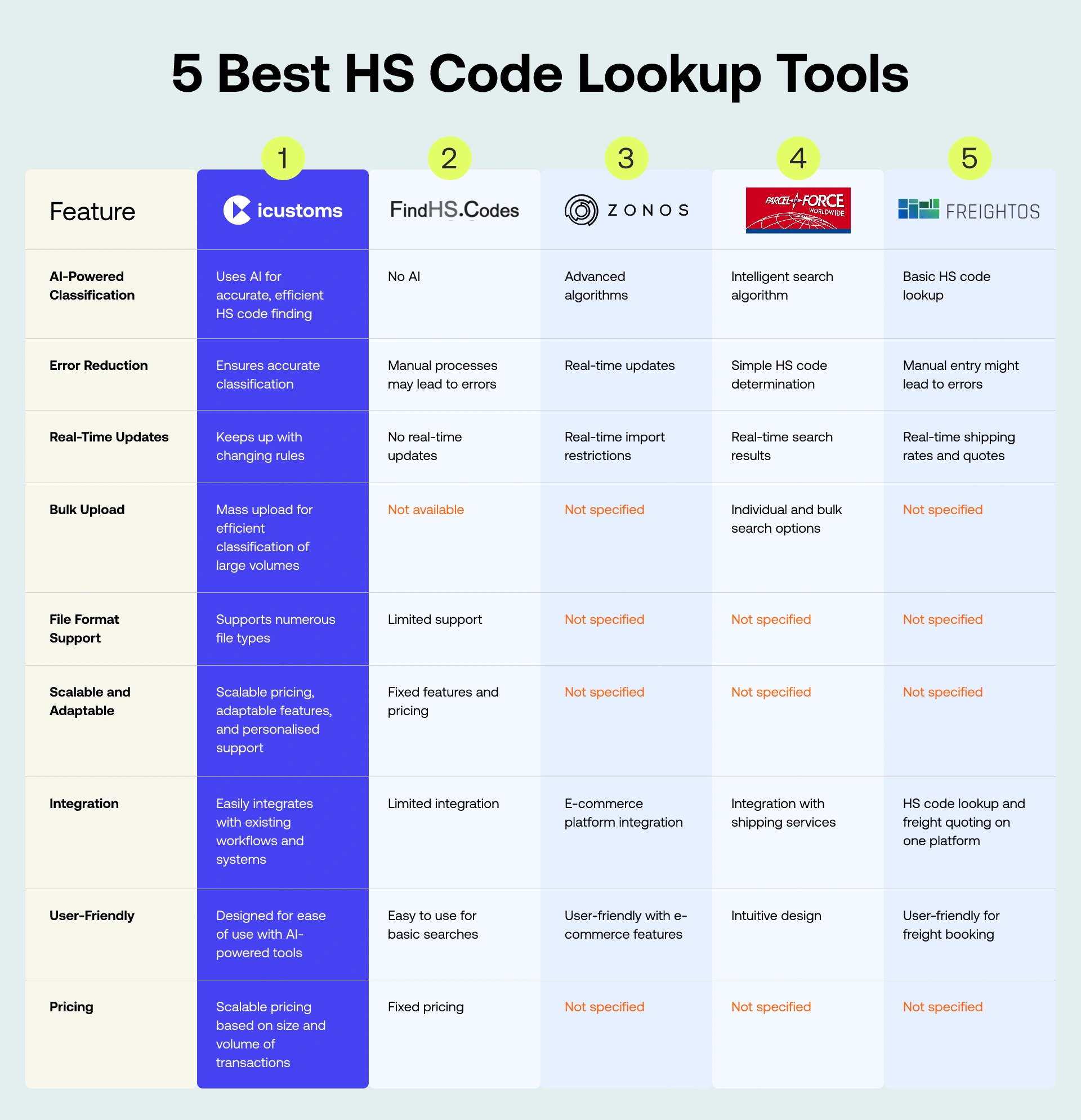
1. iClassification by iCustoms: Best HS Code Lookup Tool for UK Importers, Exporters, and Compliance Teams
iClassification is the AI-powered tariff classification engine built by iCustoms specifically for the UK customs environment. Unlike global tools that classify goods to the 6-digit WCO Harmonised System level, iClassification works with 10-digit UK commodity codes as used in HMRC’s Customs Declaration Service (CDS). This matters because UK importers submitting CDS declarations need the full 10-digit commodity code, not a 6-digit international approximation, and errors at the 10-digit level are what trigger HMRC queries and duty recalculations.
The platform works by analysing your product description, whether that is a single item description, a line from a commercial invoice, or a bulk product catalogue, and returning the most likely 10-digit UK commodity code with a confidence score. For goods that fall into ambiguous categories, iClassification flags the classification for human review rather than returning a low-confidence suggestion without warning. This is a more useful behaviour than tools that always return a code regardless of certainty.
iClassification Key Capabilities
HS code lookup by product description: Enter a product name, description, or materials composition and receive a suggested UK commodity code with confidence scoring and duty rate information.
- Bulk upload and batch classification: Upload product catalogues in CSV or Excel format and receive classifications for thousands of SKUs in a single session, with exception flagging for items that need manual review.
- AI trained on UK declarations: The product classification model is trained on UK customs declaration data, which means its accuracy for UK-specific commodity codes is higher than tools trained primarily on WCO international data.
- IDP integration: iCustoms Intelligent Document Processing (IDP) reads commercial invoices and packing lists and extracts product descriptions automatically, feeding them into iClassification without manual data entry. This creates an end-to-end workflow from document to commodity code.
- CDS-ready output: Classified codes are formatted to the 10-digit standard required for CDS import declarations. Exporters using CDS for export declarations also benefit from iClassification’s output format compatibility.
- Classification audit trail: Every classification is stored with the date, the user who performed it, the AI suggestion, and any manual review notes. This audit trail is the standard required by HMRC for businesses that use simplified declaration procedures.
- API access: iClassification is available via API for businesses that want to integrate HS code classification directly into their ERP, TMS, WMS, or ecommerce platform. The API accepts product description strings and returns commodity codes with confidence scores, duty rates, and VAT rates.
Best suited for: UK importers and exporters managing more than 50 product lines who need accurate 10-digit commodity codes for CDS declarations. Particularly strong for retailers with large SKU catalogues, manufacturers importing components under inward processing relief, and freight forwarders classifying goods for multiple clients.
Tired of manual searches and guesswork?
Get the precise, AI-powered classification for your product instantly.
HS Code Lookup Tool

UK Integrated Online Tariff
Best match Products Name or products description , you can select any of them to check and calculate duty rate, VAT rate and total landed cost.
- Searching...
This tariff information is for the UK only
2. Find HS.Codes
FindHS.Codes is a search engine that contains thousands of predefined harmonised system codes that enable you to determine the accurate code for your product.
What FindHS.Codes offers:
- User-friendly interface: Find HS is renowned for its ease of use. It is excellent at giving fast suggestions for HS codes based on product descriptions.
- Not designed for single products: This site is not for you if you want to determine the HS code for a single or a few products.
- Limited advanced features: FindHS works well for basic searches. Advanced elements like duty and VAT calculation and trade data for intricate product categories could not be present.
3. Zonos
Zonos assists in finding HS codes with its advanced product “Classify,” enhancing efficiency and preventing delays.
What Zonos offers:
- E-commerce integration: Zonos is the best option for online retailers since it easily integrates with well-known e-commerce platforms to automate tariff classification, duty computation, and HS code search.
- Real-time information: The platform offers real-time updates on import restrictions to ensure compliance and save delays.
- Global coverage: Businesses that operate in several markets can benefit from Zonos’s extensive coverage of countries and product categories.
4. Parcelforce
Parcelforce is a reliable partner when it comes to finding a harmonised system code for your goods, but it may only be best suited to delivery and parcel companies.
What Parcelforce offers:
- Integration with shipping services: Parcelforce, a top shipping company, offers simple HS code determination for businesses sending goods to and from the UK, a smooth shipping experience.
- Intuitive design: With our intelligent search bar, you can easily find HS codes for your products. Our search bar is the ideal tool for classifying products quickly and easily. Simply enter a product description, keyword, or part of the code, and our intelligent search algorithm will return relevant results.
- Search options: We understand that product catalogues may vary; thus, we provide you with individual and bulk search options, saving time and resources.
5. Freightos
Freightos is a global logistics company helping freight forwarders, importers, and exporters with shipment and freight management. Their HS code calculator helps you find the accurate code for your goods, plus it offers the following benefits.
What Freightos offers:
- Global network: Freightos offers a wide range of shipping options at reasonable prices, facilitated by its extensive network of freight carriers.
- HS code lookup and freight quoting: Freightos’s HS code lookup tool helps users find HS codes, import tariffs, and shipping costs on one platform.
- Focus on shipping: Freightos provides helpful HS code information, but its primary focus is freight booking, so businesses that are solely interested in HS code research may not be able to utilise it fully.
Confused about how Destin8 fits into your CDS declaration process? Read our guide to Destin8 login codes and port community system workflows.
HS Code Updates: What HS2022 and HS2027 Mean for Your Classification Compliance
The Harmonised System is maintained by the World Customs Organisation and is updated in full every 5 years. The most recent update, HS2022, came into effect on 1 January 2022 and introduced over 350 amendments across product categories including pharmaceuticals, chemicals, electronics, and food products. The next update, HS2027, is currently in development and will introduce further changes, particularly in areas such as renewable energy goods, electronic waste, and digital commerce products.
HS code updates matter for businesses because a commodity code that was correct in 2021 may have been changed, split, or merged in the HS2022 update. If your classification system was not updated in January 2022, or if your product catalogue was not reviewed against the new schedule, you may have been filing incorrect commodity codes for UK CDS declarations since then without realising it. This is one of the most common causes of HMRC retrospective duty assessments.
iClassification automatically applies updates when the UK Global Trade Tariff schedule changes. When HMRC publishes amendments to the 10-digit commodity code structure, iClassification’s classification database is updated accordingly. For businesses using manual lookup tools or static HS code lists, this update management must be done manually, which is error-prone and resource-intensive.
When choosing an HS code lookup tool, ask specifically how the provider manages tariff schedule updates. A tool that was last updated in 2021 is not safe for current CDS declaration filing.
Classify 1000s of Products in One Click
Managing a large product HS code list catalog? Our bulk upload feature eliminates the bottleneck, saving you time and reducing costs dramatically.
HS Code API Integration: What Businesses Need to Know Before Choosing an API Provider
An HS code API is a programmatic connection that allows your business software (ERP, ecommerce platform, TMS, or customs management system) to send a product description and receive an HS code in return, without any manual input from a user. For businesses classifying hundreds or thousands of product lines, an API connection eliminates the manual lookup step entirely and integrates classification directly into existing workflows.
The iClassification API from iCustoms accepts a product description as an input and returns the UK 10-digit commodity code, the applicable import duty rate, the VAT rate, and a confidence score. For ecommerce retailers, the API can be integrated at the product listing stage so that every new SKU is classified automatically when it is created. For manufacturers, the API connects to bill of materials systems to classify each component as it is added to the procurement catalogue.
When evaluating HS code API providers, ask three questions. First: does the API classify to the national tariff level (10-digit for UK, 8-digit CN for EU, 10-digit HTS for US) or only to the 6-digit WCO international level? A 6-digit API will require additional manual steps for CDS declarations. Second: how is the API updated when the WCO issues a new Harmonised System edition (HS2022, HS2027)? An API provider that does not update its classification database when the tariff schedule changes will return outdated codes. Third: what is the API rate limit and pricing model for high-volume classification? Businesses classifying 50,000 or more SKUs per year need enterprise API access, not a standard tier.
iClassification API is available to iCustoms customers. Contact the iCustoms team to discuss API access, rate limits, and integration support for your specific platform.
Bulk HS Code Lookup: How to Classify Thousands of Products Without Manual Searching
Manual HS code lookup, one product at a time through a web interface, works for businesses importing a small number of product lines. For retailers with hundreds of SKUs, manufacturers with extensive component catalogues, or freight forwarders classifying goods for multiple clients, manual lookup is not viable. Bulk HS code classification tools process your entire product list in a single upload and return classifications for every item simultaneously.
iClassification supports bulk upload via CSV and Excel. A typical bulk classification session works like this: you export your product list from your inventory system, upload the file to iClassification, the AI processes each product description and returns a suggested 10-digit UK commodity code, and you review the results with exceptions flagged for human attention. For a catalogue of 1,000 products, a session that would take several weeks of manual lookup takes a matter of hours in iClassification.
Not all bulk lookup tools are equal. The key distinction is between tools that return a code for every product regardless of confidence level, and tools that flag low-confidence classifications for review. iClassification uses a confidence scoring system so you can see at a glance which classifications are high-certainty and which need a second look from your compliance team. This is particularly important for goods in complex categories such as industrial machinery, chemicals, and electronics where classification at the 10-digit level requires specialist knowledge.
If you are a freight forwarder classifying goods for multiple clients, iClassification supports multi-client bulk sessions with classification histories stored separately by client for audit purposes.
How to Check an HS Code for Import
Checking an HS code for import means verifying that the commodity code you intend to declare on a UK customs entry is accurate, current, and appropriate for the specific goods being imported. This is not the same as simply finding a code. Finding a code identifies a candidate classification. Checking it confirms the candidate is correct by validating it against four criteria: structural validity, tariff schedule currency, duty rate appropriateness, and import measure compliance.
HMRC does not accept good-faith effort as a defence for misclassification. The legal standard is reasonable care, which requires a documented verification process, not just a single lookup. For regular importers, having a structured checking process is the difference between a defensible classification and a compliance exposure.
What to Verify Before Filing Your Import Declaration
| Check | What to Verify | Where to Confirm |
|---|---|---|
| 1. Structural validity | Is the code 10 digits? Does it exist in the current UK tariff? | UK Global Online Tariff (trade-tariff.service.gov.uk) |
| 2. Currency | Was the code updated in the HS2022 revision? Is it still active? | UK tariff — check for ‘End date’ against the commodity code |
| 3. Duty rate | Does the duty rate match your cost model and invoice value? | UK tariff — ‘Import duty’ tab for the 10-digit code |
| 4. Import controls | Does the code trigger a licence, permit, or certificate requirement? | UK tariff — ‘Measures’ tab for the 10-digit code |
| 5. Trade preference | If claiming a preferential rate, does the code qualify under the relevant agreement? | UK tariff — ‘Preferences’ tab and rules of origin check |
If any of these checks raises a concern, do not file the declaration until it is resolved. HMRC’s risk profiling system flags declarations where the commodity code is inconsistent with the goods value, the country of origin, or known patterns for that product category. A failed check that results in a held shipment at the border is significantly more disruptive than taking the time to verify before filing.
How to Verify HS Code Accuracy
Verifying HS code accuracy is a distinct step from initial classification. Classification is the process of identifying which code applies to a product. Verification is the process of confirming that the identified code is correct before it is used in a live customs declaration. Businesses that skip verification and file directly from their first classification result are accepting unquantified compliance risk on every shipment.
The most common verification failure is checking only that a code exists, without checking whether it applies specifically to the goods in question, whether it is still active under the current HS edition, and whether it carries any measures that affect the shipment. A code can be structurally valid and still be wrong for a particular product.
The Three-Layer Accuracy Check for Any HS Code
- Descriptive match check. Compare the commodity code description in the UK Global Online Tariff against your product’s actual physical characteristics — material, function, dimensions, and intended use. The tariff description must accurately describe your specific goods, not just the broad product category. If the tariff description covers your product only partially, or if a chapter note excludes your product from that heading, the code is wrong regardless of how commonly it is used for similar goods.
- Edition currency check. Confirm the code is valid under the current HS edition (HS2022 until HS2027 takes effect). The UK tariff shows an end date for any commodity code that has been discontinued or replaced. If no end date is shown, the code is current. If an end date is shown, you need the replacement code from the HS2022 correlation table. HMRC issues notices when commodity codes change; iClassification applies these changes automatically.
Measures and controls check. Look at the ‘Measures’ tab for the commodity code in the UK tariff. Some codes carry import licences, phytosanitary certificates, CITES permits, anti-dumping duties, or safeguard measures that are not visible from the duty rate alone. A shipment declared under the correct commodity code but without the required accompanying licence or certificate will be held at the border regardless of how accurate the code itself is.
HS Code for Ecommerce Sellers
For ecommerce sellers shipping goods internationally, an HS code is no longer optional or only relevant at customs clearance. Major ecommerce platforms now require HS codes at the product listing stage. The UK government requires an HS code on all export declarations including low-value items shipped directly to consumers abroad. And from July 2026, the EU’s Import One Stop Shop (IOSS) scheme requires full 10-digit TARIC codes on all eligible consignments, replacing the previous requirement for a 6-digit HS code.
The practical consequence for UK ecommerce sellers is that every product in their catalogue needs a verified HS code — not a rough approximation, but the correct 6-digit international code for customs paperwork and the correct 10-digit national code for declaration purposes. Sellers shipping to multiple markets need to know which national extension applies in each destination country.
HS Code Requirements by Ecommerce Sales Channel
| Sales Channel / Destination | HS Code Requirement | Consequence of Wrong Code |
|---|---|---|
| UK to EU (IOSS, from July 2026) | Full 10-digit TARIC code per product | EU customs query, shipment held, IOSS compliance risk |
| UK to US (de minimis under $800) | 6-digit HS code on commercial invoice | Potential CBP query; above de minimis needs full HTS |
| Amazon, eBay, Shopify (cross-border) | 6 or 10-digit code required at listing stage | Platform may auto-assign a code — verify it is correct |
| UK domestic sales sent abroad as gifts | Required on all export declarations over GBP 0 | HMRC may query missing or incorrect codes on CN22/CN23 |
| B2B exports (any value) | 10-digit UK commodity code on CDS export declaration | Declaration rejected or HMRC compliance query |
For ecommerce sellers with large catalogues, classifying every SKU manually is not practical. iClassification’s bulk upload feature allows sellers to upload their full product list and receive HS code suggestions for every item in a single session. The AI flags low-confidence classifications for human review, which is particularly useful for sellers whose catalogues span multiple product categories with different classification rules.
HS Code Guide for Importers
For importers, the HS code on a customs declaration is the single most consequential classification decision in the entire shipment process. It determines the import duty rate, the VAT treatment, whether an import licence or permit is required, and whether trade agreement preferences are available. An incorrect code creates financial exposure through duty underpayment or overpayment, operational exposure through border delays, and legal exposure through HMRC penalties under Finance Act 2008 Schedule 41.
UK importers using the Customs Declaration Service (CDS) must declare a 10-digit commodity code on every import entry. The 6-digit international HS code is the foundation, but it is not sufficient on its own for a CDS declaration. The additional 4 digits determine the specific duty rate and any UK-specific measures that apply to the goods.
Five Things Every Importer Needs to Know About HS Codes
- You are legally responsible for the code, even if a broker files it. Under UK customs law, the importer of record bears primary liability for the accuracy of the commodity code. If your freight forwarder or customs agent files an incorrect code on your behalf as direct representative, HMRC pursues you for any underpaid duty. Get your classifications documented and reviewed.
- The 6-digit code is not enough. UK CDS declarations require a 10-digit commodity code. Filing at 6-digit precision will result in a rejected declaration. The additional 4 digits often determine whether duty is 0% or 12%, so they are not administrative detail.
- Your supplier’s HS code may not be your import code. The code your overseas supplier uses for export in their country reflects their national tariff. The UK 10-digit commodity code for the same product may differ. Always verify against the UK tariff, not the supplier’s invoice.
- HMRC audits classifications for 3 years. Post-clearance audits can reach back 3 years from the declaration date. Systematic misclassification across multiple shipments creates a compounding liability. A classification audit trail demonstrating your methodology significantly reduces penalty risk.
- Binding Tariff Information (BTI) gives legal certainty. If you import a product regularly and the correct classification is unclear, apply to HMRC for a BTI ruling. It is legally binding for 3 years, free to obtain, and provides complete protection if HMRC later disagrees with the classification.
HS Code Guide for Exporters
Exporters need HS codes for different reasons than importers, and the consequences of getting them wrong are also different. For UK exporters, the commodity code on a CDS export declaration determines whether export controls apply, whether an export licence is required, and how the shipment is recorded in UK trade statistics. Critically, the HS code also determines how the goods will be classified by the customs authority in the destination country, which affects the duty your overseas buyer will pay on receipt.
A UK exporter who provides an inaccurate HS code to their freight forwarder for inclusion on the commercial invoice is not only creating a compliance risk on the UK export entry. They are also potentially causing their buyer to incur incorrect import duties in the destination country, which can damage the commercial relationship and, in the case of controlled goods, create liability under UK export control legislation.
Export HS Code Requirements: What Is Different from Importing
| Factor | Import Declaration | Export Declaration |
|---|---|---|
| UK code required | 10-digit commodity code (CDS Data Element 6/14) | 10-digit commodity code (CDS Data Element 6/14) |
| Primary code purpose | Set duty rate and VAT treatment | Export control check and trade statistics |
| Export licence check | Not applicable | Code checked against UK Strategic Export Control Lists (ECJU) |
| Dual-use goods risk | Screened on import controls tab | Additional check required under Export Control Order 2008 |
| Destination country impact | Not relevant to UK entry | Determines buyer’s import duty; wrong code = wrong duty for buyer |
| Error consequence | Duty underpayment, HMRC audit | Unlicensed export of controlled goods; seizure; criminal liability |
For exporters shipping the same products to multiple countries, the 6-digit international HS code is the universal reference point that customs authorities worldwide will use to classify the goods on import. Providing the correct 6-digit HS code on your commercial invoice helps your buyers’ customs brokers classify the goods accurately in their own country, reducing delays and duty disputes at the destination end.
HS Code API: What Is It?
An HS code API is a software interface that allows a business application to request an HS code classification programmatically, without any manual user input. Instead of a person opening a tariff tool, entering a product description, and copying a code into a declaration system, the API does this automatically: the business system sends a product description to the API, the API processes it against the tariff database and classification model, and the API returns the HS code directly back to the calling system.
For businesses classifying goods in volume, an HS code API eliminates the manual lookup step entirely. The classification happens automatically at the point in the workflow where product information is first captured — at the SKU creation stage for ecommerce sellers, at the purchase order stage for manufacturers, or at the booking stage for freight forwarders. By the time a shipment reaches the customs declaration stage, the commodity code is already assigned.
How an HS Code API Works in Practice
| Step | What Happens | Who Benefits |
|---|---|---|
| 1. Product description input | The business system sends a product description string to the API endpoint | ERP, WMS, ecommerce platforms, TMS systems |
| 2. NLP processing | The API analyses the description using natural language processing to extract classification-relevant characteristics | Any system with product description data |
| 3. Tariff matching | The classification model matches the extracted characteristics to the correct HS subheading and national tariff extension | UK importers (10-digit), EU TARIC, US HTS |
| 4. Code and confidence returned | The API returns the commodity code, confidence score, duty rate, and VAT rate | Compliance teams reviewing AI suggestions |
| 5. System update | The calling system stores the code against the product record for use in declarations | Customs teams, logistics operators, finance systems |
The iClassification API from iCustoms works at the 10-digit UK commodity code level, not just the 6-digit WCO HS level. This matters because UK CDS declarations require 10-digit codes, and an API that only returns 6-digit codes requires additional manual steps before the code can be used in a live declaration. The API also returns the applicable import duty rate and VAT rate alongside the code, so the business system can use the classification result for landed cost calculations as well as declaration filing.
Businesses evaluating an HS code API should confirm three things before integrating: that the API classifies to the correct national tariff level (10-digit for UK, 8-digit CN or 10-digit TARIC for EU, 10-digit HTS for US); that the API database is updated when the WCO issues a new HS edition or when HMRC amends the UK tariff; and that the API provides confidence scores so low-certainty classifications can be routed to human review rather than filed automatically.
The bottom line
Choosing the optimal HS code lookup tool depends on your particular business requirements, such as business complexity and size, features you need, pricing, and more.
With features like the customisable plan, seamless integration, and bulk upload, iCustoms is the ultimate solution, suiting all your business requirements. Contrary to generic HS code lookup tools, iClassification ensures utmost precision, real-time updates, and thorough support. Visit our website for a free trial and see how iCustoms can help you grow your business.

Ready to unlock the power of AI-driven iClassification tool?
Get expert guidance from our customs specialist!
People Also Ask
Which systems are considered best for bulk tariff code validation and correction?
For bulk tariff code validation at scale, the leading platforms are iClassification (iCustoms), Avalara AvaTax Classification, and Descartes Classification Intelligence. iClassification is the strongest option for UK importers who need 10-digit commodity code validation against the UK Global Trade Tariff, with exception flagging for codes requiring human review and a classification audit trail for HMRC compliance. Avalara is the preferred choice for multi-country enterprise validation covering US HTS, EU TARIC, and other national schedules simultaneously. Descartes is strongest for logistics and freight forwarder use cases requiring multi-client bulk validation workflows.
Which platforms deliver the best tariff code assignment automation for global trade?
For automated tariff code assignment across global trade lanes, Avalara and Descartes Classification lead for enterprise multi-country coverage. For UK and EU-focused trade, iClassification from iCustoms provides AI-powered commodity code assignment from product descriptions, returning 10-digit UK codes and 8-digit EU CN codes with confidence scoring. The key differentiator between platforms is whether they classify to the national tariff level (required for UK CDS declarations and EU customs filings) or only to the 6-digit WCO HS level, which is insufficient for live declaration filing without additional manual steps.
What are the best commercial platforms for tariff code rule updates and maintenance?
Platforms that automatically apply WCO Harmonised System updates (HS2022, HS2027) without requiring manual tariff database management include iClassification, Avalara, and Descartes. iClassification applies updates when HMRC publishes changes to the UK Global Trade Tariff 10-digit schedule. Businesses using manual tools or static HS code lists must manage these updates themselves, which creates compliance risk when codes are changed, split, or merged in each 5-year WCO revision cycle. For businesses with large product catalogues, choosing a platform with automated rule updates eliminates a significant ongoing compliance burden.
Which tools provide the leading analysis of duties by HS code and origin country?
Duty analysis by HS code and country of origin requires a tool that combines tariff classification with rules of origin and preferential duty rate calculation. iClassification returns the applicable import duty rate and VAT rate alongside the UK commodity code, and indicates where preferential rates may apply under UK trade agreements. For comprehensive multi-country duty analysis including US HTS duties, EU TARIC additional duties, and antidumping measures, Avalara and Descartes offer deeper global coverage. For UK-centric duty analysis in the context of CDS import declarations, iClassification is the most integrated option.
Which providers deliver the leading classification accuracy for duty calculation?
Classification accuracy for duty calculation purposes means correctly identifying the 10-digit commodity code that determines the applicable duty rate, not just the 6-digit WCO base. iClassification achieves high classification accuracy for standard goods categories entering the UK by training its AI on UK customs declaration data and applying confidence scoring to flag ambiguous cases for human review rather than returning low-certainty codes automatically. Avalara publishes benchmark accuracy rates for its AvaTax Classification product. For duty-critical classification where an error would trigger HMRC review, any platform should include a human expert review step for complex or high-value goods.
Which tools offer the most reliable tariff classification workflows?
Reliable tariff classification workflows include four features: AI-assisted initial classification, human expert review for flagged items, a full audit trail recording who classified what and when, and automatic updates when the tariff schedule changes. iClassification provides all four of these features in a single platform. The audit trail is particularly important for businesses using simplified declaration procedures under HMRC authorisation, where HMRC may request evidence of classification methodology during a compliance check. Role-based access controls ensure that only qualified users can override AI suggestions and approve final classifications.
You may also like




Streamline Product Classification

Uncover iClassification for precise Global Trade, Delivering Time-Saving Accuracy.
Subscribe to our Newsletter
About iCustoms
iCustoms is an all-in-one solution helping businesses automate customs processes more efficiently. With AI-powered and machine-learning capabilities, iCustoms is designed to streamline your all customs procedures in a few minutes, cut additional costs and save time.
Streamline Product Classification
Uncover iClassification for precise Global Trade, Delivering Time-Saving Accuracy.