Italy Customs Declaration Guide, Digital Filing, MRN Workflow, ICS2 Compliance and AI Automation
- John Hall
- Customs Specialist at iCustoms.ai
Italy operates one of the most advanced digital customs systems in the European Union. For freight forwarders, hauliers, NVOCCs, and logistics providers moving goods between Italy and non-EU countries, customs declaration accuracy is not administrative. It is operational control, financial exposure management, and regulatory compliance infrastructure.
This guide explains how the Italy Customs Declaration functions under the Union Customs Code, how electronic filing operates, how MRN and ICS2 security flows interact, and how intelligent automation strengthens compliance resilience.
The Legal and Institutional Framework in Italy
Italy’s customs regime is governed by the Agenzia delle Dogane e dei Monopoli (Customs and Monopolies Agency) and operates under the Union Customs Code, aligned with the EU Customs Data Model. All Italy import and export declarations must be submitted electronically via national telematic systems integrated with EU platforms including ICS2, AES, and NCTS.
Customs processing is system-driven and data-validated. For B2B operators, compliance depends on structured data accuracy, correct procedure selection, and system interoperability.
What Is a Customs Declaration in Italy
A customs declaration is the formal electronic submission that places goods under a specific customs procedure. It defines the legal status of goods, determines customs duty and Import VAT liability, and activates compliance and security controls.
Declarations are transmitted through structured XML messages aligned with EUCDM. Required data includes classification, origin, customs value, transport details, and supporting documentation. Errors or inconsistencies lead to electronic rejection, inspection, or post-clearance audit review.
Customs Declaration Forms and SAD Documentation
Although submission is digital, declaration structures derive from the Single Administrative Document framework, which standardised customs data elements across the EU.
In Italy, SAD data fields are mapped into electronic message types. For logistics operators, this requires:
- Correct Customs Procedure Codes
- Accurate TARIC code selection
- Proper valuation methodology
- Digitally attached supporting documents
Alignment with EUCDM logic is essential to prevent validation errors.
EORI Number Italy, Economic Operator Registration and Identification
The EORI number (Economic Operator Registration and Identification) Italy is mandatory for any economic operator lodging customs declarations within the EU. It consists of a country code followed by a unique registration number and is required for both import and export declarations.
No declaration can be submitted without a valid EORI. In B2B practice:
- Freight forwarders file under their EORI when acting as direct representatives
- Importers must maintain active registration
- EORI validation is required before filing
Incorrect data results in immediate electronic rejection.
EORI Number Italia and Data Alignment
For operators within the Italian customs framework, maintaining an EORI number Italia is a core compliance requirement. The identifier links fiscal and customs records across EU systems. In logistics operations, EORI details must align with VAT registration data and ERP records. Periodic validation prevents declaration mismatches and reduces exposure during customs audits.
Movement Reference Number and Clearance Traceability
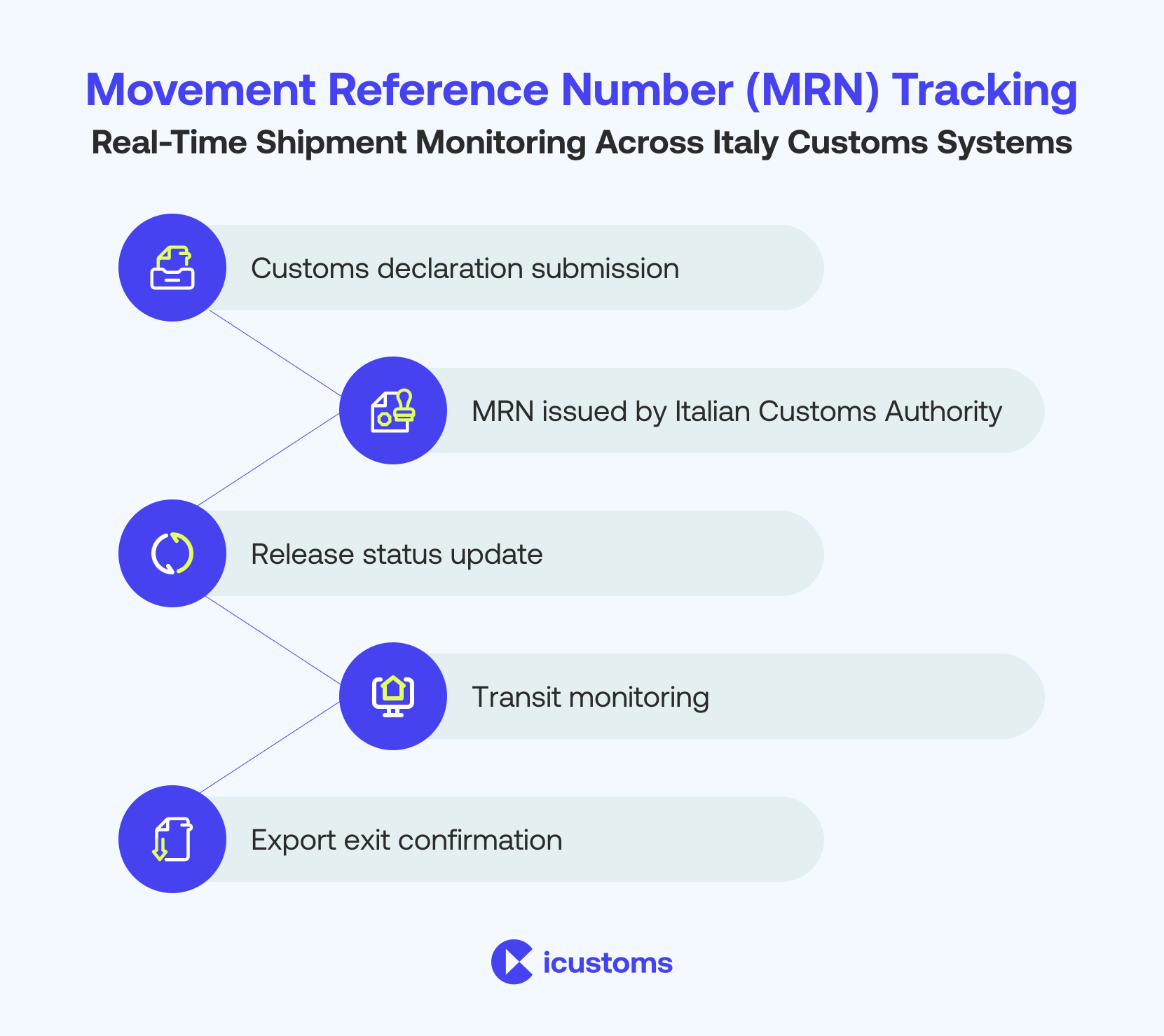
Once a declaration is accepted, customs assigns a Movement Reference Number. The MRN is the lifecycle identifier of the shipment and governs its operational and fiscal traceability. The MRN connects declaration data, customs responses, release status, export exit confirmation, and accounting documentation under a single reference.
Scenario: A freight forwarder submits an H1 declaration for goods arriving in Genoa. Customs accepts the filing and issues the MRN. Without confirmation of release status under that MRN, the container cannot be collected. Automated tracking prevents operational delays.
H4Inward processingManufacturing inputs
| Message Type | Procedure | Use Case |
| H1 | Release for free circulationc | Standard imports |
| H2 | Customs warehouse | Deferred storage |
| H3 | Temporary admission | Short-term use goods |
| H7 | Low-value goods | E-commerce consignments |
Each filing must include TARIC code, customs value or intrinsic value, country of origin, Incoterms, and commercial invoice data. Incorrect HS Classification Codes create customs audit exposure.
TARIC Code, Commodity Codes and Harmonized System
Italy applies the EU TARIC system derived from the Harmonized System for product classification. Accurate product classification determines:
- Duty rate
- Anti-dumping measures
- Licensing requirements
- Statistical obligations
Scenario: A logistics provider misclassifies industrial components under a general machinery heading. A post-clearance review identifies anti-dumping applicability, resulting in retroactive duty assessment.
AI-assisted classification reduces risk by analysing product descriptions against TARIC datasets.
Import VAT and Fiscal Documentation
Import VAT is payable at clearance unless deferred under authorised regimes. After release, customs generates accounting summaries and supporting documentation linked to the MRN. These records are essential for VAT deduction and must be digitally archived in compliance with Italian preservation standards. Automated retrieval and structured storage ensure financial accuracy and audit readiness for high-volume operators.
ICS 2 Italy - Import Control System 2 Requirements

Security filings are separate from fiscal declarations. The Import Control System 2 requires pre-arrival Entry Summary Declarations for goods entering the EU.
ICS2 performs risk analysis before arrival. For logistics operators:
- ENS data must align with final customs declaration data
- Discrepancies trigger automated risk profiling
- Missing filings may block loading
Integrated customs software prevents inconsistencies between ENS submissions and import declarations.
Export Declarations and Proof of Exit
Exports from Italy follow AES message formats. Once goods exit the EU, confirmation must be validated under the corresponding MRN. Proof of exit is necessary for VAT zero-rating. Failure to validate export status may result in fiscal reassessment during audit. Automated export monitoring ensures exit confirmation tracking and structured documentation retrieval.
Customs Telematic Services and Digital Integration
Italy’s customs environment is fully electronic. Declarations are transmitted in structured XML, automatically validated, and processed in near real time.
High-volume freight operations require EDI and API integration to enable:
- System-to-system communication
- Automated validation responses
- Real-time status updates
- Structured audit logs
Customs declaration software becomes core operational infrastructure.
Intelligent Document Processing in Customs Operations
Freight operators process large volumes of commercial invoices, packing lists, certificates of origin, and transport documents. Intelligent Document Processing uses AI-based extraction to convert unstructured documents into structured customs-ready datasets.
Benefits include:
- Automated HS classification suggestions
- Pre-submission validation
- Reduced rejection rates
- Faster clearance cycles
For multi-country logistics operations, IDP improves data accuracy and reduces manual intervention.
Italy Low-Value Shipment Rules, €150 Threshold
From 1 January 2026, Italy applies an administrative contribution to imports from non-EU countries where declared value does not exceed €150.
H1 Customs Import Declaration, Customs Value Threshold
For H1 declarations, the threshold is assessed using customs value. Where the value does not exceed €150, the contribution must be calculated and declared at filing. Accurate valuation logic and TARIC mapping are essential to prevent incorrect liquidation and compliance exposure.
H7 Simplified Declaration, Intrinsic Value and Periodic Accounting
For H7 declarations, the threshold is based on intrinsic value. Contributions are accounted for periodically rather than per declaration. High-volume operators must manage valuation accuracy and reconciliation controls to mitigate financial risk.
Debtor Liability and Representation
Under the Union Customs Code, the declarant is responsible for customs debt. In indirect representation scenarios, both the declarant and the represented importer may share liability. Freight forwarders providing customs declaration services must manage classification, valuation, and procedural risk through structured internal controls.
Practical Scenario, Multi-Modal Freight Operations in Italy
A Milan-based freight forwarder manages:
- Air freight from Asia
- Maritime containers via Genoa
- Road freight from Germany
Each shipment requires ENS submission, H1 declaration, TARIC classification, Import VAT accounting, MRN monitoring, and digital archiving.
With integrated customs software:
- Documents are extracted automatically
- Classification suggestions are generated
- ENS and declaration data remain synchronized
- MRN events trigger workflow updates
- Fiscal records are archived automatically
Operational risk decreases while throughput improves.
Building a Future-Proof Italy Customs Strategy
A resilient Italy customs declaration strategy should include:
- Structured EUCDM-aligned data governance
- AI-supported HS classification
- Automated EORI validation
- Integrated ICS2 submission
- Real-time MRN lifecycle monitoring
- Digital audit-ready archiving
- API connectivity with national customs systems
Why iCustoms Is Built for Italy’s Digital Customs System
Italy operates one of the most structured digital customs regimes in the European Union. Electronic declarations, MRN lifecycle control, ICS2 security submissions, and evolving compliance reforms require more than form-based software. They require infrastructure that sits inside the transaction.
iCustoms is designed specifically for high-volume EU and Italy export declaration workflows, embedding AI-driven compliance within live customs operations. Rather than acting as an interface layer, the platform integrates directly with Italian customs systems, supporting structured filings aligned with the Union Customs Code and EU Customs Data Model.
Built for Italian Regulatory Complexity
The Italian customs environment is dynamic. From low-value shipment reforms to ICS2 pre-arrival requirements and export validation through AES, compliance demands continuous alignment.
iCustoms provides:
- Automated validation against current EU and Italy customs rules
- Real-time MRN monitoring for imports and exports
- Integrated ICS2 declarations in under 90 seconds
- Seamless transit processing through iNCTS
- Audit-ready digital record retention
For freight forwarders and logistics operators filing in Italy, this reduces the risk of penalties, rejected declarations, and compliance gaps.
AI Embedded in Italy Customs Transactions
In Italy’s fully electronic filing system, data accuracy determines clearance speed. iCustoms applies AI-powered intelligent document processing to convert invoices, packing lists, and transport documents into structured customs-ready datasets.
The platform enables:
- AI-assisted HS classification and TARIC validation
- EORI number verification
- Automated duty and valuation checks
- Mirror data logic to eliminate duplicate filings
This reduces manual customs entries, improves accuracy rates up to 99 percent, and streamlines Italy customs clearance workflows.
Scalable Customs Software Integration Across EU Countries
Operating across all key European countries, iCustoms provides a single platform for export declarations, import control system filings, and transit management. API-first architecture enables direct integration with ERP and TMS systems, ensuring Italian customs submissions are synchronised with internal operations.
For logistics companies filing through the Italian Customs Authority, this means:
- Reduced administrative workload
- Faster declaration processing
- Lower compliance exposure
- Scalable cross-border customs operations
In Italy’s high-data regulatory environment, customs compliance is no longer a back-office task. It is operational infrastructure.
Conclusion: From Italian Customs Compliance to Strategic Infrastructure
Italy’s customs ecosystem combines electronic declarations, ICS2 security controls, TARIC precision, MRN traceability, and fiscal documentation into a high-data regulatory environment. For freight forwarders and logistics operators, automation is not optional. AI-driven customs declaration software transforms compliance from reactive document handling into proactive regulatory control.
In Italy’s digital customs environment, intelligent automation is an operational infrastructure and competitive advantage.
FAQ: Italy Customs Declaration Questions and Answers
What is a customs declaration in Italy?
A customs declaration in Italy is a structured electronic submission that places goods under a specific customs procedure. It determines duty, import VAT, and compliance checks under the Union Customs Code, using EU-aligned data formats.
Is customs declaration in Italy fully digital?
Yes. Italy operates a fully electronic customs system where all import and export declarations are submitted via telematic platforms aligned with the EU Customs Data Model. Manual submissions are no longer accepted.
What is an MRN number in Italy customs?
The Movement Reference Number, MRN, is a unique identifier assigned after a declaration is accepted. It tracks the shipment lifecycle, including release status, export confirmation, and audit records.
What is ICS2 and how does it apply in Italy?
ICS2, Import Control System 2, is the EU’s pre-arrival security system. It requires Entry Summary Declarations before goods reach Italy, enabling risk assessment and preventing non-compliant shipments from entering the supply chain.
Do you need an EORI number for Italy customs declarations?
Yes. An EORI number is mandatory for any business submitting customs declarations in Italy or across the EU. Without a valid EORI, declarations cannot be processed or accepted.
What are the main import declaration types in Italy?
Italy uses EU-standard message types such as H1 for release for free circulation, H2 for warehousing, H3 for temporary admission, H4 for inward processing, and H7 for low-value consignments.
How does AI improve customs declaration in Italy?
AI-powered customs software automates document processing, validates TARIC classification, ensures ICS2 data alignment, and reduces errors. This improves clearance speed, compliance accuracy, and audit readiness.
What is the Italy Customs and Monopolies Agency?
The Italy Customs and Monopolies Agency, Agenzia delle Dogane e dei Monopoli, is the national authority responsible for customs controls, trade compliance, excise duties, and state monopolies. It oversees import and export declarations, risk management, and enforcement under the Union Customs Code.
What does the Monopolies Agency do in Italy customs operations?
In customs operations, the Monopolies Agency manages electronic declaration systems, validates trade data, assigns MRN numbers, and enforces compliance with EU regulations. It also supervises excise goods such as tobacco, alcohol, and energy products within Italy.

Italy Customs Declarations, Built for Faster Clearance
Automate ICS2, declarations, and MRN tracking with accuracy and speed. Reduce errors and delays. Book your demo today.
You may also like:
How TARIC Codes Influence Import Duties
Struggling to Extract, Catagorise & Validate Your Documents?

Capture & Upload Data in Seconds with AI & Machine Learning
Subscribe to our Newsletter
About iCustoms
iCustoms is an all-in-one solution helping businesses automate customs processes more efficiently. With AI-powered and machine-learning capabilities, iCustoms is designed to streamline your all customs procedures in a few minutes, cut additional costs and save time.
Struggling to Extract, Catagorise & Validate Your Documents?
Capture & Upload Data in Seconds with AI & Machine Learning