Denmark Customs Declaration Process for Imports and Exports
- John Hall
- Customs Specialist at iCustoms.ai
All goods entering Denmark from non-EU countries must follow the Denmark customs declaration process defined under EU customs law and administered by the Danish Customs Agency. Importers or their representatives must submit an electronic customs declaration containing shipment data, commodity codes, valuation details, and transport information.
The declaration ensures that customs authorities can determine the correct duties, VAT obligations, and regulatory checks before goods enter the EU single market. Denmark applies the same customs framework as other EU member states, meaning that once goods are cleared in Denmark they may move freely across the EU internal market.
How to File Customs Declaration Denmark
Most freight forwarders and shipment companies submit declarations electronically using EU-compatible customs systems integrated with the Danish customs infrastructure. The process typically involves preparing shipment data, classifying the goods under the correct tariff code, calculating duties and VAT, and transmitting the declaration to customs authorities.
For example, a logistics company shipping machinery from South Korea to a Danish manufacturer must submit the import declaration electronically before or at arrival. Customs authorities review the declaration, assess duties based on classification and origin, and release the shipment once compliance checks are completed.
Entry Summary Declaration and ENS Security Filing
Before goods physically arrive in Denmark, carriers transporting shipments into the EU must submit an Entry Summary Declaration (ENS) under the Import Control System security framework. The ENS provides advance cargo data allowing customs authorities to perform risk analysis and security screening.
Failure to submit the ENS within required timeframes can result in shipment holds or administrative penalties. For freight forwarders managing large shipment volumes, automated systems that generate ENS data directly from transport documents significantly reduce compliance risks.
Denmark Import Declaration Requirements
Denmark import declaration requirements are governed by EU customs law and require complete, accurate electronic submission before goods enter free circulation.
Authorities rely on structured shipment data to assess duties, VAT, and regulatory controls across the EU single market.
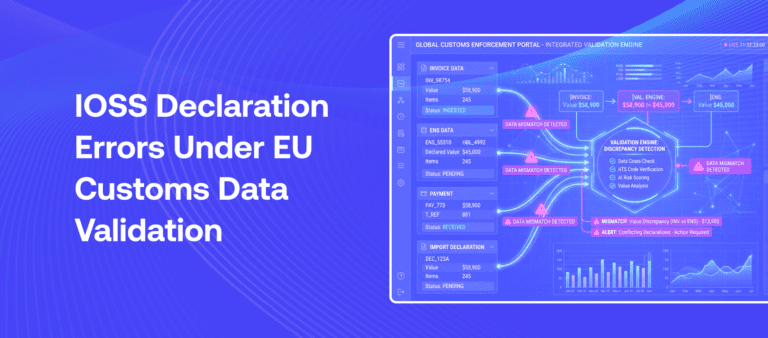
Any data inconsistency can trigger inspections, delays, and additional compliance costs for importers and logistics operators.
Denmark Import Declaration Requirements for Non-EU Shipments
When goods are imported into Denmark from countries outside the European Union, importers must comply with Denmark import declaration requirements under EU customs law. These requirements ensure that customs authorities receive sufficient information to determine tariffs, VAT obligations, and regulatory restrictions.
A standard declaration includes shipment details such as the importer of record, commodity classification, customs value, and country of origin. The declaration must be submitted electronically before goods are released into free circulation within the EU.
Required Data Fields in a Customs Declaration
Import declarations submitted to Danish customs must typically include the following information:
- importer and exporter identification numbers
- product description and commodity code
- customs value and invoice details
- transport method and border entry point
- country of origin and destination
Accurate data entry is critical. Incorrect information can trigger additional inspections, delaying the release of goods and increasing operational costs.
Scenario: Logistics Company Importing Electronics to Denmark
Consider a freight forwarding company importing consumer electronics from Taiwan to a warehouse in Aarhus. The shipment must include a commercial invoice with accurate product descriptions and tariff codes. The customs declaration submitted electronically will calculate import duties and VAT before the goods are released for distribution across the EU market.
EORI Number and VAT Number Denmark
EORI and VAT numbers are fundamental identifiers for businesses engaging in customs and trade activities in Denmark and across the EU. Without valid registration, companies cannot submit declarations, process imports, or fulfil tax obligations within the EU single market.
EORI Number Registration for Denmark Customs Activities
An EORI Number is mandatory for any company involved in customs activities within the European Union. The Economic Operators Registration and Identification system allows customs authorities to identify traders engaged in cross-border trade.
Companies submitting customs declarations, acting as carriers, or requesting customs decisions must have an EORI number before conducting operations within the EU customs territory.
VAT Number Denmark and EU VAT Number Verification
In addition to an EORI number, businesses importing or exporting goods from Denmark often require a VAT number Denmark to manage tax obligations related to imports and sales within the EU. VAT numbers are used to track taxable transactions between companies operating in the European single market. Many logistics and customs platforms integrate tools that allow operators to verify VAT numbers or check EU VAT numbers before submitting declarations.
Scenario: Foreign Exporter Shipping Goods to Denmark
A U.S. manufacturer exporting industrial equipment to Denmark must appoint an EU importer of record with a valid EORI number and VAT registration. Without these identifiers, the customs declaration cannot be submitted and the goods will not be released from customs control.
HS Code Denmark and Product Classification
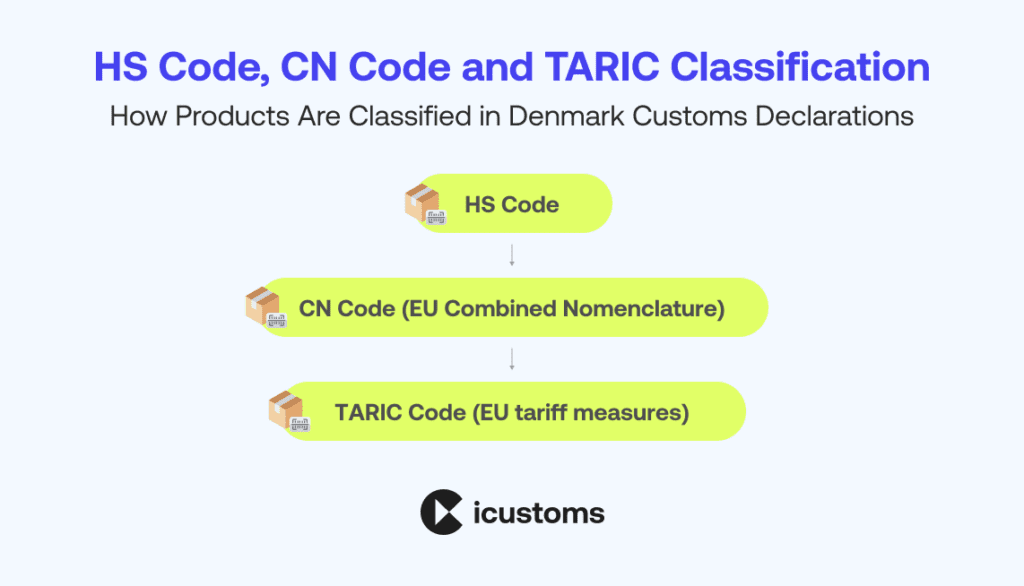
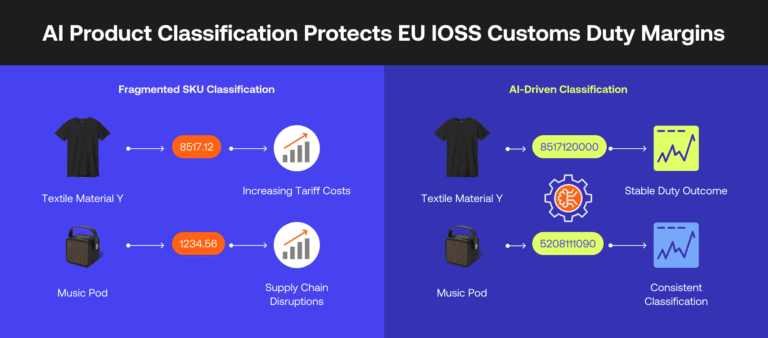
HS code classification in Denmark determines duty rates, VAT exposure, and applicable regulatory controls for all imported goods. Accurate classification under the EU Combined Nomenclature and TARIC framework is essential to avoid audits, penalties, and incorrect duty payments.
HS Code Denmark and Harmonized Tariff Schedule Classification
Product classification is one of the most critical aspects of customs compliance. All goods imported into Denmark must be assigned a Harmonized tariff code, commonly known as an HS code, which determines applicable duties and regulatory requirements. The HS system is maintained globally by the World Customs Organization and used by customs authorities worldwide to standardise product classification in international trade.
HS Code Finder and Commodity Code Lookup
Freight forwarders and importers frequently rely on HS code finder tools or commodity code lookup systems to identify the correct classification for a product. Within the EU, the classification system is extended through the Combined Nomenclature and the TARIC database. Accurate classification ensures that shipments are assessed correctly for tariffs and regulatory controls. Misclassification can lead to underpayment or overpayment of duties and may trigger customs audits.
Scenario: Misclassification Risk in Industrial Imports
A Danish importer sourcing spare machinery parts from China incorrectly classifies the components under a lower duty category. During customs inspection, authorities detect the error and reclassify the goods under the correct tariff heading, resulting in additional duty payments and administrative penalties. Automated classification systems can significantly reduce this risk by analysing product descriptions and suggesting the most accurate tariff code.
TARIC Code and CN Codes EU
TARIC and CN codes extend the global HS framework into EU-specific classifications, enabling precise application of tariffs, trade measures, and regulatory controls. In Denmark customs declarations, these codes directly determine duty calculations, preferential rates, and compliance requirements under EU trade agreements.
TARIC Code and CN Codes EU in Denmark Customs Declarations
Denmark uses the EU TARIC tariff system, which expands the global HS classification framework into more detailed commodity codes applied across the European Union.
TARIC codes allow customs authorities to enforce:
- EU tariff rates
- trade defence measures
- import restrictions
- preferential trade agreements
How TARIC Codes Influence Import Duties
The TARIC database integrates tariff measures such as anti-dumping duties, quotas, and preferential trade agreements. When customs declarations are submitted, the system automatically calculates duties based on the TARIC classification. For example, goods imported from countries with EU trade agreements may qualify for reduced duty rates if the importer provides valid proof of origin.
Scenario: Preferential Tariff under EU Trade Agreement
How TARIC Codes Influence Import Duties
A logistics provider importing automotive components from South Korea may benefit from reduced duties under the EU-Korea Free Trade Agreement. If the exporter provides a valid origin declaration, the TARIC system will apply preferential duty rates during the customs declaration process.
Import Tax Denmark and Import Duty Calculator
Goods imported into Denmark from outside the EU are subject to import duties and VAT depending on the value and classification of the shipment. Customs duties are calculated based on the applicable tariff rate for the product, while VAT is applied to the total customs value of the shipment. The standard Danish VAT rate applied to imports is 25 percent, which is calculated on the value of goods including shipping costs and customs duties.
Import Duty Calculator and Cost Estimation
Many importers use an import duty calculator to estimate total landed costs before shipping goods internationally. Duty calculation typically considers several factors:
- HS tariff code
- customs value of goods
- shipping and insurance costs
- applicable trade agreements
Accurate duty calculations are essential for pricing strategies and supply chain planning.
Scenario: Importing Machinery to Denmark
A manufacturing company importing industrial machinery worth €50,000 must calculate customs duties based on the relevant tariff classification. After duty calculation, Danish import VAT is applied to the combined value of goods, shipping costs, and duties. Automated customs platforms often integrate duty calculators that provide real-time estimates before declarations are submitted.
Denmark Customs Rules for E-commerce Shipments
E-commerce shipments entering Denmark from outside the EU must be declared to customs when their value exceeds specific thresholds or when goods fall under regulated categories.
For example, goods purchased online from outside the EU may require payment of customs duty when the total value exceeds EUR 150, in addition to import VAT and carrier handling fees.
IOSS VAT and Low-Value Consignments
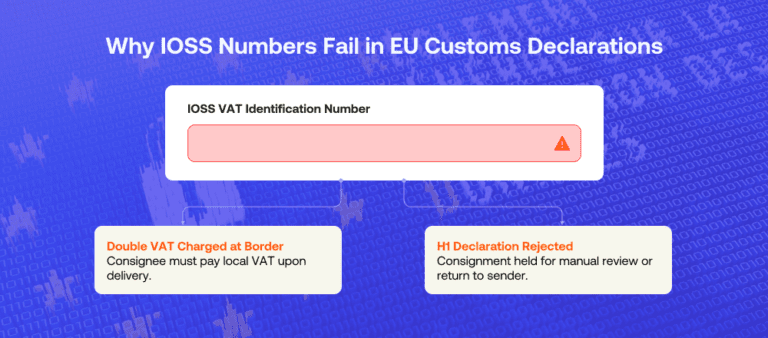
The EU IOSS (Import One Stop Shop) scheme simplifies VAT collection for low-value consignments imported through e-commerce platforms. Under this system, VAT can be collected at the point of sale rather than during customs clearance. This reduces delays at the border and allows parcels to move through customs faster.
Scenario: E-commerce Shipment from Asia to Denmark
An online retailer shipping clothing from Vietnam to Danish consumers may use the IOSS scheme to collect VAT during checkout. The logistics provider includes the IOSS number in the customs declaration, allowing customs authorities to release the shipment without collecting VAT again at the border.
ICS2 and EU Security Filings
The Import Control System 2 (ICS2) is the EU’s modern cargo security system designed to strengthen risk analysis for incoming shipments. Carriers and logistics providers must submit advance cargo information through ENS filings before goods reach EU borders. This information enables customs authorities to detect potential security risks before shipments arrive.
Role of NCTS Transit System
The New Computerised Transit System (NCTS) allows goods to move across EU countries under customs supervision without paying duties until the final destination is reached. Transit procedures are commonly used for goods entering Denmark through major logistics hubs and continuing to other EU countries.
Scenario: Road Freight Entering Denmark via Germany
A trucking company transporting electronics from Turkey to Sweden via Denmark may place the shipment under a transit procedure using NCTS. The goods remain under customs supervision until they reach their final customs office of destination.
Digital Customs and Automation in Denmark
Denmark is one of the most digitally advanced economies in Europe. Nearly 91 percent of internet users in Denmark purchase goods online, highlighting the importance of efficient digital trade systems and customs processes. The country also has one of the highest levels of e-government usage in the EU, demonstrating a strong national focus on digital public services.
Intelligent Document Processing in Customs Declarations
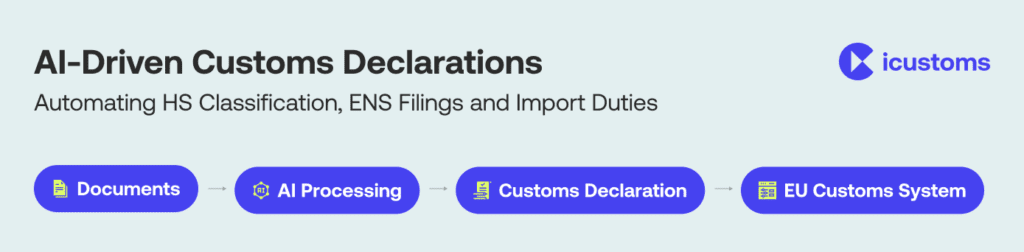
Modern customs platforms increasingly rely on artificial intelligence to process trade documents automatically. Intelligent document processing systems extract key information from invoices, packing lists, and shipping documents. This automation reduces manual data entry while improving the accuracy of customs declarations.
Scenario: Automated Customs Filing
A freight forwarding company managing thousands of monthly shipments into Denmark integrates AI-driven document processing tools via Denmark customs filing. Shipment data is automatically extracted from invoices and transmitted to customs authorities, significantly reducing administrative workload.
Trade Compliance Software and Customs Automation
As global supply chains become more complex, logistics operators increasingly rely on trade compliance software to manage customs obligations. These platforms help automate customs declarations, product classification, and regulatory checks. For companies handling large shipment volumes, manual processes often lead to errors that delay shipments and increase compliance risks.
Benefits of Automated Customs Declaration Service
Modern customs platforms provide several advantages for international traders:
faster customs declarations
improved classification accuracy
automated document processing
real-time duty calculations
reduced administrative workload
These technologies enable logistics companies to process shipments more efficiently while maintaining regulatory compliance.
Simplify Denmark Customs Declarations with iCustoms
Managing customs declarations, HS code classification, and ENS filings manually can slow down international shipments. iCustoms helps automate Denmark customs declarations with AI-driven classification, intelligent document processing, and seamless EU customs integration. Explore how iCustoms can streamline compliance, reduce manual workload, and accelerate cross-border trade into Denmark.
Denmark Customs Declarations FAQs
What is the customs declaration process in Denmakr?
The customs declaration process involves submitting structured shipment data so authorities can assess duties, VAT, and compliance. AI-powered platforms like iCustoms automate this process by extracting data, validating entries, and reducing manual errors before submission.
What are the steps for customs clearance in Denmakr?
Customs clearance includes data preparation, classification, duty calculation, declaration submission, and customs approval. With AI-driven software such as iCustoms, these steps are automated into a single workflow, reducing delays and improving accuracy across high-volume shipments.
How long does customs clearance take in Denmark?
Clearance can take minutes for accurate electronic submissions, but delays occur when data is inconsistent. AI-powered systems like iCustoms accelerate clearance by validating data in real time and minimising errors that trigger inspections.
Do you still need to fill out a customs declaration form for Denmark?
Yes, but modern customs processes are fully electronic. Platforms like iCustoms replace manual form filling with automated data capture and direct submission to EU customs systems, improving speed and compliance.
What is the Danish software for customs declaration?
Customs declaration software in Denmark automates classification, document processing, duty calculation, and submission. iCustoms provides AI-powered capabilities including intelligent document processing, HS classification, and seamless integration with EU systems like ICS2 and NCTS.
Can I do my own customs declarations?
Yes, but manual declarations require expertise and carry a higher risk of errors. Many businesses use iCustoms to automate declarations, ensuring compliance, reducing operational workload, and improving processing speed.
What is an electronic customs declaration?
An electronic customs declaration is a digital submission of shipment data to customs authorities. With iCustoms, this process is enhanced through AI that extracts, validates, and submits data automatically, enabling faster and more reliable customs clearance.

Customs Compliance for the EU Customs Data Hub
Automate classification, declarations, and customs data validation with AI.
You may also like:

How TARIC Codes Influence Import Duties
Struggling to Extract, Catagorise & Validate Your Documents?

Capture & Upload Data in Seconds with AI & Machine Learning
Subscribe to our Newsletter
About iCustoms
iCustoms is an all-in-one solution helping businesses automate customs processes more efficiently. With AI-powered and machine-learning capabilities, iCustoms is designed to streamline your all customs procedures in a few minutes, cut additional costs and save time.
Struggling to Extract, Catagorise & Validate Your Documents?
Capture & Upload Data in Seconds with AI & Machine Learning