Austria Customs Declaration Guide for Hauliers, Logistics Companies & Freight Forwarders
- John Hall
- Customs Specialist at iCustoms.ai
In international logistics, most import delays are not caused by customs authorities themselves. They occur because data arrives late, documents are inconsistent, and multiple parties operate through disconnected systems. This reality is especially visible in Austria, where customs authorities process approximately 22,000 import and export clearances every day.
Austria’s geographic position in Central Europe makes it an important transit hub for goods moving between Germany, Italy, and Eastern European markets. High freight volumes passing through the country increase the importance of efficient digital customs processing and reliable declaration systems.
Why Austria Customs Requires a Digital-First Approach
Modern customs is no longer limited to duties and taxes. It is driven by real-time trade monitoring, digital compliance, and automated risk analysis. Austria’s e-Zoll system reflects this shift, operating as a fully electronic customs environment designed to receive structured, validated data at scale.
However, e-Zoll alone does not resolve the core challenge faced by postal operators, carriers, freight forwarders, customs agents, brokers, and hauliers. The real complexity lies between these actors and the customs authority, where fragmented data exchange, manual handoffs, and inconsistent documentation slow clearance and increase compliance risk.
This is where customs declaration software becomes essential. Manual filing cannot scale with modern EU trade volumes. iCustoms provides a digital compliance layer that connects stakeholders, structures data, validates declarations, and enables accurate, e-Zoll-ready customs submissions.
What Is Austria Customs (Zoll Austria) and Why It Matters Today
Austria customs, commonly referred to as Zoll Austria (Zollbehörde), is responsible for regulating the movement of goods across Austrian borders while enforcing national customs law and the EU Union Customs Code (UCC).
Austria’s customs operations are also integrated into the wider European Union customs framework. This means declarations submitted in Austria must comply with EU systems such as the TARIC tariff database, the Import Control System 2 (ICS2) for security risk screening, and the New Computerised Transit System (NCTS) used for goods moving across multiple EU countries.
While the collection of customs duties and import VAT remains a core function, Austria customs today operates as a trade monitoring and enforcement authority, fully integrated with EU-wide customs systems and risk-management frameworks.
Key responsibilities of Zoll Austria include:
- Collection of customs duties and import VAT
- Facilitation of electronic customs declarations
- Enforcement of EU customs and trade regulations
- Protection of the Austrian economy and consumers
As trade volumes increase, Austria customs relies heavily on electronic filing systems and automated risk analysis, placing greater responsibility on operators to submit accurate and compliant data.
How the Austrian Customs Administration Operates in the Digital Era
The Austrian customs administration has transitioned into a digitally driven authority that balances trade facilitation with strict regulatory enforcement. High-volume processing and EU integration require reliable, system-based customs operations.
Austria customs plays a key role in protecting both public safety and economic interests while ensuring the smooth flow of legitimate trade.
Core operational responsibilities include:
- Preventing counterfeit goods and product piracy
- Blocking dangerous or non-compliant imports
- Conducting documentary and physical customs checks
- Verifying export refunds for agricultural products
- Administering international treaties governing preferential trade
- Processing thousands of import and export declarations daily
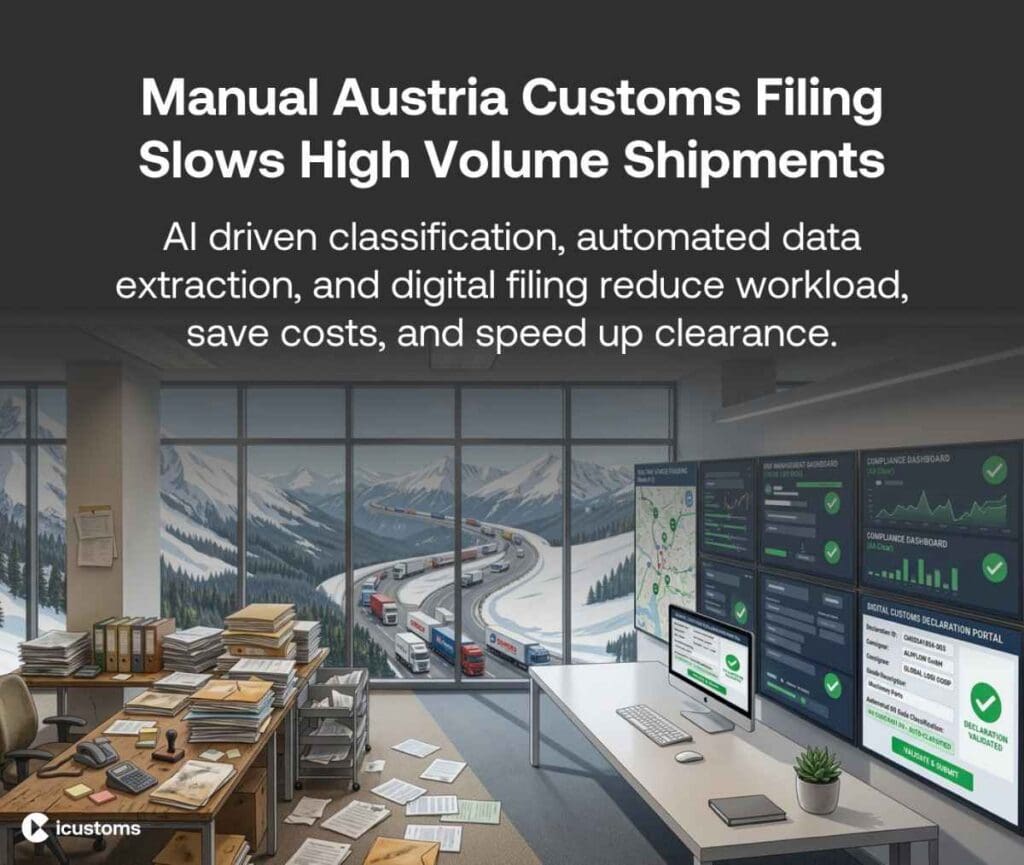
At this scale, manual data entry and disconnected systems significantly increase error rates, delays, and compliance exposure.
Electronic Customs Systems Used in Austria
Austria operates a fully digital customs infrastructure designed to support high-volume international trade and real-time regulatory monitoring. Customs declarations are submitted electronically through national and EU integrated systems that validate shipment data before goods can move across borders.
Key digital systems used in Austrian customs operations include:
- e-Zoll, Austria’s national electronic customs declaration platform
- ICS2, the EU Import Control System used for Entry Summary Declarations and risk analysis
- NCTS, the New Computerised Transit System used for EU transit procedures
- TARIC, the EU tariff database used to determine duties, restrictions, and trade measures
For logistics operators and freight forwarders, these systems require accurate, structured data submission to avoid declaration rejection or customs delays.
The Austria Customs Declaration Process
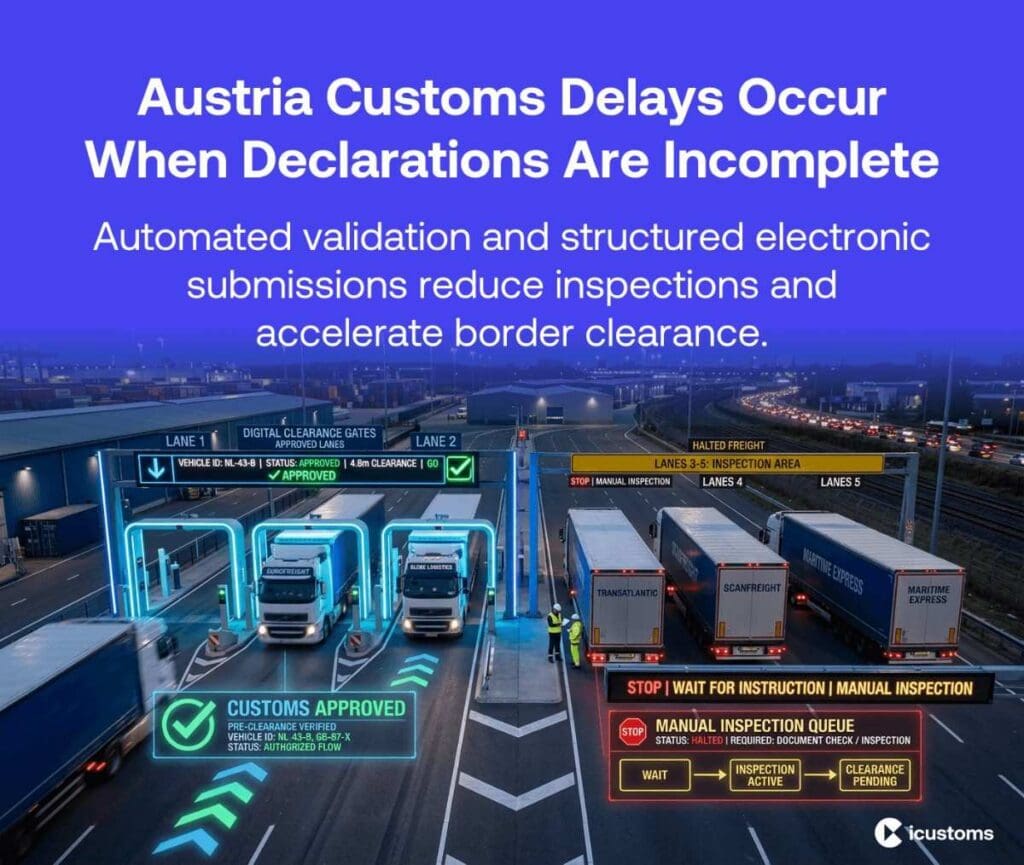
The customs declaration process in Austria involves multiple steps, each requiring precise, structured, and compliant data. Errors at any stage may result in rejection, delayed clearance, or post-clearance audits.
Step 1 – Customs Document Preparation (High Error Risk)
Customs declarations rely on source documents that must be complete and accurate from the outset.
Key documents may include:
- Commercial invoices
- Packing lists
- Transport documents (CMR, airway bill, bill of lading)
- CN22 and CP71 forms (applicable primarily to postal consignments)
- Country of origin information
- Product-specific regulatory documents
Manual handling of these documents often leads to missing fields, inconsistent values, and formatting errors.
Step 2 – HS Classification & Tariff Calculation
Correct CN and HS classification codes determine customs duties, import VAT, and eligibility for preferential treatment. Even minor classification errors can result in financial loss or regulatory penalties.
In the European Union, HS and CN codes are further extended through the TARIC system. TARIC integrates customs duties with additional regulatory measures such as anti-dumping duties, tariff quotas, and import restrictions. Austrian customs authorities rely on TARIC data to determine the correct treatment of imported goods.
Common challenges include:
- Misclassification of goods
- Incorrect application of Austria customs tariffs
- Overpayment or underpayment of duties and VAT
Manual classification does not scale for high-volume logistics operations. Automated classification tools, such as iClassification, support accurate HS code determination across multiple EU jurisdictions, reducing compliance risk and rework.
Step 3 – Submission via e-Zoll
Once a declaration is submitted, e-Zoll performs automated validation and risk profiling based on the data provided. Before goods arrive in the European Union, shipment data may also be assessed through the Import Control System 2 (ICS2).
This EU-wide security framework requires carriers or logistics operators to submit Entry Summary Declarations (ENS) before goods reach the EU border. Austrian customs authorities use ICS2 risk analysis to identify high-risk consignments and determine whether additional controls are required.
Declarations are frequently rejected due to:
- Missing mandatory data fields
- Incorrect message formats
- Inconsistencies introduced through manual entry
Each rejection delays customs clearance and increases operational costs.
Step 4 – Customs Checks, Controls, and Audits
Austria customs may conduct:
- Documentary inspections
- Physical examinations
- Post-clearance audits
Inaccurate or inconsistent declarations increase the likelihood of additional controls and follow-up audits.
Things That Must Be Declared at Austria Customs
All goods meeting declaration thresholds must be accurately declared. Under-declaration or misdeclaration increases compliance risk.
Items commonly requiring declaration include:
- Commercial shipments
- High-value consignments
- Regulated or licensed goods
- Cash and controlled items
Automation helps ensure completeness, consistency, and audit readiness.
Austria Import & Export Requirements for Freight Forwarders and Hauliers
Austria’s customs environment requires precise coordination between import, export, and transit procedures across EU systems. Freight forwarders and hauliers must ensure accurate data, compliant declarations, and complete documentation at every stage. Any inconsistency can lead to delays, financial exposure, or enforcement action across cross border movements.
Austria Import Declarations
Before goods are released, importers must ensure:
- A valid EORI number
- Correct import VAT calculation based on HS codes
- Required licenses and permits
- Compliance with import control mechanisms
- Supporting documents such as certificates of origin and transport documents
Example of Duty and VAT Calculation for Austria Imports
When goods are imported into Austria from outside the European Union, customs duties and import VAT are calculated based on the customs value of the shipment.
Example scenario:
- Goods imported from China
• Customs value: €10,000
• Duty rate: 3% (depending on the TARIC classification)
• Austrian import VAT: 20%
Calculation:
Duty = €10,000 × 3% = €300
VAT = (€10,000 + €300) × 20% = €2,060
This illustrates why accurate HS and TARIC classification is essential for calculating the correct duties and taxes.
Austria Export Declarations
Export compliance is equally critical, particularly for VAT treatment.
Export requirements include:
- Electronic export declarations
- Proof of export
- VAT zero-rating documentation (where applicable)
- Export control compliance
- Certificates of origin
Transit Declarations Through Austria
Austria plays a key role in European transit movements connecting Central and Southern Europe. Goods moving through Austria without being imported into the country are typically placed under the Union transit procedure. Transit declarations are submitted through the New Computerised Transit System (NCTS) and commonly use:
- T1 transit for non-EU goods moving between customs offices
- T2 transit for EU goods transported through non-EU territories
- Transit guarantees to cover potential customs liabilities
For hauliers and logistics operators, accurate transit declarations are essential to ensure uninterrupted cross-border movement and avoid customs enforcement actions.
Why Manual Customs Declarations Are No Longer Viable in Austria
For hauliers and freight forwarders, manual customs filing creates operational bottlenecks that directly affect profitability and service reliability.
Common challenges include:
- Repetitive data entry
- High rejection rates
- Border delays
- Increased compliance exposure
- Limited scalability
Austria’s customs environment now requires automation, validation, and system-to-system connectivity.
Role of Intelligent Document Processing in Austria Customs
Modern customs automation begins with Intelligent Document Processing (IDP), which converts unstructured documents into structured, customs-ready data.
IDP enables:
- Automated extraction from invoices and transport documents
- Reduced manual intervention and error rates
- Structured data aligned with e-Zoll requirements
This foundation is critical for scalable and audit-ready customs operations.
Benefits of Using Customs Declaration Software
Austrian importers, exporters, and logistics operators benefit from customs declaration software beyond basic compliance.
Accuracy and Compliance with Customs Authorities
Customs declaration software for Austria helps ensure accurate submission of customs data by aligning declarations with local and EU customs regulations. Automated validations reduce the risk of incorrect or incomplete filings.
Time Efficiency
Customs declaration software speeds up the filing process by automating data preparation and submission. The use of artificial intelligence ensures declarations follow standard operating procedures (SOPs), reducing errors, lowering compliance risk, and enabling faster delivery of consignments.
Cost Savings
By minimizing manual errors and rework, customs declaration software helps Austrian shipment companies reduce operational costs. Faster customs processing also allows staff to focus on higher-value tasks, improving overall efficiency.
Transparency and Traceability
Customs software supports a transparent declaration process by managing documentation in line with customs laws. Shipment companies can track filings and better predict delivery timelines, improving reliability and trust with clients.
Integration with Other Business Systems
Modern customs declaration software can integrate seamlessly with existing systems such as ERP or SAP. This integration streamlines data flow, improves productivity, and supports smoother business operations.
Audit Records and Compliance History
Customs declaration software maintains detailed records of all submissions and declaration changes. These audit trails are essential for traceability and are valuable during customs audits or dispute resolution.
User-Friendly Interface
A well-designed customs software solution offers an intuitive user interface, making it easier for teams to manage declarations efficiently without extensive training.
Common Austria Customs Errors and How to Avoid Them
Austria’s fully digital customs environment leaves little room for error. Most delays and penalties are not caused by inspections, but by incorrect or inconsistent data submitted during declaration. Preventing these errors is critical for maintaining clearance speed and compliance stability.
Incorrect TARIC Classification
Misclassification leads to incorrect duty, VAT, and regulatory treatment. Even small errors can trigger audits or retroactive charges. Use AI-supported classification tools and validate TARIC codes against product specifications before submission.
Inconsistent Declaration and Invoice Data
Differences between commercial invoices and customs declarations are a common rejection trigger. Ensure values, quantities, and product descriptions are fully aligned across all documents and systems.
Missing or Incorrect ICS2 ENS Data
Failure to submit or align Entry Summary Declaration data can result in shipment holds or loading refusals. Synchronise ENS and declaration datasets to maintain consistency across EU systems.
Invalid or Mismatched EORI Numbers
Incorrect EORI details lead to immediate rejection at submission stage. Validate EORI data before filing and ensure alignment with VAT and company records.
Transit Guarantee and Documentation Errors
Incomplete transit guarantees or incorrect T1 or T2 declarations can disrupt cross-border movements. Automate transit validation and ensure all guarantees and references are correctly applied.
Austria Low Value Shipments and €150 Threshold
Low value consignments are subject to specific customs rules across the European Union, including Austria. These shipments require structured declaration processes despite their lower value, especially in high-volume eCommerce and parcel logistics environments.
H7 Declarations and Intrinsic Value
For consignments valued at or below €150, simplified H7 declarations are typically used. The threshold is based on intrinsic value, excluding transport and insurance costs.
Accurate valuation is essential to prevent incorrect duty treatment and compliance issues.
Removal of Historical Low Value Relief
The previous €22 VAT exemption has been removed, meaning all commercial goods are now subject to VAT. This change has significantly increased declaration volumes and compliance requirements for low value shipments.
IOSS and High Volume Shipment Management
The Import One Stop Shop simplifies VAT collection for eligible consignments, but requires strict data accuracy. High-volume operators must ensure consistent classification, valuation, and reporting to avoid reconciliation issues.
MRN Tracking and Shipment Visibility in Austria
In Austria’s digital customs environment, shipment visibility is built around structured identifiers. The Movement Reference Number acts as the central control point for tracking, compliance, and audit processes across the shipment lifecycle.
What Is an MRN and Why It Matters
The MRN is generated once a customs declaration is accepted and serves as the unique reference for the shipment. It links declaration data, release status, inspection outcomes, and fiscal records into a single traceable workflow.
Operational Importance for Logistics Teams
Without MRN confirmation, goods cannot be released or moved forward in the supply chain.
Delays in tracking MRN status can lead to missed collection windows and operational disruption.
Automated MRN Monitoring
Manual tracking is not scalable in high-volume environments.
Integrated customs software enables real-time MRN tracking, automated status updates, and faster response to customs decisions.
Austria Customs Compliance Checklist
Austria’s customs system requires structured, accurate, and complete data at every stage of the declaration process. A standardised checklist helps operators maintain consistency and reduce compliance risk across high-volume shipments.
Pre-Submission Validation Checklist
Before submitting a customs declaration, ensure:
- EORI number is valid and correctly assigned
- TARIC classification is accurate
- Customs value and invoice data are aligned
- Required documents are complete and attached
ICS2 ENS data is submitted and consistent
Post-Submission Monitoring
After submission, operators must:
- Track MRN status and release confirmation
- Monitor for customs queries or inspection requests
- Maintain structured audit records
- Ensure VAT documentation is correctly archived
Integration with ERP, TMS and API Systems
Austria’s high-volume customs environment requires seamless data exchange between internal systems and customs platforms. Disconnected workflows create delays, duplication, and compliance risk.
System to System Connectivity
Modern customs operations depend on API and EDI integration with ERP and TMS platforms.
This enables direct data transfer, eliminating manual re-entry and reducing errors.
Real Time Data Synchronisation
Integrated systems ensure that shipment, invoice, and declaration data remain consistent across all platforms. This alignment is critical for ICS2 filings, e-Zoll submissions, and audit readiness.
Scalable Customs Operations
Automation allows logistics providers to scale customs processing without increasing manual workload. Integrated platforms support higher volumes, faster processing, and improved compliance control.
FAQs: Austria Customs Declaration Questions and Answers
What system is used for Austrian customs declarations
Customs declarations in Austria are submitted electronically through the e-Zoll platform, which connects with EU customs infrastructure such as TARIC, ICS2, and the Union Customs Code framework.
Do carriers need Entry Summary Declarations for Austria?
Yes. For goods entering the EU, carriers must submit Entry Summary Declarations through the ICS2 system before arrival to allow EU customs authorities to perform security risk analysis.
What documents are required for Austrian customs clearance?
Typical documents include commercial invoices, packing lists, transport documents, certificates of origin, and any product-specific regulatory documentation.
What role does TARIC play in Austrian customs declarations?
The TARIC system determines customs duties, trade measures, and import restrictions applied to goods entering Austria and the wider EU customs territory.
How to get an EORI number in Austria?
To obtain an EORI number in Austria, businesses must register with the Austrian customs authority. The process involves submitting company and VAT details, after which a unique EORI identifier is issued for EU customs operations.
Can freight forwarders file customs declarations in Austria?
Yes, freight forwarders can submit customs declarations in Austria either as direct or indirect representatives. In indirect representation, both the forwarder and the importer may share customs liability under EU regulations.
What is e-Zoll Austria?
e-Zoll is Austria’s national electronic customs system used for submitting import, export, and transit declarations. It connects with EU systems such as TARIC, ICS2, and NCTS to enable automated validation and processing.
What happens if a customs declaration is incorrect?
Incorrect customs declarations may be rejected, delayed, or flagged for inspection. In some cases, authorities may initiate post-clearance audits, apply penalties, or reassess duties and VAT based on corrected data.
What is a transit declaration in Austria?
A transit declaration is used when goods move through Austria without being imported. Submitted via NCTS, it allows goods to travel between customs offices under procedures such as T1 or T2 while suspending duties and taxes.

Simplify Austria Customs Compliance
Automate e-Zoll declarations, ICS2 filings, and TARIC classification with iCustoms to reduce errors, prevent delays, and maintain full compliance at scale.
You may also like:

Struggling to Extract, Catagorise & Validate Your Documents?

Capture & Upload Data in Seconds with AI & Machine Learning
Subscribe to our Newsletter
About iCustoms
iCustoms is an all-in-one solution helping businesses automate customs processes more efficiently. With AI-powered and machine-learning capabilities, iCustoms is designed to streamline your all customs procedures in a few minutes, cut additional costs and save time.
Struggling to Extract, Catagorise & Validate Your Documents?
Capture & Upload Data in Seconds with AI & Machine Learning